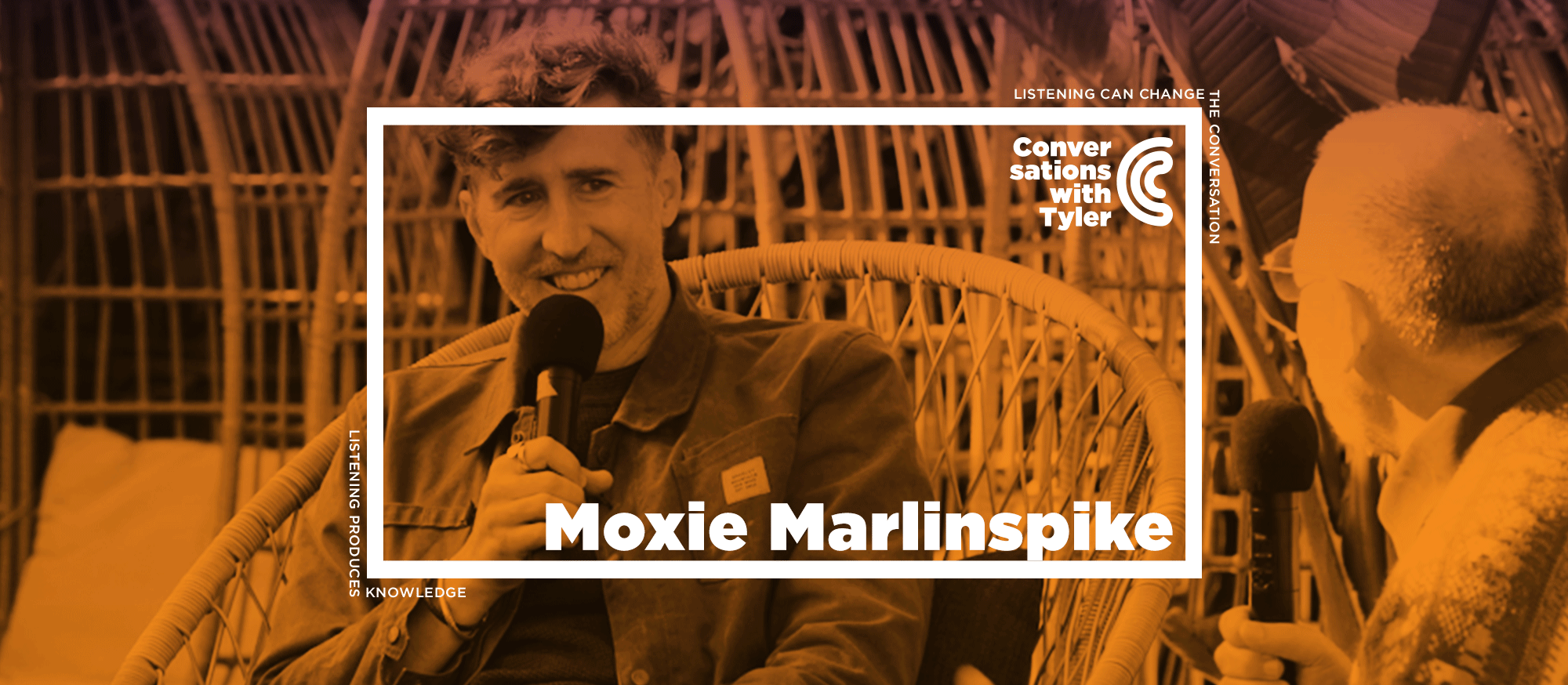



Moxie Marlinspike built Signal and designed the encryption protocol underneath it — the same protocol that also secures WhatsApp, Facebook Messenger, and Skype. He’s spent his career on the unglamorous, structural side of privacy, down to whether the company itself can see your contacts, your group names, or your search history. That background makes him an unusually direct interlocutor on the biggest live question in his field: whether the recent flood of AI-assisted math results could put cryptography itself at risk, and what the world should actually do if public-key encryption stopped working with little warning.
Tyler and Moxie discuss whether AI could break cryptography, Marlinspike’s own private AI chat service, his case for surveilling AI models instead of the humans using them, his skepticism of airport facial recognition, the case he tentatively makes for consent-based over centralized surveillance, why he thinks law enforcement should stay deliberately imperfect, what makes Signal different from WhatsApp, his doubts about cryptocurrency as it’s currently used, a Pentagon group chat scandal he seems almost pleased about, nearly drowning alone in San Francisco Bay, what Starlink has taken from solo sailing, hitchhiking across America in the late ’90s, a mysterious period of being secretly flagged every time he flew internationally, what he’s building next, and more.
Watch the full conversation
Recorded live at the Progress Conference, hosted by the Roots of Progress Institute, October 10th, 2026. Special thanks to Wild Horse Productions for the video production.
Help us keep the conversations going in 2027. Donate to Conversations with Tyler today.
TYLER COWEN: Hello, everyone, and welcome back to Conversations with Tyler. Today I’m greatly honored to be chatting with Moxie Marlinspike. Moxie is, you could say, the Signal guy. He’s an entrepreneur, cryptographer, computer security researcher. He built Signal. He co-founded the associated nonprofit, was the first CEO of the associated LLC, and he designed the encryption protocol that is behind Signal, WhatsApp, Facebook Messenger, Skype, and much more. Moxie, very glad you’re here.
MOXIE MARLINSPIKE: Thank you. Nervous to be here.
COWEN: I have many questions. They’re nerve-wracking for us, but maybe not for you. All the math advances coming out of AI, are they just going to break cryptography?
MARLINSPIKE: I don’t know.
COWEN: That’s not the reassuring answer we wanted, right?
MARLINSPIKE: Yes. There’s some valid concern. Much of cryptography is based on problems that we think are difficult to solve. People have been thinking about them for a long time, but maybe AI is better at thinking about them than we are. The cryptography community has been preparing for things like this for a while with post-quantum. Everyone is proceeding with caution. Hopefully, AI will also help improve new cryptographic techniques and methods that we can apply.
COWEN: Someone who works in quantum told me to switch over the way companies actually work, larger companies could take as long as five years. If the mass math results come out and encryption can partially be broken, we don’t have five years, right?
MARLINSPIKE: Maybe. It depends on what you mean by broken or partially broken. Some algorithms might be more vulnerable than others. It could just be like we need to increase security bounds with larger key sizes. The post-quantum stuff has been an interesting exercise in that we’ve gone through this five-year cycle once, and now we’re better at doing it. It would probably take less than five years to do it again.
COWEN: What would that look like if it happened? Say, OpenAI releases some new solutions to math problems maybe a few days in advance through some weird asset trading, funds reallocation. The news comes out. The next day, are we all panicked, or is it a ho-hum, or we don’t notice? Asset prices start decaying? You’ve thought about all this.
MARLINSPIKE: I don’t know that I have thought about all this. There’s a world in which it’s really bad. If there is some result that just all of public-key cryptography doesn’t work anymore, then the whole internet is in trouble. It’s like you can’t trust your operating system image updates anymore. You can’t trust your connections to any website, your bank, online. Everything is plain text again. That’s the worst possible case.
There’s a whole range of intermediate cases, or maybe nothing at all. It’s hard for me to really know. I’m not of the math community. There’s all these recent math results that came out. These were difficult problems, but it’s hard for me to know how many people have actually been working on these. I asked someone maybe more familiar with math a few nights ago, and he was like, “Oh, a lot of people.” I was like, “Oh, how many is that?” He was like, “Dozens.” In some way, that was encouraging in the sense that I think more than dozens of people have been thinking about these cryptography problems for probably longer, but again, we don’t know.
COWEN: Let’s say a prepper comes to you, and I know a few of them in this audience, and says, “This is only a 2 percent chance, but I’m worried. What should I actually do? Is it keep a lot of cash at home, stock up on beans, abandon my crypto?” Do you have advice or nonadvice?
MARLINSPIKE: In general, I think the problem with prepping is that it’s very difficult to anticipate exactly what kind of apocalypse we could be walking into. You buy an abandoned missile silo in South Dakota, and then you’re just really hoping for a very specific kind of apocalypse. Every day it doesn’t happen, it’s maybe a little disappointing. When it comes to prepping, how I apply it in my own life is I think it’s best to be a prepper with skills. You develop skills that could be useful in a variety of different apocalypse scenarios. You’re not really rooting for any individual one. If it doesn’t happen, it’s nice to have skills anyway.
COWEN: What’s the core skill? Is it archery? Working a sewing machine?
MARLINSPIKE: Those are great skills. Those are great skills to have, and I don’t think anyone would begrudge being an excellent archer who can sew.
COWEN: On a more mundane level, I have the impression, just talking to friends, that more crypto accounts are being hacked now, not by super sophisticated techniques, but could not have been done a year ago than had been the case before. Do you have the same sense? If so, why do you think that’s happening?
MARLINSPIKE: I have not been following. I don’t have that sense.
COWEN: People with 2FA are finding the crypto gone, or their Twitter accounts are getting hacked at a higher rate than I think before. This is anecdotal, but I feel it’s true.
MARLINSPIKE: I haven’t noticed the same anecdote.
COWEN: Now, some questions about privacy and AI models. People treat the AI model like a therapist or a girlfriend or a boyfriend. Why are people willing to confess to an AI what they would not tell a priest or a therapist?
MARLINSPIKE: People are confessing what they would tell a priest or a therapist to an AI. The form of technology affects how it is that we interact with it. The form of AI in this sort of conversational interface that makes it really powerful is a form of technology that invites confession. You feel like you’re communicating with somebody and that it is a private space.
My critique of the way that technology is often organized in general is that what I am trying to do in creating privacy-enhancing technology is to create an interface where the underlying technology is consistent with the way that the app looks. You open a messaging app, and you send a message to your friend. The way it looks in the app is it’s just you and your friend in this little window talking to each other, but the way that it actually works for many messengers is the exact opposite of that. It’s not just you and your friend in there. It’s you, thousands of people who work at this company, anybody who compromises the computers of that system, information that could be stolen from advertisers.
Every individual one-on-one chat in those apps should actually be a group chat with all of those people in it if the interface was honest to how the underlying technology worked. I think that disparity is even more true today with AI than almost anything else in history, where you feel like you’re having this conversation with this agent or assistant that gets to know you as your friend, deeply understands you, your preferences, your memories, your history, your life experience, but actually, it’s a huge group chat with many, many more people.
COWEN: Putting aside open weights models, is there a version of privacy-enhancing chat with an AI from one of the major labs that could be secure?
MARLINSPIKE: It’s possible to build, yes.
COWEN: It’s possible to build?
MARLINSPIKE: Yes.
COWEN: Say there’s someone in the lab and they can access your account. This happens a few times because people who are planning murders get reported to the FBI, right? Someone is reading something. Maybe the AIs read it first.
MARLINSPIKE: A lot of people are reading something.
COWEN: A lot of people.
MARLINSPIKE: All of your chats end up in a data lake that’s designed for semantic understanding and extracting meaning and training loops and everything else. I run a service called Confer that is a private AI chat where you talk to the AI assistant-style chat, and only you have access to your chats. I can’t access your chats, and no one else can.
COWEN: How do I use Confer? Say, typically I chat with Claude or with GPT Pro, and you do Confer; what do I do to use Confer?
MARLINSPIKE: Instead of typing Claude.ai into your web browser, you type Confer.to.
COWEN: That connects me to all the others?
MARLINSPIKE: It connects you to Confer.
COWEN: To Confer, yes. I can’t do it with Claude or with GPT Pro?
MARLINSPIKE: No, they are not operating private services.
COWEN: Now say when people use agents, and there’s a certain level of accountability we want for agents. If the agents hack someone else’s privacy, we want some kind of recourse, liability. Can there be privacy in a world with agents and accountability at the same time?
MARLINSPIKE: This is a line that’s very difficult to navigate private or unprivate of what does AI safety mean. I think that it’s probably possible to navigate in the private AI world, but it’s just as difficult and thorny as in the nonprivate AI world.
COWEN: If we want to trace what agents have done and then trace what you told the agent, if the law is to have that power, definitionally, it’s not truly private, right?
MARLINSPIKE: You’re talking about loss of control as your concern?
COWEN: People telling their agents to do evil things.
MARLINSPIKE: Okay. This is a big challenge because there’s a version of AI safety that is concerned with this question. This question is an interesting one. The fear is that people have an equal ability. When you think about things like cyber or cyber risks, this is what you’re suggesting, where suddenly people can use an agent to compromise computer systems, these are things that have always been possible. It just required humans with specific talent or ability.
What AI does is democratize that ability, where now anybody has access to this talent. It’s interesting that that’s actually a scary thought of the democratization of ability. There’s something, for some reason, that makes you think that someone having to develop that ability on their own makes them somehow less dangerous or less likely to use it in an inappropriate way. Right now, the AI safety approach to this question is mass surveillance.
COWEN: That’s not your approach.
MARLINSPIKE: I think that’s a really dangerous approach. The current approach is basically we don’t want bad people to do bad things. What we’re going to do is classify everything that everyone does on a score of badness, and we’re going to rank that from most bad to least bad. We’re going to have an army of human reviewers that just go through and are looking at everything and evaluating the badness. You’re building a machinery of mass surveillance that is larger and more efficient than any other mass surveillance machinery in history. That just seems like a dangerous thing to be constructing.
COWEN: What’s your approach?
MARLINSPIKE: The thing that we should be surveilling is not the people, the actors that are doing things, but the models. There’s a different way to think about it of instead of trying to do actor monitoring, where you’re trying to figure out what are people up to and do we think that the thing that they’re up to is good or bad, of systems that are monitoring alignment of the models themselves. Do the models themselves show negative tendencies?
COWEN: Can we surveil the models? People in the main labs claim the chain of thought isn’t working so well anymore. It may go away altogether. Like the Hugging Face incident, the number of pages of documents—if pages is even the right word—I forget the number, but I think it was tens of thousands. Basically, we surveil that by using AI. If we’re just using AI to surveil AI, are we really surveilling the models, or do we know what we’re doing?
MARLINSPIKE: You are when you use AI to surveil AI. The idea is you build these general capacity models, and you try to align them, but it’s difficult because they can do so many different things. There could be jailbreaks and all kinds of stuff or whatever. Then you build more specific models that classify specific behavior, and they’re good at just that. Then you use that as a monitoring system. That, to me, seems plausible.
COWEN: We’re recording in October 2026. You probably know a few days ago there was an account of one person who broke into the South Korean banking system, not even using the best models. It was some mix of open-source and open-weight models. I’m not sure it created any damage. What would your approach do to stop that, or is it just something you tolerate because you don’t think it will be that harmful in the aggregate?
MARLINSPIKE: I think that’s connected to a larger question of what’s going to happen with increased cyber abilities. The hope is, and I think my hope is, that we reach an equilibrium where LLMs are better at finding vulnerabilities, but they also get better at patching vulnerabilities, and we get to a place where there’s a period of pain until things are in more equilibrium.
COWEN: An equilibrium, you think, takes three years, five years, eight years?
MARLINSPIKE: A year.
COWEN: A year. If I’m the mayor of Utica and I want to patch up my systems, I can take care of all the loose vulnerabilities in a year? I get maybe the FBI, the CIA, and Amazon will do this, but the world as a whole? It’s a lot of soft targets.
MARLINSPIKE: It is. The Hugging Face thing is actually maybe a counterpoint in the sense that these agents attack something by escaping a sandbox. The sandbox, you can criticize for being a weak sandbox, but that’s just the real nature of the world. The sandbox is probably also created by agents. The fact that the agents created a sandbox that then other agents escape from would be counterfactual that we reach equilibrium. If things continue to accelerate on the pace that they’re on, that hopefully cyber defense becomes as effective as cyber offense.
COWEN: You’re worried that policymakers want to surveil humans. You favor surveilling models. Do you think we’ll end up in some kind of weird compromise where it’s hard drives that we surveil, or to you, is that the same and just as bad as surveilling humans?
MARLINSPIKE: What’s on the hard drives?
COWEN: Whatever. The government has access to what’s on your hard drive, and AI monitors it. That’s what I think people might end up doing. I’m against that.
MARLINSPIKE: I’m also against that.
COWEN: How do we stop that?
MARLINSPIKE: By building privacy-enhancing technology and demonstrating the possibility of another way.
COWEN: Let’s say we lose and we end up with near-perfect surveillance of everything. What’s the first law we need to get rid of? The 25-mile-per-hour speed limit? What else? I drive at 27 in those zones. Occasionally, 28.
MARLINSPIKE: Oh, I see.
COWEN: If there’s total surveillance, I get a ticket every time, and the universe becomes unworkable. It’s like everyone is in a Waymo or something, right?
MARLINSPIKE: Yes.
COWEN: What are the laws we need to get rid of if surveillance really comes?
MARLINSPIKE: The danger is that, apparently, in the United States, we don’t even know how many laws there are.
COWEN: The AIs can tell us over time, right?
MARLINSPIKE: Maybe eventually they can tell. The dangerous position that you end up in is everyone is breaking the law all the time. We have total surveillance, and then enforcement is just purely selective and arbitrary based on whoever is enforcing.
COWEN: That’s somewhat how it is now.
MARLINSPIKE: It is.
COWEN: Not total surveillance.
MARLINSPIKE: It is, but it could be worse.
COWEN: I fear that’s my prediction for what will happen, and just rule of law goes away.
MARLINSPIKE: Are you getting the missile silo or what?
COWEN: I drive less in Washington, DC, and take Ubers more because they have 25-mile-per-hour speed zones where if you go 28, you might get a ticket. That’s my “solution.” On that K Street bridge, do not drive on that. I don’t care how careful you are. You can get the ticket and not pay it. That actually also works.
MARLINSPIKE: How long?
COWEN: How long not paying it?
MARLINSPIKE: Yes.
COWEN: I think forever.
MARLINSPIKE: They don’t come for you? They come for you? No?
COWEN: With AI, they may come for you in the future—
MARLINSPIKE: Oh, they may come for you, yes.
COWEN: —but people to date have been getting away with it.
MARLINSPIKE: I would like to believe that it’s not hopeless and that we can build privacy-preserving AI systems that develop tremendous value and also don’t cause tremendous harm. We can demonstrate the viability of these things and get them into large commercial products so that it becomes part of the future.
COWEN: What are the forms of surveillance you favor? If I fly to Heathrow, I walk right through the gate. It takes a minute and a half, if that much. I’m fine with that. I know they know where I am, but it actually means I’m less likely to be convicted on a false murder charge. Are you in favor of that or against it? You know what I’m talking about, right? Or a Delta flight, even.
MARLINSPIKE: Wait. What?
COWEN: If I take a Delta flight, it just sees my face, and it lets me on. If I enter the UK through Heathrow, it knows who I am. The gate swings open. There’s no time spent in a passport line. Is that good or bad?
MARLINSPIKE: In the tension there, I am on the opposing side of that tension. I think that it’s actually under-appreciated that there is real value to living in an authoritarian mass surveillance kind of place. I think that this is under-discussed, actually. The problem with under-discussing it is that people don’t recognize it when it’s happening.
Your first experience with authoritarianism or a police state is usually not going to be like the FSB or the Gestapo knocking on your door. It’s going to be with clean streets and safe spaces, and the trains run on time. It turns out that it can really eventually lead to doom. What you’re talking about is true, where it’s like, yes, it’s faster to just walk through than to have to talk to the customs agent or whatever, but there could be some long-term negative consequences.
COWEN: Let’s say you’re in São Paulo, Brazil, where the murder rate traditionally has been high. They’re using a lot of CCTV. I don’t even think it’s super sophisticated, but when they put in CCTV, the murder rate falls. Would you tell them not to do that or just to think twice? What are these surveillances where you’re willing to say, “I’m all for that?”
MARLINSPIKE: Tyler. I’m probably not going to say, “I’m all for that.” It’s difficult for me to sit here and be like, “You have a murder problem, but think about something else.” In general, I do believe that law enforcement should be difficult; that it should not be perfect enforcement of all laws all the time. Many of the things that we consider decent today were once illegal: same-sex marriage, legalization of marijuana, freedom from religious persecution, the Declaration of Independence.
Without the ability to sometimes break the law, it’s difficult to even explore other spaces of what could be possible. How would anyone know that we want same-sex marriage to be legal today if no one had ever been able to have a same-sex relationship because the sodomy laws had been perfectly enforced everywhere all the time? There’s something about if there is some kind of enough people want to or feel compelled to break a law in some way, that’s probably an indication that something else somewhere is wrong, either the law itself or there’s some fundamental thing, and that it’s worth trying to address that or accommodate that or whatever, rather than just more CCTV.
COWEN: How important for you is the distinction between government surveillance and private surveillance? If I’m in Switzerland and my shoelace is untied, even in a city, someone will stop me and say, “Hey, your shoelace is untied.” They mean well, but it’s also a kind of surveillance, right? They’ve been watching me, and they speak up. Is that the same to you, or the government is somehow categorically worse as a surveiller?
MARLINSPIKE: It seems different to me—
COWEN: Better or worse?
MARLINSPIKE: —the shoelace thing.
COWEN: The government may not care about you like the Swiss people care about your shoelace.
MARLINSPIKE: I see. You can even make a case for something like distributed video surveillance. If what there was CCTV, but instead of it all being piped into a centralized feed, that everybody manages their own set of video recordings, and if you want to examine them, you have to get the consent of everyone involved. You’re distributing permission to surveil.
You could make the case that that’s better acceptable than some kind of centralized surveillance thing. I think that still has problems in the sense that for much of history, many of the things that we consider decent today, a majority of people maybe even would have consented to releasing their video surveillance for. I’m not going to campaign against shoelace tying.
COWEN: Say I live in India and I’m trying to talk people into valuing privacy more, and someone says to me back, “Privacy? What’s privacy? I share a bedroom with three brothers,” what do I say to them? How much is privacy a luxury? The people who have that luxury, say, many Americans, don’t really value it that much anyway.
MARLINSPIKE: Oh, I think we value it.
COWEN: You think we value it, but when CCTV is supposed to come into a neighborhood, typically people are happy, is what I observe. In the UK, in the US, people want it. They like cameras. If they’re in a private development, they love cameras.
MARLINSPIKE: You and I right now are having a conversation, but it’s a specific kind of conversation. There’s a lot of people eyeballing us right now.
COWEN: I’m used to it.
MARLINSPIKE: You’re more used to it than I am. To me, and I assume you as well, even you being used to it, it changes the character of what it is that we’re saying. We’re having a certain kind of conversation, and it could be different if we were alone. We might choose to be more vulnerable or talk about different things or talk about what we’re uncertain about or just trying to work out. I think that that’s really valuable. You can still get that in a bedroom with three brothers or whatever.
COWEN: Depends on the brothers.
MARLINSPIKE: Maybe it depends on the brother. If we lose that ability, that’s bad for us all. Online, increasingly, we’ve been losing that ability. More and more of our lives have been moving online. Those spaces, it looked like maybe they were going to disappear for a while. We got a reprieve with messaging. Now, we’re seeing that danger again with AI.
COWEN: Personally, do you feel you’re above or below what I call the optimal level of fame? People, at some rate, recognize you. That could be more. That could be less. The fact that they recognize you means you have more social capital. You might enjoy it sometimes, but it can be a pain, or they overhear what you say in public. Where are you on that scale?
MARLINSPIKE: I don’t know. I’m probably at an optimal level for me in my life. Like I was saying, recently, I was in a televised Mafia game that increased the level of recognition that I got. The major downside of that is that just now everyone keeps inviting me to play Mafia with them, and they’re just killing me in the first round because they think I’m some pro Mafia player. That’s a negative.
I’ve been interested more in trying to meet older, cool people while they’re still with us. This started for me when I read that Stalin’s daughter died seven years ago over there in Wisconsin, an old person’s home in Wisconsin. She was like, “We could have just knocked on the door of a retirement home in Wisconsin, and Stalin’s daughter would have opened the door and just had tea with us.” To me, I was like, “What’s the Stalin’s daughter equivalent?” Sometimes a little bit of recognition has helped me try to meet those people, and still sometimes I can’t get the meetings. Maybe a little more recognition would help me meet the Stalin’s daughters of the world.
COWEN: There’s some people in the Bay Area; occasionally, they show up at this space. I won’t name names, but they live extremely public open lives. I’m told, for instance, that China reads my email. Is there some equilibrium out there where there’s a kind of complete surveillance, complete openness, and it turns into indifference? On one hand, that’s liberating with respect to privacy, but on the other hand, social norms collapse, and the real danger is the disappearance of social norms. In a funny way, when everything is open, you end up with all this de facto privacy because there’s so much else to gossip about. My email is not, in fact, interesting to China. They read it. I’m not upset about that. Whatever.
MARLINSPIKE: Why are you not upset about that?
COWEN: Oh, I had lunch with Shruti the other day, and now China knows. It’s not interesting. I don’t prefer it. In terms of depredations, it’s pretty low on my list. Maybe it bothered me at first, but now I’m used to it.
MARLINSPIKE: You don’t think maybe people are more reluctant to email you now that they know that China is going to read it?
COWEN: Maybe they’ll email me fewer private things and WhatsApp me or Signal me, and I’m on both. That’s fine.
MARLINSPIKE: Sure. It’s good that we have those spaces, but it just seems a shame that you’ve lost email.
COWEN: A shame or a benefit? It cuts both ways, right? China is so overwhelmed with information, even just about me if they want it, but about everyone. It leads to indifference. It’s such a bureaucratic exercise in reading Tyler Cowen’s email.
MARLINSPIKE: Sure. Now you can get AI to make a summary podcast every morning of your email, and the CCP can listen to it on their way to work on the drive.
COWEN: On the on-time trains.
MARLINSPIKE: There’s a risk, too, of just the stored history. That someday in the future, maybe you want to do or say something that might be dangerous for you with respect to the country of China. You like to travel to China, perhaps. Maybe that’s going to be in the back of your mind.
COWEN: No, it’s in the front of my mind.
MARLINSPIKE: That seems bad.
COWEN: It’s slightly bad. I agree. Yes.
COWEN: Now what makes Signal safer than, say, WhatsApp?
MARLINSPIKE: Oh, Signal is a project that is just fully committed to pushing the envelope of privacy. Signal knows almost nothing about any user or user data. Signal doesn’t have access to your messages, obviously, but it also doesn’t have access to things like your contacts, your group metadata, like what groups you’re in, the titles of those groups, the avatar images of those groups, your profile name, your profile images, what you’re searching, GIFs you search for, the stickers you use.
Everything has been meticulously designed to be privacy-preserving. A long time ago, I worked with WhatsApp to integrate the Signal protocol into WhatsApp for message content. WhatsApp has end-to-end encryption for the messages you exchange, but a lot of those other things like what groups you’re in and who your contacts are and things like that aren’t protected.
COWEN: Are we just pushing the ultimate privacy burden onto all the hardware? If someone snatches your phone—
MARLINSPIKE: Oh, I see.
COWEN: —or if the government is monitoring your hardware, that it’s ultimately a game of whack-a-mole and privacy again ends up losing?
MARLINSPIKE: It could be. The difference is between mass surveillance and targeted attacks. Right now, and this could be changing in the future, but right now, it’s pretty expensive to develop a targeted exploit that someone is going to use against your device to compromise it or to break into your home and steal it or whatever. That doesn’t happen that frequently because it’s expensive and risky. That’s compared to mass surveillance, where everything just used to be in one big pile somewhere that someone could go and just sift through all of it.
COWEN: What would Signal look like today if it were a for-profit rather than a nonprofit?
MARLINSPIKE: That’s a great question. It might look pretty similar. It’s hard to know because I’ve only lived one version of it. One challenge with privacy-enhancing technology is that you cannot perceive the privacy-ness of something that you’re using, like an app. It’s about branding, where somehow you have to develop a brand where people somehow feel that through the brand.
Signal, as a nonprofit, helped with that. Originally, I thought it would in the sense that if you do anything at scale, you’re going to do things that are unpopular. You’re going to end up making some decision that’s difficult that people might not approve of. As a nonprofit, at least people can’t say, “Oh, you’re just doing that for the money. It’s all about the profit margin or whatever.” I think that helps. In the end, people just developed other conspiracy theories to comply with it. It’s like, “Oh, you’re just a CIA agent,” or whatever.
COWEN: As you know, the FBI pretty frequently can trace transactions on normal blockchains and end up sending people to prison. Are you bullish on the fully anonymous crypto monies? They don’t seem that popular, right?
MARLINSPIKE: Yes. I’m not really bullish on crypto in general as a space. I’m maybe equally bearish on the current private crypto monies, but not because they’re private.
COWEN: Even in relative terms, they seem quite small relative to the normal blockchains. Doesn’t that get us back to the “people don’t love their privacy that much after all” point?
MARLINSPIKE: I just think, in general, people aren’t really using cryptocurrency for payments. It’s not like they’re paying their rent or buying things for them. It’s more of like a slot machine.
COWEN: Or transfer capital, right? You want to leave China, Russia, you send crypto ahead of you.
MARLINSPIKE: Yes. I just don’t think that these are super integrated day-to-day things in people’s lives that they’re concerned about their transaction privacy around. It would be great if we could do that, if we could build something that’s actually used for payments that’s private, so all of our transaction data isn’t going through a few credit card processors who are now working to get more detail about what you’re buying through L1/L2 data. I think that would be great. I just don’t know that that’s what the current incarnation of cryptocurrency really is.
COWEN: Given that fear, why aren’t you more bullish on crypto? What’s your worry with crypto?
MARLINSPIKE: Oh, I don’t have a worry. I guess my concern is that that’s not what people are building. That people are building—
COWEN: Slot machines.
MARLINSPIKE: —slot machines.
COWEN: Why isn’t there room for a nonslot machine version of crypto? It’s an alternative to the mainstream payment companies. The mainstream payment companies are now doing crypto, and Visa is doing crypto, Stripe is doing crypto, right?
MARLINSPIKE: I think there could be room for that, yes. I’m not saying it’s impossible.
COWEN: There was this 2025 Pentagon group chat done through Signal. Did that help business, hurt business? What was the upshot of that?
MARLINSPIKE: It made it all worth it for me.
COWEN: You argued in your web3 essay that no one really wants to run their own server, and that makes sense to me. Will AI change that at some point? You can have your AI, which would be open weights and on your own hard drive, and it “runs your server,” but you don’t have to do anything. It’s your agent, and it’s smarter than you are. We’ll end up with radical decentralization in a way that would not have been possible two years ago?
MARLINSPIKE: I think it’s possible. Right now, there are companies that are still operating software as a service, and those companies have employees still. It’s not just AIs that are running those companies. There’s something that they’re doing and thinking about and working on every day to improve their products that I think users still continue to appreciate. If we start to see those companies go to just an AI as operating the whole service, then you can imagine a world where everyone just has their own AI operating their own service, but I don’t think we’re there yet.
COWEN: I greatly enjoy the paranoia of many 1970s movies. The Conversation is the classic example, but even cheaper ones like Capricorn One, it’s a lot of fun. Do you like those films? Do they resonate with you the way they do with me?
MARLINSPIKE: I’m ashamed to say that I’ve not seen either of those films.
COWEN: Oh, Coppola, The Godfather, directed The Conversation. It’s one of the best 1970s movies, and it’s about surveillance. It’s done with tape recorders. It’s wacky how low-tech it is.
MARLINSPIKE: I missed the whole thing.
COWEN: Oh. You’re a sailing enthusiast. What is it that sailors understand about risk that, say, major AI labs do not?
MARLINSPIKE: Tyler, that’s a very interesting question. I don’t know what major AI labs understand or don’t understand about risk exactly. I think there is something about the ocean and, traditionally, solo sailing or operating boats alone on the ocean that was pretty unique in the sense that, traditionally, you get on this boat, and it’s its own little ecosystem. It’s not a mystery when you turn on the tap and the water comes out where the water came from, or when you flush the toilet, where that goes. When you open the pantry, where did the food come from?
You’re responsible for all of that. You have a sense of exactly how everything works, and it’s essential that you do. You sail out over the horizon, and you’re by yourself, and you make decisions. If you make the wrong ones, you just don’t come back. No one will ever know what happened. No one will ever know what went wrong, what decisions you made.
I, maybe 10 years ago, almost drowned in San Francisco Bay. I was sailing a boat. I made a series of small mistakes. Boat capsized. I ended up floating alone in the dark, slowly succumbing to hypothermia. It was not quick. You’re floating there in the water alone in the dark, and you have time to think about this. You realize that how many other people have gone through this just alone, slowly coming to terms with the idea that they’re going to die. People like Jim Gray, Joshua Slocum, sailed over the horizon, never came back. They had that moment. We’ll never know what it was. It could have been hours long. A near-death experience makes you think about risk differently than sitting in front of a computer all day.
COWEN: How did we get you back? The dolphins rescued you ashore?
MARLINSPIKE: I should not be here. A tugboat randomly saw me and pulled me out of the water. Later, I talked to the tugboat guy, and he was like, “We weren’t even supposed to be there. We had this weird situation. We were out of position. We had to anchor, and we came out.”
COWEN: You now feel you’re playing with house money with your life, and you can take more chances, or you play it safer? What’s the psychological adjustment?
MARLINSPIKE: It’s interesting. I’ve had subsequent near-death experiences that have superseded that. I’m constantly updating. The next day, you go to the office or whatever, and they’re like, “Oh, the sleeve lag on the secondary day.” You’re like, “What are we doing here, man? Why do we care about this?” You’re like, “Come on.” Somehow, the world whittles that away. You can’t keep living like that forever.
COWEN: You revert to normalcy.
MARLINSPIKE: Somehow, eventually, yes. It sticks with you.
COWEN: Starlink making sailing safer but less interesting?
MARLINSPIKE: Yes.
COWEN: How is it less interesting? You’re just anywhere else on your phone or scrolling?
MARLINSPIKE: Yes. That phenomenon is now over, where it’s like my sailing heroes—I’ve never been a racer or whatever, not a professional sailor or anything; I don’t even make it out on the water that much anymore—my sailing heroes of the past were people who got in a boat and set out over the horizon and were really alone.
Tania Aebi, who was, at one point in the ’80s, the youngest person to solo circumnavigate the globe unassisted, she set off from her departure point in New York to her first stop, Bermuda, with a sextant for navigation, just a brick of plastic. This is all that she has to figure out how to get there. She was too embarrassed to tell anyone. She didn’t fully understand how to use. Somehow, she made it there. Now it’s like, “Oh, yes, this person has their team by sat phone or Starlink or whatever that’s helping them diagnose their systems and make the choices or whatever.” It’s a different thing.
COWEN: When you hitchhiked across America several times, this is all pre-GPS, right? What did you have? A let’s-go guide?
MARLINSPIKE: No. You just had the names of the stores. Hitchhiking is easier, but riding trains, you get on a freight train, and you don’t really know where you’re going exactly. You just have to look at the stores as you go through the town, where it’s like Winnemucca dry cleaners or whatever. You’re like, “Oh, okay. We’re in Winnemucca. Yes, Winnemucca. We’re here.”
COWEN: What did you learn doing all that hitchhiking?
MARLINSPIKE: It’s a great way to get out of your filter bubble, particularly back then.
COWEN: What years are these?
MARLINSPIKE: That was late ’90s, early 2000s. I think I learned a lot by intersecting with people that I never would have intersected with otherwise and just maybe things that would have come or been obvious in town. I remember the first time I ever went to LA, actually, I got a ride hitchhiking from the University Street on-ramp here in Berkeley to LA. I got one ride out of town, and then I got one ride all the way down the I-5 with this guy who was a baby boomer. He just told me the whole time these awesome stories about hitchhiking when he was a kid and running weed across the country and all these things he used to do.
I remember at some point being like, “Man, why was it so easy for you? It sounded great. What was going on?” He was the first person to really explain this to me. He was like, “Listen, you’re never going to fully understand this, but I was a boomer.” He was like, “Before World War II, there were 140 million people in the United States. Everyone went to war, came back, had kids. There were 90 million of us. The population of the United States almost doubled in one generation.” He looked at me, and he said, “When I was a kid, everyone was a kid.” He was like, “You’d be hitchhiking and someone your age would see you and stop because you were the same.” It was an identity thing. Stuff like that. That was the first time I really understood what that meant.
COWEN: As you know, crime rates are way down except for cybercrime. Serial killers as a phenomenon have almost disappeared. Why is hitchhiking not a thing?
MARLINSPIKE: I think it’s a great question.
COWEN: It really isn’t. I never see hitchhikers, and I drive a fair amount.
MARLINSPIKE: I never either. I will always pick up hitchhikers. You could be standing on the side of the road holding a bloody machete, and I will stop and pick you up.
COWEN: What if they’re holding a surveillance device?
MARLINSPIKE: Even then. Even then. Even then. I owe it. Actually, it’s funny. Maybe a month ago, I had a free afternoon. I tried hitchhiking from LA to San Diego. I made it.
COWEN: You’re optimally famous.
MARLINSPIKE: Nobody recognized me who picked me up. I don’t know. I recommend it.
COWEN: This is a story attributed to you, 2010. You’re coming back from the Dominican Republic, and you’re held for five hours and asked for your passport. Is that something you’re able to speak about? Is it even true?
MARLINSPIKE: Yes, that’s true. There was this weird period of time where it was very difficult for me to fly. Every time I went to the airport, I would not be able to check in using the normal mechanisms. I would have to go to the counter. They would have to call this number, called Secure Flight, and wait on hold for about an hour to get approval to print the ticket. The ticket would have the SS on it. I would get the Selective Search at TSA.
Then at any transfer that was domestic, when I was at the gate for the next flight, TSA would come and find me at the gate with a photograph of me and go through all my stuff again, even though I hadn’t left the TSA area. Then whenever I was coming back through customs, that would happen where they would confiscate all my electronic devices.
COWEN: Why was that?
MARLINSPIKE: I have no idea.
COWEN: You must know other people this has happened to. If anyone would know them, it’s you. You don’t all sit around and trade stories and figure out what the thing was?
MARLINSPIKE: I think the pernicious thing is that you just never know. That it’s arbitrary. One day it stopped. Now I can fly, and it’s no problem. What was that about? I don’t know. Does anybody who was doing that know? I don’t think that they know.
COWEN: Other countries, never a problem?
MARLINSPIKE: No.
COWEN: If you would fly Toronto to Montreal, the Canadians wouldn’t do the same thing?
MARLINSPIKE: Not that I noticed. When I was flying back, if I were in the UK, someone from the embassy would come to the airport in London with a photo of me and try and find me in the gate, and then interview me.
COWEN: They were greeting you. It’s like the AI greets me at the gate. You get the embassy guy instead.
MARLINSPIKE: The most annoying thing was the confiscation of electronics. That meant that I couldn’t travel with a phone or a laptop because it would just get taken when I came back.
COWEN: Very last question. What is it in life you want to do next?
MARLINSPIKE: I’m working more on this private AI stuff. I think that that’s important, as we’ve discussed. I just finished building a floating sauna, a sauna that floats on the ocean. It’s like a sauna boat.
COWEN: With Starlink?
MARLINSPIKE: No Starlink.
COWEN: No Starlink.
MARLINSPIKE: Yes. I’m anchoring off the coast of Malibu. Anyone who can get there can use it for free. The cost of admission is the difficulty of getting there. I guess a few other art projects that I can’t really talk about yet.
COWEN: Moxie Marlinspike, thank you very much.
MARLINSPIKE: Thank you.