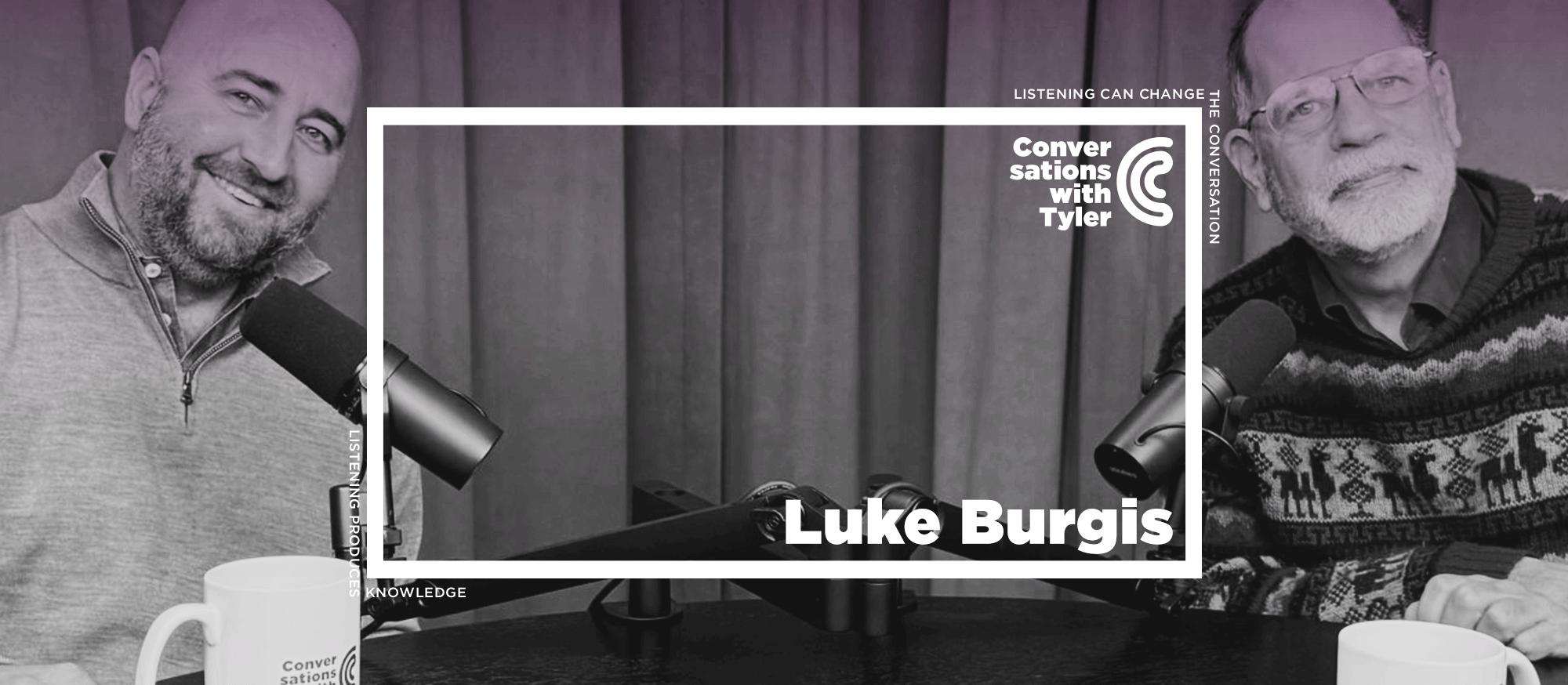



Luke Burgis left Wall Street after two years, founded a few successful companies in his twenties, then walked away to spend three years in a Roman seminary on the path to the priesthood. He now runs the Cluny Institute and teaches at Catholic University. His book Wanting made René Girard legible to a general audience; the new one, The One and the Ninety-Nine, takes mimetic theory into the dynamics of self and crowd in an age of social contagion.
He joined Tyler to discuss whether the age of pessimism is ending, why the Anglo world in particular seems so unhappy, whether Dostoevsky or Thomas Mann better diagnoses modernity, the kind of reader his own book would ruin, why he thinks AI will make social contagion weaker, what put him off consulting with Anthropic on Claude’s constitution, what effective altruism misses, why men and women are drifting apart, what he’d fund in every American city, the case for reintroducing friction, whether a Gnostic reading of the lost sheep explains our moment, what Rod Dreher gets right about withdrawal, why Genoa is Italy’s most underrated city, what confession times reveal about a church, why Italians seem tired of their Catholicism, why he didn’t become a priest, where he differs from Ross Douthat, why exorcists appear to be on the rise, the sudden mimetic antisemitism on the right, the book his 23-year-old self would have hated, what he secretly admires about Silicon Valley, why Michigan never left him, what the original Cluny can teach a modern talent network, how he hopes to face his own death, what he’ll do next, and more.
Watch the full conversation
Recorded April 30th, 2026.
TYLER COWEN: Hello, everyone, and welcome back to Conversations with Tyler. Today I am sitting here personally with Luke Burgis, one of my favorite current thinkers. He’s author of the bestselling book Wanting, and his recent work is just coming out. It is called The One and the Ninety-Nine: Forging Identity in the Age of Social Contagion. Luke, welcome.
LUKE BURGIS: Thanks for having me, Tyler. Good to be here.
COWEN: I should add you are also director and founder of the Cluny Institute. What is your title?
BURGIS: I’m assistant professor of practice in the business school at Catholic University.
COWEN: Great. I have questions about your latest book and your thought more generally. Is the current age of pessimism and despair ending?
BURGIS: I think it might get worse before it gets better. I hope it ends. There’s been a lot of talk among friends of mine who are very pro-tech accelerationists that the pope is going to really come down on tech in his new papal encyclical, which at the time of our conversation is not out yet. There’s been a lot of speculation about it. I think they’re absolutely wrong, for instance, in that case. I think he’s going to be very optimistic about what AI can do for humanity, of course, with some cautions about the way that it develops.
I think that even among my tech friends, I’m seeing a lot of pessimism for what a thinker like the pope might say and not even giving him the benefit of the doubt that we might be entering an age where we can actually learn more about what it means to be human than less. That might lead to a renaissance in the humanities, for instance. I think AI is performing a kind of via negativa on the human person, maybe even the human soul, in helping us discover who we are. To me, that’s very exciting.
COWEN: I agree with you about the pope, but if social contagion is such a dominant force, how does the age of pessimism get turned around? What’s the mechanism by which things will flip?
BURGIS: We need some more optimists, and then we can hope for a good contagion with the optimists.
COWEN: Why doesn’t the negative contagion just get stronger and stronger and overwhelm everything, and we all drown in a sea of terribleness?
BURGIS: The negative contagion and pessimism can’t go on forever. I think that there are cultural and societal release valves for that kind of thing. Vibe shifts happen. There’s the scapegoat mechanism. I don’t know if we’ll talk about Girard today. I think that there are things that correct. Sometimes we over-correct. I just don’t see the age of pessimism lasting. I think sometimes if something happens that is traumatic and tragic, like a serious war, even worse than the wars that we currently see in the world today, maybe it will take something like that to actually help people build something. It sounds a little bit paradoxical, but I think sometimes optimism can arise out of tragedy.
COWEN: Why does it seem in the data, at least, that the Anglo world is especially so unhappy?
BURGIS: The Anglo world, I think, especially in the US, I really believe that we have some bad ideas, what Byung-Chul Han has called the achievement subject. It’s this very Calvinist idea that I think has affected even the way that we think about entrepreneurship, which I’m extremely pro-entrepreneurship, but I think that it’s in his book, The Burnout Society, which was one of my favorite books. I think he diagnoses the problem very well.
We’ve internalized this idea that we always have to be doing something. There is always more to achieve. We’ve forgotten some of the fundamental things that actually make for a good life. Family structures, people are not having children. You and I have talked about the fertility crisis before. I think that that achievement subject mentality has affected the West through everything from media to our business culture.
I think we’re going to need to reevaluate that as a society. I just got back from three and a half weeks in Italy and I came back—I was going to say I came back refreshed, but I traveled with the toddler, so I can’t say that—I came back wondering. For all of the economic stagnation and problems that Italy has, do they also have something right? People there actually seem more joyful and optimistic, even than most Americans that I know that are doing pretty well.
COWEN: As a critique of modernity, is Dostoevsky or Thomas Mann more on the mark?
BURGIS: I’m very sympathetic to Thomas Mann because I went to a seminary on top of a hill in Italy for three years that almost felt like a sanatorium in some ways. I’m going to go with Dostoevsky, though, because I think his book Demons diagnoses what can happen at a psychic and spiritual level when social contagion runs rampant. Of course, having just written a book about social contagion, I don’t think he’s mentioned in the book, but Dostoevsky and some of the demonic elements, whether you believe in demons or not, we can speak of the demonic as something that seems to be characterized by social contagion usually.
COWEN: Here’s a question from GPT, and I quote, “Name the kind of person who reads your book, takes the thesis sincerely, applies it carefully, and yet ends up worse off.” What’s the story there?
BURGIS: The new book or Wanting or both?
COWEN: The new book. Both, but they’re of a piece, right?
BURGIS: They’re connected. Wanting is about mimetic desire, and this book is a continuation of that and how it plays out in social dynamics, the self versus the crowd. I actually think there’s a risk with my books and with any nonfiction book or the exposure to any big idea, especially one that purports to explain some fundamental first principle about social life, of thinking about it too much, making it a theory of everything, over-psychologizing everything, and losing sight of the concrete realities and circumstances that we’re in.
To give you an example, it’s been said that once a novelist reads the work of René Girard and understands mimetic theory and mimetic desire, it will ruin them as a novelist because now they don’t think that they have any original ideas, everything’s just mimetic. The way out of that problem actually is to stop thinking about it so dang much and to not impose that frame on everything and to get back to the concrete and the particulars of life, which is a kind of antidote. I’m not saying don’t reflect and don’t think and that we shouldn’t think about these things, but there is such a thing as overthinking.
COWEN: It’s a little bit like efficient markets theory. Even if it’s true, it’s better not to believe it?
BURGIS: Yes.
COWEN: Better for the world and maybe better for you too. Speaking of AI, will it make social contagion stronger or weaker or in which ways?
BURGIS: I would bet that it’s going to make social contagion weaker.
COWEN: Why?
BURGIS: Because we’re leaving the age of information and entering what I would call the age of intelligence. AI, to give one example, I think, will lead to highly customized, personalized education and learning experiences. People being able to construct and follow. If you’re an autodidact, I think it will be very good for you because you’ll be able to follow ideas to the end. We used to have to just read the footnotes and try to track down obscure books. I think AI will make that process a lot easier and more exciting. That is not a mimetic process. It’s not a social contagion process. That is using the AI to follow your own intellectual interests. I could probably think of other ways that it will make us less contagious, but that’s just one of them.
COWEN: That might be part of what flips us out of the pessimism?
BURGIS: I think so.
COWEN: Is that new emancipation?
BURGIS: I’m incredibly excited by that. I’m thinking about my own writing and my own work. I’ve got all kinds of blind spots and limitations. When I write something or when I’m thinking about something, asking the AI, what are all the implications of what I’ve said here to a bunch of domains of life that I don’t really know that much about, I’m always amazed by what it says.
COWEN: What’s the story behind you declining to work for Anthropic?
BURGIS: Well, it wasn’t to work for them, just to set the record straight.
COWEN: Not to work for pay, but to confer with them, right?
BURGIS: Just to confer with them, yes. There’s a lot that I don’t want to say, but I can tell you more than I think I’ve said so far.
COWEN: Sure.
BURGIS: I always probe people’s motivations. In this case, I had a back and forth with some folks at Anthropic. I was asking basic questions like, what’s next after this? They basically invited 14, 15 people out for a couple of days to comment on Claude’s constitution. I think they were all Christians, and they were interested in virtue ethics and what Christianity might have to add to the development of making Claude be good.
I asked basic questions like, “What do you mean by be? Philosophically, like that. What does that mean? What does it mean for Claude to be good? It seems like your discovery of virtue ethics, and they were using the word discernment, is you’ve landed on something that Ignatius and the Jesuits had figured out 500 years ago. What’s next? Is it just the two days, and what comes after that?” The more that I talked to them—people do this all the time; it’s why people like to meet the pope, for instance—I didn’t know how genuine it was. I thought that they were looking for a way to say, “We did this thing, we conferred with some Christians, we’re the good guys, we’re building the good AI.” Then the way that it was pitched to me was very much like, if I care about the future and the good of humanity, then this is definitely something that I could do.
It was framed like a moral imperative, not only by people at Anthropic, but even by people that know me, by fellow Christians. I said, “I do think I have some moral responsibilities, and there’s some moral imperatives in my life, but flying out to San Francisco to consult for Anthropic for free is not one of them.” I don’t think that makes me a bad person. It was just in the communication with them, I felt like something was off.
COWEN: Just philosophically, putting aside your theological views, but what do you think of effective altruism as a normative philosophy? That has guided, at least, some parts of AI production, right?
BURGIS: Yes. It seems to have guided many parts of it. I think ultimately it hasn’t proved very successful in doing some of the things that it set out to do. I guess when we go back to the beginning of effective altruism, I’m unclear on how effectiveness is defined by each person that practices it in different ways. I don’t think that there’s enough conversation on what the goals really are, and it’s—and this will not surprise you—ultimately very materialistic and doesn’t account for things like the quality of relationships, depth, culture. The things that can be measured, usually with effective altruism, are often not the things that I think are most important in life.
COWEN: If I ask you a question like, why do men and women seem to be so far apart these days, politically and aesthetically, you think you would have a better answer to that than the effective altruists would.
BURGIS: What’s their answer to that question?
COWEN: I’m not sure, but what’s your answer?
BURGIS: I’m not sure if that’s true.
COWEN: It’s political polarization. If you poll them on politics, men are more right-wing.
BURGIS: Oh, we’re talking specifically about politics.
COWEN: Women are more left-wing, but as you know, measured sex seems to be going down; certainly, childbearing, which we measure pretty well, is going down. Marriage is a more complicated story, but for some socioeconomic groups, it’s down. There’s just much less dating. Everyone claims the dating apps are broken. There was a piece in New Statesman about, in Britain, angry young women are very upset at the men that they encounter. It just seems to be worse than usual, the gap between men and women?
BURGIS: Yes. I think technology is largely to blame for that, the way that it sorts things that it thinks men should see versus things that women should see. It increases the political polarization for everybody, but in particular, between the genders, I think that it plays a huge role. I think that the way that men and women even meet each other, the way that dating works, is very, very different than the way that it used to be.
We often sort based on what we think our preferences are before we’ve had a chance to encounter a flesh and human person of the opposite sex, and perceptions are formed, often wrongly. The woman that I eventually married, I never would have found her if I was using a dating app, for instance. I think technology has exacerbated some of the false perceptions that we have about the opposite sex and what people believe.
That’s especially true when it comes to men and women because the algorithms, the way that the social contagion works, it knows that we are different. We are men and women, and it exacerbates all of the differences and doesn’t do much to promote common understanding. I believe that men and women are complementary, different but complementary, and that’s not necessarily a very popular view anymore.
COWEN: At what point does being anti-mimetic itself become a mimetic identity, and do you see some signs of that in Silicon Valley? Everyone’s supposed to be contrarian. There’s a kind of false contrarianism. You don’t even know anymore what’s a contrarian point of view. Are we at that stage with Girardianism?
BURGIS: I think Girard would be relatively mortified that mimetic theory was very mimetic and so popular. I think he himself worried about that, and that was a running joke while he was still alive in his circle at Stanford. I do think it’s an issue. It goes back to why I said we shouldn’t think about it too much. The book is titled The One and the Ninety-Nine. The message, as you know from having read it, is not that everybody should become a rugged individualist and that the goal is to become the one.
I think that’s incredibly dangerous. It’s actually, in a world where all of the focus is on the one, maybe we need to think more actually about the 99 and the relationship between the one and the 99 and the way that the group and the self affect one another. I think the focus has actually swung way too far in the direction of the one. I mean, all of us are the one in some sense, but the challenge of today is how do we live in communities without clustering in communities where everybody shares the same values and thinks the same things? Those are the most boring communities for me. I don’t want to be in one of those communities, but I get invited to them almost on a daily basis, and I usually decline.
COWEN: Let’s say we put you in charge, either of the government or of certain voluntary norms, and you can change one thing. What’s the thing you would change within the realm of it being somewhat feasible?
BURGIS: In charge as a political leader or a CEO?
COWEN: You can either be dictator, or you can be pope, or you can just be the most influential person on moral norms, and you can change one thing.
BURGIS: If I were the dictator of the United States—my fiscally conservative friends will hate this one—I think we lack mediating intermediary institutions between individuals in the state and that communities, places are healthier to the extent that they have these odd places in between, whether third places or just intermediary institutions.
I would probably find a good musician in every city who had some entrepreneurial spirit and was interested in bringing people together—let’s call it cities with over 100,000 people—and I would give them startup funds to open jazz clubs in every single city, and I would fund them from my government. I would do probably a public campaign to encourage—actually, I don’t know; maybe the public campaign would backfire on me because nobody likes being told what to do.
COWEN: Become too mimetic.
BURGIS: Forget that part. I think jazz clubs in every city would go a long way toward helping men and women. It would probably actually go a long way toward something nothing like jazz and alcohol to help men and women learn to like each other.
COWEN: Changing a voluntary social norm, what would you pick? Like young men lose interest in pornography?
BURGIS: That one I’d definitely want to change.
COWEN: What’s at the top of your list? It gives us a sense of your priorities.
BURGIS: It is. You named one that is at the top of my list. I think it’s absolutely destroying young men and women. The data is very clear that women are watching a lot of porn, too. I think that there are certain things that should be made taboo. Porn is taboo in the sense that nobody talks about it. I actually bring it up often in my class because the data are something like 90 percent of the men in my class are watching porn, and not quite that number with the women.
I’ll often bring it up in class, and then I’m shocked at how many students over the course of a few years actually come talk to me about it. I’m actually relatively in favor of introducing friction into the process and how easy that stuff can be found. It’s being found by accident. There was a story in the Free Press last year. I think it was a 13-year-old girl found it by accident. She said the discovery of it has become like a rite of passage for people, and it’s not even one that they’re seeking. It just happens to them. I think there has to be some friction introduced in that process, and I would do that.
COWEN: In Girardian terms, is there going to be a scapegoat that leads to catharsis for us, or things remain unresolved?
BURGIS: My understanding of Girard is that that world is gone, the world in which we can have a scapegoat that will lead to catharsis. We’re past that. We’ve seen too much. One of his fundamental points is that Christianity has created the conditions for the runaway violence precisely because the scapegoats don’t work anymore.
COWEN: Are we still in a Christian society, ideologically?
BURGIS: Yes, absolutely. I think even people that would consider themselves very secular have obviously adopted a lot of Christian ideas, in the West, I assume you mean.
COWEN: Sure, but say Japan. Is Japan going to have a scapegoat?
BURGIS: It would be more likely for Japan to have a scapegoat than for any country in the West. I think we’re very much in a Christian society, and there are some people on the integralist right that don’t realize how Christian of a society we actually do live in.
COWEN: You must know Rod Dreher. What do you think of The Benedict Option? Withdraw.
BURGIS: I want to do Rod justice, and I think it’s easy to strawman Rod and say that he’s just recommending that everybody move to a small farm. I don’t think that’s what he’s saying. I think what he gets right is that every person, every family—my wife and I are thinking through this right now—is going to have to probably, in the world of social contagion, if it’s as bad as some people think that it is, and I think that there are many things that are bad, will have to take certain actions to protect themselves.
If I don’t want my children watching porn at a very young age, there’s certain things that I’m going to have to do, and it will involve putting boundaries between them and the broader culture. I don’t think it can be very prescriptive. I think everybody’s case is very unique. I don’t plan to move to Montana, but other people might.
COWEN: They have the internet in Montana. I would worry all the more in Montana, right?
BURGIS: They have great internet in Montana. I think that we live in a relatively Manichean society. There’s a desire for purity. I think the desire for purity is relatively dangerous. It’s my disposition, I think it’s my wife’s disposition, to roll up my sleeves and just deal with the messy world. I’ve noticed that every time in my life where I’ve tried to flee it in some way, I’ve actually ended up less happy.
COWEN: I’m not saying you’ll ever do it, but what does your escape fantasy look like? One of mine is I’ll go live in a third-tier city in Mexico. I’m not going to do it, but sometimes I think about it. Cost of living would be very low. The food would be amazing. I could improve my Spanish.
BURGIS: It is moving to Genoa with my family, making my US income, living in Italy. I love Italy. I love the food. I love the people. I love the culture. I feel lighter while I’m there. I laugh more. We eat dinner later. I love everything about it. It would probably be living in Italy for the most part, or at least making that my home base, brushing up on my Italian, working less.
COWEN: Why Genoa? It’s a wonderful city. It’s still medieval, right, in a funny way?
BURGIS: It’s medieval. I think it’s the most underrated city in Italy.
COWEN: In Italy, I mean, yes. I agree. Yes.
BURGIS: I think it’s the most underrated city. You agree.
COWEN: I took my wife there. She was stunned. “How come no one goes to Genoa?” She was telling me.
BURGIS: It’s close to Cinque Terre. It’s this city that’s elevated. It has a fascinating history. It was still a very functional port city. It was really the most important city in Italy, arguably the world, during when Spain was a great power. It’s very cosmopolitan. It reminds me of Marseille a little bit. It’s vertical, breathtaking views. The people there, they’re not very touristy. The Italians there seem indifferent to you as a tourist.
It just feels very, very homey. It’s so close to a lot of other great things in Italy. You can get to Torino relatively easily. That whole area up there, Bra, where the Slow Food movement originated, you’re just in striking distance from everything. Nobody I know that goes to Italy goes to Genoa. I plead with them. I’m like, “Please, just go to Genoa.”
COWEN: I am the exception. My wife sometimes talks of wanting to live in the smaller towns nearby, which we’re not going to do because we’re slated for a third-tier city in Mexico, but we’re not going to do that either. I sometimes think of Northern Italy as a place where there were fewer different dimensions for mimetic desire. That is, more people dress the same. There are fewer status dimensions, maybe less room for eccentrics compared to America. Do you think that’s true, or do you think I’m off base? Paris is a bit like this also. There’s a certain notion of what kind of shoes an Italian man should wear. They wear them, and they’re amazing, and actually more affordable than here. There’s a sameness to some things.
BURGIS: I don’t think the sameness is a bad thing. I think the sameness is very charming. The sprezzatura of an Italian man, the way that an Italian man dresses, something I’ve never been able to pull off in my life. For those that don’t know what that sprezzatura means, it means you put tremendous care into putting on an outfit that looks like you didn’t think about it at all, and somehow it comes together and looks amazing. Even that seems highly mimetic to me, the idea of sprezzatura. I love Naples. Naples is maybe my second-favorite city in Italy.
COWEN: It’s my second favorite, too. Maybe it’s my favorite. That and Genoa, to me, are the two undiscovered, less discovered gems.
BURGIS: It makes sense why we get along. Nobody goes to Naples either. It’s too dirty. It’s endless. I’ve heard all the excuses.
COWEN: It’s become somewhat more popular, though. There’ve been some New York Times articles. The food has drawn some people, I think.
BURGIS: My test for whether or not I’ll get along with somebody is their reactions to Naples after they’ve been there. That’s my number one test. To the Northern Italian question, there’s a great book on Italy, if you haven’t read it. It’s called The Italians by Luigi Barzini in the ’60s. It’s just a fantastic book. I think that the North has a little bit less of the animated Italian gestures and spectacle that you get in the South. It’s a little more reserved. I would say that because of that, it’s less mimetic than the South. I think that disposition, that flamboyant way of being, is the more mimetic thing about the South, about Naples.
COWEN: Speaking of Barzini, what do you think of his hypothesis that the face an Italian will show you, in terms of level of cheeriness, depends on how your status is perceived? He thinks they’re somewhat of a sad people, but they seem happy to outsiders because they put on that face for the higher-status outsiders.
BURGIS: I wouldn’t disagree with Barzini on Italian culture, so I’m not going to disagree with him on that. He knows Italians much better than I do. I think that the face in Italy, maybe it’s like the smile in Thai. There’s 1,000 different smiles, and they all mean something different. Italians are incredibly good at reading the face and facial expressions, but I think they have a different standard for foreigners like me than they do for each other.
COWEN: How is Italian Catholicism different?
BURGIS: Depends on what part of Italy you’re in.
COWEN: Say, Genoa, whatever part you know best.
BURGIS: I think that, having spent a few weeks there very recently and went to mass quite a few times—I was there during Holy Week—it is aesthetically very different. You typically will walk into a very old church that has no heating or AC, has absolutely terrible acoustics, and you’ll find people wandering in and out, like you would in an orthodox church. It’s like walking around. I would say that it’s relatively low liturgy compared to what you see.
A lot of the revival in Catholicism here in the US are high-liturgy things. I actually found it to be somewhat difficult. I couldn’t even hear the priests most of the time because the sound system is really bad. I think that the liturgy is really the test for me about everything else that’s going on, and that’s the sacramental life. The first thing I notice about any Catholic church is how many times they offer confession. I look at it right away, and I can tell you 10 other things about that same church and predict it with a very high degree.
COWEN: What does that tell you? Let’s say they offer confession frequently. What do you then infer?
BURGIS: I infer that it’s thriving. One could say they offer confession frequently because they just have a lot of people there that believe in the sacrament of confession. I think it’s quite the opposite. It turns out from every priest that I’ve talked to that if you offer confession frequently, maybe a few times a week or daily, the lines just start to form. It’s actually quite the opposite. You’ll have a lot of priests that just start offering it more.
The extremes are confessions available by appointment only on Saturdays versus confession before every mass. That is the number one signal for me, and then how often they have adoration. This is Catholic inside baseball here. It is like politics. If I know your position on gun control, I can, with a high degree of accuracy, predict your position on 10 other clustered things.
COWEN: Why is it that, at least in formal terms, Italy has become so nonreligious? I get that underneath the cultural structure, it may be quite Catholic still, but the number of people who go to church or who profess, say, a belief in the Trinity seems fairly low. How did that happen?
BURGIS: It seems like they’re almost tired of their Catholicism. They’ve had it for so long. It almost seems like cultural Judaism to me. It’s maybe like the familiarity breeds contempt. I don’t know, but that’s the sense that I get. Like some politics in Italy, I think Mussolini had something to do with it, the Christian Democrats. I think that it was such a part of their identity for so long, it wasn’t handed down by the last few generations, and there’s just a sense in which it has become cultural.
I met many Italians on this last trip that would make the sign of the cross if they heard an ambulance drive by or they walked by an image of Madonna on a street corner or something like that, but they probably haven’t been to mass in years. This has become very cultural. I don’t know why, but I think that they’re tired.
COWEN: What was it like living next to Vatican City?
BURGIS: Speaking of this, I was mortified when one day I had to walk directly by St. Peter’s very often just to get home up on the Janiculum Hill. I walked by St. Peter’s one day and I didn’t look at it, I didn’t think about it, and then I was mortified and I realized it was too late to go back because I had to be somewhere. Rome can be a very difficult place to live as a person of faith. When I got there, somebody said, Rome will either strengthen your faith or lose it as a Catholic because you will see the dark underbelly of everything.
You will see a lot of worldliness and you will either come out of it with a more supernatural vision of what the church is or you will come out of it with your tail between your legs, really worried about things. For me, it was really not one of those two extremes. It was like I came out of it not that much different than when I went in. It was probably the three most formative years of my life when I lived next to the Vatican because it was an incredibly strange situation.
I was a 31-year-old man who had owned my own house in Las Vegas and suddenly lived in what was essentially a dormitory with 250 other men, most of them younger than me. The typical age for a seminarian is 20, 25 probably, with a shared bathroom on every floor. Talk about a relatively mimetic environment where we share so much in common. I would also say because of that, it was one of the funniest places that I’ve ever been because one of the ways that you learn to live in a situation like that is through comedy.
COWEN: Why didn’t you become a priest?
BURGIS: John Henry Newman said that one should never tell the story of their conversion or their vocational discernment between tea and dessert. It’s just too complex of a question. The easy answer that I’ll give you, it’s not a cop-out, is that I carefully discerned for a number of years that it was not what I felt like I was being called to do. I’ll tell you one of the little parts of that story that helped me realize that. I was studying theology at a pontifical university in Rome, right in Piazza Navona.
I was on my way to a fundamental theology class in my second year in Rome. I was having nagging doubts. Something felt a little bit off in my discernment process. It turned out that there was a Matthew Luhn who was a Pixar animator. He played an instrumental role in the development of the first Toy Story. He was a storyboard guy. He worked with all of these guys at Pixar. He happened to be in Rome giving a master class on storytelling that day. This is a very typical Italian story. The venue you’re supposed to give the workshop at in Rome did not allow him in due to some kind of bureaucratic maintenance of the building.
COWEN: Very Italian already.
BURGIS: It’s incredibly Italian. He had to find an emergency place to hold his workshop, and he held it at my pontifical university. I don’t know the backstory there, but he was there. I saw a sign, “Matthew Luhn, Pixar, storytelling master class.” It was not cheap. All these Italians paid to go. I talked my way in, and I skipped class, and I went to the storytelling class that day. I was so lit up by that class that I realized that there was something in me that craved this creative, artistic, aesthetic thing. I think it ruined theology for me for the rest of the year.
COWEN: Aesthetics trumped theology?
BURGIS: Von Balthasar wrote a whole aesthetic treatise, the theological aesthetics. Theology and aesthetics go hand in hand, really. He understood the whole story of the incarnation, like the acts of a play. I think that I’m very much a von Balthasar Catholic in the sense that I do see a lot of the goodness and beauty and aesthetic characteristics of the church as related to truth. It’s one of the ways that we can come to the truth is through beauty.
COWEN: Aesthetically, what is it in Christianity that’s most important to you personally? If it were me—I’m not Christian—but I might say Bach’s B minor mass or maybe Monteverdi’s Vespers. What would you say?
BURGIS: Aesthetically, it is the liturgy. It is a beautifully celebrated Catholic mass. I’m not one of these pre-Vatican II guys where I think that the Latin mass is the only real mass. I do think that is incredibly beautiful, though. I go to it every once in a while because I think it’s very beautiful. I actually came back to my faith through that practice. It’s not one particular thing or piece of artwork for me; it is the beauty of the ritual.
We’ve lost ritual in the world today in many cases. Seeing that, seeing the reverence, seeing a church full of people shoulder to shoulder on their knees in itself is beautiful to me. I remember just seeing everybody drop to their knees for the first time when I went back to mass after not having gone in a very long time. I remember being struck by that’s not something I would see anywhere else in the world.
COWEN: If I speak to people who are Ethiopian Christians or maybe Egyptian Coptic Christians, possibly Armenian Christians, they will communicate a sense that somehow they’re in tune with an earlier, more fundamental Christianity than what we have in many other places. Does that argument carry any weight with you? Are you tempted by that or no?
BURGIS: A little bit. I don’t think that it’s true, but I’m very attracted to orthodoxy, to the liturgy. It is incredibly beautiful. Even the divider that they have, where the priest consecrates the Eucharist behind a wall, there’s a sense of mystery and transcendence to that I really like. I think the world could use more sense of mystery and more otherness. I think one of the things that worries me a lot about the church today is that the church has become highly mimetic with the world.
You have priests and influencers, they’re on TikTok performing skits and things like that. I think it’s incredibly unhelpful because there needs to be a level of otherworldliness, alterity, that I think the Eastern Orthodox liturgy preserves in a way even better than the new Mass, the Novus Ordo does.
COWEN: Do we need Protestantism in America to keep print culture front and center? Isn’t Catholic culture in some ways too visual or too theatrical, and the Protestant impulse is very good for broader society because print is a more thoughtful medium?
BURGIS: I love my Protestant brothers and sisters, so I don’t want them to go away. I might want them all to become Catholic, but I think that many, many great things have come out of this tension. I think generally good things do come out of tension, and yes, the church is oral to more of an extent than Protestantism is. I think it’s interesting now because we’re entering a world in which—I’m a big fan of Marshall McLuhan—but it seems to me like the traditional forms of written word, even traditional essays, that is changing incredibly fast in the world that we’re entering. AI is just going to change the form of that, so I don’t know where that goes.
COWEN: Now, you and Ross Douthat, you both self-identify as Catholics. He’s been on this podcast several times. We’ve talked about religious issues. If you had to pin down exactly where your religious vision of Catholicism differs from his in as fundamental a manner as possible, how would you describe that?
BURGIS: He might take more of a rationalist approach than I do. And I believe in faith and reason, as John Paul II said, are like two wings by which one rises to the contemplation of the truth. It goes back, for me, I mentioned, aesthetics and beauty, so it’s the witness of the saints that initially attracted to me. It was the beauty, it was the tradition, the continuity of the church and the world through such a long time. Reading the lives of the saints as a witness, for me, that has always been the first step, not trying to think my way to it.
I think Augustine had this beautiful phrase of faith seeking understanding. What I’m not saying is that we should not see—because the church has a wonderful intellectual tradition—but I’m less of an apologetics guy, maybe. I think the best chance that I have to help somebody see what I see in the church is not to try to convince them of the argument of why Christianity is true, which is the only good reason to be Christian, in my opinion. It’s to take them to Rome, and bring them inside a beautiful church to witness a beautiful mass, to drink a lot of good wine, and have conversations late into the night about the good, the true, and the beautiful. That, to me, is the more circuitous route. Maybe it’s not the fastest route, but I would say it’s more of an aesthetic approach.
COWEN: If the world today is enchanted, or we should think of it as enchanted, what are the most literal manifestations of that? Of course, it would be the world itself, but specific things. Are there miracles happening commonly, or how do you think about specific events within that framework?
BURGIS: I wouldn’t be surprised if there’s a Marian apparition in my lifetime, like a big one. I don’t know if it’ll be Our Lady of Guadalupe, but I think that sometimes, the enchantment requires that people need to be open to enchantment to see it. There are enchanting things going on all around us. The world is not necessarily becoming more enchanted. It’s us that are perceiving and noticing the things to be enchanted by. That’s why I say maybe I just have a sense that maybe there will be some openness to things that seem supernatural. I don’t know nearly enough about this. Speaking of Ross, I know that he’s fascinated by the question of UFOs—
COWEN: Sure. UAPs, yes.
BURGIS: —but it seems as if even this discourse that we’re in right now points to a desire for some extraterrestrial, supernatural, enchanted things. We’re really trying to find them, and we’re having a hard time.
COWEN: J. D. Vance said he thought they were demons. I don’t agree with that, but I don’t find it crazy.
BURGIS: I don’t find it crazy either, as one who believes in demons. That’s a better explanation than others that I’ve heard.
COWEN: Do you think he, and maybe you, have a Manichean approach to Christianity, if demons are relevant?
BURGIS: Well, demons are fundamental to Christianity. The gospels are full of stories of Jesus driving out demons. The Gerasene demoniac is the most famous example of that. He says, “We are legion,” and this is the quintessential gospel story where the demonic has and always has an element of contagion because the entire herd is infected by this demon and is driven off into the sea. There’s nothing Manichean about that to me, living in a world where demons are real, where evil is real, and exorcisms are real.
I’ve known my fair share of exorcists, and they seem to be on the rise, by the way, from what the data shows. Most of it’s anecdotal. I don’t know how rigorously they’re actually tracked. I think they are by the church, but that is not public data. Anecdotally, it seems like they’re on the rise. Manichean is kind of there’s good, and then there’s evil, and we have to purify. Just admitting a world that might have the demonic element in it, there’s nothing Manichean about that.
COWEN: If you think of Shiite Islam, which sometimes is compared a bit to Catholicism, relative to Sunni Islam at least, do you feel any affinity to that approach? Obviously, it’s missing the Trinity and Jesus and many other fundamental things from your point of view, but is there any kinship?
BURGIS: I don’t know enough about Shiite Islam. What would be one thing that might be similar to Catholicism about it?
COWEN: The world being enchanted, things and truths being hidden, and the multiplication of intermediaries as a way to get to those truths seem to me much more Catholic, if I had to say, and Sunni Islam seems much more Protestant with an emphasis on the Quran itself.
BURGIS: Well, given what you’ve just shared, I probably would be if I learned more about it. Seems to share some elements. The idea that there are truths that are hidden is something I would like to just drill down on just for a second, because in Catholicism, it’s that the truth has basically been revealed fully in the person of Jesus Christ. The alternative to that is Gnosticism, which is generally the idea that there’s always some hidden truth. It’s like Scientology. There’s always this one more thing. If you just learn this next thing, then that’s the pathway to salvation is more and more knowledge.
Very interestingly, when I read the parable of the lost sheep in the gospels, where Jesus tells the story of a shepherd that has 100 sheep. One of them goes missing, is lost. He leaves the 99 to go find it and brings it back. There is a Gnostic gospel of Thomas version of that same parable. In the Gnostic gospel of Thomas, the sheep is not a sinner that Jesus finds. The one lost sheep was the smartest sheep. When Jesus finds the one, he does not bring him back to the flock. He pats him on the head and praises him for not being like all of the other sheep, for being smart enough to forge his own way, and to leave the herd and the crowd, and all of the other dumb sheep. Now, that is the Gnostic interpretation, just to be clear. I find it very, very interesting and very indicative of the times that we live in today, where I think people would be more attracted to the Gnostic interpretation than the traditional one.
COWEN: The revelation of Jesus, again, within a Christian framework, it’s not fully transparent. There’s four Gospels. They have some differences, if only of emphasis. There was a period where there’s an Avignon papacy. You can count on the church to interpret, but there’s a claim that there’s two popes, who’s the real pope, which is the real church. One way or another, people had to make up their minds. Isn’t there room again for hiddenness in that framework, even if you adhere to a Catholic perspective as fully as you might try to?
BURGIS: Yes. One of the exciting things about the faith, and being Catholic, is the adventure of navigating a spiritual life and a religious life that ultimately is your own. One part of the tradition that I always find interesting is personal divine revelation to individuals. This goes to the heart of the question, the hidden. Sister Faustina is a very famous Polish saint. She was a nun. She died in her 20s, lived in a convent, barely left her whole life. Then, when she died, there were just diaries and diaries filled with personal conversations that she claimed to have with Jesus. This is where the divine mercy, the famous painting. She said that Jesus actually showed her how he would like to be depicted in the painting to show the world his divine mercy. That’s an example of this personal revelation, which the church has probed and decided that it’s worthy of sharing and belief. The hiddenness is certainly there.
COWEN: On the political right these days, why do you think there’s now so much mimetic antisemitism? It seems to have come from nowhere. Maybe that’s an incorrect impression, but haven’t you been shocked by how much there is, and how open it’s become?
BURGIS: I’ve been totally shocked by it.
COWEN: What happened?
BURGIS: Scandalized by it. I don’t know. I hate to think that it’s always been there. There’s two ways I think that one could explain it. It’s either always been there, and something has happened that makes people show their true colors. I hope that version of the story is not true. The other version of the story, which I think imputes less culpability to people, is that there is some crazy mimetic thing happening right now. It’s cool to be edgy or something like that and to say things. You’ve got Nick Fuentes. I think he’s incredibly influential, especially to a younger generation, and that it is a mimetic thing that, hopefully, people will snap out of once it’s been exposed for what it really is.
COWEN: The Luke Burgis production function. What did you learn in your Wall Street years?
BURGIS: How much I hate working on Wall Street. I learned that efficient markets theory is BS. All of the things that I learned in a very good undergraduate business school did not actually seem to be used in the day-to-day. Maybe it was because I was a lowly analyst at an investment bank. If I had worked at a hedge fund, I would have been enthralled by seeking alpha. Unfortunately, I didn’t get to do that as an analyst who just put together pitch decks and built financial models in Excel. I learned that I wanted to take risks, and I couldn’t wait to take those risks, so I did not spend very long on Wall Street. It was less than two years that I actually worked on Wall Street. I left when I started my first company.
COWEN: What did you learn starting those businesses in Italy?
BURGIS: Well, I never started a business in Italy.
COWEN: You ran them from Italy?
BURGIS: No, no, I was in Italy as a seminarian.
COWEN: Okay.
BURGIS: I ended up walking away from a company in my late 20s to take up some time off, and that eventually led me to enter the seminary as I was on the pathway to becoming a priest. I did organize my life so that I was on a board while I was there. I didn’t let go completely, but I let go of all of the operational stuff. It was still a little distracting for me as I was trying to study philosophy and theology, and then would get reports about something super technical going on a few thousand miles away back home. I slowed down a lot in Italy. Being an entrepreneur is incredibly difficult because nobody ever tells you to stop, and there’s always something else to do. It helped me bring some balance back into my life.
COWEN: Is there a book that the current Luke would recommend to the 23-year-old Luke that he would have hated but you still think he should have been reading?
BURGIS: Byung-Chul Han, The Burnout Society, I would have hated that book as a 23-year-old. I remember having an older investment banker come speak to me when I was a senior and tell me that I was gung-ho. I was saying, “If I can come work at Goldman Sachs, I’ll work 80-hour weeks, I’ll sleep in the office.” He really walked me back from all of that language. He was like, “Young man, that’s really not what you want to do. That’s not really the best approach here.” I thought he was really lame. I thought, “This guy, he’s not going to make it.” He wasn’t that old. He’d been doing it for a few years. I thought that he was just not ambitious enough. The Burnout Society would have been a struggle for me.
COWEN: What part of Silicon Valley, if any, do you secretly admire more than perhaps your audience expects from you?
BURGIS: I really admire people getting together to build things, usually, without sorting by things like political preference. The thing that I love about Silicon Valley is solving real problems in the world with the best people you can find working in small teams together—wish the church did more of this, should do more building, maybe, and less talking about the ethics of AI—to actually try to build things, experiment with things.
I think the church probably needs a workshop in Rome to actually start building things. You can speak much more intelligently about it. I admire so many things about Silicon Valley. I miss the energy of it. DC is very different energy. It has created a culture. There are some parts of it that I think can be dangerous, but San Francisco is still the most important city in the world, particularly because of the AI boom, because it’s never been replicated anywhere else. I think there’s a reason for that.
COWEN: Why do you remain personally so tied to the state of Michigan?
BURGIS: Well, I spend my summers in Michigan, most of my summers. I think it’s the greatest state in the country. It has a lake that looks like an ocean when you’re standing on it. There’s something about the Midwest that I’ll never be able to take it out of me, even having lived in big cities. My dad was a truck driver. My mom was a grade school art teacher and artist. There’s kind of an earthiness, and it was great growing up there. I hated it at the time, but now I think about how wonderful it was to have to go through the four seasons every year.
COWEN: Where did you grow up, exactly in Michigan?
BURGIS: Grand Rapids, Michigan, on the west side of the state. Scraping the ice off of the windshield at seven o’clock in the morning on my way to school. All of those things, I think, they do form some character. I love it. I love the grittiness. I love Detroit. I’m a little partial to the West side of Michigan just because that’s where I’m from. I’ve suffered as a Detroit Lions fan my entire life. I think that the Upper Peninsula is one of the hidden gems in the entire world. I don’t know if you’ve ever been to the UP.
COWEN: Of course, it’s wonderful.
BURGIS: It’s just wonderful.
COWEN: Highly underrated—
BURGIS: It’s highly underrated.
COWEN: —like Genoa.
BURGIS: Yes. I try not to talk about Michigan too much because Northern Michigan, like the Traverse City area, is getting written up in the New York Times, which I hate to see anytime I see it, because it is wonderful. Prices are totally out of control, so I should probably just stop talking about all the wonderful things about Michigan.
COWEN: Now, your own Cluny Institute, do you think of it as closer to a monastery, a salon, a talent network, a way of organizing a Christian counter elite, all of those? How’s the way you would present what it is or what it does?
BURGIS: I would think of it as trying to build a talent network and forming a kind of artist colony and workshop for people that have a religious sense or sensibility, that are open to the transcendent, that are smart, that care about serious ideas, and that want to build real things in the world, that really care about the vector of innovation. It’s not just building, but it’s like a step back, what should we be building? Trying to find as many of those people as possible in the world. It’s got a couple of different functions.
One of them is it’s trying to operate as a bat signal, putting things out into the world that bring the right people out of the woodwork. That’s certainly happening. Then there’s a part of it where I want to work with people that are able to work at the intersection of what I call Athens, Jerusalem, and Silicon Valley. We don’t have to silo those things. I think that Silicon Valley, for instance, would be healthier if it actually wasn’t as allergic to religious thinking, for instance. I think religious thinking could do Silicon Valley a lot of good. I’m betting that if we can begin to find that network, and invest in that talent network, that 10 or 20 years from now, it will be building some of the most important things in the world. I don’t just mean companies. I mean cultural things, aesthetic things, workshops, things that will produce new forms of community, maybe even a model for a new institution.
The reason that I am so struck by the story of the original Cluny is that it was an entirely new kind of institution in its day. Even legally speaking, right? Its original charter, the guy that gave all of the money renounced his right to have anything to do with the way that it operated. It formed a network of over 1,200 Cluniac monasteries. My imagination is struck by, “Well, what does that look like today if we can have networked workshops of people that are all drawing inspiration, and talking about ideas that are open to the religious sense?”
COWEN: The original Cluny was also a pioneer of accounting techniques. Is that correct?
BURGIS: I know that a Franciscan invented double-entry accounting. I know that, but he wasn’t associated with Cluny. There were all kinds of innovations, architectural innovations, agricultural, winemaking innovations that happened. It was really the largest church in the world for 300 years, the most important institution in Europe, in my opinion. It was the center of innovation in Europe, out of the liturgical renewal that it instituted, and it welcomed people in. Monasteries, the Benedictine tradition, has always been known for hospitality. No matter who you were, if you’re sick, if you’re poor, if you’re traveling, if you’re a pilgrim, you could knock on the door, and you would be let in, and you could stay for a day or two or longer, and then you would be sent on your way.
Cluny actually popularized the Camino de Santiago. They’re the first ones that would send people on the Camino de Santiago. I could go on and on about all the things that Cluny did, but the people that came into contact with it—it was worldly in the sense that it interacted with politicians, with builders, with the Romanesque, the masons in Italy. It was incredibly worldly in that it opened its door to all of those people and interacted with them, and then somehow shaped them. Is there a lay version of that? I’m obviously not trying to build a monastery. I’m not a monk, but I’m inspired by the way that it existed in the world as a sign of something completely different.
COWEN: Before the last two questions, just another plug for your book. The title is The One and the Ninety-Nine: Forging Identity in the Age of Social Contagion. Last two questions. First, I’m sure you’ve been following the case of Ben Sasse as of late. How do you think you will deal with your pending death?
BURGIS: I hope I can deal with it as good as he has dealt with his. It’s interesting because there’s Bryan Johnson in the live forever campaign. He’s speaking at a conference that I’m hosting this summer, and directly following him as a Benedictine monk who, part of the Benedictine tradition, is literally meditating on your death every single day. There’s the memento mori. The tradition of keeping a skull on your desk, which I do. I learned that when I was in seminary. It’s not a macabre-looking skull. It’s actually from Mexico. It’s incredibly painted with all these bright colors. It is on my desk. It’s about this big, but meditating on it and actually going through it are two different things.
I suppose that my hope is I draw a lot of inspiration from Ben Sasse, that in C. S. Lewis’s words, “One should die before they die and die a series of small deaths to our ego.” I’ve certainly had to do that several times in my life. I’m sure they won’t be the last, and I think that’s really the key. I can’t tell you how much I admire him going and talking to people. I can’t remember anybody that has died in public since John Paul II, who really died a slow death in public over many years. Unfortunately, Ben Sasse, it’ll probably be much faster. There’s a Catholic tradition of actually praying for a good death. It’s to St. Joseph.
COWEN: Final question: What will you do next?
BURGIS: I plan to be building Cluny for a very long time. I’ve had an itch for a long time to do something more artistic. I’ve had a novel that I’ve thought about writing for a long time, but it’s not easy to write serious nonfiction, and then flip into a different mode. I don’t know if that will take some kind of detox period from the world of ideas. Maybe I’ll need to go live in Italy for a year.
I’m really inspired by creating new environments and experimenting with new forms. I don’t think it’s unrelated to the artistic project, but I feel a really strong desire to do that. I hope that Cluny is a place where I can do that out of so I often think of, I am one artist in the colony that is Cluny, and maybe whatever art that I create, whether it’s a novel, a book, or whether it’s a gallery, or some kind of experience, or something like that. It will just be a manifestation of what I hope Cluny will help other people do. I want to open a restaurant, but I probably won’t do that for another 30 years, until I can afford to lose a lot of money.
COWEN: That’s in the US or in Italy?
BURGIS: Probably in Italy.
COWEN: Luke Burgis, thank you very much.
BURGIS: Thanks for having me, Tyler.