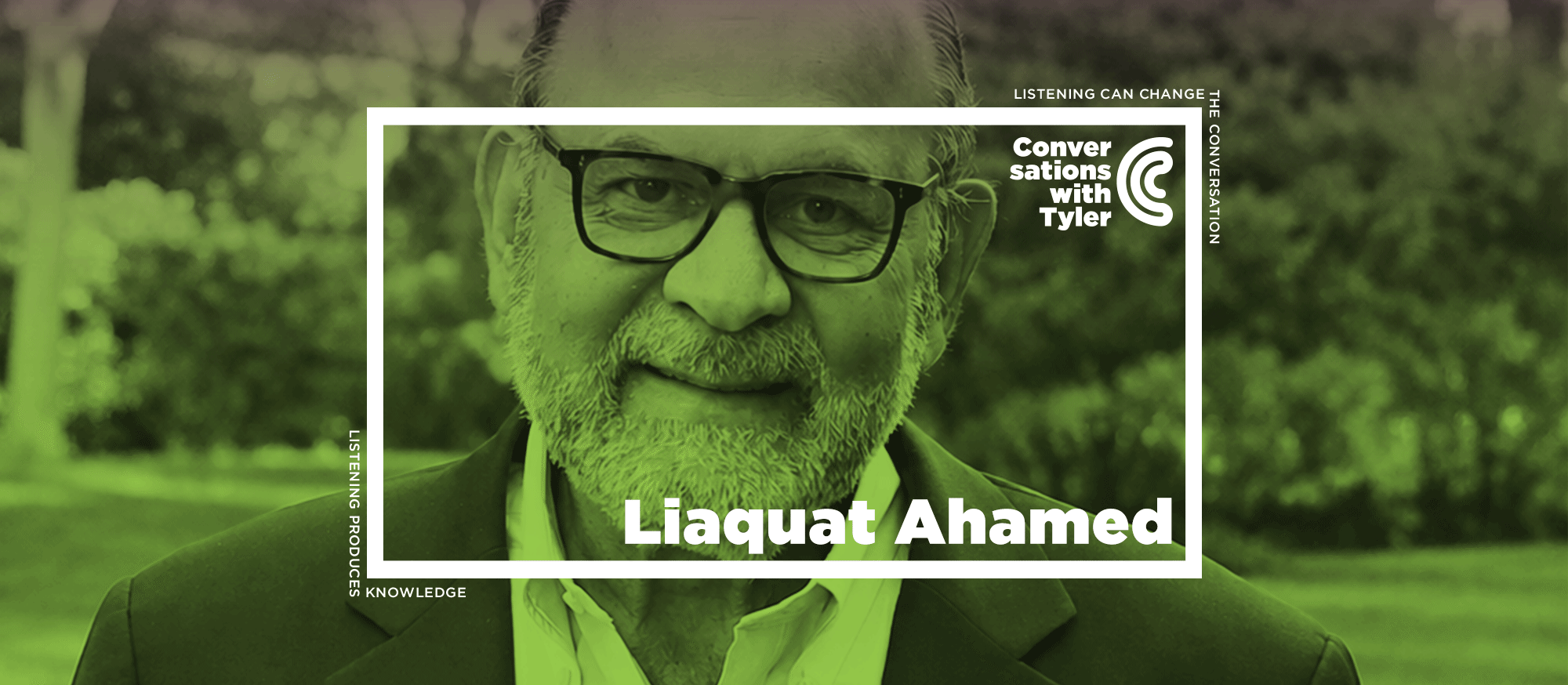



Liaquat Ahamed has spent years making central bankers into compelling characters. His 2009 book Lords of Finance won the Pulitzer Prize for its account of the bankers whose decisions helped cause the Great Depression; his new book, 1873: The Rothschilds, the First Great Depression, and the Making of the Modern World, tells a stranger story — a severe deflationary crisis that barely dented global growth but poisoned politics for a generation. Tyler pushes him hard on the central puzzle of those two books — why did one financial crisis derail the world, while another left growth almost untouched?
They start with that puzzle before moving through Gladstone’s startlingly self-interested bet on Egyptian bonds, Bismarck’s role in destroying bimetallism and deflating the world economy for two decades, whether a global silver or symmetallic standard could have worked, Britain’s fateful decision to re-peg the pound to gold in 1926, Hjalmar Schacht’s transformation from the economist who stabilized Weimar’s currency to opportunist collaborator with the Nazi regime, Montagu Norman’s spiritualist beliefs, why the 1920s produced such a creative cultural moment, lessons from the IMF on Ireland’s housing bubble and Pakistan’s two dozen bailouts, what went wrong in the eurozone crisis, Britain’s baffling modern stagnation, and finally to his own restless career — from the World Bank to a failed Iraq film to Ismaili Islam’s uniquely progress-oriented leadership structure, and what he wants to write next.
Watch the full conversation
Recorded July 28th, 2026.
TYLER COWEN: Hello everyone, and welcome back to Conversations with Tyler. Today I am chatting with Liaquat Ahamed, who is the author of a new and wonderful book, 1873: The Rothschilds, the First Great Depression, and the Making of the Modern World, which I enjoyed very much. Many of you will know him as the author of Lords of Finance: The Bankers Who Broke the World, from 2009, a book that won the Pulitzer Prize for history and numerous other awards. Liaquat also has extensive experience in the private sector, dealing with the World Bank and the IMF, and he has headed the World Bank’s investment decisions. He’s also produced a movie about Iraq and done much more as well. Liaquat, welcome.
LIAQUAT AHAMED: Thank you, Tyler.
COWEN: I have a general question about how your work fits together. Your book Lords of Finance, it convinced me that financial crises really matter, and your new book, 1873, almost convinced me that financial crises don’t really matter, because the world just keeps on growing. What makes the difference for when, historically speaking, crises will really matter?
AHAMED: I think the first book, Lords of Finance, was about the financial crisis that really plunged the world into a Great Depression. The second, 1873, is about a crisis that didn’t actually plunge the world into a terrible great depression, but what it did was cause a sequence of effects throughout the world which damaged the political economy of the world for the next 20 years. A better title would have been The First Great Deflation.
COWEN: We’re supposed to believe that deflation is bad, nominal wages are sticky. This was a pretty slow deflation, but by one measure, the major world economies are growing 2.5 percent over the next 20 years from 1873 onwards. How did we adjust so well to this?
AHAMED: Because prices were flexible. Nominal wages went down. I think the distributional consequences and the political impact of those distributional consequences were much more damaging than the pure economic consequences.
COWEN: In the 1920s, and a bit afterwards, of course, you could say politics goes crazy in many countries, most of all in Europe. After 1873, would you say politics went crazy, or it just continued along its 19th-century path?
AHAMED: No, I don’t think it went crazy, but it wasn’t a happy time politically—it’s populism in the United States, the resurgence of protectionism in Europe, the retreat from liberal ideas, the revival of imperialism by Britain when it invaded Egypt. Those were not happy things that happened.
COWEN: I wouldn’t endorse any of those, but they sound a bit like business as usual for Europe in the 19th century. England goes many places in that century, often with bad results, but Egypt hardly seems like a major outlier, right? There was protectionism throughout.
AHAMED: It was the beginning of the scramble for Africa and gave a second wind to imperialism because you could argue that until then there was actually a retreat away from the growth of imperialism.
COWEN: Do you view imperialism as a natural expression of liberalism, or as something contrary to its spirit? Because the liberals themselves often favored it. There’s a whole literature called liberal imperialism as a topic.
AHAMED: No, I think it’s definitely contrary to the spirit of liberalism.
COWEN: The liberalism of that era, surely it was a doctrine that thought England and some other countries could improve the rest of the world. They thought of that as quite a liberal idea. Malthus and Mill, of course, worked for the East India Company. They don’t seem so morally torn over that. I’m not saying they were correct, but isn’t that in some way a high watermark of liberalism to think you can reengineer the whole world along liberal lines?
AHAMED: Yes, you’re right. They didn’t think that they were damaging these societies, but I think the long-run consequences weren’t happy.
COWEN: If we look at the somewhat fragmentary data we have, I see that the estimated rate of per capita economic growth for the United States over the period you consider it’s below 2 percent. Some sources would estimate 1.7 percent to 1.8 percent, but this seems to be the time in American life where just everything is starting to change. It’s not fully taking off until the 1920s, but fossil fuels are being mobilized. Some centerpieces of modern society are being laid. Am I right to think below 2 percent is a mistake, and we’re not hedonically measuring the improvements carefully enough, and the real rate of growth was, in fact, considerably higher?
AHAMED: God, that’s way outside my expertise. Sorry.
COWEN: You’ve read plenty about this period. You have a sense of life in 1873 and, say, 1896, which is sometimes when the depression or recession is supposed to have ended. Don’t you feel that it’s a bigger difference than just real incomes doubling every 40 years, which is like a 1.8 percent rate of growth would imply?
AHAMED: Oh, yes. No question that it truly transformed the United States. When I talk about the distributional consequences and the political consequences, I think the thing that I focused on was at the beginning of the period, the Republican Party looked as if it was going to dominate American political life for a generation or two. It had the presidency. It had both houses of Congress. The 1873 depression or crisis and the subsequent monetary policy decisions set that back.
You got the revival of the Democrats in the South. In the congressional election of 1874, the Democrats came back. They almost won the presidency in 1876. You could argue that they actually did, and only were deprived of the presidency because of the backroom deal. That set back Reconstruction. That was the end of Reconstruction. It’s not hard to trace a line from there to Jim Crow. Those were all terrible things, I think.
COWEN: As you well know, we built a lot of railroads over the last 30 years of the 19th century. There was the boom-bust cycle, but we got the railroads. We still have them, in fact. The people who did all that, who extended the credit, should we just think of them as heroes and not villains? They’re the good guys in the story, just like the people today building AI. Some of them will go broke, whatever. It’s their money. They’re building stuff.
AHAMED: Oh, yes, very much so. As you said, we had boom-bust cycles. We had three railroad booms and three busts. We ended up with a fantastic transportation system that knitted the country together. No question, we should think of them as heroes. There were a few villains along the way, though.
COWEN: Sure. The institutions of this period, like very loosely regulated credit, if it’s regulated at all, and flexible nominal wages and prices, due in part to less regulation, though there might be other reasons, should we just look back at those and say, “Oh, that’s better than what we have now?” Is that the correct conclusion? If you could have a big thing that you’re calling a depression, and we just have a lot of steady growth and lay the ground for some great infrastructure, wasn’t that just a better set of systems to have?
AHAMED: Did we have steady growth? Half the period from 1873 to 1896 was classified as recessionary. The growth was very opposite of steady. It was very unsteady and highly unstable.
COWEN: The average growth seems quite good, especially if one believes, as you do, that we’re underestimating true growth over that 30-year period.
AHAMED: Yes. No question. I agree.
COWEN: Those were just great institutions? Why shouldn’t we just like them?
AHAMED: Well, can we restore flexible prices? Can we get rid of nominal wage rigidity?
COWEN: I could lessen it. I don’t think our current political system could. I know what to do. Trade union privileges, minimum wages, a bunch of other things, right?
AHAMED: Yes.
COWEN: That’s good, or that’s bad in your view?
AHAMED: I don’t think it’s politically feasible.
COWEN: Neither do I, but I could do it. Could you? Tell me the story of William Gladstone buying so many Egyptian bonds.
AHAMED: The story is that when Britain invaded Egypt in the 1880s, Gladstone had put 40 percent of his net worth into Egyptian bonds. He’d accumulated them over a few years, but he’d progressively put more and more money into Egyptian bonds until, at their peak, they were yielding probably 12 percent to 14 percent. He thought this was a great buy. It proved to be a fantastic investment because he invaded Egypt. Britain insisted that the Egyptians pay off their bonds at par. There was very little restructuring. Anyone who invested in Egyptian bonds at that point got 100 cents on the dollar or 90 cents on the dollar.
The question is, did he take the decision to insist that Egypt pay back its debt because of his own personal stake, or did he just believe in principle that that’s what should happen? The interesting contrast is with Turkey. Egypt owed $500 billion to British and French investors. Turkey owed $1 billion, but because of the greater geo-strategic significance of Turkey, they managed to negotiate to have their debt cut in half, so 50 cents on the dollar. Even that 50 cents on the dollar was restructured, so they essentially paid maybe 30 cents on the dollar. The differential treatment of Egypt and Turkey suggests that Egypt got a raw deal.
COWEN: Could it be Gladstone thought that insisting on full repayment from Egypt was optimal, and he bought the bonds because he knew he would enforce it, but he wasn’t doing it to be corrupt. He simply was trading on inside information, the way you might find today inside parts of the Trump administration.
AHAMED: Yes, probably. I’m sure he thought that it was the moral thing for Egypt to pay its debts in full. If he could have insisted that Turkey pay its debts in full, he would have also insisted that Turkey pay its debts in full. He just didn’t have the power. He wasn’t going to invade Turkey. He needed the Ottoman Empire to remain intact as a bulwark against Russia. Yes, I think you’re right that he didn’t invade Egypt in order to make a lot of money on his bond investments.
COWEN: Given how Victorian the Victorians were, are you surprised that the Egyptian bonds were yielding 12 percent to 14 percent? They don’t seem like that risky an investment if you know Gladstone will back you up and insist on repayment. I would have bought some. Maybe you too, right? You’ve managed the portfolio of the World Bank. Fourteen percent sounds pretty good.
AHAMED: Yes, at a time when 14 percent nominal and goodness knows what real because prices were falling, it was a brilliant investment.
COWEN: Now, you’ve done a great deal of reading about this era starting 1873 or even a bit before. What has surprised you the most or what views have you revised the most as a result of all that reading?
AHAMED: I think that the downturn, the depression portion, was not that great. Surprisingly, the economic growth was surprisingly resilient. That’s not the most important thing. The striking thing about this whole period was the fractured political economy. Societies were totally divided in a way that they hadn’t been before. The liberalism, which was at its high noon during the mid-Victorian period, took a big retreat. It laid the foundations for many of the things that afflicted the global economy in the early part of the 20th century.
COWEN: Who, for you, are the “good guys” of this era? I take it not Gladstone, not Joseph Chamberlain?
AHAMED: Actually, I’m going to disagree that not Gladstone. I think he wasn’t a bad guy. The biggest villain in my whole book is Bismarck. In an attempt to bring France to its knees, he not only imposed this giant reparation bill on France, which then disrupted the financial markets in Europe; he also destroyed what was actually a very stable monetary system, which is bimetallism. I’ve never quite understood why he decided to hit France while it’s down.
France was the linchpin of bimetallism, and held the largest stock of precious metal reserves, stabilized gold and silver prices throughout the early part of the 19th century until 1873. By destroying that system, he, I think, initiated the deflation, which then had all of the damaging distributional consequences during the last 20, 25 years of the 19th century.
COWEN: Is bimetallism stable? Doesn’t it tend to collapse into monometallism? Because over time, it may be corrected first, but the actual market values will diverge from the pegged price, and you end up with one currency or the other, which is okay from my point of view. It’s not really bimetallism in an active sense anymore.
AHAMED: Not if you have a stabilizing central bank. France had successfully stabilized gold and silver prices throughout the 19th century, even after you’d had massive expansions in gold supply. There’s an argument that they could have done it even with the massive expansions in silver supply. You’re right. If there’s giant increases in the supply of one metal versus another, that will cause bimetallism to collapse, but there’s no evidence that they couldn’t have stabilized gold and silver prices.
COWEN: Most currency pegs don’t last for that long. There’s plenty of 20th-century evidence for that. You might get lucky they last a while, but eventually the central bank runs out of reserves, runs out of credibility.
AHAMED: You’re right, eventually. After the massive expansion of gold supplies, the bulk, the fronts, and if you’d had other central banks doing the same thing, the central banks collectively, I think, could have stabilized gold and silver prices. They would have probably stabilized gold and silver prices through the big increase in the silver supply of the 1880s and 1890s. They could have then shifted their holdings into gold. I think they could have kept the bimetallic system going for a lot longer than they did.
COWEN: Is it correct for me to think that the South African gold discoveries, in effect, ended the impetus for bimetallism?
AHAMED: Yes.
COWEN: How significant were they?
AHAMED: They essentially bailed out the gold standard. Until then, during the gold drought of the 1870s and 1880s, it looked as if the gold standard was becoming a sort of ever-tightening vice on the global money supply. I think another decade of declining prices you could have seen the US abandon the gold standard and move to silver. I think the South African gold discoveries essentially saved the gold standard.
COWEN: What do you think of symmetallism as an option? You have two monies, gold and silver, but you don’t peg them. You just let the prices float. You deal with the inconvenience of having two monies. Some medieval systems approximated this. Could that have worked for the late 19th century?
AHAMED: God, you know, I’ve never thought of it. I think that if the goal is to stabilize prices, the average price level, I think a group of central banks stabilizing and holding reserves in both metals would have been optimal.
COWEN: The countries that were on silver flat out—Netherlands, Mexico, Austria—how did they do? How was just having a silver standard?
AHAMED: They devalued. Essentially, India, China, everyone devalued against the gold standard currencies. They didn’t face deflation. There was no deflation in India. There was no deflation in China, but it meant their currencies were going down. It would have been hard to think of their currencies as reserve asset currencies. If the US had become a silver currency, I think it would have delayed the development of the US as a major financial market.
COWEN: Say Mexico was not going to have a reserve currency, anyway, the Netherlands, from the vantage point of the 1930s or even ’20s, the silver standard back then sounds pretty good. Oh, devalue, get rid of the deflationary pressure.
AHAMED: I totally agree.
COWEN: Why did we just push out silver as a money altogether? Do you blame Britain for that, or who’s the villain there? Is that Bismarck again?
AHAMED: Yes, totally Bismarck.
COWEN: Why did he do that?
AHAMED: I’ve never quite understood it. The Germans claimed that they wanted to emulate Britain, and Britain was on the gold standard. Because you can have a bimetallic global system with individual currencies, individual countries being either on gold or silver. That was the situation during, let’s say, 1820 to 1870. You just need some key countries and key central banks to stabilize the gold and silver price.
COWEN: Bismarck’s a bad guy, Gladstone’s okay. Who then are the real good guys for you? The ones you sit down with, have a beer, and say, “Hey, I’m on your side, let’s plot something.”
AHAMED: I don’t think of this system, or I certainly don’t think of the 19th century as divided between good guys and bad guys. Essentially, all of the people in charge had no clue how the system worked. I can think of good guys and bad guys in the 1920s and ’30s, but I’m not sure that I would think of the 1870s to 1890s as divided between good guys and bad guys.
COWEN: At least post-1815, the 19th century seems like it was, by far, and I do mean by far, the most successful human era ever. It’s weird not to have good guys, I think.
AHAMED: Right.
COWEN: I have some questions about the 1920s, which, of course, you’re also an expert on. If you had to steelman the British decision to re-peg the pound at its previous parity—that’s what, 1926 they did that?
AHAMED: Yes.
COWEN: How would you steelman that decision? Is it defensible at all?
AHAMED: Is it defensible?
COWEN: Because Germany chooses a lower valuation, and they end up in a lot of currency trouble. They end up with a hyperinflation. The record of fiat currency up to that time was not very good. Although we know it’s wrong, was it defensible in some way?
AHAMED: It was defensible. I think the problem was could they have fixed it at a lower price or a higher price for gold? Could they have gone back and said, “Look, all prices have gone up by 50 percent because of the First World War? We need to revalue gold by 50 percent, all collectively, or change the price of gold.” I think that would have been a much better decision because that would have, with the stroke of a pen, increased the availability of global reserves and eliminated many of the constraints of the 1920s.
COWEN: If Britain had just gone off gold altogether, and said it’s a fiat currency world from here on out, would that have worked or would that have been a global financial crisis?
AHAMED: Oh, I think it would have been a global financial crisis. I think the fear was that ultimately—and the example of Germany and France in the immediate post-war period, with no link to gold—investor confidence would not have allowed Britain to do that.
COWEN: What do you think is the time in world history where a true fiat currency order actually becomes feasible? Is it as late as 1971? That sounds so strange to me. I somehow intuitively have the sense, like in 1890, someone like Sweden could have just done it. It would have been fine. Is that wrong?
AHAMED: I don’t know enough about Sweden.
COWEN: But some smaller country.
AHAMED: Yes. As long as you had credibility, as long as there was a belief that you would not allow the currency to collapse, people could do it. Could we have had a global fiat currency system? I think we did after ’45.
COWEN: There’s still a tie to gold through the dollar. Keynes made sure there was. It was weird.
AHAMED: It was both. It was not really a tie to gold. Witness what happened when they broke the link with gold in ’71.
COWEN: At least for a few decades, there’s a sense if the US inflates too much to just turn seigniorage against the world, that the French or someone else will convert into gold. That did constrain us somewhat, right? Weren’t the ’50s and ’60s, pretty good, macroeconomically speaking?
AHAMED: Yes. Did it actually constrain us? I don’t think so.
COWEN: Until Nixon, it constrained us, I think. Now, the German money printing of the ’20s, why does that get so out of hand? Germans, of course, were pretty smart back then. It’s not seigniorage maximizing to hyperinflate to the point where people push money around in wheelbarrows. Why didn’t they just inflate at 40 percent or 60 percent and try to get through at that level? Why did it go so crazy?
AHAMED: I don’t know. It happened over a very short period of time. That’s the first thing, so they lost control. Secondly, were they deliberately doing it to convince the world that they couldn’t pay reparations or to convince their creditors that they couldn’t pay reparations? I totally agree with you. I think there was, under any sort of revenue-maximizing strategy, it didn’t make sense. Yes, I don’t know. The only plausible explanation is that they said, look, the only way that we will get out of paying reparations is if they realize that it’ll destroy our financial system, which they did.
COWEN: I had Katja Hoyer, the historian, on the show a while back. She postulated that Gustav Stresemann was a kind of hero of the ’20s. His death was a great tragedy. He’s underrated. Do you agree with that assessment?
AHAMED: Yes, yes. I think it was under him that we got the appointment of Schacht as the governor of the central bank. He’s the one who stabilized the currency, so yes.
COWEN: What’s your view on Schacht? Why did he turn bad? It seemed he was so reasonable, so smart. Do you think he was always bad, or he was an opportunist, or he was pressured, or he thought he could still do best that way?
AHAMED: I think he was an opportunist. He presided over the German economic miracle of the ’20s by stabilizing the currency, was never able to get reparations down to a reasonable level, but presided over a Germany that got them down at reasonable levels. Borrowed heavily from the US and had an economic boom of the late ’20s. He always thought that the Allied powers should have done a better job about reducing reparations, and he was quite bitter about that.
I think when the Great Depression hit, he realized that he did not want to take the fall for that. That’s why he resigned and resurfaces later as Hitler’s minister of the economy and central bank governor. He presided over a second “economic miracle,” and it was based on the fact that Germany had no reserves, world trade had collapsed, and he had to do the best he could under the circumstances and devise this remarkable system of essentially constant controls and import quotas, and managed to see Germany through the whole rearmament boom.
COWEN: What was Montagu Norman’s weirdest belief?
AHAMED: I think he claimed that people could walk through walls. He had some very weird spiritualist beliefs.
COWEN: He was a theosophist, right? Is that where it comes from?
AHAMED: I’m not sure. Yes. I think he was part of that generation of the 1920s where they dabbled in all sorts of esoteric spiritual practices.
COWEN: As you know, the 1920s, they’re a very rich time culturally for much of Europe. What is it from that period, from culture, that you feel closest to?
AHAMED: Oh, fascinating question. I suppose I’m not a great modernist in terms of literature, so I couldn’t say that I love the modernist novels. I’m not sure the answer to that. I’ve never really thought about it. I actually prefer the American novels of the 1920s.
COWEN: Like?
AHAMED: Fitzgerald, Hemingway, those, rather than Joyce and Ulysses.
COWEN: Why do you think it’s seen as such a creative period?
AHAMED: Because we’d eliminated the sort of constraints, the Victorian constraints. And yet there was a much more sort of a shared belief in what was great art, great literature. I know literature better than I know art. We’d eliminated constraints, and yet there was a sort of shared culture about what made for great writing.
COWEN: Now, there’s a third book you wrote, which is much less well known, and much of it deals with your experiences at the IMF. It’s a shorter book. It’s quite vertical. I have a few questions from that book. Here’s a very simple and stupid question. Given the price of homes in Ireland today and the fact that it’s so hard to get anything built, before 2008, did Ireland actually have a housing bubble, or were those the correct prices?
AHAMED: God, you’re taking me back.
COWEN: You worked on this, right?
AHAMED: I did, although I was not a staff member of the IMF. This book came out of a strange idea that you could write about institutions by embedding yourself in for a few weeks and essentially try and describe what these institutions did from a journalistic point of view. When I started the book, my approach was, let’s suppose you are someone whose son has just got a job at the IMF. You ask your son, what does the IMF do? This book was designed to provide an answer to that. That was the origin of the book. It didn’t do well. It turns out I’m not a very good journalist.
COWEN: It’s a good book. I like it.
AHAMED: Okay, great. Then turning back to Ireland, I don’t think you can judge a mania purely by the level. I think you can judge a mania by the rate of change as well. Prices were going up at an unsustainable rate, people were buying three, four, five houses. That’s, to me, the sign of an unstable economic situation. We got that in the US. We got that in Spain. We got that in many places in the world. A bubble has both to do with the level, but also the rate of change.
COWEN: Isn’t this a bit like the railroads? A lot of the railroad companies went under. We got the railroads built. Ireland needed to build a lot of homes. They actually didn’t build enough. People should have been buying 10, 15 homes, not just six or seven. They didn’t have a big enough bubble, ex post.
AHAMED: They should have been building homes. I’m not sure they should have been trading on existing homes, but maybe one couldn’t happen without the other.
COWEN: Now, as you probably know, Pakistan has been through what, it’s either 23, 24 IMF bailouts. There’s something wrong there, right? Okay, it’s a poorly run country, but there’s a lot of poorly run countries that don’t go through so many IMF bailouts. If we make you dictator of the IMF, what would you do differently?
AHAMED: I would not respond to pressure from the US to put money into unsustainable countries. It’s happened time and time again. The US has used the IMF as a vehicle for foreign policy objectives which essentially distort the IMF’s very reasonable economic practices.
COWEN: The eurozone crisis, what should we have done differently?
AHAMED: The optimal thing when people borrow too much is to find a way to restructure their debts. Now, I don’t remember all of the details, but it seems to me that that should have happened. I don’t remember quite how that eventually happened, but that, it seems to me, is the flaw in the eurozone crisis. That was the flaw in the US housing bubble problem. That whole era was we had too much debt by people who couldn’t pay it back. We should have found a better way to have restructured those debts.
COWEN: Was the problem that Europe had no distributional mechanism for allocating the costs of that restructuring? Say they had been more liberal with Greece, treated it as Gladstone had treated Turkey, but then which country exactly picks up which part of that bill? Is that the thing that hadn’t been solved, or something else went wrong?
AHAMED: No, I think that was essentially the problem. What you need is a sort of, I don’t know, a hegemon, Germany, taking charge and deciding how that should have happened.
COWEN: Germany was too reluctant because Germany was Germany?
AHAMED: Yes.
COWEN: Why does the United Kingdom now seem economically and politically to be so stuck? They have a system of government that, at least on paper, allows for a lot of decisive change, and yet they cycle through prime ministers and nothing gets better, and they haven’t had much real wage or productivity growth since 2008. What’s gone wrong?
AHAMED: God, I wish I knew. I totally subscribe to the view that things have gone wrong. I really don’t know because there are so many impressive things about the UK. One of the striking things is how many inventors of AI were British. An educational system that can throw up that many innovative thinkers and yet not be able to capitalize on it, there’s something wrong there.
COWEN: What’s a part of the world you’re especially optimistic about right now?
AHAMED: Oh, I’m generally optimistic about most of the world. I’m not very optimistic about India because of the environmental damage and because of the water problems and the inability of the authorities to deal with that. I’m optimistic about the US just because I think we will see ourselves through this downturn in our political fortunes and the inherent innovation that is coming out of the United States will see us through.
I think that Europe, I don’t know—and I haven’t been to Europe for five years apart from passing through. I haven’t spent enough time there, but I’ve always admired France, for example. It seems to have hit upon an equilibrium where people like the balance between work and leisure and a lifestyle that works very well. It’s a remarkably innovative country. I think it probably has more startups than most other countries in Europe.
COWEN: You’re a workaholic, right?
AHAMED: No, I’m not.
COWEN: You’ve been very successful in the private sector. You’ve produced a movie. You’ve written two extremely notable books. You’re well known world over. You have the Pulitzer Prize, and you’re talking to me about work-leisure balance?
AHAMED: Well, it’s just I don’t like golf.
COWEN: What is it you see yourself as maximizing? You left Harvard. You didn’t finish a PhD, which I can very well understand, but later in life, you come back, you write these two books when you’re not needing them for the income. What are you pursuing?
AHAMED: An interesting life.
COWEN: What makes what you do interesting?
AHAMED: I don’t know. Intellectual stimulation. I’m not a great athlete, but ideas stimulate me. When you want to find out about something, writing a book about it is a remarkably good way of learning it. That’s what I’m trying to maximize to stave off dementia.
COWEN: David Halberstam’s The Best and the Brightest. Why do you find that book so notable?
AHAMED: Oh, it was probably the first book I read when I came to the United States in ’74. I find it’s just remarkable how it opened up the US political system. I learned so much about how the United States worked just by reading that book.
COWEN: GPT said about you, “Think tanks are your hobby.” What might it have meant by that?
AHAMED: Oh, for a while, I used to kid around that when I retired from the investment business, and I was writing Lords of Finance, I joined the boards of several think tanks. I found it quite fascinating because these are organizations that didn’t seem to have the dysfunction of universities where people were paid and got a stipend to be able to come up with good ideas. Being on the board of them exposed you to some wonderful thinkers. I suppose I became disillusioned after a point. In part because these were almost all policy ideas, and policy seemed to have nothing to do with good ideas. I suppose 2016 was the turning point in my mind. That since then, for the last 10 years, so little policy is driven by great ideas.
COWEN: If old-style think tanks are somewhat obsolete, what should we replace them with?
AHAMED: God, I don’t know. I wish I knew. It’s maybe a model which was less top-down driven. A model that essentially was more allowing a thousand flowers to bloom and create institutions where you allow people, you get great writers and thinkers to write about subjects they’re interested in, and then see what rises to the surface.
COWEN: You produced a movie called The Situation, and it’s set in Iraq. Why did you do that? This gets back to what do you optimize.
AHAMED: No, I had a friend who was a director. We were talking about the situation in Iraq. It was more and more depressing. This was in 2003, 2004, after we’d invaded. We’d met a journalist who’d been stationed there. We approached her about writing the script. It was a fun project. It was a total failure financially, so I would not do it again, but it was a fascinating project.
COWEN: Do you follow how Iraq is doing these days?
AHAMED: A little bit. I’ve got a couple of Iraqi friends. Yes, yes, a little bit.
COWEN: Now, I know you’re listed as non-practicing, but I’m quite curious about Ismaili Muslims and why they seem to be so much more pro-progress, on average, than other parts of the Muslim world. Do you have a view on this?
AHAMED: Yes, very much so, because of our leadership. We Ismailis believe in the leadership of a man, the Aga Khan. We believe he’s the direct descendant of the Prophet Muhammad, and he sets the agenda for the whole community. Many, in the old days, people believed he was divine or he had divine spirit. I don’t think many people believe that anymore, but he’s invested with so much moral authority that if he says, move to Africa, big chunks of the community will do that. He has charted an incredibly enlightened direction for the community. It’s not very large. There are maybe two or three million Ismailis in the world.
COWEN: You think it’s that the Imam is nonhidden that’s useful because he’s a source of ongoing change?
AHAMED: Yes. That was the whole rationale for Shiism.
COWEN: Why is it so persecuted by the mainstream in Iran? Because it’s a threat to the Ayatollahs?
AHAMED: I don’t actually know how many remain in Iran. It was a very important community in Iran in the 19th century. The Aga Khan, in fact, came from Iran and moved to India. The British sponsored him and invested him with the title “his highness,” making him, putting him on a par with other Indian princes. I think there were probably 20,000 or 30,000 Ismailis left in Iran in the latter days of the Shah of Iran. I don’t even know how many remain there now.
COWEN: Maybe this is a naive question, but given that the Ismailis are so successful, why aren’t there more of them? You’re allowed to convert, right? There’s no barrier to entry.
AHAMED: No. Right. All religions have some strange beliefs. Perhaps believing in the potential divinity of a man is not something that people believe in.
COWEN: Some number of Christians seem okay with that postulate, right?
AHAMED: Well, not someone who’s alive.
COWEN: That’s a little harder, but he was alive at some point in time.
AHAMED: Well, there weren’t that many Christians in those days.
COWEN: Sure.
AHAMED: They believed it retrospectively after he was crucified.
COWEN: Very last question—really combining two questions. What is it you want to learn about next, and what is it you want to do next?
AHAMED: Oh, okay. I’ve been reading a great book about the intellectual movement in France during the ’40s, ’50s, ’60s.
COWEN: The Eakin book.
AHAMED: Yes. I find that so fascinating. That’s what I’m reading at the moment. What do I want to do next? I would like to write another book. It probably is going to be a book about some aspect of the global economy. I would like to find a subject that draws on what I’ve been doing up to now, which is the interaction among countries with a few central characters as driving the story. A narrative about the global economy. I thought initially, or the one that I’ve stumbled across is the ’71 collapse of Bretton Woods. I’m not sure that has enough broad appeal, but that sort of checks many of the boxes of the things that I find fascinating.
COWEN: I hope you do that topic. Liaquat Ahamed, thank you very much.
AHAMED: Thank you, Tyler. You took me in directions that I did not expect.
COWEN: Always the case. Thanks.