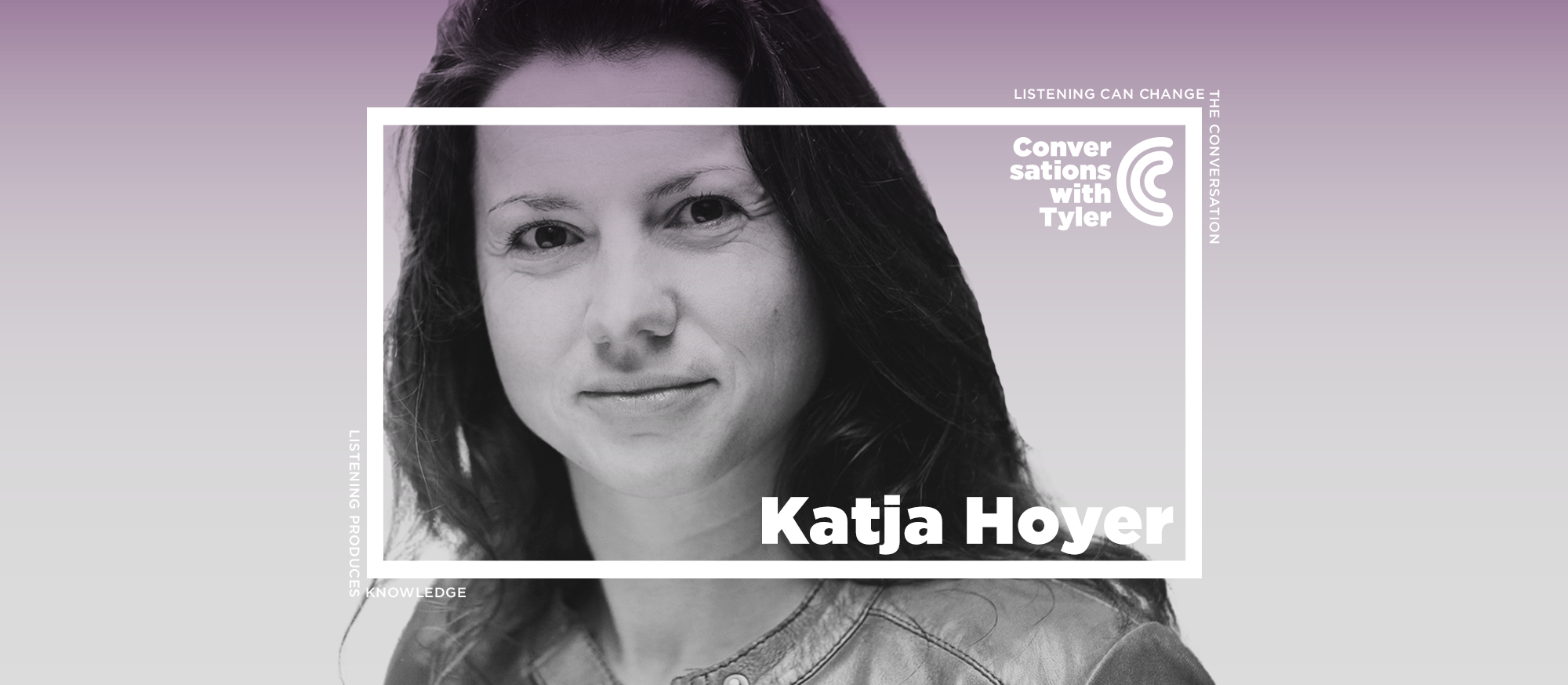



Katja Hoyer is a German-British historian who has made a career out of explaining Germany to the world—and, just as importantly, to Germans themselves. Born in East Germany in 1985 and now based in Britain, she has written acclaimed histories of the German Empire, the GDR, and most recently the Weimar Republic.
Tyler and Katja discuss why communism made East Germans more loyal to the system while it bred dissidents in Poland and Hungary, how happy or unhappy life in the GDR actually was, Tyler’s own bleak day-trip to East Berlin in 1984, the underrated literature of the GDR (Christa Wolf, Brigitte Reimann), whether Good Bye, Lenin! got the era right, why it’s no coincidence that Richter and Polke came from the East, the strange coexistence of communist prudishness and Germany’s nudist culture, what Merkel’s East German background did and didn’t give her as a chancellor, why East Germans remain dramatically underrepresented in leadership positions today, what makes Weimar the cultural and spiritual heart of Germany, why relatively few Jews ever settled there, how much the citizens of Weimar knew about Buchenwald, what actually killed the Weimar Constitution, how she’d rewrite the Treaty of Versailles, Hitler’s citizenship problem, underrated German thinkers, the complacency behind Germany’s current economic decline, which side of the Weißwurstäquator she’d choose to live on, and much more.
Watch the full conversation
Recorded March 30th, 2026.
Thanks to an anonymous listener for sponsoring this transcript.
TYLER COWEN: Hello, everyone, and welcome back to Conversations with Tyler. Today I’m chatting with Katja Hoyer. She just published a new and very interesting book called Weimar: Life on the Edge of Catastrophe. She’s well known for her history of East Germany called Beyond the Wall and a broader book on earlier German history called Blood and Iron: The Rise and Fall of the German Empire. Katja, welcome.
KATJA HOYER: Thank you.
COWEN: Let me start with East Germany more generally. Why was it that communism seems to have made the Poles and Romanians more anti-communist, but it made the East Germans overall more communist?
HOYER: Do you refer to the time afterwards or during the time that the GDR was going?
COWEN: Both, actually. Poland really had rebelled against communist ideals, and it was pretty unpopular at the time. In, say, the 1970s and ’80s, the DDR had a reputation of being relatively loyal within the Soviet Empire. There’s a lot of residual communist or sometimes fascist sympathies there today, so both.
HOYER: Yes. I think during the time there was certainly, I wouldn’t say rumor, but certainly the story was going around that this was a very German thing. Basically, this compliance with the state that if there’s a rule, you stick to it. That was something that was so instilled in the German mindset already because of the previous forms of autocratic regimes that people had gone through, particularly the 12 years of Nazism, and then coming out of that into another form of dictatorship. There wasn’t really a time in between where people were used to a more democratic way of thinking.
There is a line of thinking that says that this was instilled in generations of Germans already at that point, without any break. I think also if you look more widely at German culture, there’s a really strong adherence to rules and order and discipline. That sounds like a bit of a cliché, but I think there’s something to that. Yes, you’re right.
When I talk to people from other former satellite states, people from the Soviet Union or from Poland or from Hungary, they always said that there was the stereotype about East Germans being the most hardcore communist state, because there wasn’t a layer underneath the state where people just went on and did their own thing. There’s a long tradition of that, for example, in Poland, where they have this conspiratia concept, where basically society has another layer underneath the state, and that just doesn’t exist in Germany.
COWEN: Before the Wall came down, how happy or unhappy do you think East Germans were?
HOYER: I think it completely depends who you ask. I interviewed lots of people for my book. I also was just about born in East Germany myself in 1985. Talking to family members, to friends over the years. I think so long as you were happy to live a reasonably quiet, humble life, as it were—you were happy and content to have your job, go on holiday, get married, live your family life—you did have a reasonable quality of life because just the living standards were higher than in all of the other communist states. People didn’t starve. They didn’t lack things as such.
The moment you tried to diverge from the path that was dictated to you, that’s when you really, very quickly discovered that you did live in a dictatorship and there wasn’t a way out of that. The Stasi, the secret police in particular, had means of making your life absolute hell. There was even a concept they called this Zersetzung, which means to almost dissolve your life, where they would really attack even your social structures, your relationships, and everything. Depending on who you ask, basically, you get very different stories about what it was like to live there, even right up to the fall of the Berlin Wall.
COWEN: I was in East Berlin for a day, only a single day in 1984. It seemed to me, as a naive distant observer, that everyone was incredibly stressed and fearful. No one would talk to me. Old ladies would yell at me in the street in German. There was nothing in the stores that I could spend my 35 marks on. I had to change money. Was that a mistaken impression? What’s the other side that I didn’t see, or is that correct, and the other side is also correct?
HOYER: I think they are probably all correct in the sense that, as I was just saying, you will find people in East Germany who will confirm that view and who will say, “Yes, that’s exactly what it was like.” I think partially the issue is that I presume you went to East Berlin rather than—
COWEN: Sure, yes.
HOYER: —venturing further. That’s always part of the story. People say it was so gray, and it was always concrete and nothing going on. I think if you’d gone to, say, a village or a town somewhere where people lived a different life, that would have given you a slightly different impression as such. Of course, there were shortages, and people do talk about having to make do. Say, if your car broke down and you needed a replacement part for something, you needed connections to try and get that. You needed to find a way of getting hold of things.
Nonetheless, you wouldn’t have gone, say, to the Baltic Sea to see people on holiday, or to a factory and see people working in there with their colleagues, or to observe a football match or whatever. These day-to-day things that made people’s lives—filled them basically with life, with friendship, with colleagues, and so on. I think there is a bit more nuance than that to it.
COWEN: What was the best literary creation from East Germany?
HOYER: I wouldn’t necessarily point to one single thing. I was quite struck when I was researching this that artists did take a fair amount of freedom from the state back and basically did write literature. Even those that seemed quite close to the state, [produced work] that was quite critical. If you take Christa Wolf, for example, who wrote a famous book called Divided Heaven, which was also translated and also a huge bestseller in West Germany, that’s highly critical of the Berlin Wall, of the way that lives were quite often ruined or split by this, yet it became a bestseller in the GDR as well.
I would say, overall, the corpus of literature is well worth looking at because people lived in a dictatorship in a different world and tried to find ways of expressing that, even though the censorship was in place. I would say rather than reading one specific work, to try and read maybe four or five different things and get a cross-section of what was going on at the time. Christa Wolf, being one of them, although she’s a difficult read as well, it’s not something to easily get through. Brigitte Reimann is a very good read, I find. Her books, again, they are openly critical of the state, but at the same time, she was also somebody who did well for herself in the GDR. That nuance, again, is coming through quite well there.
COWEN: Uwe Johnson is good. Speculations About Jakob.
HOYER: I haven’t read that, to be honest, so I can’t comment.
COWEN: That’s a great book, yes. The movie Good Bye, Lenin!—it’s very famous in the United States as a portrayal of East Germany. How accurate is it?
HOYER: I think it toys with the idea of nostalgia quite well. This idea that people struggled with the transition from one system to the other. Just briefly, for those who haven’t seen it, the premise is that you have a mother falling into a coma just before the fall of the Berlin Wall, and then she’s not to be disturbed afterwards. The doctors are worried. Her son basically tries to recreate this illusion that the Berlin Wall hadn’t actually fallen. That is done in a tragic, comical way that I think encapsulated the experience quite well. Most people were happy. They were euphoric.
They wanted reunification, but they were also worried about losing their entire way of life, the world around them, and especially that insecurity of not knowing what was coming next. I think that really describes the zeitgeist of the era quite well. I think it’s done a decent job in encapsulating that.
COWEN: Is it an accident that the painters Richter and Polke came from the East, or were there undercurrents of creativity there, where it’s, in retrospect, not at all surprising that they came from East Germany?
HOYER: No, I don’t think it is surprising. You do have a system where, when you speak to artists, again, you get very different views. Some people say it was absolutely oppressive, and they had to get out. That’s often creatives who will tell you that because by definition, they were the most exposed trying to do their own thing to censorship and to state oppression. At the same time, the state also spent a lot of money on arts and literature, culture, and film, and things like that. There were also artists who said, that there was a degree of freedom in being given the means to do these things, to not have to worry about the day-to-day financial concerns that artists are often exposed to.
That in itself set the economic parameters for some people to work relatively freely, particularly in theater. You hear that a lot, that because of the amount of money that was spent by the state that that gave a degree of freedom. I also think just the sheer experience of living in a dictatorship, of being surrounded by the constraints of that, by having to work around censorship, you have to find quite clever ways of expressing yourself in a different way, I think, than people do in freer societies. I don’t think it is surprising as such that you get a different type of creativity coming from those sorts of systems.
COWEN: The nudity cult from East Germany, FKK, why is that so strong? It catches on, but there’s also this extreme prudishness to communism. How did that picture fit together?
HOYER: Yes, that’s a very good question. I’ve been pondering that myself for quite some time. The whole FKK, the free body culture, I don’t know how it’s actually translated into English, but this nudist culture is actually much older than East Germany. It’s something that came out of the 19th century. Again, you could ask the same question there. You have a very prudish, conservative society that develops this kind of culture. I think, in part, it is a counter culture to that. The idea that this comes out of the people themselves and is an expression of people’s freedom, this feeling of just jumping into the ocean naked, being surrounded by nature, being together with others.
That stripping of clothes means stripping of class boundaries, of politics, of culture, in a way, and everyone looks and is the same. I think that’s partially the appeal of that particularly there. On top of that, it’s just the pragmatic reason, but the Baltic Sea was in the East largely, most of it. The nicer stretch of Germany’s coastline, just in terms of developing any beach culture, really, was in the former GDR. Therefore, you naturally have the landscape that lends itself to that. There’s a bit of that in the West as well. When you go to certain areas, say, for instance, the English Garden in Munich is quite famous even today. Sometimes you see people sunbathing in the nude or topless there because there are pockets of that, but it’s never that mass movement that it is in the East. I think that comes out of those two factors that I just explained.
COWEN: If you were to make the case that the rule of Angela Merkel was in some significant way influenced by her East German background, do you think that’s true? Is there a case to be made there? If so, what is it?
HOYER: She tried very hard for that not to be the case. She was asked after her 16 years in power, why weren’t you a more East German type of chancellor? Why weren’t you overtly East German? She initially always said, “Well, I want to be the chancellor of all Germans. If I’d been overtly from the GDR, I would have lost people in Bavaria and other parts of Germany who would have felt culturally alienated by that.” She also admitted later on, after she retired, that there was an element there of people rolling their eyes and saying, “Why do you have to talk about the East,” or, “Why do you have to start talking about the East all the time?”
She tried to avoid that and was very conscious, I think, of not coming across like that. There was one speech, which I mentioned in the book as well, where, in 2021, it was her last big speech in office. She actually talked about her experiences in East Germany there and said people always described this as a dark past that she had to shrug off or get rid of, in a way, her time in the GDR. She bristled against that and said, “Look, this was 35 years of my life. I had experience there. It’s literally half of my life that you’re expecting me to forget or to somehow overcome.” I think it was there.
She always also claimed that this made it easier for her to deal with the Russians because she spoke Russian and had experienced the same system in her youth and knew what it was like. There was always an argument there that she said, balancing out her very transatlantic outlook. She was a huge fan of German-American relations as well. Balancing that out with an eastern outlook, she said, was easier for her because of her background.
Lastly, if I may, I think the fact that she was the first female chancellor and to this date, the only one, that was easier for her because she’d already got used to working in a way. In East Germany, over 90 percent of women were in full-time employment, and they’d become a part of the workforce in a less obviously feminist way and a more obvious, normal, natural way. Dealing with men in your work area, I think, was a more normal thing in the East than it was in the West at this point. For her to go into the still quite stuffy male environment in Bonn, in the West German capital, and deal with her new colleagues in politics, I think, was easier for her than it would have been for a woman for whom that hadn’t been already a normal way of working.
COWEN: Do you think she was too self-consciously aware of the need to be accepted by a largely West German establishment?
HOYER: She was certainly aware of that. She talks about that in her biography as well and in later interviews. It’s certainly something that was going around her mind. As I say, not in an obvious way in the way that, say, as a feminist, you’d go in, and you’d deliberately try and rail against what you would see as a male environment. I don’t think it was that she went in there as an East German and said, “I’m facing a West German establishment here. I need to be particularly aware of this.” I think it was almost like she was trying to blend into that a bit more, to scale down her East Germaness and to try and basically adapt to the culture that she found, rather than providing an obvious counterpoint to that.
COWEN: There’s a common claim. I don’t know how true it is, but that many East Germans still today are somewhat resentful or upset because they feel pushed out of leadership positions in business, in culture, in media, often in politics. Do you think that’s true?
HOYER: It’s not just subjective. The figures point to that. I haven’t got the exact figure in my mind now, but there was a book that came out at the same time as mine by Dirk Oschmann called Der Osten: eine westdeutsche Erfindung—The East is an Invention of the West, in which he brings out some really quite stark figures. One of them is something like 1.4 percent or so of leadership positions across the board—politics, economics, everything—are occupied by East Germans. Given that East Germans make up about a fifth of the population, that’s astonishingly low.
This isn’t just a subjective feeling that East Germans have. They are genuinely not part of the conversation in proportion to the amount of people that they provide in society.
COWEN: Why is that? The schooling was very good in East Germany, right?
HOYER: Yes. Take something like networking. I didn’t realize that much later. As I say, I was a child when the Berlin Wall fell. Then I went to university in the former East. All of my professors were West German because, by that point, they’d purged the entire academic class, if you will. I only went to university in the early 2000s. You go there, and they bring their own staff with them. They have a certain way of talking to students. They expect you to know these things when you start networking yourself. I didn’t even have a concept of networking in my mind because that type of careerism, of pushing, of ambition just didn’t exist in the culture that I grew up in.
You were just told what to do, really, and then climbing a certain ladder that was provided for you, but you had no idea how to do these things yourself. That means that things like scholarships, you have no idea how they work. You don’t really sound and look like the people that you’re trying to impress. Effectively, other people get given the positions that you didn’t even know vie or compete for. I think that’s a more subtle way of thinking about it.
The other thing I would say is because of over 40 years of socialism, you have a very working-class-oriented culture. People don’t have wealth built up. All of these figures exist as well. Basically, East Germans are a lot less economically secure. As a result of that, you take fewer risks as well. If you’re sitting there wondering, should I do a PhD or not, for example, and you think that’s three years of not really having an income, I don’t really know how to do that, and you haven’t got a family that can back you up, you haven’t got a house to live in, no matter what, because it doesn’t belong to you—those kinds of things also mean that people tend to take the safe option and go with the easy way forward with earning an income if there’s any doubt over that.
All of these things, I think class differences and so on—I don’t think people were aware of what that would do to society. I don’t think there’s a deliberate conspiracy to keep East Germans out as such. I think it’s just a question of those hidden structures underneath society still being there.
COWEN: Put aside accent, if you meet someone today, do you have a good sense of whether they’re East German or West German?
HOYER: Some people, yes. I certainly realize when I go back now—I’ve lived in Britain for quite a long time now, and so I’ve got a bit of distance—when I go back to East Germany, I immediately feel I know how to talk to people. You know the types of people that you encounter, even if it’s somebody that you’ve never met before, because you recognize from your own experience growing up in the East what these people are basically like, what types exist, and how to talk to them. Say, for example, talking in an accent or in a local dialect is still much more common, I would say, in the East because it wasn’t seen as a marker of your social standing. Quite the contrary, politicians would even speak with regional dialects and accents.
Whilst in the West, it’s a marker of your middle- or upper-class status. If you can switch to high German when required in formal situations, that marks you out as somebody who’s well educated, well read, and so on. It’s seen as something that you have to learn, whilst in the East, we never did. I found that out again the hard way when you go to university. I had a really broad Berlin accent when I grew up. Going to university somewhere else, quite far away—I studied in Jena, which is about two, three hours away from Berlin—suddenly, you’ve got these Bavarian professors who think it’s hilarious that you speak in a Berlin accent. That wouldn’t have happened to a West Berliner who might have been able to switch to high German more easily. These differences still exist.
Growing up, my parents both worked. That was quite unusual in West Germany, still, that the mothers worked when they had young children. You grow up in a different way. You come home from school when you’re six, seven, cook your own food, do your own homework, go shopping, take over responsibility, that kind of thing, earlier. Culturally, there’s a difference still between East and West for those sorts of reasons as well. I could give you 100 other examples, but there are still differences between East and West Germans in those subtle ways.
COWEN: Why have so few mothers in West Germany worked over previous decades? If you compare it to the rest of Western Europe, it’s still often a marked difference.
HOYER: Yes. I think people often forget that, but it was a really, really, really conservative society. That’s partially, I think, because Germany is a Protestant and Catholic country because of the way that the Reformation worked out. You got the northern part being Protestant largely, and the South Catholic. Then, suddenly, when you split Germany in the way that happened after the Second World War, you ended up with a 50-50 ratio of Catholics to Protestants in West Germany.
That’s much higher than any other Germany that’s ever existed in terms of the Catholic proportion. They were socially more conservative and placed emphasis on things like family values, raising children at home in quite a conservative way. My mom said in the ’90s when she went on a further education course in the West, and then she said in the evening, “I just got to call home quickly and make sure that my children are okay.” They said, “Well, how old are they?” She said, “Well, one of them is a baby. The other one’s five or six.” That was me, the five, six-year-old. There were these old West German professors, and they all looked at her aghast, like, why are you here, hundreds of miles away from home, when you’ve got two small children at home? What are you like?”
This difference there, I think, partially comes out of this West German society being socially very conservative for a long time and led by conservative leaders for most of their time as well, until you get Willy Brandt and Helmut Schmidt in the ’70s as more left-leaning, more progressive leaders who break up these structures a little bit.
COWEN: Turning to Weimar, how much do West Germans today still care about Goethe and Weimar? Right after the Wall comes down, it’s a big thing to go visit the East, go around, see everything that was much harder to see before. Is that still alive? Is Goethe something in people’s minds that’s discussed or shared?
HOYER: Oh, yes, hugely. Goethe, I would say, is still the national poet. I would say he’s comparable to the position that Shakespeare has in Britain. He’s that figure. He’s the national poet, I would say, still. At school, you have to recite his poetry, you analyze the ballads and his work, and Faust and all the rest of it. He is big on the literary horizon, I would say, of all Germans everywhere, because you do encounter him at school. I find it very hard to imagine that anyone in Germany goes to their school education without being exposed to Goethe in some way.
Then, if you’re in Weimar—I spent a lot of time there now researching for my latest book—you see the type of tourism is very different from other parts of Germany in that you do get a lot of people from West Germany there. You can hear different accents. You can hear people from Bavaria, Swabia, and from the Rhine region. There is that tourism. I think similar to Dresden as well, which has got a similar standing as an all-German culture place. The same, I would say, applies to Weimar as well, where people still come to hail these literary heroes. It’s not just Goethe. You’ve got Beethoven, Liszt, and Nietzsche.
COWEN: You have Cranach, you have Bach, you have Nietzsche, you have Bauhaus, Marlene Dietrich. Wieland was there. It’s a very small place
HOYER: Yes. It’s a very, very cultural place.
COWEN: It’s not even 100,000 people. It looks fine, but it’s not especially beautiful. Why is it attracting all these people, these incredible thinkers and creators?
HOYER: It is a lovely place. Imagine your typical idyllic German city, and it’s pretty much there. It has got the timber-framed houses, the villas, and the cobbled streets and things. You’re right, that doesn’t explain why it’s had this elevated position in German culture. Partially, it is because the University of Jena, where I studied as well, is one of the oldest German universities. That’s not far from there. That’s almost next door in Jena itself, which is about a 15-minute or so train ride away. That attracted people like Schiller, for example, who was friends with Goethe and also a very famous German poet. He was a professor at the University of Jena and then went and visited Goethe, who lived in Weimar. It’s had that attraction of being nearby.
Then it was also a royal residence of the dukes, basically, in different incarnations of it, because of Germany’s fragmented history. Basically, it has a schloss—little palace—in Weimar and various gardens and pleasure gardens and that kind of thing as well, because it was always a royal residence town. That gives the place the political importance as well over time, which means representative buildings are being built and so on. It becomes quite a prestigious place for that reason as well.
When Goethe moved there, and then suddenly Goethe shot to fame as he did, he was the theater director there for a long time and then died in Weimar, it became a bit of a Goethe shrine. It elevated that even further, that status.
COWEN: How much of a spa town was it?
HOYER: I wouldn’t say it’s a classic spa town, but it is a town for wealthy cultural retirees. If you’re like an old general and you want to spend your last years somewhere prestigious, somewhere where there’s still a bit of culture going on, that’s more of a thing, I would say. Conferences have always taken place, like meetings. If you wanted a more prestigious place, if you wanted to say we’re discussing something important here, then Weimar was always a place where people would meet. It’s also central. It’s right in the heart of Germany.
Again, whichever incarnation of Germany you look at, it always ends up being pretty much right in the middle. It’s about halfway between Munich and Hamburg. For that reason alone, it ended up being quite a popular place for people to go to visit, to meet up. Accumulatively, I would say that gave Weimar quite a large standing on the firmament of German culture.
COWEN: Why were relatively few Jews attracted to Weimar over the years? Again, pre-Nazi time, of course.
HOYER: Yes. When I lived in Jena, and then you travel abroad, and people say, “Where in Germany do you live?” There’s no other reference point. There are no urban centers, basically. You have to say what I just said, “Oh, about halfway between Munich and Hamburg.” Same with Frankfurt. There are no urban centers because the vast majority of German Jews lived in urban regions, particularly, of course, Berlin, but also Frankfurt, Hamburg, Munich, and so on. There just isn’t a large urban conglomeration anywhere nearby. It just doesn’t have the traditional areas that German Jews were involved with, things like culture, banking, finances, that kind of thing, the higher middle class. The professions.
There just wasn’t much along those lines in Weimar. The time that I’m looking at in my book, between the two world wars, you have about 100 Jews in a town of about 35,000 people. It’s a tiny population. They’re largely people like shopkeepers. One runs a department store, one family in Weimar, that kind of thing. It is a small town. That’s, I think, partially why that’s the case.
COWEN: If you’re trying to talk an American into visiting Weimar, say they don’t know German, they don’t have German heritage, is there a case you would make, or are they just not going to grasp what’s going on there?
HOYER: I would definitely make a case. As I say, I just spent a whole year basically researching this because it is so crucial to understanding Germany, I think. You get a good handle on what Germany is if you go to Weimar that’s across different centuries. You do have this cultural legacy we just discussed. That really isn’t just at the time when Goethe’s there, but because Goethe’s legacy lasts for so long, he gets reinterpreted by every incarnation of Germany that comes after. Even today, still, he’s more seen as a humanist or someone who’s into the European idea. Every generation of Germans takes something new out of Goethe. To understand that, again, it makes sense to go there.
Then, of course, it was where the Weimar Republic was founded. In terms of the 20th century and understanding that, there’s a very good case—this is why I chose to place my book there as well—there’s a very good case of going to Weimar to see both the ambitions of the nation and where they unfolded after the First World War, as well as the fall of those ideals, because you have the Buchenwald concentration camp just on its doorstep as well. To see that side by side, I think, is really quite enlightening in lots of ways to see the high ambition of the era, as well as the fall of those ideals.
COWEN: During the Holocaust, how much were citizens of Weimar aware of what was going on at Buchenwald? They would have seen the smoke come up, right? There were all kinds of provisions and supply contracts for something.
HOYER: Yes, that’s absolutely right. This is one of the questions that really occupied my mind whilst I was researching this as well, because it’s so close. People still walked up there. My main guy, who I use as a bit of a protagonist in the book, he’s a shopkeeper. He has a stationery shop right in the town center. He still goes up the hill where the concentration camp is to go hiking and sledging, because it was a popular forest area before the concentration camp was put there. People carry on, and he even writes in his diary at one point, “Oh, I can’t even go hiking properly anymore because of the stupid concentration camp,” because some of the walking routes were cut off because there were fences and things now. People definitely know it’s there.
The prisoners never get their own train station. The prisoners who get taken there arrive at Weimar train station, very public place with a huge square in front of it. They are gathered there and then put onto lorries to be taken up the hill to the camp, so people can see them rounded up. I found various testimonies where people said there was always this excitement when a new “Jew transport,” as people called it, arrived, and they would all rush to the station to see that and just to observe it and to gawp effectively. People did know what it was and what it did. I don’t think that meant they understood the actual horrors that were going on there.
They did realize obviously that people were dying there, and it initially didn’t have its own crematorium, so the bodies were transported down the hill again and into the Weimar crematorium, which is in the town center. People did know that there was a large amount of deaths going on there as well, but I don’t think that meant really visualizing the absolute sheer horror, the torture, the imprisonment, that kind of stuff, because Weimarers do get taken there when the Americans occupy Weimar at the end of the war, and they decide to show the population what they’d tolerated, what they’d stood by and watched happen. There’s genuine shock there when they go up, and they see the actual reality of what was going on there because I don’t think the human mind was even capable of visualizing that if you hadn’t actually seen it.
COWEN: The people who worked there didn’t talk, or they told a false story, or they were self-deceiving. What do you think?
HOYER: Well, a lot of them actually lived on site, so they had barracks built for the SS. Yes, they did come into town to drink and to shop and so on, but they didn’t actually live in Weimar, a lot of them, and I think that helped keep that a secret. The other thing is that quite often the Nazis were quite open about this. They wanted the terror of this to really seep into German society. They had tours, for example. There’s one instance that I found where a German-American group who’d come over to see Nazi and tour Nazi Germany. They were taken up to Buchenwald and shown around. They would tidy up the camp. They’d only show them certain bits of it. I think it was always a gray area between allowing some of this horror to dissipate so that it would work as terror, and it would work in subduing the population, but never enough to really create some public outrage, or a demonstration, or anything like that. It’s a bit of a gray area there in terms of the actual details that people know, but they certainly do know what this camp is and what it’s for, not least because it’s so closely tied to the town as well.
For example, later on when the crematorium actually breaks because they put too many bodies in there—the bodies are emaciated, it doesn’t work properly—the Weimar town council sits down and decides to buy a new crematorium, and they’re discussing why the old one is broken with the engineers. They tell them it’s because the bodies are unusually emaciated. It’s because it’s not supposed to function at the high rate that you’re using it. They’re very well aware of what they’re discussing there. These are Weimar civilian politicians who are basically sitting in the town council deciding to buy a new crematorium oven because the old one can’t cope with the amount of bodies that they’re putting through it.
COWEN: Why did the Weimar Constitution fail?
HOYER: How much time have I got?
COWEN: Americans typically think it’s that the proportional representation system allowed too many small parties to enter into government. That’s one factor, but what else is there?
HOYER: There are plenty of factors, I think. Some of these are inbuilt flaws, like the proportional representation that you just mentioned. Another one that’s often referred to as Article 48, which was a kind of emergency article that was in the constitution that allowed the president to bypass parliament and the other democratic structures in time of emergency.
If you just follow down this route, then the fall of the Weimar Republic becomes inevitable. If you’re just assuming that there were all these flaws in the constitution already, so therefore it was bound to fail, I don’t think that is the case because when you study this closely, you do see all these kinds of forks in the road as to where things could have gone differently. I don’t think the system was set up to fail. I think these things contributed to the brittle nature of this. I think there was perhaps a degree of naivety there in 1919 to think that you could have this ultra-democratic system without any guardrails.
When you think how long it took the American Founding Fathers to sit there and really work out every angle, and “What if we got a mad president, what do we put in there to try and protect against that?” Those sorts of things. That process is so rushed in 1919 that they just put an ultra-liberal democracy in place, which allows extremists to hijack it. That is part of the reason. I think the other group of reasons is the circumstances under which the system is born. It’s basically born into crisis. It comes on the back of the First World War and then runs into economic trouble very quickly. That never really goes away despite the so-called gilded years in the middle. All of that’s propped up by American money, even the stability years of the middle 1920s. The moment that falls because of the Wall Street crash, you basically get the very economic foundation taken away again.
The subtitle I chose for the book, Life on the Edge of Catastrophe, I’m trying to hint at the fact that that’s how a lot of people felt. They were literally balancing constantly for this entire time, really, after 1919, on the edge of their own personal catastrophes. It was always unemployment, hyperinflation, trying to get enough food. People were dying of diseases. There’s the Spanish flu. There’s tuberculosis. It’s always something or other. People don’t feel that the system is giving them stability. I don’t think there ever really is a feeling that this can really work long term.
People do, at the slightest whim, think, “Oh, maybe we just need to go back to a system where someone makes the decisions.” The Weimar Republic actually dies in 1930, three years before Hitler comes into power, as a democracy. He takes over a system, I think, that’s already given up on being a democracy, even at that point. As I say, I could talk about this for two days and still be lining up factors. It is complex.
COWEN: The army is interfering in politics quite early and pretty frequently.
HOYER: Yes. They still think that because of the nature of the Prussian system previously, it’s often been said that “Prussia wasn’t a state with an army, but it was an army with a state.” That intrinsic self-confidence, if you want to call it that, of the army, that they are really calling the shots, that doesn’t really go away.
People also often forget that in the First World War, you have the so-called silent dictatorship, which is basically the army running absolutely everything under Hindenburg’s system, from the economy and culture to newspaper output and everything else. Again, that they don’t just suddenly turn that off in 1919. They do try and make their influence heard ongoingly.
Then the young Weimar Republic has to make a pact with the military because they defend them effectively against communists and also right-wing Putschers. They depend on the military in that way as well for security. They do try and build up a new military, but they never go Stalin-style and purge everybody who was there previously. They keep the existing elites largely in place, so they inherit an army that isn’t loyal to them, that’s still loyal to the old system.
COWEN: As you mentioned, there’s this cliché that Prussia has been especially militaristic. There’s also the observation that Hitler often had his strongest support in South Germany. How does all that fit together? Both the North and the South are especially militaristic?
HOYER: Yes. Coming from that part of Germany myself, that was the Prussian heartlands—I grew up just outside of Berlin—that often annoys me that people still think, well, if only Prussia hadn’t been there, then you would have had some lovely Catholic-dominated, more civilian-type Germany. I think that fails to acknowledge the fact that Prussia also was quite liberal. It’s a real hub of social democracy, actually, in the Weimar Republic, which is the reason why the first time it gets abolished, it’s by the Nazis. They get rid of Prussia, if you will, because the idea was that it was so left-leaning and so dominated by social democracy that they have to get rid of it.
It gets even more complicated than northern Prussian militarism, and then the South comes in with its cultural contributions to Nazism. I think the other thing is that you do have such a splintered system that it allows the Nazis to build little islands of support, and the central state can’t do very much about that. If the Bavarian state decides that, actually, they want to allow, say, the Nazi party to reform after Hitler comes out of prison, and they want to allow him to speak again, or even in 1923, it’s partially the Bavarian elites who are plotting against the central state in Berlin as well, then the authority is just not there from Berlin to try and impose anything else on Bavaria.
There’s separatism everywhere. Even when Hitler tries a coup in 1923, and then everywhere the Nazi party gets banned, individual states and regions slowly start lifting those bans again, and the central government can’t do much about that. That’s partially the reason why in Weimar, the Nazis also relaunched their movement, because the Thuringian government—the state around Weimar is Thuringia—they also allow the Nazis basically to rebuild from there, because there’s local sympathy for that. I think it’s that fractured nature of the German state that is the answer, I suppose, to your question, that all the parts contribute to the Nazis being able to build their movement.
COWEN: What about the towns on the sea? Königsberg, Rostock, Wismar, smaller places, but were they more cosmopolitan or not really?
HOYER: No, certainly not the East Prussian ones. Königsberg and that entire region along the Baltic coast, that was where some of the staunchest support for Nazism was. They had grievances because of the settlement after the First World War, where Poland is founded as an independent state after the First World War. It’s given access to the sea. You end up with a part of Germany, East Prussia, being split off from the rest of Germany.
That creates a lot of grievance and very staunch support for Hitler there, when Hitler basically promises to undo all of that and reunite all of these parts of Germany into one block state again. They’re not, as such, averse to Nazism at all. They basically think that Hitler’s restoring the old Germany as was before the First World War.
COWEN: If you had written the Treaty of Versailles, what would you have done differently?
HOYER: As always, in hindsight, I think it’s always a bit much to sit there as a kind of armchair politician and say, “This is what I would have done differently.” I think it’s the worst of both worlds. It’s harsh enough to give Germany grievance, to make it feel like it’s punished alone for the First World War, particularly Article 231 that gives it the war blame, basically, and says, “It’s your fault and your fault alone.” This is something that unites, bizarrely, all of these fractured political movements in Germany. Even Social Democrats find that unfair. That, I think, builds grievance.
On the other side, it wasn’t harsh enough to subdue Germany. It wasn’t split up. It was still a whole state. It was still powerful enough to do something with that grievance. I think, in a way, it would have made more sense to go either way or the other, either make it even harsher and basically create a weak Germany in Central Europe, or go the other way and rebuild from the beginning, as was the strategy after the Second World War.
This is interesting. The lesson that they draw from that is after the Second World War, there is no reparation. Some, as such, are slapped onto Germany. They basically say, let’s just take out what’s actually there and then start rebuilding Germany because of the Cold War. This means that there’s now this quite close relationship between Western parts of Germany and the US and Britain and France, in particular because they very quickly began to see them as allies. I would say a decision just had to be made either way. This compromise treaty, I think, is part of the problem.
COWEN: Why, in your view, does antisemitism so take off in Germany? Because earlier in history, sometimes Jews would go to Germany for a better life, or it was not obviously worse than many other places, though there was always plenty of antisemitism there. How and why did it explode?
HOYER: That’s a very good question because you do see it across Europe. Even in the 1920s, you still get an influx of Jews to Germany from the East because they find much harsher conditions there in many states. For example, I saw that there were lots of people at Munich University who were complaining that suddenly lots of Hungarian Jews would turn up and enroll at the university because they introduced a quota for Jewish Hungarians at their universities. Even then, there’s still a degree of tolerance there.
I think partially it’s because antisemitism tends to always be a symptom of a society in crisis; the worse it gets, the worse antisemitism gets. That’s partially, I think, an explanation for that is that particularly because it’s economic grievances, people then look for scapegoats for the Great Depression, but also hyperinflation. They see that the Jewish Germans who are largely in middle-class and upper-class social environments, that they’re still doing reasonably well for themselves. This narrative of they’re exploiting the poverty of the others is particularly easy to exploit in a situation like that.
A journalist put it quite well recently on a different reason, but he said, “To be German means to walk down every cul-de-sac to the end.” The idea that there’s antisemitism already latent in society, then it becomes Hitler’s own obsession. People are working toward the Führer, as Ian Kershaw, the historian, puts it. They’re finding more and more extreme ways of dealing with things that are already latent in society, and the system that Hitler sets up allows this to happen.
Rather than saying, you sit there with your antisemitic grievances and prejudices in your head, or you talk about it in the pub, somebody will say, “Why don’t we do something about it?” because that’s what Hitler wants. Then they need to be heard amongst the field of competitors, and they find the most radical and the most extreme solution and take that forward. This is something that spirals very quickly out of control.
Most historians now agree that there wasn’t a master plan that led to Auschwitz, basically, in the 1920s within the Nazi movement, despite the rhetoric that you see there. It’s bit by bit, the escalation that you see is due to the radicalism of the Nazi movement and the way that people follow orders and go along with it.
COWEN: To what extent did people think it was weird that you had a highly nationalistic movement, but it’s led by an Austrian with a very bizarre accent?
HOYER: Yes, that is certainly an aspect of this. I describe that a bit in my book as well because Hitler didn’t even have German citizenship. When he wanted to become president in 1932, he stood for the election then against Hindenburg. He actually needed to become a German citizen very quickly so that he could even exercise his passive electoral rights. That was a problem. All the Nazi leaders were falling over themselves to try and find a way of giving him citizenship, but certainly not something that’s automatically there.
He himself always argued that he always felt German. He was from the far Western part of Austria by the German border, where he was born and where he grew up, in Braunau am Inn, which is literally just the other side of the border. He argued that actually his accent is Bavarian. It does have that because it is so close to the German borders. It’s that sort of being Catholic, being Alpine, being from that region. It’s not an obvious distinction, I would say, in the way that people think of it now.
Then people also forget that in Austria there was a huge movement in the 1920s because Austria, basically after the First World War, was split from its own empire. It became the small German-Austrian rump state, and it suddenly feared for its own existence and survival because it was so small, having previously been an empire. There’s a huge movement, even from left-leaning and progressive Austrians, toward a unification process with Germany in the 1920s, which is forbidden in the Treaty of Versailles. They’re not allowed to do that, but the movement exists.
It’s not an unnatural position for Hitler to say, or he’s certainly not alone in that, for Hitler to say, “Actually, I’m German. We’re all Germans because we’re Austrians, and we should be part of this.” Look at the 19th century, when there were debates about a greater Germany that included Austria at that point. He’s harking back to that, and he’s saying, “Actually, we shouldn’t be in two separate countries.” This works for many Germans.
You actually see a much higher than average proportion of Austrians serving in concentration camps as well as guards, which is an interesting development. There’s almost a more fervent, more extremist type of Nazism going on in Austria. They almost feel like they have a point to prove that they want to be part of the same system.
You see the same with Kristallnacht, with the pogroms against Jews in 1938. They take a much more violent turn in Austria where, in Germany, it’s mostly shops and synagogues and so on that are being attacked, although people also die and get murdered and arrested. In Austria, it’s very much targeted at the people themselves, at Jews, because of this emotionality of wanting to prove that you’re part of this. It’s not as odd as it looks today when we’re looking at two very distinct states there, basically. That isn’t really the case in the 1920s where there’s still arguments about some form of unification of Germany and Austria, which Hitler, of course, ends up doing.
COWEN: To the extent you have fondness or nostalgia for cultural creations of the Weimar era, what is it for?
HOYER: I wouldn’t say I’m personally nostalgic in that sense. As a historian, it’s my job to analyze what happened in the past rather than to crave something from there, if that makes sense in an emotional sense.
COWEN: There’s Rilke, Thomas Mann. There’s incredible cinema.
HOYER: No, no, absolutely.
COWEN: Amazing music.
HOYER: I do appreciate that, and especially the creativity of the 1920s. There’s something about the utter devastation of the First World War that creates this absolute creativity and creative freedom that you see and the willingness to experiment in the 1920s. When you look at films like Metropolis or M, they’re so innovative. The whole idea of the vampire movie, the arch vampire movie in the 1920s with Nosferatu, that’s a German creation because they’re looking at these really dark, twisted horror themes as well.
I think that’s certainly something about the 1920s that’s incredibly precious, this willingness to just break the boundaries, try again, start from scratch, because the world that people had come from and that they knew had gone. They knew that the First World War was an absolute turning point. It wiped the slate clean, and you could start again. Because of hyperinflation and all those things, people also felt they had nothing to lose.
There wasn’t this fear now when you think, “Oh, can I really say this? Can I really do this? Will I get canceled? What will it do to my career?” People were almost hedonistic in a way. They would just go out and try things because of this absolute dizzying state where there are no certainties, where there’s nothing to cling on to. That’s unique, I would say, to that time period. It created this absolutely dazzling cultural scene that you see in the 1920s, particularly in Berlin, of course.
COWEN: Who is the great underrated German thinker or writer?
HOYER: In the 1920s?
COWEN: Anytime.
HOYER: Oh, an underrated one. Now I have to really think because rather than coming up with the obvious answers.
COWEN: For me, it’s von Humboldt, but I’m an American classical liberal, right?
HOYER: Yes, and I wouldn’t really put him as underrated. He’s one of the stars, I would say, of the German self-image and self-appreciation in lots of ways, both of them, the Humboldt brothers.
COWEN: He’s identified with building up state education, right? In that sense, he’s underrated because he did other important things.
HOYER: No, that’s very true. The impact, certainly the long-term impact, perhaps isn’t quite as well understood. Of course, he does feature larger in Germany, and you do have things named after him and people referring to him in that essential way as part of the central strand of German culture that comes through.
Because my brain’s permanently stuck in the 19th and 20th century, I’m going to pick someone from there. I think Gustav Stresemann, who was the foreign minister in the Weimar Republic. As such, he was more than just a politician. He really had a big idea as to where he would take Germany, how he would tackle the problems. I think he got a long way with that. In the 1920s, he was really rehabilitating Germany and the world. He was presenting an image of a country that was recovering, restoring its morality.
People believed him. He did rebuild Germany’s position in international treaties and so on. He had an idea as to how to take the economy forward. Then he died just before the Wall Street crash happened. Forever, in my head, there’s been this what-if moment. How would he have dealt with that? Because he had solved seemingly unsolvable problems before in terms of dealing with hyperinflation and those kinds of things.
To me, it’s this idea of he almost saved Germany, and therefore Europe and the world, from this catastrophe that was befalling it later on. That tantalizing moment of, had he not died there and then, could he have done something about it, perhaps makes him underrated because he never got the opportunity to. We might be living in a completely different world today if he had survived.
COWEN: Let’s say you’re mayor of Weimar today. You have more or less absolute power. How would you improve the city? What would you do? What should they be doing better?
HOYER: Maybe that’s because I’m a historian rather than a mayor. I think there is a lot of focus in Weimar, or obsession almost, still with the things it’s always been obsessed with—it’s culture, it’s Schloss, it’s Goethe. You go there, and it’s basically impossible to escape these things. There’s very little emphasis on its role, actually, in the 20th century, because there’s almost an uncomfortable notion there that if we go there, we have to deal with this legacy as well.
I would be a bit braver with that and try and show visitors, of whom there are still many that come to Weimar, a town that is comfortable with its own history and goes back not just to these cultural stars that it’s harbored and fostered, but actually a more nuanced picture across the board. Trying to show the people who come there basically Weimar across the ages, rather than just focusing on its glory days, on the golden years of what people call the classical Weimar, basically because it’s a very artificial place in many ways.
You go there, it’s super neat, super clean. It looks after itself. It’s very confident about these visitors coming in and out because it’s been so used to that, but it shows the world a very narrow image of itself, namely that of the so-called classical era when Goethe and Schiller lived and worked there.
COWEN: AfD is relatively weak there. Is that correct compared to the rest of East Germany?
HOYER: Comparatively, but it’s still there. People also vote for the far-lefty Linke in higher numbers as well. It’s still a place, if you look at it across the board, where the numbers are still relatively high, but not as high as the rest of the state of Thuringia around them. I think that’s because it’s always been socially different from its environment. Thuringia itself is quite working class, lower middle class. It’s got lots of small businesses. Things like garden gnomes, for example, famously come from there. You have these small craft industries.
That means that people tend to go with whatever the working classes are doing. They’re currently voting for AfD, so does Thuringia. Weimar itself is very middle-class. Not just middle class, but a particular branch of the middle class. It’s the educated, the professorial types, the intellectuals who move there. You end up with quite a small-C conservative culture there that sets it out a little bit from the rest of the region there. The numbers are a little bit lower.
COWEN: Putting aside both tourists and student populations, who are the immigrants who move into Weimar?
HOYER: There are actually fewer, a lot fewer than you would expect, given Germany’s overall population. When you walk through Weimar, you see a few foreign students, particularly at the Bauhaus University, which is modeling itself on that tradition and therefore attracts some. Largely, it’s the people who run the kebab shops, who run the takeaways, who drive the taxi into town, that part of the population. It’s not huge. It’s just a few people, basically much, much smaller than in lots of other places.
COWEN: What’s the biggest issue in purely local politics there? Immigration, not AfD, not the European Union, but locally?
HOYER: Most people, when I go there and speak to people, most people are very concerned with the state of the economy and with the interference they feel is coming from the state without it being helpful. They feel that there’s too much regulation. It’s still a place that’s dominated by lots of small independent places, like little shops and that kind of thing. People feel that their own personal progress is being hampered by the way that the state, Berlin in particular, which seems very far away from Weimar, is setting the parameters for their economic activity. That was certainly the biggest issue that I heard a lot, is that people were grumbling about that, about the regulation, the taxes, and so on.
COWEN: Now, there’s a common sense that the German Mittelstand, you would call it, is disappearing, that there’s more competition from China, and general employment in manufacturing is going down. A lot of German sectors, such as automobiles, don’t seem well poised to do well over the next 10 years. How pessimistic are you about that?
HOYER: It would be odd not to be pessimistic because all the experts are telling us to be pessimistic, as do the people in the field. You do see entire industries breaking away at the moment. There’s a huge issue, particularly with energy, that isn’t being addressed and isn’t being resolved.
If you run a part of the economy that relies on stable and affordable energy, then there isn’t an obvious solution. This isn’t a temporary crisis that you just have to sit out and hope that it’ll go away. Actually, the structural things that are wrong with the German economy don’t seem to be going anywhere. I’m quite pessimistic at this point, but I’m hopeful that the election results that are coming in thick and fast now, and you begin to really see that in politicians, that it’s beginning to sink in just how pessimistic other people are and how fed up they are, that this is now hopefully leading to some reforms. There’s certainly talk of that at the moment in Germany.
COWEN: Say, at a deeper level, what do you think went wrong? German trains, they used to almost always be on time. Now they’re quite typically fairly late. Things Germany for a long time was very good at seem to be fraying. What’s the deepest structural model of what’s going on there?
HOYER: I think the biggest problem is complacency. I think people were so used to the idea of the system always going that way. When you look at the whatever are the 20 largest German companies today, they’re all 19th century. A lot of them are 19th-century companies like Siemens, Bosch, the big companies that you’d expect—chemical industry, electronic engineering, that kind of thing.
Because these things survived two world wars and the complete moral and economic destruction that the Second World War brought, and came back, bouncing back afterwards with the economic miracle in West Germany, I think people thought that they would always just carry on running, no matter what you do with them. You don’t have to look after the system. You don’t have to reform it. You don’t have to modernize it.
As a result of that, I think people didn’t really think, “How do we get this or how do we adapt this thing to the 21st century?” When you look at things like startups, say, in Germany, the rate is much, much lower there than it is in comparable countries because the innovation is lacking. People just thought, let’s run with the existing thing itself as well, without having the nimble-footedness that made the system great in the first place. That innovation of the 19th century, that zeal, I think has gone to a large extent.
COWEN: You’ve now lived in Britain for quite a while. How do you feel that shapes your interpretation of East German history and Germany in general?
HOYER: I always find it helps because you sit outside. I sometimes joke that I live in exile so you can observe your own country, perhaps in a slightly less cautious and fearful way. I feel that people who live in Germany and their careers depend on what they say and what they write, they tend to be a bit more cautious than people who don’t.
Then, also, Germany has got a bit of a habit—I suppose like the US because it’s quite large, quite dominant for where it is—it tends to not look across its own borders. It tends to interpret its issues within its own ecosystem and thereby doesn’t see that other countries either have the same problems and have dealt with them in some way that might actually be useful to look at, or that the problem that they have is distinctly German.
Say, for example, when the AfD began to rise, the far-right party in Germany, people immediately said, “Oh, this is an East German problem,” because it’s much larger in the East than it is in the West. They ignored it for a long time. They basically looked at that and said, “Well, this is just East Germans not understanding how democracy works. Oh, well, they’re only a fifth of the population, doesn’t matter.”
Had they looked a little bit further, they could have seen what’s going on in France, in Britain, in Eastern Europe, in the US, and in other places. They could have seen that, actually, the patterns there are not dissimilar. You have basically a working-class population that is deeply unhappy about things and is trying to find a way of expressing that. They could have addressed it, perhaps a little bit earlier, and actually taken it seriously. That, I feel, living outside of Germany, but still close enough and having relatives and friends and people there, and I go there a lot as well. I have enough of a foot in there to follow events, but I feel I’m far enough away as well to have an outsider’s perspective on these things.
COWEN: Let’s say someone pays you a good stipend so you can live where you want. Put aside work commitments, family commitments, where in Germany would you actually want to live? That was what you had to do to get the stipend. Where would you pick?
HOYER: If I had to live in Germany, which I would really rather avoid—I’m very happy in Britain; that would be my first choice. If I had to live in Germany, it would definitely be somewhere northern rather than in the south because that is the second people always think of Germany, when they think of Germany in East-West terms. Actually, the North-South divide is much older and much deeper, I would say.
For someone like me to go to Bavaria, say, it feels like you’re in a foreign country. You don’t really know the social conventions. They’re very conservative, very Catholic still, a very different culture compared to the northern half. Definitely in the north, I always feel more comfortable the further north I get. I like being in Hamburg, for example. I like being by the coast. People are very calm and often a bit aloof as well, but I quite like that. A very calm, to me, quite polite, cautious way of being, rather than the sort of brash culture that is associated with other parts of Germany. I’d probably end up somewhere along the coast.
COWEN: Hamburg, to me, is the most British part of Germany, of course.
HOYER: Yes, people say that. Yes, they say it’s the most British city in Germany. That’s maybe part of the reason.
COWEN: For you on the map, where does North Germany stop and South Germany begin?
HOYER: People joke that there’s a Weißwurstäquator, a sausage equator, basically south of which they eat this white sausage that is famous at the Oktoberfest. It’s like a squishy sausage that you have to cook and boil and then suck out of its skin. If you like that, you tend to live in the south. If you don’t, you live in the north. That is usually along the river Main, which crosses Germany horizontally about a third or so. It’s south of it, and two-thirds is north. That tends to be about right, I would say.
It’s also, in terms of the geography, if you look at it, the north is quite flat. Then, once you get to Thuringia and Hesse and areas like that in the center of Germany, it becomes more mountainous, which is also associated with different types of cultures. It’s that foresty, mountainous image that people have of Germany that starts about halfway down and then becomes more pronounced the further south you get until you get to the Alps as well. I would say, yes, probably the top half to two-thirds. It’s a bit larger than half, I would say, in the top. Yes.
COWEN: Before my final question, just to plug your book again, Katja Hoyer, Weimar: Life on the Edge of Catastrophe. Finally, what will you do next?
HOYER: I haven’t really quite decided yet. I think I want to really delve down into one particular story or case or individual, something really quite distinct and specific. I’ve looked at the bigger picture for so long now, telling these big stories that happened over decades, that I think just looking at one particular issue might be an interesting thing to do.
I’m bouncing around different ideas there at the moment. Sorry to be a bit guarded still about that. It’s just that whilst I’m still having these ideas swirling around, the moment you say anything, people come back and say, “Yes, do that,” or “Don’t do that.” You end up being influenced by that. I tend to make a decision at some point and then release it.
COWEN: Great. Katja Hoyer, thank you very much.
HOYER: Thank you.