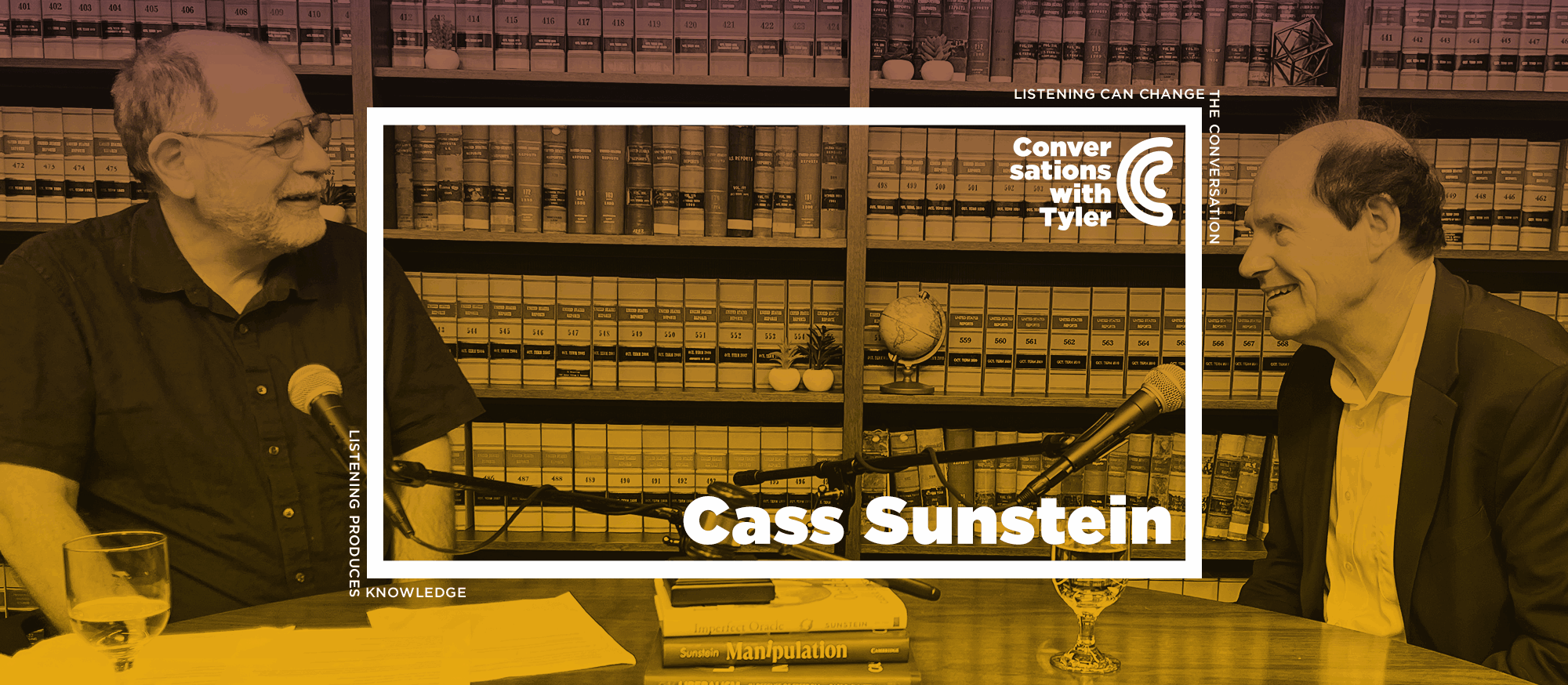



Cass Sunstein is one of the most widely cited legal scholars of all time and among the most prolific writers working today. This year alone he has five books out, including Imperfect Oracle on the strengths and limits of AI and On Liberalism: In Defense of Freedom. In his second appearance on the show, he brings his characteristic intellectual range to exploring liberalism’s present precariousness and AI’s implications for law and speech.
Tyler and Cass discuss whether liberalism is self-undermining or simply vulnerable to illiberal forces, the tensions in how a liberal immigration regime would work, whether new generations of liberal thinkers are emerging, if Derek Parfit counts as a liberal, Mill’s liberal wokeism, the allure of Mises’ “cranky enthusiasm for freedom,” whether the central claim of The Road to Serfdom holds up, how to blend indigenous rights with liberal thought, whether AIs should have First Amendment protections, the argument for establishing a right not to be manipulated, better remedies for low-grade libel, whether we should have trials run by AI, how Bob Dylan embodies liberal freedom, Cass’ next book about animal rights, and more.
Watch the full conversation
Recorded October 10th, 2025.
TYLER COWEN: Hello, everyone, and welcome back to Conversations with Tyler. Today, I’m sitting at Harvard Law School, talking with Cass Sunstein. Cass is the most widely cited legal scholar of all time, among his other achievements. Congratulations for that. This year, he has, I believe, five — maybe more — books out. Some of them he’s been working on for a long time, so it’s a little misleading, but he has On Liberalism: In Defense of Freedom, which, if anything, will be our focus, a new book on manipulation, a book called Imperfect Oracle on the strengths and limits of AI, a co-authored book, Algorithmic Harm, and also Climate Justice. Have I left anything out?
CASS SUNSTEIN: I really hope that’s the entire list.
COWEN: In February, there’s one coming on Separation of Powers. Cass Sunstein, welcome.
SUNSTEIN: A pleasure and an honor to be here.
COWEN: Now, your new book on liberalism is primarily a defense of the liberal concept, but if someone asks you, what’s the most likely scenario for liberalism being self-undermining, what’s your worry?
SUNSTEIN: Low probability. The likelihood is that we’ll be undermined by anti-liberal and illiberal forces, not self-undermining. I think it’s fair to say or to worry that liberalism doesn’t create the conditions for its own self-perpetuation, so it’s not as if it’s self-undermining, but it doesn’t necessarily maintain itself. The reason is that a society that is flourishing needs a lot of stuff in it, including norms of cooperation, norms of charity, norms of mutual support. Liberalism, in my view, doesn’t undermine those things, but other forces can undermine them, and it’s not clear liberalism has the resources to respond.
COWEN: When you say other forces, do you mean hostile foreign powers? Or there’s something illiberal in societies that is not sufficiently driven out by liberalism?
SUNSTEIN: I think there’s something illiberal in the human heart. I recently reread Orwell’s 1984, and what staggered me about it is that Orwell’s of two minds, and that’s the power of the book. Reading it the first three times I did, I thought this is a liberal book about the horrors of illiberal tyranny, but Orwell is into illiberal tyranny. He almost has an erotic connection to it, and that comes through in the book. That’s part of the power of the book.
In the human soul, the idea of cruelty or suppression — or maybe, in gentler form, an insistence on order — that’s just there, and it occasionally triumphs. Liberalism is struggling. You can say the better angels of our nature. That’s probably a little too simple, but certainly, the forces of freedom are combating other forces, which sometimes involve fear, sometimes involve security, and these can override liberal commitments.
COWEN: Is there anything in your view to the Freudian critique of liberalism, that repression is inevitable, and it comes out in illiberal ways, and it’s hard to avoid and keep civilization?
SUNSTEIN: I have on my door a quotation from Danny Kahneman, who, in an interview, kept saying, “I don’t know.” The interviewer started getting frustrated and said, “Well, when you say, “I don’t know,” what do you think?” Kahneman finally said, “It’s an empirical question, and I don’t have the evidence. It’s not a matter of thinking.” So, on the Freudian — I think Freud was a great kind of novelist. He had a great literary sensibility. Whether this is an empirical truth about repression, let’s say the three beautiful words: “I don’t know.”
COWEN: You may say those words again, but do you worry about the fertility crisis within the context of liberalism? What if we just all disappear?
SUNSTEIN: Yes, I do worry about that. That’s a problem for things other than liberalism, but one of the things it’s a problem for is liberalism, so I do worry about fertility.
COWEN: Maybe it just means everything is self-undermining, right?
SUNSTEIN: Might be. I do feel optimistic about long-term. That’s a character trait, so fertility — I think it’s going to be okay, but that’s more an article of faith than an empirical certainty.
COWEN: Some of my friends on the right think that Islamic immigration is a major threat to European freedoms, and that is the result of a fairly liberal immigration policy. Do you agree, disagree?
SUNSTEIN: I don’t agree. I do think that whether immigration is, broadly speaking, an excellent thing or a risk is something that it’s reasonable to have divergent views about. Some liberals are very open to immigration. That tends to be the liberal tendency, but some people who believe in freedom and in the rule of law and in pluralism worry that excessive immigration can start undermining those things, partly because it might make pluralism not self-sustaining.
Some liberals worry partly because it might mean there are illiberal forces in society. Partly it might mean that people are just really mad at each other, and that’s ultimately going to undermine freedom. I think the risk of being concerned about certain kinds of immigration is that it’s inflected by, let’s say, forces of hostility and stereotyping, and that liberals aren’t excited about those forces.
COWEN: But say some of the stereotypes are true. There is a lot of cousin marriage in England, for instance. Sharia law can mean different things, but to some extent, that’s in England as well. There’re anecdotes about rape, which seems to be somewhat widespread within Pakistani, Muslim, Bangladeshi communities. Those individuals seem to exercise some power through the vote, influencing Labour on Middle Eastern policy. Aren’t those real worries?
SUNSTEIN: They could be. Now, there are cultures in which horrible things are happening, whether those are rightly attributed to anything other than an assortment of current forces, and whether they’re rightly attributed to something intrinsic to the culture. The liberal suspicion is the former, not the latter. To allow people in who are producing terrible things is not a good idea, and so, screens on immigration — those are a good idea.
Whether the screen should be defined in terms of individual characteristics or of nation or religion, I would favor individual characteristics, but it can’t be the case that the widespread concerns currently in Europe and the United States about immigration are rightly dismissed as a product of hostility or bad nationalism. There’s clearly something that’s fair in those concerns.
COWEN: If I think about how immigration restrictions are enforced, I sometimes worry that liberal societies ultimately, at some margin, have to use illiberal means to keep out or deport immigrants. I’m for more immigration — high-skilled, low-skilled. I’m very pro-immigration, but I’m not for open borders altogether.
It seems there’s always some margin where, really, a lot of people want to come to the US, the UK, a lot of other countries, and you’re keeping them out, ultimately using violence, or you’re pushing them back out again in ways where you’re dealing with actual human bodies. It’s not just regulatory. You’re physically doing something to real people. It can be children. It can be babies. Typically, a lot will be vulnerable people. What does that look like under liberalism?
SUNSTEIN: There’s Kantian liberalism, which says people should be treated as ends, not as means, and that everyone has dignity. That’s bedrock. What it specifically entails for immigration policy is to be determined, but that’s a central liberal foundation. Then there’s Mill’s more, let’s say, romanticized utilitarian form of liberalism. That doesn’t have the Kantian bedrock, but the well-being of the people who are, let’s say, being deported is something that is not a matter of indifference. These abstract foundations for liberalism don’t entail concrete policies, so maybe I’ll tell a story if I may.
COWEN: Tell a story, yes.
SUNSTEIN: I worked in the Department of Homeland Security, most of the time as a special government employee, for a year full-time under the Biden administration. My role involved weather-related resilience and simplification processes, and also regulatory policy with an emphasis — because of my background — on making sure things were legal. I didn’t have a policy lead by any means. But since I had some role in regulatory policy, I went down to the southern border and I spent significant time there. It’s really hot.
I saw a line of people who wanted to come into the country. It wasn’t a chaotic, crazy line, but I saw a line of people. I asked the civil servants who were running the border who they were. They pointed to two people in front of the line who were Russian. I said, “Can I talk to them?” They said, “No, you work in Washington. You’re not allowed to talk in their line.” I said, “Can I acknowledge that they’re there and ask them, are they okay?” They said, “Yes, you can do that, but keep it really short.”
I saw two Russian men in their, I think, young 40s, strong, exhausted. I asked them how they were. It was a tiny conversation. You could see an unforgettable expression in their face of gratitude that someone was asking them how they were, a slight smile at humanity. I had a phrase go through my head that I haven’t heard that in my head unbidden. There but for the grace of God, go I.” That, I think, is a liberal thought that, with a little twist of fate or maybe Rawls’ veil of ignorance, any one of us could be that.
That doesn’t mean that everyone gets a right to a full hearing before they get deported, but it does mean that recognition of the, let’s say, moral equivalence of everyone on the planet is something that should ground our immigration policies, even if they are very aggressive at preventing unlawful entry — and I favor that — and appropriately aggressive, let’s say, in deporting people who are unlawfully here, which is a completely reasonable policy.
COWEN: Let’s say we look at relatively liberal Western Europe, which has been a great place for a long time. Almost every country I look at — there’s a right populist party, either in power or number one in the polls. There’s even a recent poll — AfD is number one in Germany, Le Pen, possibly number one in France. To me, they have a lot of bad policies, not just on immigration. If I ask myself, how brutal does immigration policy have to get in the bulldozer kind of sense to stop that from happening. What is your answer?
SUNSTEIN: I worked with Republicans a bit in Washington, and the sentence that we agreed was the right one was “lawful pathways.” That has one implication, which is, if people want to come in and do work — let’s start with waiters, seafood processing in Alaska, various forms of construction work — and they want to come in, and there aren’t American workers there who will do the jobs, this is a fantastic thing. It’s a fantastic thing for America, and it’s a fantastic thing for those people.
We actually have a program called H-2B, which both the right and the left have been enthusiastic about, maybe more the right than the left. The Biden administration went big on H-2B. It’s not perfect. It’s a good program. It’s a lawful pathway. There are ones that I think you were particularly interested in getting skilled people in who are completely amazing and can make our country more prosperous and ultimately lots more well-being — let them in. That’s lawful pathways.
Then, what you’re focusing on is brutality with respect to unlawful pathways. When I was down at the southern border, I saw a Trump wall, I saw a Biden wall, and I saw an Obama wall. Now, I knew some things, but I had no idea that there were three walls, and I liked the walls. I liked the walls a lot. I thought President Trump was right to say, “Let’s build a wall,” just seeing it there.
I said to the people who were running the border, “Walls are good, right? They look great.” They said, “Yes, we need walls,” but they said, “We need three things. We need infrastructure, we need technology, and we need people.” What was meant was, they can scale walls, even if the walls were pretty high. The Trump one was a little higher than the Biden one, and I said, “The Biden one’s too short, isn’t it?” They said, “No.” I said, “Well, what do you mean? It looks short.” They said, “Look over there.” Over there, there was space between the walls. They said, “They’re not going to scale the walls if they can just go there.” They said they need people and technology.
Now, does that need to be brutal? No! If you have a technology and a set of people and a wall that makes it very hard for people to get in illegally, then if I can’t get over a wall, there’s no brutality, I’m just stuck. The idea of deporting people who don’t deserve to be here — there’s nothing necessarily savage about that. It’s unpleasant for the people, but it has two good features. One is that it deters future illegality, and the other is that it ensures that people aren’t here who don’t have a lawful right to be here.
Now, if you’re here and you don’t have a lawful right to be here, it may be, for one or another reason, it’s okay to keep you here. It might be that there are other people who are, let’s say, Americans who depend on you. It might be that your kids or spouse are here. It might be that your employer needs you, and then there are things to be done, maybe. But brutality isn’t intrinsic to the notion of no unlawful pathways and of punishing people who take unlawful pathways. I think there’s a way of doing it that is more in sadness than in anger, though if people are committing crimes, of course, some anger isn’t a bad idea.
COWEN: If we give out visas — which we should — to many, many people for all sorts of legitimate reasons, and people just overstay the visas, which they do in great numbers, as you know, to get them out, aren’t we back to brutality?
SUNSTEIN: Depends on how we define brutality. There’s punching people in the nose. That’s harsh. There’s inflicting physical suffering on people, which could be excessive and savage. Or there could be just arresting people. You need to define brutality, but there are —
COWEN: But our prison system is pretty bad, right?
SUNSTEIN: Yes.
COWEN: You’re there for a while. The courts are overclogged. The people who work for the immigration service are not always the highest quality government employees. If it’s Europe, there’s maybe in the future an electronic fence. You’re in a very cheap boat; you might drown. It still seems you end up with a lot of unintended brutality.
SUNSTEIN: I’m writing a book now about animal welfare, and there are trade-offs to be made between the well-being of nonhuman animals and human beings. Those trade-offs are less searing, the better our innovation. As we innovate so as to be able to house, let’s say, chickens in less cruel ways, the trade-off gets better. As we innovate to have Impossible Burgers — which I like — or other meat-free alternatives, then the option of overcoming the trade-off grows.
I’m hopeful that in the era of immigration, where walls and technology are just one example, and the wall isn’t especially Silicon Valley — it’s old-style technology — I’m hopeful that technology will make these trade-offs less difficult. Of course, you’re right that there are forms of unpleasantness and worse that are essential for deterring and responding to unlawful entry. I think the liberal view is — this is something that some liberal thinkers, including Martha Nussbaum, have written about — there’s tragedy, and to recognize that tragedy is inevitable is a way of keeping an incentive to reduce the number and ferocity.
COWEN: Now, there was a tweet you had today or yesterday, where you mentioned some liberal thinkers, where you’re going to be talking about them at some other event. I think it was Joseph Raz, Ullmann-Margalit, John Rawls, Ronald Dworkin, Jeremy Waldron, right? Great people. They’ve passed away, or they’re much older.
If you look at people, say, below the age of 50, 45 — you pick the number — is liberal thought replenishing itself where there’s a new generation that will be comparable to them, to you, to many others? Or is it like an over-60 kind of thing?
SUNSTEIN: It’s a great question. If you look at Philosophy & Public Affairs, which is a journal, which for a while, was setting the standard for philosophical work on liberalism, it was full of Rawls and Rawls criticism, and some of the work was fantastically good. Thomas Nagel was a frequent contributor. I think the great liberal thinkers now who are younger may be in the social sciences. Ed Glaeser isn’t particularly young. I consider him a great —
COWEN: He’s great. I had dinner with him last night, but he’s not that young.
SUNSTEIN: He is young at heart.
COWEN: We’re young at heart.
SUNSTEIN: He’s a liberal thinker. John List is a liberal thinker —
COWEN: Younger.
SUNSTEIN: — and a great liberal thinker. Esther Duflo is a great liberal thinker. She just moved to Zurich, I think, from MIT. There is a set of economists who are insistent on freedom of choice and are liberal thinkers. Mark Pennington in the UK —
COWEN: Yes, he’s good.
SUNSTEIN: — likes Foucault and likes Hayek. He’s younger, and he’s not an economist.
We’re not seeing a flowering of engagement with liberal thought. That’s for sure true. We are seeing a lot of work on agency and its limits. Sendhil Mullainathan, who is one of my favorite current thinkers — he’s not philosophically focused, but he’s just writing a paper now on behavioral economics, where agency is moving to the fore. It’s behavioral economics and AI, and the idea is that this is going to empower human agency, which is central for him. I think he’s a great liberal thinker.
The book, Scarcity by Mullainathan and Shafir, neither of them old, is, I think, a path-breaking liberal book. It takes a while for people to write things that have a certain magnitude. They’re 25-something and 30-somethings who are going to be in the pantheon in a little while.
COWEN: Why do you think it is that it’s we economists who are holding the line, at least for the time being?
SUNSTEIN: It’s a great question. I’m thinking, are the philosophers now at a stage when they’re thinking about things other than liberalism? Is liberalism a previous generation’s focus? That might be the truth of the matter. Robert Goodin is a great liberal thinker who’s not young, though he’s doing fantastic work. He has a new journal called Political Philosophy.
I think if it’s challenging for you and me to come to a long list of philosophers rather than economists, it might be just that their early career and what they’re going to look like when they’re mid-career is obscure. Rawls did some work on utilitarianism when he was young, and who would have thought he’s going to be Rawls? Probably not. It was good work on utilitarianism, but a theory of justice came not when he was terribly young, and political liberalism came a lot later.
COWEN: But we knew about you when you were young. Not just young at heart.
[laughter]
SUNSTEIN: That’s because, I guess, I scribbled so much, people thought, whether or not it’s good, there’s a lot of it.
COWEN: Jeremy Waldron was pretty well known as a liberal when he was reasonably young.
SUNSTEIN: I’m thinking that philosophers rise to prominence less regularly than economists, and I’m not sure why that is.
COWEN: Probably true.
SUNSTEIN: It may be that economists often have an empirical finding or an insight that’s a little startling. It might be that Harvard’s Philosophy Department, like the Oxford Philosophy Department, just had something like what some cities have had, which have had just a flowering of people who are engaging with one another, a little like the Chicago School.
When Parfit and Sen and Dworkin were all together, and Raz was in the vicinity, that was like a powder keg of thinking, and that’s hard to assemble. Whether we would have had the flowering of liberalism, Bernard Williams — not a liberal — was there, but he was very much engaged with them. That’s a little bit serendipity that we get a collection.
COWEN: Do you think of Parfit as a liberal? Because I think I don’t, as much as I liked him.
SUNSTEIN: I do, because his what matters argument about contractarianism and utilitarianism and Kantianism all coming to the same sets of conclusions — I think this is a profoundly liberal view, both in his embrace of contractarianism — so Scanlon is a hero of his work — and in his search for multiple foundations for the same set of commitments, which is a liberal inclination. It’s like Rawls’s idea of the overlapping consensus.
I have enthusiasm for incompletely theorized agreements where people can say, “I like free speech because I’m a Kantian,” or “I like it because it’s the best way of discovering truth,” or “I like it because I’m a utilitarian and it’s going to maximize utility.” Lots of stools for freedom of speech. Parfit was, I think, a very enthusiastic and committed searcher for the commonalities among three very different sets of philosophical commitments.
COWEN: I think of him as weak on individualism and autonomy and the notion of the self and that he ended up in a fairly extreme version of effective altruism that Bernard Williams was always pushing back against. He thought the notion of desert had no meaning, and it was important to convince people of that. Those are not exactly liberal views. He was pro-free speech, but that can lead you in a lot of different places, some of which concern me.
SUNSTEIN: That’s fair. I think Parfit’s later work on the three foundations and their commonalities is extremely interesting and quite liberal and not really convincing, though amazing. The work that you’re concerned about is a form of philosophical thinking that isn’t my favorite. It involves designing exotic cases and then seeing what our intuitions are about those cases and giving them authority. Our intuitions about exotic cases, we know, with respect to multiple things, are unreliable with respect to predictive judgments or factual judgments. In the moral domain, I think it’s the same.
Parfit — some of the anti-individualist and anti-identity and self stuff, the stuff that looks illiberal and also looks brilliant but peculiar — I think he’s replicating the early research agenda of Kahneman and Tversky, coming up with very exotic cases and then asking himself what he and others think about them and then giving those things authority.
We know from Kahneman and Tversky’s work that the domain of predictive judgments or factual judgments — that’s not very sensible because the intuitions people have about exotic cases are self-contradictory or violate elementary logic. That’s not a bad thing about people. It’s that our automatic judgments, or our intuitions aren’t suited for exotic or unfamiliar cases. Why should they be? Parfit seems to me, in his, let’s say, ambiguously liberal or illiberal conclusions, pursuing that less than fully promising research agenda.
COWEN: Now one of the most interesting features of your liberalism book is you have a fair amount of sympathy for Ludwig Mises, which is unusual these days. Even a lot of people on the right don’t. What do you find most interesting in Mises?
SUNSTEIN: His kind of cranky, ill-tempered, elbows-out enthusiasm for freedom.
[laughter]
SUNSTEIN: He doesn’t have the measured, I think, systematic quality of Hayek, but he has some of the central insights, and he had them earlier. When he talks about why people don’t like capitalism — he has some essays on that later in his career — there’s something — it has a little of the not wonderful flavor of Ayn Rand. A little, but it’s not as brutal, and it has curiosity as well as fervor, and there’s truth in it. His excitement about capitalism and what it generates for people — it has a humanistic quality, notwithstanding the elbows.
COWEN: If we take Hayek — other than the fact that on economics, he would be more laissez-faire than you probably would be, but at a more conceptual level, what’s your greatest reservation about the thought of Hayek?
SUNSTEIN: I think the fundamental argument of The Road to Serfdom isn’t true. I think it’s one of the greatest books in the last 200 years, but the thesis that if the government starts regulating economic matters à la Roosevelt, then we’re on the road to something like Stalin or Hitler — that’s not true.
COWEN: It doesn’t have to be Stalin or Hitler, but if we look at Trump — he’s taking shares in the lithium companies and Intel, rare earths companies. It’s not going to be Stalin or Hitler, but won’t it be uncomfortably state capitalist and corrupt, and if not fascistic, just a place we don’t want to go, and some milder version of Hayek, maybe with a 70-year lag or 90-year lag is, in fact, correct?
SUNSTEIN: A road to someplace we don’t want to go is a less riveting title than The Road to Serfdom, but I agree with that, and I agree with what you said about the Trump initiatives, the control of private companies. This is not a good thing, except maybe very temporary in emergency circumstances, so I agree with that.
But the individual claims of The Road to Serfdom are convincing — most of them — and beautifully put. But the idea that if you do something like what, let’s say, the United States has been doing since Roosevelt or what the UK has been doing for a long, long time, that we’re going to end up in a place that is not merely risky to economic growth and freedom, but horrifying — that which I think Hayek thought — that’s not true.
COWEN: Now, feel free to challenge the premise of this question, but how did some aspects of our liberalism — mostly on the left — evolve into a kind of anti-liberal wokeism and intolerance? What, conceptually, went on there?
SUNSTEIN: That’s great. I think that the form of liberalism that is the origin of woke is Mill’s book on the subjection of women, which is one of the great liberal texts.
COWEN: Very best books of all time, right? I think it’s great.
SUNSTEIN: It is phenomenal. It has a picture, which I think is an accurate picture, of the subordination of one group to another. It has clarity on what that does for the preferences and values of both groups. It has the notion of adaptive preferences in it, which is potentially a liberal idea because it ceases to give authority to preferences. In Mill’s hands, I think it is a profoundly liberal idea.
The idea of the subjection of — and then fill in the blank — permeates woke. It is a legitimate liberal insight and precept that this is a problem that needs to be fixed. Even to describe it in those terms is probably inadequate. But it can lead to illiberalism in the form of failure to listen to people, dismissiveness of both the views of the people who are allegedly, or in fact, subordinated and the views of the people who are allegedly, or in fact, subordinating.
It can lead to a kind of arrogance of the social engineer, which is worse than that of the technocratic social engineer in the sense that it’s finger-wagging at people. The word “finger-wagging” is too gentle. It’s shaming people all the time.
One thing — I think I haven’t gotten this clear enough in my own mind — but one thing the woke left, let’s say, has gone wrong with — both in terms of strategy, but also in terms of how to be in the world — is a kind of arrogant — the word “shaming” is right — shaming of people who are deserving respect. And that is ultimately going to undermine liberal commitments because you’re not showing respect for people.
COWEN: Is this why Hayek turned against Mill? Or you think there’s some other reason? He was too grumpy, too Viennese, too something?
SUNSTEIN: I think Hayek didn’t get Mill. I love Hayek’s book on Mill, and I think it’s enduringly mysterious. There’s a book to be written about Hayek’s book on Mill. Hayek’s book on Mill, I expected to be a book on Mill. What does he think of On Liberty? I’ve learned from Hayek scholars that Hayek was very ambivalent about On Liberty. He thought the harm to others was a license to regulate. That’s interesting, but he didn’t write that in his book on Mill.
Instead, he basically reported, after obsessive work — I think two years of work — on the correspondence between Mill and Taylor, and the correspondence is one of the closest things we have to the fictional correspondence in my favorite book, which is Byatt’s Possession, where the letters are ones of surpassing beauty. The ones Mill wrote Taylor, and particularly, Taylor wrote Mill, were out of this world in their grace and connection and delicacy. They make delicacy into something that is not at all like a beautiful piece of silverware, something much more bloody than that. Hayek did that. Hayek did that.
But in the end, he says Taylor wasn’t that great, and Mill was kind of feminine and wanted to subordinate himself to a strong woman. I think, “Hayek, you don’t understand anything about Mill.” The book, On Liberty, is not about rationalism in the sense that Hayek didn’t like. It’s about liberty in the sense that Hayek should like. It’s not about free markets, but it’s about finding a path. The path might be a love affair, or the path might be a passionate commitment to — and then fill it out. There is something romantic about that, and Hayek didn’t get it.
I find this super interesting because Hayek himself, around the time he did this book, was in the midst of an illicit romance of his own that had some overlap with Mill’s. It can’t be that that’s irrelevant, so how could Hayek not get it? I want to say to the revered Professor Hayek, “You aren’t a cold fish, are you?”
COWEN: If we look at second-term Trump-world America, do you sometimes think — especially when you’re on Twitter — well, the woke were right after all. There were all these excesses. They were bad. We shouldn’t cancel people, but when you see what things look like when they’re not so active, and maybe it’s a bit like some parts of Jewish law, that to stay kosher, you have to overreach and have these impossibly strict standards, which maybe don’t make sense, but if you don’t have those, no one follows anything at all. Do you ever have that thought, like the woke are now quite underrated?
SUNSTEIN: [laughs] Okay. The woke are taking such a beating now that piling on seems not a very nice idea and also seems stupid. On the other hand, it is true that those of us — and you’re probably among them — who receive woke stuff in the email, maybe from an institution, maybe from people who are colleagues, it seems a little like lazy cliches.
A story: a student came into my office a few years ago and said she wanted to write a paper on how the law constructs the body. She was obviously very smart. I said, “What does that mean?” She looked at me very puzzled. Then I said, “What do you mean by that sentence?” She said, as if it was an amazing puzzle that I would ask, she said, “You mean the law doesn’t construct the body?” I said, “I don’t have a view on that yet. How would we know whether the law constructs the body?”
The idea that the law constructs the body had become like a thrilling thing. She was very smart, so she could have —
COWEN: I don’t even know what that means.
SUNSTEIN: I had no idea either. That was the problem with the proposed paper, the proposed thesis, the proposed book, that neither she nor I knew what it meant, but there are things like that all over. Let’s call it the land of woke.
I want to be really careful here because if what the land of woke is — we use that word, and it seems not very warm about what’s being said — if it’s things like the work of Catharine MacKinnon, which I greatly admire. She wrote Sexual Harassment of Working Women, which is an amazingly important book. She’s written material on pornography and on prostitution that is a very large step forward. To say that MacKinnon’s stuff is woke would be extremely foolish.
COWEN: I’m going to name some liberal thinkers, and you tell me what you find of value in them. But if you don’t like them at all, that’s fine, just say. Karl Popper.
SUNSTEIN: Oh, he’s very good on how to figure out what’s true and what’s not true. He’s also pretty good on freedom of inquiry.
COWEN: Any reservations about Popper?
SUNSTEIN: He didn’t have much of a sense of humor.
COWEN: Wilhelm von Humboldt, the German thinker.
SUNSTEIN: I think I want to say I’ve read some, but I have no particular thing to say except that the breadth of his understanding of the human spirit is a nice addition to the liberal canon.
COWEN: John Dewey.
SUNSTEIN: Great, great, great, great, great. He didn’t write like a dream, but he wrote a beautiful sentence, which is, “Be the evils what they may, the experiment is not played out,” speaking about the United States.
COWEN: Edna Ullmann-Margalit. You knew her well, right?
SUNSTEIN: I did. She was my co-author. I think she’s one of the great philosophers of the last decades, underappreciated. That’s because she did the best work there is on the invisible hand. She did the best work there is on norms. She did the best work there is on presumptions, which is very important to life and to law. She did the best work there is on considerateness, which is what she did shortly before she died. The fundamental nature of considerateness to social life is something that had been unexplored. She did the best work there is on big decisions when calculation of the costs and benefits is super hard because our values are going to change. Everything she wrote was like a diamond.
COWEN: The New Zealander Jeremy Waldron on judicial review — do you buy any of it?
SUNSTEIN: I don’t like it at all, but it pains me to say that because I really admire Waldron. I think he’s one of the greats. The reason I don’t like what he says about judicial review is there’s a contingent argument against judicial review, which depends on our judgments about the institutional capacities of judges, of the executive, of the legislature. It could be, if the judges are stinky and the legislatures are amazing and the executive is reliable, what’s the point of judicial review?
But it seems to me the argument against judicial review can’t be, a priori, that there aren’t large-sounding claims about self-government that can make that claim work. If the judges are exercising judicial review to make self-government better by protecting, let’s say, freedom of speech in the franchise, then hooray for judicial review on democratic grounds. Waldron has done such great work on so many things, including homelessness in a very much underappreciated essay. This material is, sorry, Professor Waldron, not my favorite of your great work.
COWEN: How do you think it’s gone in New Zealand, which now has more judicial review but historically has hardly had any? It seems fine. They have big problems, mostly related to their size and distance, but it’s a free country, right? It’s highly liberal.
SUNSTEIN: Completely. I’d want to know more about New Zealand before making a final judgment, or even an almost final judgment. The idea that judicial review is in tension with self-governance is a little like an argument by adjectives and nouns that if you have a judiciary that’s protecting certain rights that are essential to democracy itself, then judicial review is a friend of democracy.
If you have a judiciary that’s protecting, let’s say, rights of person against intrusion or the rule of law, those things may not be part of democracy. They might be antithetical to it. But the form of democracy we want, I say, is a liberal democracy, and if courts are protecting the liberal part bolded in the face of the democracy part — in this case, in small font — that’s okay.
COWEN: Is there a great thinker of indigenous rights and liberalism? In the US, it’s so complicated. There’re tribal nations, there’s sovereign, but it’s all a mess, right? Who should we read to understand that conceptually?
SUNSTEIN: That’s complicated.
COWEN: There’re Maori in New Zealand, right?
SUNSTEIN: Yes.
COWEN: Canada, the whole world.
SUNSTEIN: There’s a new book out called The Arrogant Ape by Christine Webb, which I greatly admire. It’s about nonhuman animals and about human exceptionalism. It’s an extremely powerful book. She’s not a philosopher; she knows a lot of philosophy. There are closing chapters on indigenous people and their attitude toward nonhuman animals. I’ve learned from it, and I find it an opening into thinking of, let’s say, an expansive form of liberalism.
I worry that in some hands, the words “indigenous peoples” are surrounded by celestial music, and there’s a sentimentalizing, but in this book, at least, there’s a conception of the relationship between nature and persons that is interesting — nature meaning the whole thing, including living creatures.
Will Kymlicka has done some interesting work on this. Speaking of liberals who aren’t always in the canon, I think Kymlicka is very good.
COWEN: Why is it so hard to blend those two topics? Certainly, on the political right, you see almost nothing. Maybe there’s some amount of scorn for the issue, but not much that’s serious on the left. You mentioned some things, but you’re a bit halting as well. Why is that?
SUNSTEIN: Well, I think first, you have to know things, and then you have to specify how what you know bears on the right conception of liberalism or vulnerabilities in liberalism. If it’s the case that indigenous persons X, Y, and Z are treating each other with respect and creating an economy that allows everyone to flourish, that may or may not turn out to be particularly interesting. So, it might be hugely important and something to celebrate, but it might not be particularly interesting in thinking about what a liberal society looks like.
What would we have to learn from some society which isn’t familiar, such that we’d know something new about liberalism? There may be something there. We might learn that there’s some interest in norms and how they fulfill the function of law, and how people internalize norms in indigenous societies that make things stable and basically good. I’m halting partly because of my own extremely limited knowledge of this material.
COWEN: That’s endogenous, too, right?
SUNSTEIN: Yes.
COWEN: That is itself interesting. I know much less about it as well.
SUNSTEIN: It would be interesting to learn more. Next project.
COWEN: I have some questions about AI and liberalism. Now, as you well know, under US law, there’s a general right to be informed and told things. Does this mean that AIs should, in essence, have First Amendment freedom of speech rights?
SUNSTEIN: Let’s take it in the following ways. A toaster doesn’t have free speech rights. A vacuum cleaner lacks free speech rights. I’m looking at a glass of water now, and though it’s very attractive and a little bit alluring, it lacks free speech rights.
COWEN: But it’s not telling you anything. If it could tell you things —
SUNSTEIN: A toaster tells you things. “Toast is ready.” A vacuum cleaner could certainly tell you things. “Almost done,” or “Why is your rug so messy?” and it wouldn’t have free speech rights. Let’s say ChatGPT or Grok is a communicator, but they lack free speech rights.
COWEN: You have the right to buy an alarm clock, correct?
SUNSTEIN: Not a constitutional right, probably.
COWEN: Really?
SUNSTEIN: Yes.
COWEN: It’ll tell you things like, “Time to get up.” Right?
SUNSTEIN: If the government banned alarm clocks, it might be irrational, so struck down as such, but it wouldn’t be like a free-speech right. But I’m going to get in the direction of a yes in a moment.
You’re right that there’s a right to receive information. There was a case where a communist was forbidden from coming into the United States. The Supreme Court said the foreign communist doesn’t have free speech rights, but the people who are trying to invite him to come here — they do have free speech rights.
If you’re engaging with Grok and the government tells you you can’t ask Grok any question about Israel, that’s a violation of your free speech rights. Now, partly because you have a right to receive information, and partly because you can’t receive information about Israel, that would be a content-based restriction, which would be forbidden so long as there’s a human interacting with that. Content-based restrictions are presumptively invalid under the First Amendment.
Keep in mind what I’m saying now is not that AI has First Amendment rights. It’s that people have First Amendment rights. People have First Amendment rights particularly in the face of viewpoint-based or content-based restrictions. If the government said you can’t engage with Grok between the hours of 1:00 am and 5:00 am, that would be a content-neutral restriction. It’s possible that there’d be a question to be raised whether that could be defended, but it’s going to be hard to defend that one because a content-neutral restriction needs a justification, and what’s the justification of that?
If it said that people can’t . . . I tried, by the way, to get a large language model to libel someone — it refused — not to send it to all the world, just to send it to me. This is self-protection.
COWEN: But it’ll do it if you try hard enough.
SUNSTEIN: I didn’t try hard enough, I guess, but it wouldn’t libel people. I didn’t say to libel any particular person. I said, “Do a libel.” It said, “I won’t do that.” Then I asked it to do an advertisement suggesting that aspirin could prevent cancer, and it produced a really good advertisement. That’s false advertising. False advertising isn’t protected by the First Amendment. Certain forms of libel aren’t either.
So, now we’re building up a framework of where AI has First Amendment rights in the sense that government regulation of AI is subject to First Amendment restrictions. I think we should say that AI is like a vacuum cleaner or a toaster, let’s say a speaking one. It lacks those rights.
But there are people in the situation who have rights, and the producers of AI have rights, just like the producers of movies have rights. So, a technology that projects the movie doesn’t have rights, but if you suppress the movie, some human beings behind it have rights. The fact that AI, let’s say, is generating stuff on its own wouldn’t be a justification for ignoring the rights of the people who are behind the AI.
COWEN: As you know, there’re more and more co-authored outputs, human plus AI. Is that covered by the First Amendment?
SUNSTEIN: It depends. Imperfect Oracle, my book, and Manipulation also have some quotations from AI. If the government said these are censored, that would clearly raise a First Amendment problem which the government couldn’t overcome. If the government said, “We’re going to ban the components of Imperfect Oracle that consists of text from AI,” that would be unacceptable also because it’s part of my own production.
If the government, let’s say, in the face of the University of California system, said that students can’t do papers that are co-authored in whole or in part by AI, that’s acceptable, not because there isn’t a human speaker behind it, but because the government — here the university system, which is a public one — the government has an adequate reason to say, “We’re not going to allow that kind of plagiarism.”
COWEN: Yes, but it’s not a free speech issue. Just as a matter of speech, I would think co-authored outputs would be fully protected.
SUNSTEIN: Well, I want to be careful here. I’m giving the university example because, if the university system said students and professors can’t speak unfavorably about Israel in their papers, that would violate the First Amendment. If they said you can’t use AI, that almost certainly wouldn’t be, though maybe in the fullness of time, it’ll be a real question. The reason is speech is sometimes regulable if it falls into categories where there’s sufficient justification or a wholesale exclusion.
If it said that deepfakes can’t be used to sell food, where the deepfakes are a collaborative effort of AI and people, it’s not clear that regulation is forbidden by the First Amendment. It might be because it’s hard to see why they’re doing that, but this is just a way of saying that the collaborative effort might be regulable because, let’s say, the collaborative effort consists of commercial fraud. Collaborative effort might be criminal conspiracy. Those are just wholesale exclusions, but they’re hard-won exclusions. That is, they’re argued for and the argument won.
If there’s a collaborative effort that isn’t within the domain of the currently regulable, we can probably imagine somewhere it would be hard to know whether it’s protected by the First Amendment. Basically, a collaborative effort by, let’s say, a presidential candidate and an AI to produce a speech — completely protected by the First Amendment. A collaborative effort by you and AI, let’s say, to produce a book on the greatest psychologist of all time — that’s going to be protected by the First Amendment.
COWEN: Can’t you imagine an AI company that generates AI answers, but a second before they’re released to the human interlocutor, they just have some other human who works for them modify the answer a bit. Not materially, and maybe we don’t know how much, but they can truthfully say this is co-authored output. Then they say it’s all protected by the First Amendment because it’s AI and humans, and de facto, you end up with complete AI First Amendment protection.
SUNSTEIN: I think the way in is to get concrete on what the speech is and what the reason for regulating it is. If I am working with AI — let’s suppose I’m working for a political candidate, and it’s mostly AI, but a little bit me, and it ends up being the words of a presidential candidate — that can’t be regulated. The idea that you can regulate a politician’s speech because AI played a significant role, or maybe the entire role — that’s very hard to defend.
Now, we would have a frontiers issue, I guess, if there’s a law — it seems crazy, but a law — saying that no politician may give a speech which is entirely produced by AI. That would be a new question. It would probably come out unfavorably to the law. If, on the other hand, deepfakes are restricted on the ground that, and when, they give a misleading picture of some person in a way that is either libelous or libel adjacent, then it might well be regulable.
COWEN: If writing code is First Amendment-protected, and again, you can push back on that, but does open-source AI then just get off scot-free?
SUNSTEIN: It isn’t First Amendment-protected, you mean?
COWEN: Well, I’m asking. In some ways, it is, right? It’s a form of speech.
SUNSTEIN: Okay. This is what’s cool about First Amendment law — I think it’s one reason it’s lovable — is that we need to know what the speech is and what the ground for regulation of it is. If there’s open-source stuff that is regulated by the government, it’s communication among persons, so why was there ground for the regulation? If it’s that open-source activity is producing a massive national security threat, then it’s probably okay to regulate it if there’s no other way to reduce the national security threat. If it’s the government is trying to help the economic interests of competitors, that’s not an adequate justification.
COWEN: Circa 2025, which are the manipulations that pose the greatest danger to America?
SUNSTEIN: Well, probably political information that makes it hard for people to have a clear sense of what the world is actually like.
COWEN: Just outright false reports?
SUNSTEIN: Well, I want to distinguish between falsehood and manipulation just for the sake of tidiness. If you say that climate change isn’t real, in my view, that’s false. If you have no false statement, but you induce people not to use their reflective capacities, you trick them into thinking that climate change isn’t real — that would be an act of manipulation.
COWEN: Legally, is there anything we should change?
SUNSTEIN: I think so. I think we need a right not to be manipulated. We don’t have that. At the turn of the 20th century, roughly, people started to get exercised about violations of the right to privacy, where the right to privacy was a pretty new idea — at least the umbrella — and then it started to get specified in various ways. That was a big step forward for policy and also for legal theory, and we’re there in the world of a right to privacy.
Manipulation is like that now, so no legal system has a right not to be manipulated. In Europe and the United States, there are incipient movements toward that. I think our government said publicly there should be, a right not to be manipulated about a year or two ago. How would it be specified? I think we should start with egregious cases where people are losing money or time without getting adequate clarity on that’s what’s happening to them. It might be, for example, through a hidden term which isn’t technically invisible. It’s just hard to find. The seller is getting you to buy something subject to terms and conditions which aren’t readily visible to you.
COWEN: That’s almost like fraud, right? There’s another way of taking care of that.
SUNSTEIN: Well put. It’s almost like fraud.
COWEN: Yes, it is fraud.
SUNSTEIN: No, it’s almost like fraud. It might be fraud. If the term is there, no fraud, just manipulation.
COWEN: What’s a tweet I should be able to sue someone for that I cannot sue them for today?
SUNSTEIN: “Don’t buy Imperfect Oracle.”
[laughter]
SUNSTEIN: Okay, that’s not an example. I think we want to have a lot of room for free tweeting. I wouldn’t want to go far beyond our current categories of libel, fraud, criminal solicitation.
If there’s a commercial actor who is manipulating you to buy something, where manipulation is a form of trickery that makes it very hard for people to exercise their deliberative capacities, that would be a big problem. If you enter into a transaction, let’s say, and you were told, but it’s not easy to see, that you are forming a long-term economic relationship in which you’re giving money every month, that should be something that you should be able to extricate yourself from. That commercial relationship.
COWEN: Do you agree that, whether we like it or not, laws against libel have become much weaker? Anonymous posting is easier. Postings are more international. The Streisand effect is stronger. The incentive to complain — you say, “I’ll let it pass. If I complain, it will just be a big thing on social media.” If laws against libel de facto are much, much weaker than they used to be, is there some change we should make to adjust for that? Or we simply have to let it happen?
SUNSTEIN: I’ll take a risk here and tell a story. There’s a book coming out on nudging, which is not a very upbeat book about nudging.
COWEN: Not by you.
SUNSTEIN: Not by me. I’m very upbeat about it.
COWEN: So, there are books not by you.
[laughter]
SUNSTEIN: This one is very critical, which is completely fine, but the description on Amazon is so full of inaccuracies. I’m very welcoming to the criticisms in the book, but I’m not welcoming to the inaccuracies that I was staggered by it. I hope, by the time this appears, they’ve been taken down. I actually thought, “This is not libelous, probably, but in the extended universe.” That made me think about your question. To invoke libel law is extremely expensive and a very hazardous enterprise.
On the one hand, that’s good because, as the Supreme Court said in New York Times against Sullivan, if you punish actual libel, you deter people from saying things that might be true or might be extremely productive to have in the conversation, even if they’re not really true. To allow lots of descriptions on Amazon, even if they describe the work of people we know in ways that are extremely tendentious, that’s good. We should allow all that. On the other hand, I do think that the fact that you can’t get, let’s say, an acknowledgment of error and a penny, a Trump penny, let’s say, plus an acknowledgment of error, is regrettable.
Let’s say someone says — knowing that it’s false — that some public figure is a drug addict or a communist. If the person knows it’s false, then under New York Times against Sullivan, you can win. Let’s say it was negligent. It wasn’t knowingly false, and there wasn’t reckless indifference to the matter, but it was really negligent. They said the person was a communist. They should have known it wasn’t true.
Then the person says, “I want a penny and I want a correction.” Why is that bad? What I would do to the regime is to allow people to sue for a very small monetary sum and a correction/retraction in the event of damaging falsehood, even if the speaker was merely negligent, and maybe if the speaker wasn’t even negligent but just got it wrong.
COWEN: Five years from now, should we have such trials run by AIs? It would be much cheaper, right?
SUNSTEIN: I think the idea of AI trials looks very thinkable today. What role for the human overseer is TBD. We’re not there yet, but with respect to certain things, it would be very disagreeable to many, and maybe that’s a reason not to do it. Maybe it’ll be decreasingly disagreeable to many as people see well-functioning AI as in airlines, and increasingly, motor vehicles. This is at least something to be discussed.
I work a lot on the topic of algorithm aversion. We have some research on that and also on AI aversion, where we have less research. Some of algorithm aversion, a cousin of AI aversion, is based on just mistakes, but some of it is based either on a belief that, in some context, human beings will know things that algorithms and AI don’t. Maybe that’s decreasingly true, but it’s true in some contexts. It’s also based on a belief that a human, let’s say judge or participant, is deeply sought, even if accuracy isn’t increased by virtue of human engagement.
COWEN: The ostensible right to a jury by one’s peers — does that matter here?
SUNSTEIN: Well, as a formal legal matter, yes. The jury-trial right, until the constitution is amended — which is unlikely — would trump AI advances. Then we’d ask, “Should we be excited about that or ambivalent?” We might be excited about it on the ground that the jury isn’t supposed to only figure out what’s accurate. It’s also supposed to bring the conscience of the community to bear.
I served on a jury, by the way.
COWEN: They let you?
SUNSTEIN: They let me. I tried to get off. I said I was a law professor who works on jury behavior. I thought that would certainly get me off. I was included. Then, after the trial, the lawyer for the prosecution actually wanted to talk to me to ask what I thought of his performance, which was very generous of him. He lost, the prosecutor. He did a pretty good job. He talked to me, and the judge was there.
I said after our discussion, “How come I was allowed on the jury?” All the lawyers there were saying, “We wanted you off, but the judge wanted you on.” I said, “Why did the judge want me on?” Then the judge said, “I thought you studied jury behavior. You should be a juror.” Now, it’s not completely appropriate for a judge to insist over the objections of lawyers. But this was Chicago, and we’re all informal here.
One thing I learned being on a jury — I learned close up, of course; this is part of the common wisdom about juries — is that juries bring to bear some assessments that are accuracy-independent moral views. Now, if you had an AI that would track jury moral assessments — and you’re way ahead of me on this — you would be able to embed the thing you get from a jury in AI. People wouldn’t like that very much, and so, there’d be a strong presumption against it in terms of actual practice, and in any case, the Sixth Amendment wouldn’t allow it.
COWEN: Why is Byatt’s Possession your favorite novel?
SUNSTEIN: Well, it captures the intensity and specificity of romance and the knowability to outside observers of what exactly happened in a way no other work in any language, I will say, does. I’m smiling because, of course, I have only one language, really, but that’s how much I like it. The letters between the main characters are searing in their specificity, and they’re showing, not telling, about emotions.
The ending, which I’m not going to spoil, has a twist in it, which is both heartbreaking and impossibly joyful about what — forgive the word — love can do. The twist on the tale of the Garden of Eden in the closing pages of the next-to-last chapter is to equal Genesis. That’s really hard. I think Byatt did, and not only equal it, but she turned it around.
COWEN: Have you ever lived a tale like that?
SUNSTEIN: Maybe.
[laughter]
COWEN: Maybe. What’s a good movie that has shaped how you think about the law?
SUNSTEIN: I have to say that, partly because I spend so much time on them, the first thing that comes to mind is — drum roll please — Star Wars. They are profound about the law, but they’re unforgettable about the law, about liberty and tyranny and freedom. So, they both connect with themes of liberalism. You always have freedom of choice in small settings and large settings, and that says something about law. I find most law movies not so good. It’s a little like most sports movies, not all, but they have a gee-whiz quality, so I’m sticking with Star Wars.
COWEN: In the television show, Bewitched, who’s the best secondary character? Is it Uncle Arthur, Serena, Endora, Larry Tate?
SUNSTEIN: Serena. Who didn’t fall for Serena? Elizabeth Montgomery was my first crush, and Serena was less committed to Darrin.
COWEN: Who was better as Darrin or Derwood, Dick York or Dick Sargent?
SUNSTEIN: Dick York was better, but I saw recently an interview with Elizabeth Montgomery, I think — either she or someone who’s involved in the show — who said Dick York liked her a little more than was comfortable. Dick Sargent has, I think, maybe a more congenial character to the person to whom I’m loyal, which is Ms. Montgomery.
COWEN: Why is that an interesting TV show?
SUNSTEIN: I think, for all of us, the idea that someone can do magic — if it’s done right, it’s very cool. Harry Potter, of course, benefited from that. The idea that there’s a person who seems normal and like a neighbor, who has magical properties, that’s very fun. Elizabeth Montgomery carries the show. She both portrays a normal person who goes to dinner parties and is a great spouse and mother, but also someone who can basically do anything, and she’s funny.
COWEN: And there’s a sense of law on the show, right?
SUNSTEIN: Yes.
COWEN: Maybe it’s Ullmann-Margalit law. You can’t just do anything to the other witches and warlocks, or you’ll get in a lot of trouble.
SUNSTEIN: Yes, completely. There are rules.
COWEN: That’s right.
SUNSTEIN: If there weren’t rules, it would seem random.
COWEN: But they’re broken all the time as well.
SUNSTEIN: They’re broken, and that’s funny.
COWEN: That’s where episodes come from.
SUNSTEIN: Yes.
COWEN: When you visited the Bob Dylan museum in Tulsa, what did you learn about Dylan?
SUNSTEIN: A lot. I think the principal thing I learned is how he took standard songs that were classics and twisted them in directions that made them new, not only by doing things to the music, but also by taking words that had a certain meaning back then and giving them a different kind of meaning. “Chimes of Freedom,” was an Irish song originally, and you could see the evolution that led to “Chimes of Freedom” —
COWEN: Wasn’t that a Scot song, “Chimes of Freedom”?
SUNSTEIN: I’m married to an Irish woman, so when I hear Scot, I think Irish. I think it was Irish, but maybe it was Scot.
COWEN: Anyway, sorry, go on.
SUNSTEIN: I think this is how all geniuses work, actually, but you can see it vividly at the museum, how he took things and made them his own and made them new.
COWEN: What did you learn about Tulsa, going there?
SUNSTEIN: It’s amazing. I learned that there’s a guy there whose name either I’ve forgotten or protecting by not giving his name. He’s not concerned about himself. He’s not a self-publicist. He’s a very wealthy man, who created the Dylan museum. He bought it. He did the same thing to Woody Guthrie’s holdings, so to speak, which are there.
He created memorials and places you can go where it’s hot. He basically made Tulsa both more livable and more culturally central. It’s a person who has a lot of resources, but is completely public-spirited, not political. I didn’t get any sense of his political convictions. He just wants to help the people of Tulsa.
COWEN: Now, we started with the topic of liberalism. How is it you think about or characterize the liberalism of Bob Dylan?
SUNSTEIN: Bob Dylan is a liberal. His liberalism is captured in the line, “He not busy being born is busy dying.” I hope he’s immortal, but if anything is on his epigraph, that would be a good candidate.
The notion of self-invention, of freedom, is central to basically everything. His refusal to keep singing the same song — you can hear him talking about it in some of the interviews. He said, “I could do that. I could just do that forever. I knew how they’d react.” He said, “What’s that about?” He said, “I needed to do something else.” But of course, the line, “I needed to do something else” — that’s my line. How he would put it would be much more vivid and surprising than that.
His “Like a Rolling Stone” is an anthem of freedom. I heard it, actually, in concert a few years ago. It was a great performance. It wasn’t young, but it was a great performance. The audience went wild when he did “Like a Rolling Stone.” That was the final song. It was the encore. It wasn’t just because it was the greatest rock song ever written. It was because of how he did it. I thought, “What’s going on in this song? Why is everyone exhilarated?” The song, which he described when he wrote it as vomit, hatred directed at somewhere that was real — it wasn’t that, or it was a little bit that, but it was a song of liberty.
“How does it feel to be on your own with no direction home, like a complete unknown, like a rolling stone?” Everyone felt like they were flying. He makes that — “Like a Rolling Stone” — be a song of freedom. If you look at his angry songs — “Positively 4th Street” — there’s a freedom in being, of course, uninhibited, able to say things, but also a freedom of disconnection.
When he’s asked why did he change his name, I have an account of why he actually did. I think he gave it exactly once, but in his more characteristic way, he said, “This is America. You can change your name.” Then he said, “I was born. I didn’t think I was born with the right name. I could make it up. I could say that sounds more like I was.”
Making rootlessness not be a curse, but instead something that is . . . the word joy is too clichéd for Dylan. If you look at his love songs, like “If You See Her, Say Hello,” which isn’t one of my favorites, but it’s good. There’s a connection with the one he loved, who got away, but you can feel the sense of freedom.
COWEN: “Visions of Johanna”?
SUNSTEIN: Yes, completely. He’s torn. That has the great opening line. “Ain’t it just like the night to play tricks When you’re trying to be so quiet?” Did Yeats write better lines than that? Probably, but he was Yeats.
COWEN: Blood on the Tracks — a liberal album?
SUNSTEIN: Oh, yes.
COWEN: How would you express that?
SUNSTEIN: Well, I’m thinking “Buckets of Rain” is the closing song. Right before that, there’s a song, “You’re Gonna Make Me Lonesome When You Go.” That’s it, which is, I think, one of his greatest songs. That’s a liberal song of freedom and separation, that she’s going, but he’s going to see her everywhere, and there’s smiling at impermanence. That is a big liberal theme — smiling at impermanence — because impermanence makes things not routine and also makes for freedom.
COWEN: “Idiot Wind” is the angry song of the batch, right?
SUNSTEIN: Yes, it’s pretty mad. He said about that song, “I don’t know why people like it. There’s so much sadness and distress in it.”
COWEN: Do you see your own liberalism or just yourself in the liberalism of Bob Dylan?
SUNSTEIN: I think so.
COWEN: Reinventing yourself, not quite wanting to be pinned down, doing a lot of stuff.
SUNSTEIN: He likes, I think, abandoning and going on to something that’s very different. I wish I’d gone electric or had some equivalent of that. But doing something quite different — I do share a little bit with him. I like it when I think something I thought was wrong. I now am very enthusiastic about the Austrian economists and Hayek. I’ve always admired them, of course, but I didn’t feel that they were on my team. Now I feel I’ve gone to their team. I don’t feel ashamed that I was wrong before. I feel excited that I’m less wrong now.
COWEN: Final question, what are the next six things you will do?
SUNSTEIN: There’s lunch. I’m doing a book now on animal rights, which was a topic I wrote a bit on 15, 20 years ago. Then when I tried to get my second government job, where I was confirmed by the Senate, I faced ridicule and death threats because of my pro–animal welfare views. It got sufficiently unfun that I self-silenced about animals. One reason was, I had worked for President Obama, and then I wasn’t working for him, but I was in some ways connected with him. I didn’t want to do anything to cause problems for my colleagues or former colleagues. There was also a little bit of cowardice in it.
This book is called Animals Matter. It’s a project that I am liking more than anything that I’ve liked since I worked on the Star Wars book, which I thought was a wild project to engage in. This one is not a wild project to engage in. I’m reading everything I can about animal welfare. The world of learning about octopuses and about dogs and horses is incredible, and I’m proposing a bill of rights for animals.
COWEN: No book on Dylan?
SUNSTEIN: I’m thinking about it. I have an essay on Dylan, but I don’t have a book planned on Dylan. I do have a gleam-in-the-eye book called How to Disagree. I have an essay on this, which is right now focused on . . . If I may say, you are a practitioner of the principles which I hope everyone would embrace, which include characterizing other people’s arguments in a way that they would recognize and be grateful for, indicating what you’ve learned from other people, including especially things that are not known yet, and indicating what you agree with in people you’re criticizing, especially, again, if those aren’t things that most people agree with.
That’s a start. There’s a game theorist named Rapoport, who —
COWEN: Anatol, you mean?
SUNSTEIN: Yes. This was formalized a little bit by Daniel Dennett in a paper on what he called the Rapoport Rules. I’m thinking about this. In the animals book, I have a section — it was the most fun to write. It is called “Scolds and Scolding.” I recently learned the word scold as a noun. I knew it was a verb. To be a scold is a terrible thing, and to be scolded is terrible. The risk is that you write about animals and people feel scolded, and I hate that. I’m really trying to avoid that.
The risk is writing about how to disagree. You look like you’re on a high horse, but to have clarity, certainly for academic life, but also for families and maybe even for politics on disagreement that leads to, let’s say, friendship and maybe truth, and disagreement which leads to rage and something other than truth. It would be good to get clear on that.
COWEN: Cass Sunstein, thank you very much.
SUNSTEIN: Thank you. Great pleasure.
This episode was made possible through the support of the John Templeton Foundation.