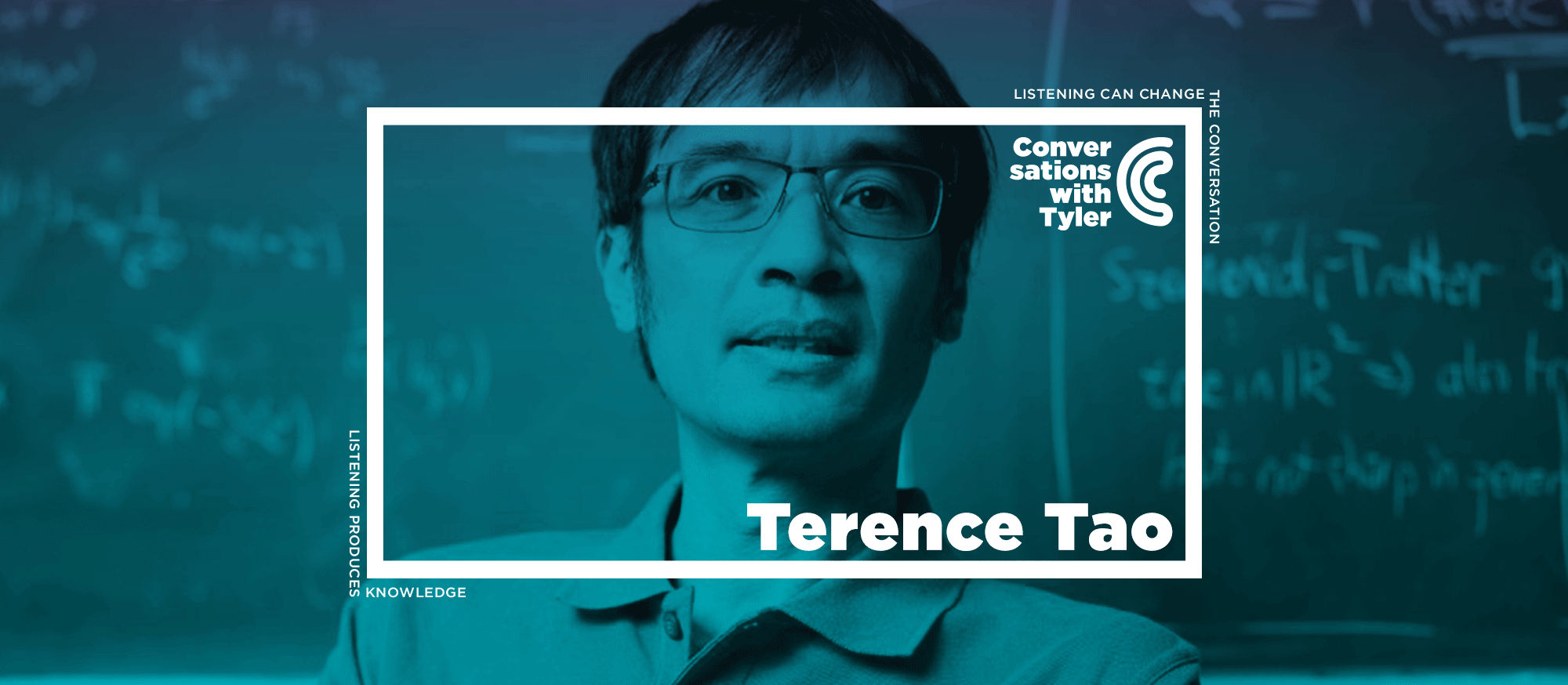
Tyler calls Terence Tao arguably the greatest mathematician of his generation: a Fields Medal winner who has published serious work across harmonic analysis, partial differential equations, number theory, probability, and compressed sensing, among many other fields. His new book, Six Math Essentials, is the occasion for this conversation, but Tyler spends much of it asking something more personal: not what the proofs say, but what they feel like. Tao’s answers reveal a mathematician who treats beauty as a real signal, finds Gödel’s incompleteness theorem genuinely unsettling even decades later, and is remarkably candid about failing both Fortran and quantum mechanics as an undergraduate.
Tyler opens by asking Terence what it feels like to contemplate Euler’s identity, quantum mechanics, the Riemann hypothesis, and Gödel’s incompleteness theorem, before moving into why mathematical history gets stripped out of classrooms, whether abstract math is a lottery ticket or a unified whole, string theory’s beauty versus its lack of confirmation, why real analysis arrived so late, why zero took until the 7th century to be invented, game theory, the Black-Scholes model, Bostrom’s simulation argument, and Newcomb’s paradox, math education and the case for teaching more statistics, Tao’s view that AI has pushed mathematics from an era of “proof scarcity” into “proof abundance,” what that means for the research paper, why video talks may become more valuable than papers themselves, Tao’s favorite Hong Kong action movies, his unconventional path through an Australian university at age 13, his most unusual work habit, his verdict on the Collatz conjecture, and more.
Watch the full conversation
Recorded October 8th, 2026.
TYLER COWEN: Hello, everyone, and welcome back to Conversations with Tyler. Today, I’m very happy to be speaking with Terry Tao. He has a new and excellent book out, Six Math Essentials. Terry is arguably the greatest mathematician of his generation. He is a Fields Medal winner, a professor of mathematics at UCLA, and he has done research in topics as varied as harmonic analysis, partial differential equations, algebraic combinatorics, arithmetic combinatorics, geometric combinatorics, probability theory, compressed sensing, analytic number theory, and he writes a blog, and much more. Terry, welcome.
TERENCE TAO: Oh, pleasure to be here.
COWEN: Now, people often think of mathematics as about logic, but I’d like to start by asking you about emotions. I’ll name a few results in math, and you tell me what emotions they evoke in you, okay?
TAO: All right.
COWEN: Euler’s identity.
TAO: That is a very pretty and neat identity. It connects all the fundamental constants of mathematics: e, π, i, and 1 and 0. Actually, to me, what is most beautiful about it is that what it’s really saying is that rotation is actually a type of multiplication. Euler’s formula, you can think of it as eiπ = −1. This is one form of Euler’s formula.
When you exponentiate, raise e to something, it’s like you’re multiplying something over and over again. Compound interest is one place where exponentiation shows up. The i shifts things from just multiplying to make things bigger or smaller, but instead, we’re multiplying at right angles and making it rotating. eiπ is saying that if you rotate something by π, π radians, you flip it. It becomes the negative of what you start with. It actually connects geometry and dynamics and algebra. It’s a very beautiful formula.
COWEN: When you ponder quantum mechanics, what do you feel?
TAO: Oh, yes.
COWEN: For me, it’s puzzlement, but you’re smarter than I am.
TAO: It uses very abstract mathematics, the mathematics of Hilbert spaces, which are these infinite-dimensional vector spaces, and complex numbers. You definitely need a fair bit of mathematical training to understand the mathematics. It also forces you to really change your idea of what reality is. It’s like how we used to think that the Earth was stationary, and then we had to change our perspective and think of the Earth as moving. Before quantum mechanics, we used to think of physical objects as always only being in one state. A light is on or off. The cat is alive or dead.
In order for the equations of quantum mechanics to work, you have to accept that, in fact, most of the time, objects live in superpositions. A cat is neither alive nor dead, but a mixture of both. They interact with each other in funny ways, like how waves can interfere with each other. It is a very unintuitive way of thinking about reality because we don’t see ourselves in superpositions, but the math actually works out. Despite everything, it actually is a better way of explaining the world, especially at a molecular level. It is very mysterious, and it was very controversial when it first came out. A lot of physicists did not accept what the math was telling them.
COWEN: The Riemann hypothesis, what do you feel?
TAO: Oh, yes. That is a really big prize in mathematics. Actually, recently we’re getting some progress on that. That’s another story. It concerns one of the most basic objects in mathematics, the prime numbers, which we now use prime numbers all over the place, like in cryptography. For instance, a lot of cryptographic protocols that we use to encrypt our finances and whatever rely on properties of the prime numbers. We look at the prime numbers, and they behave very randomly. Sometimes they’re close together, sometimes they’re far apart.
The Riemann hypothesis is a very precise way of quantifying this random-looking nature of the primes, and it has many, many consequences. Any part of mathematics that touches the primes, if you know the Riemann hypothesis, normally your results get stronger. There’s a large chunk of results in number theory which are conditional. If you have the Riemann hypothesis, you get this good result. Otherwise, we can’t say anything.
Out of all the results, open questions in mathematics, most open questions in mathematics, they’re like puzzles. We don’t solve them for their own sake. They’re useful for gaining insight and help us eventually understand more realistic, real-world problems. The Riemann hypothesis is one of the few mathematical questions which is actually quite useful for its own sake. Knowing that it’s true would actually imply a lot of other things.
COWEN: You think it will be proven, can be proven?
TAO: We are making progress. In fact, just two days ago, there was a significant advance on the Riemann hypothesis. We are still quite a ways from the full resolution, but now there are new ideas. Unfortunately, the ideas were generated by AI, and we don’t yet understand them. This is part of the new era now. We are getting answers without understanding, which is a very strange era to be in.
Historically, the only way to make a progress on a difficult mathematical problem was to understand it, and you could communicate these insights to others. Now we have these machines that can give us answers, but we have to really work much harder than normal to extract out the useful insights from them. It is a strange era. We now have these new tools, and hopefully we will have lots of mathematicians exploring both old methods and new methods, and we will find something. It will probably require a new idea which we haven’t seen before. We know the limits of many of the existing techniques.
COWEN: Gödel’s incompleteness theorem, does it frustrate you?
TAO: Yes. Mathematics is going through a crisis right now. There was a similar crisis 100 years ago. David Hilbert, who was one of the leading mathematicians in the early 20th century, had this great dream finding that every single open problem in mathematics should be solved or unsolved. We should systematically try to answer all the questions in our subject. Here’s a famous quote in German: “Wir müssen wissen, und wir werden wissen,” “we must know, and we will know.” Now, this was the rallying cry for mathematics in 1900.
Gödel proved this very, very striking result that no matter how you set out the rules of mathematics, there will always be statements that cannot be proven or disproven from those rules alone. That there is no fixed set of laws of logic that can answer every single question. They will always be incomplete. This was very traumatic for mathematicians. It said that Hilbert’s program would never be finished in some sense. Over time, I think, we acclimatized to it.
In practice, many of the results that we do care about, we can prove or disprove. The specific statements that Gödel showed which were not provable or decidable are not the ones that we encounter in real life. Sometimes there are questions that you can’t answer using the usual axioms or rules that you’re allowed to use normally, but sometimes we add new rules. There are other foundations of mathematics which can prove more things than the standard ones. Sometimes we do play with different rules, like when you play chess. There are some standard rules of chess, but sometimes we also consider other variants.
We’ve moved to a more pluralistic view of mathematics, where there isn’t just one true mathematics and one universal true and false facts. There is a standard one, but we do also consider more exotic alternate types of mathematics, where we have more rules or fewer rules, and there’s a multiverse of different types of mathematics to play with. We have different number systems. We have different geometries.
Mathematics has evolved over time to just a more pluralistic view of everything. We are comfortable with it now, but it was a very uneasy feeling to discover this result in 1930, that your worldview of mathematics changed. It’s as if you thought the Earth was stationary, and now you know it moves.
COWEN: Is it fair to say your overall approach to the foundations of math is quite pragmatic? It’s not Hilbert, it’s not Brouwer. There’s really no result that could come along that would make you feel nihilistic. It’s just there’s different avenues to explore things. Is your view different than that?
TAO: Yes. I try to have some humility. There are certain mathematical models that I like, and I think they explain the real world. There have been revolutions in the past where quantum mechanics, you mentioned, was a very big philosophical transition in physics. We are currently going through a transition where most of mathematics was human-generated, and we’re now entering an era where proofs are being generated by AI.
This is also changing our philosophical foundations of what does it mean to prove something. What does it mean to understand something? As I said, these two statements used to be almost synonymous, and now they have been decoupled quite severely. I try to keep an open mind, which I think is part of what it means to be a good scientist. You don’t have a dogmatic view of what science is or isn’t. You update it based on events and new data.
COWEN: How much do you read in the earlier history of mathematics, say, 19th century, early 20th century? Do you learn by doing that, or it’s just a fun thing you do as a hobby?
TAO: I think mathematics is about stories a lot more than is normally presented. If you take a math class, maybe you might hear some stories about there was a mathematician called Évariste Galois, who died in a duel. He was writing very frantically the basis of what we now call Galois theory the night before the duel because he was certain he was going to die, and he did. There are lots of wonderful stories that make the subject come alive.
Unfortunately, often when you present them in classes, you take out all the backstory and the side context, often because of lack of time. There’s a lot of math that you want to give to your students. Math often comes across as just a bunch of equations and rules and recipes. I do find that reading the histories makes it come alive. There are some really good stories in the history of mathematics, which, luckily, they make for great podcast stories and YouTube videos. Maybe they do get heard by the public, but not in classrooms so much.
COWEN: How much of abstract mathematics do you feel is useful? Is it like a lottery ticket where maybe one in every 200 things is useful, but it’s clearly worth doing, or is your view that if we knew everything, explored all angles, it would all fit together, and every part of it would be a unified whole that could be used for something?
TAO: Right. I view STEM as a whole—science, technology, engineering, and mathematics—as an ecosystem, and mathematics is the soil. It’s at the foundations. It doesn’t generate the fruits, the things that are most directly useful for humans, but it sets the stage. Of course, it gives us all the formulas and recipes that other scientists use. It also sets limits. Most other sciences or engineering, they tell you what’s possible. You can build a rocket, and it flies, and now you’ve proven that it is possible for a rocket to fly.
If you want to show that something’s impossible, that there’s a limit, for example, if you want to communicate using a wireless spectrum, what is the maximum amount of bits you can stream from A to B? There’s a branch of mathematics, information theory, that tells you this, and it gives you limits. There’s a maximum theoretical limit, and you can’t discover this by engineering.
You can send more and more bits down a channel, but only mathematics can tell you that there’s a limit. This is useful because it tells you how close you are to perfection, and when to stop trying to develop an even better wireless encoding protocol because you’re already at 98 percent of mathematical capacity. There’s really no point to spend another $1 million trying to make it any better.
Mathematics unifies science. It gives a common language, so scientists get to talk to other scientists. Whether something’s useful or not, it often takes decades. Shannon’s information theory came out in the ’40s, but it’s only when cellphones came along and big data that it really became so essential to the modern economy. Even if a topic is useless now, who knows in 20 years, 40 years.
COWEN: When string theory is presented to you, viewing it just as a mathematician, does it feel beautiful to you, or do you think this is strange and awkward, it’s not intuitive enough? What’s this higher number of dimensions doing here? Is it interesting math to you? What is it?
TAO: This is less of my field. The ideas from string theory have impacted geometry quite a lot. The modern field of mathematical geometry already studies very high-dimensional objects and making them even higher dimensional by turning points into little strings, they’re very comfortable with that. My understanding is that the ideas proposed by physicists have inspired mathematicians to solve many geometry problems in their own field.
Now, my understanding also—I’m not really a physicist, though—is that while the theory is very beautiful, it could have been a good explanation of the real world, but we have not found a really striking confirmation that string theory really is a good model. One of the objections that I’ve heard is that it’s actually too flexible a theory. There are too many ways in which these strings can vibrate. While they can explain our current universe, they can also explain trillions and trillions of other alternate universes, and there’s no obvious way to explain why we live in this one and not in all the other universes that are compatible with string theory.
I don’t know to what extent string theory is still the leading proposal for, say, quantum gravity, which is one of the big goals of modern theoretical physics, to unify quantum mechanics and gravity. There was a lot of hope that string theory would do this. They’ve tried for many decades. I think that there’s still no really conclusive evidence that it’s working. I think people are beginning to explore other alternatives to string theory as well, but you may have to talk to a physicist for the latest on that.
COWEN: Reading your book, I come away with the gut feeling, a purely subjective impression, but that you love geometry most. Is that justified?
TAO: I love all kinds of mathematics. Maybe I like it because I’m not as good at it as with other types of mathematics. There are mathematicians who are very visual, and they can see a complicated shape and rotate it in their mind. I can’t do that. I actually have to write things out and use visual aids, blackboards, to really see geometry. I have to put some real effort to understand geometric ideas. Maybe because of that effort, the ones that I do understand, I actually find quite beautiful.
My native field is actually more analysis. I like understanding what things are big, what things are small. If you add a whole bunch of small things together, can you get something big? When do waves interfere constructively, destructively? That type of mathematics feels very natural to me. I try to appreciate all kinds of mathematics. I’ve learned a lot by talking to fellow colleagues who think about mathematics in a different way. I’ve learned a lot from them, and hopefully, they’ve learned something from me.
COWEN: With respect to real analysis, why does that come so relatively late in the history of math? It doesn’t seem that difficult in a way, once it occurs to you, that there’s such a thing at all, even if some of the results are difficult.
TAO: Traditionally, mathematics was about exact formulas and numbers: 2 + 3 is exactly 5. It’s only when we started dealing with really large quantities, like astronomical scales of numbers or big data, whatever, that we needed to start working approximately. If you want to know the GDP of the United States, you don’t need it for the nearest penny. Just getting the first few digits is enough. It took a while to figure out what was the mathematics for orders of magnitude, and I talked about what happens in the limit.
If instead of working in a family of five people or a village of 100 people, you work with hundreds of millions of people, you actually really want to send the number of people off to infinity and ask, what is going on in the infinite limit? Often, the mathematics becomes simpler. It’s like if you want to model a whole bunch of particles of a fluid, you could model all the trillions of particles bouncing around, but actually, it’s easier to think of it as a continuous object and talk about pressure and volume and macroscopic quantities.
Early mathematicians struggled a lot with infinity. The Greeks had all these paradoxes. They didn’t understand how infinity worked. It was a very nontrivial task. It took centuries to work out how to deal with infinity safely. It’s like radioactive material. Not all the laws of algebra work with infinity. It really has to be handled with care, but it is very powerful once you know how to use it.
COWEN: Zero as a number, that seems to come, in a way, late in mathematics. That’s what, the 7th century AD in India?
TAO: Yes.
COWEN: Zero seems so simple to us. Why does that take so long?
TAO: Because it’s invisible. I think it’s human nature to only give names to things that you see. You see a sheep, that’s a sheep. You see two sheep, that’s two sheep. You see nothing, you don’t say, “I see zero sheep.” It is a conceptual leap. It requires some abstraction. People inferred the need for zero by manipulating the numbers that they could see. In fact, I think there are many languages where they don’t even have a name for one. The counting system starts at two. Even the idea that a single object you can attach a count, one, to it, that’s already a conceptual leap. You may think that if you see a sheep, you don’t need to call it one sheep.
People had to work with numbers of two, three, four, five, and they started applying rules to these numbers. They discovered addition and subtraction and other arithmetic operations. Just by following the rules of what these operations were trying to do, they were naturally led to consider new numbers: one, zero, negative numbers, fractions, square roots. These are numbers that are not obvious. You can’t see −3 sheep or √2 sheep.
Once you trust in the laws of arithmetic, and you just accept that they are predicting other numbers to exist and be useful, then we found them. Now we teach them in our primary school classes, so it’s obvious to us. We’ve internalized things like zero. It was a major conceptual breakthrough back in the 7th century, as you say. We shouldn’t mock these ancient mathematicians for not knowing what zero was.
COWEN: When you look at mathematical economics over the last two decades, is it interesting to you as math, or is it just a bunch of people doing something different that, to you, is low level?
TAO: Oh, yes, I was always fascinated by economics. I love game theory, and actually often there are pure math problems where it’s actually good to think in game theory terms. In analysis, you have all these complicated statements, like for every ε, there exists a δ, blah, blah, blah. It looks very intimidating, but if you phrase it as a game, your opponent is giving you an ε, you need to counter that ε with a δ of your own. If you view it as a game, then actually you can talk about strategies and who’s ahead, who’s behind. It actually activates really good modes of thinking.
I’ve used economic thinking in my own work. We talk about cost functions and minimizing loss. There are lots of concepts. Ricardo’s law of comparative advantage, I use that to run my life. There are so many things I can do. What do I choose to spend my time on? It’s actually a very useful principle: comparative advantage.
Economics, I find it’s a very good arena to understand the difference between models and reality. Physics, we’re spoiled because we’ve had these great physicists who’ve created these very accurate models of the real world, classical mechanics, quantum mechanics, and they’re very well tested and very accurate. You can just go to town exploring their consequences and still predict reality. Economics is a much more mixed situation where you have models, and sometimes they predict the real world very well, but sometimes they don’t.
In addition to doing the math, you also have to do the modeling, and you have to understand the limits of when a model starts breaking down and what you need to do to adjust it. I find that fascinating. It’s somewhere between the hard sciences and the social sciences. There’s enough hard models that you can do math, but there’s also enough real-world messiness that you have to also grapple with the subjectivity. As an outsider, I find it a really fascinating subject.
COWEN: When you looked at the Black-Scholes model, were you shocked when the probability doesn’t matter? Was that beautiful to you?
TAO: Yes, yes, yes. There is a special feature of Gaussian fluctuations that you can price options just by knowing risk. There is one algebraic miracle that makes this work. Normally, predicting future costs of anything is just an intractable problem, and there just happens to be this miracle. If you have Gaussian fluctuations, then it is beautiful. This is actually a really good example of when you need to know when the models work and when they don’t work. If you don’t have Gaussian fluctuations, then actually Black-Scholes is somewhat dangerous to use, especially if you compound it into derivatives over and over again. Again, that’s an old story. You know what happened in 2009.
COWEN: Nick Bostrom has a famous argument using Bayesian analysis that probably we’re living in a simulation. I’m not sure if he believes it, but he doesn’t reject it. When you hear that argument, are you, A, convinced, or B, you think it’s somehow a misuse of mathematics?
TAO: I think it’s a good attempt. Bayesian reasoning is very subtle because, as I said, it’s already hard enough dealing with a model because you don’t know whether the model is accurate or not accurate. Bayesian reasoning, you’re not just dealing with one model of the world, but you’re dealing with multiple models of the world, and you have some prior belief as to how likely each model is, and then you’re updating them.
It could be that you may be considering two models, let’s say a hypothesis and a null hypothesis, but there could be a third hypothesis that you’re not considering at all, which is actually the true explanation. If you focus only on the two hypotheses that you can think of, maybe it’s your lack of imagination, which is actually blocking you from seeing the real truth. You have to be aware of your own limitations when you do Bayesian reasoning.
That said, you can use some reasoning like this. There are certain models for the universe that you can refute by pure reasoning. In ancient times, people believed in prophecy and fate, that certain people were destined to have something happen 20 years from now, but this is very incompatible with free will and having laws of nature that are very predictable. It’s also incompatible, to some extent, to being in a simulation, for instance. You can do these thought experiments, and you can play off various grand philosophical ideas against each other. You can play off the idea of simulation against the idea of there being a creator.
One amusing thing I saw on the internet recently is that the fact that we can now create AIs that appear smarter than us has theological implications as to how intelligent our creator was compared to ourselves.
COWEN: Yes.
TAO: It is entertaining to explore these thought experiments, but you do have to be very humble that we could be limited by our own imagination. We are comparing different models to explain the universe, but there are infinitely many other models that could also explain things and sometimes we are just completely off track.
COWEN: Newcomb’s paradox. Are you a one-boxer or a two-boxer? You sound like a one-boxer so far.
TAO: Oh, okay. I have to be reminded—
COWEN: That’s the Nozick problem from the—well, it comes from Newcomb, of course, but you can grab one box or two box, and you’re told by a potentially omniscient being that if you grab both boxes, you’ll end up with less. The dominance principle tells you to take both boxes. Expected utility maximization says only take the one box.
TAO: Right. One thing that this paradox shows you is that sometimes having more free will and agency actually hurts you. You may think that the more optionality and ability to think you have, the better you’ll be off in life. That seems intuitive. As I recall of Newcomb’s paradox, if you lobotomize yourself to say, “I will actually do surgery on my brain so that I cannot take two boxes, I will only be able to take one box,” then this being that is observing you will see that, and it will reward you. Whereas if you’re overthinking it, then you may actually get penalized.
Newcomb’s paradox is actually an environment where you are penalized for thinking too much. It’s an exception to the rule that being more rational is an advantage. It is a nice thought experiment, but it may have real-world implications. There are actually some scenarios where you don’t want to signal that you’re too smart.
COWEN: David Lewis has this famous article, I think it’s 1982, where he argues the repeated prisoner’s dilemma is a lot like Newcomb’s paradox. This is a contested claim.
TAO: I can see that, yes. Actually, I saw a great talk about this recently, that if you automate your prisoner’s dilemma strategy with a computer program and everyone gets to see your computer program—it’s a very simple strategy, like maybe you cooperate unless you saw someone defect, and then you defect yourself. If you signal in advance what you do and you remove your own free will, then you can actually do better in the game because people will see that you’re trusted.
There was this debate about a year ago: If you’re a woman, would you rather be with a man or a bear? Many women said they feel safer with a bear, and I think one of the reasons is that the bear has a much higher rationality. It’s much more predictable what the bear will do, and the fact that interacting with someone who is really intelligent actually adds risk. There’s lots of games like that. I think the game of chicken is another game where one of the strategies to win chicken is to actually disable your steering wheel and just go full speed ahead, but visibly throw away your steering wheel. Then the rational strategy for the other player is to swerve.
COWEN: Let’s say we put you in charge of math education in the United States. Put aside AI. We’ll get to that in a bit. How would you improve math education here?
TAO: Oh, that is a really complex problem. My main experience with education is at the university level. I’m at a fairly prestigious university where we are quite selective, so we get among the best students coming from both the American and overseas high schools. I don’t have the best view of what’s going on at the K-12 level. I talk to people, and I have two kids who have gone through the K-12 system, but that’s really a small amount of data.
COWEN: Wasn’t there a recent report that UCLA faculty complained that a lot of the entering students didn’t even have great middle school math? Some do, some are excellent. I’ve taught in the UC system, but it’s high variance.
TAO: Yes. There was a report from UC San Diego in particular that was quite concerning about the basic readiness of many of the students. I’m not sure whether it’s because our selection system needs fixing. There’s a debate to reinstate the SAT in the UC. Or whether it’s because of COVID. That could be a consequence. Some people say that social media has destroyed the attention spans of school kids. We don’t know. There are people who try to systematically study education quantitatively and try to see what types of pedagogy work best, but it is a very soft science. I think some of the findings are controversial.
I do think we need lots of experiments, and some way to scale up experiments that work on a single school to the whole system. I do know that there have been lots of little experiments. Let’s flip the classes. Let’s ban technology, or let’s do things in a different way. When you do it on a small scale, it can be great. When you have some teachers who are really enthusiastic about this experiment and the kids are excited about trying something new, you can get these fantastic results. Then you try to deploy them to 100 schools, and suddenly it doesn’t work.
One big issue is getting from a prototype experiment to a large-scale deployment. This I don’t know how to solve. There’s some pragmatic realities of just how education works at a typical, let’s say, American high school, that you can’t ignore just because something works in some nice lab school experiment.
COWEN: Many of my economist friends, they think we should teach less trigonometry and more statistics. Do you agree?
TAO: Yes, I think that is a tweak. Traditionally, the college math syllabus consists of a lot of calculus, because for the classic applications to physics and engineering and the hard sciences, calculus was almost the most important higher math skill that you needed. In the era of big data, statistics and now machine learning and linear algebra and probability are becoming more important. We are making some tweaks there.
Although mathematics is often not about the specific tools that you learn, but just how to deal with abstract situations and how to problem-solve. I view math as a good playground to think where the cost of failure is cheap. In the real world, if you do something in the real world and you make a mistake, it could be very expensive. If you’re a civil engineer and you’re tasked to build a bridge and you make a mistake and the bridge collapses, you made a very expensive mistake. If you’re a surgeon and you cut the wrong thing, you’ve made a very fatal mistake, perhaps. If you have a math problem and you solve it incorrectly, you just have wasted half an hour of your time, but you can go back and do it again.
The specific tools you learn in math are somewhat useful, but actually just the ability to play and try to solve problems when there’s some unknowns and things you don’t understand. How do you even start? How do you set up the model? How do you not get terrified of all the possibilities, and how to not get paralyzed when you’re faced with anything complex. That, I think, is the valuable skill, the most valuable. All the other stuff you can look up or even consult an AI now if you really wanted to.
COWEN: You did a math Olympiad when you were 10. Should there be some kind of embedded calculus option in 7th grade that, if you want to do it, you can just learn calculus early on, and if kids don’t want to do it, they don’t have to?
TAO: There are Advanced Placement-type exams, and there are math enrichment. There’s math clubs. I think it’s good to have a lot of options like this. They shouldn’t be mandatory. I think if a kid doesn’t want to do these things and you push them into this, they will just have a horrible time and end up hating mathematics.
Whether you want to formally include this in the standard school system, I think there could be special schools where they have experts, and they really make an effort to integrate these competitions and nonstandard classes into their framework. It can work, I think, when there is the supporting infrastructure—so qualified teachers, supportive administration, and just general rules for how a student can choose these activities in place of standard classes, but it may not scale to the average school.
There may not be enough qualified teachers. Some schools may have policies that are just somehow not compatible. There may be too many parents in one school that just do not like this type of education. I think these options should exist, and it should be possible for parents and kids to select among several school options, some of which would offer these and some of which don’t.
COWEN: How do you feel about quant finance? Do you view it as a brain drain out of math, or the potentially high wages overall attract more talent into math, and some of the people still end up doing things in mathematics, so the net effect on math is positive? What’s your view?
TAO: On the one hand, mathematics, like academia in general, we don’t have enough positions in academia. Academia is a fairly small sector of the economy. We train many more students than can end up having academic jobs. As a very practical matter, we need other industries that also value mathematicians and can hire people with, say, math PhDs. Quantitative finance has been very good at that, so often they actually pay very, very well, better than academics in many cases. I think that’s fine.
There are many positive uses of quantitative finance. Used properly, you can price things well, you can get accurate market signals, you can get liquidity. If you pursue the wrong metrics too much, you can also destabilize economies and create crashes. It impacts the real world, so you have to be more aware of these issues than if you were just a pure mathematician.
There have been mathematicians who were very successful in finance and gave back to the math community. Jim Simons is one example. He founded Renaissance Technologies. He made many, many billions of dollars, and actually, he founded the Simons Foundation, which is now a major sponsor of pure mathematics and physics and astronomy and computer science. It works out.
I do think academics do need to get out of the ivory tower sometimes and engage with various industries—finance, the tech industry. Here at UCLA, we’re close to Hollywood, we had a lot of ties with computer graphics industries, for instance, and the movie industry. There are many sectors of the economy now which are becoming more mathematized. They need people with good math skills, and we should engage with all of them, I think.
COWEN: How long do you think it will be before AIs create the equivalent of new Millennium Problems for mathematics? Is that two years away, 20 years away? Interesting ones.
TAO: It’s extremely uncertain times now. I think a lot of assumptions about how mathematics operates is going to change a lot. There’s so many changes, but in one sentence, we have moved from an era of proof scarcity to proof abundance.
It used to be that proofs were really hard and valuable, and so we would create these open problems as these goals, these landmarks, and we would march toward these goals very slowly and deliberately, but we’d pick up all these insights and techniques and learn all these things along the way. We have these Millennium Prize Problems, and we have these targets that guided us, but they’re relatively few in number. There’s only seven Millennium Prize Problems. That was the way things worked in a proof-scarcity era.
I think going forward, the idea of focusing on individual problems, that currency has basically been hyperinflated. We now have machines that can just brute-force, basically solve massive numbers of the old problems that we used to use as landmarks, and we have to really switch to some sort of math 2.0. I think instead of dealing with individual problems, we may start creating huge datasets of thousands or millions of problems and try to sweep them out. With this AI, I can handle 30 percent of these problems. Using this idea that this human contributed, I can solve this 10 percent, but not pick out individual problems per se anymore as the goals, but work at a much higher scale.
I think that it will take a lot of cultural shift. We are not used to mass production of mathematics. We are still, in many ways, in a pre-industrial economy, math academia. We are forced, almost at gunpoint right now, to switch to an industrial or post-industrial economy, and this will take quite a bit of cultural change, but I think that’s what’s going to happen. Individual problems, even like Millennium-level, may disappear, and we will just have lots and lots of big datasets of problems.
COWEN: On net, you’re happy? Unhappy?
TAO: That’s not the right word. It’s very complicated. I’m excited by the possibility of completely new types of mathematics that didn’t exist before, but I’m also actually quite horrified by the disruption, which I think was much more than necessary.
Of course, every revolution, like the Industrial Revolution, of course, is a famous example, it creates job displacement and so forth. I think there was some medium between status quo and transition to a new paradigm where you had more of the benefits of transition and fewer of the disruptions. If the Industrial Revolution happened within one month, it would have been much more traumatic, entire careers cut short with no ability to transition halfway through.
COWEN: It would have been better overall, right? Like our standard of living, people might have had in the 1950s.
TAO: Yes, but a lot might have been destroyed permanently. There are still pre-industrial ways of handcrafting certain objects or doing things in a very old-school way. There are communities that keep these more artisanal types of craft alive, and they have cultural value. There was enough time in the revolution to preserve these culturally significant artifacts. It is possible that there could be some major disaster where we lose our power grid or something, and some of these antiquated skills actually become relevant again. Actually, from a strategic point of view, there’s actually some value in preserving what you might think of as obsolete skills.
Sometimes the historical insights of how an obsolete practice developed can inform the development of a modern skill. We talked about the importance of history and mathematics. It’s true. History is important everywhere. If you rush the transition too much and you just focus on just getting your productivity up or hitting some other benchmark, you may lose some of this less tangible value that you may only see after the fact what you’ve lost. It’s like everything. If you want to do urban development, you need to tear down old buildings to create new ones, but some buildings have actual historical value, and there is a way to develop sustainably.
COWEN: Will the individual paper still be the research unit for human mathematicians, or will that change also?
TAO: I believe that will change, especially since now AIs can generate that unit at a press of a button. First of all, that unit used to be bundled with other valuable things. Traditionally, when a mathematician created a paper, they also created a skilled author who could then give talks about that paper. They could go to conferences, they could interact with other humans, they could train students. Through that, they can discover new connections, new collaborations, new questions to ask.
Now we have these AIs that generate the paper, but without all that extra value. They have unbundled the PDF, the actual physical paper, from the penumbra of more social or intangible values of that paper. Also, when a human solves those and writes a paper, it came from first understanding the problem and getting some insights, and that you can communicate. The AI often does not communicate what it learned when it solves the problem. It just gives you the output, but the process is very opaque.
On the one hand, I think papers will evolve to show much more of the process. We have focused a bit too much in the past on just showing the finished product, but we’ve seen it in other disciplines. Movies are enriched when you see behind-the-scenes documentaries and lots of extra material. People enjoy that extra content, and I think papers will move in that direction.
I also think that we will also work at much larger scales than papers. We will see entire databases which are like the equivalent of thousands of papers networked together in a single spreadsheet, which you can query and you can update in real time, and you can get all these visualizations, which you just could not do with the old system. Or every time you wanted a new way to visualize the literature, someone has to write a new paper, and you have to wait a year before you get a different view. You should be able to see an entire field.
I think people will have to move to more collaborative, big math projects. Instead of a small number of people working on individual papers and then contributing atomically to the literature, the literature itself would be a much more networked, living, collaborative entity where both AIs and humans can collaborate. I think this is the only way forward.
We’ve seen in recent months that brute competition between humans and AIs is becoming very counterproductive. People are just racing to dump out a paper three minutes before someone else with an AI is generating almost exactly the same paper, and everyone is cutting corners and making the papers harder and harder to read just because they want the priority. Priority used to be a very good way to organize our field and encourage people to produce results in a timely fashion. The metric has become way too over-optimized now, and we need to switch, as you say, to beyond thinking at the scale of a single paper.
COWEN: Now, you had started a new “journal,” if that’s the right word, where people submit video talks rather than printed papers. Does that now become more important or less important?
TAO: I believe exposition, in general, has been undervalued in mathematics. We used to let the papers speak for themselves. Proofs were scarce, and there were few enough difficult papers that it worked that, when a new result came out that was interesting, everyone dropped what they were doing and read those papers. Now, the flood of papers coming out, in every field, there are 10 times, 100 times more interesting papers than people can read.
The bottleneck is now, what are the results that can be explained human to human? Papers are actually a very terrible way to communicate. Most people have not had the experience of reading an academic paper, but it’s much easier if you can interact with a human expert and ask questions, use body language, use some visual aids. Talks have been one of the traditional ways in which we do that. We view these as secondary byproducts of research, but I think, increasingly, they will become one of the primary outputs, especially since papers can be generated now by AIs. Having the human-to-human experience is increasingly valuable.
COWEN: Just for our last segment, a few questions about you. What is your favorite Hong Kong action movie?
TAO: Ha. It’s this half action movie, half comedy. My favorite is called Kung Fu Hustle by Stephen Chow. It came out about 20 years ago, back in the golden age of Hong Kong cinema. I’ve not really followed the modern era, but it is hilarious. It’s an over-the-top parody of Hong Kong action movies. The fights become more and more ridiculous and absurd, but also just incredibly funny. It works best in the original Cantonese, but it holds up in English. I recommend it to everybody.
COWEN: I like Drunken Master II, with Jackie Chan. Do you know that one?
TAO: Yes, I watched it when I was a kid.
COWEN: Sometimes it’s retitled as just Drunken Master. You have to be careful with the edition because the first Drunken Master is not that good.
TAO: Yes. The conceit is that he’s a martial artist who becomes better the more drunk he is. There’s this very weird style. This is very typical golden age Hong Kong action cinema. You start with some ridiculous conceit, and you just run with it, and you just play it straight. That’s also a very good one.
COWEN: What do you find most beautiful in music?
TAO: I used to enjoy classical music when I was a kid, especially Bach, the very intricate patterns. Nowadays, sometimes I like epic instrumental music, like the Lord of the Rings soundtrack or something. Sometimes it inspires me into a working mood. Sometimes I just need some random pop music that is very familiar as comfort, some Taylor Swift thing or something, something mindless.
Actually, it’s funny. I have access now. I can play any piece of music now just by searching on the internet very quickly. I actually listen to it a lot less than when I had to have CDs and things. It’s interesting. The more abundant something is, sometimes the less you use it.
COWEN: Now, as an undergraduate, you went to Flinders University in Adelaide. That’s correct, in Australia?
TAO: Yes.
COWEN: Do you feel you somehow would have done worse had you gone to Cambridge or Princeton? Is it part of your success that you had this unusual beginning?
TAO: Yes. My parents worked very hard to design an education track that suited me. I skipped a lot of grades. In fact, in math and science, I skipped five grades. Emotionally and in the humanities, I was not at that level, so I would also take classes in physical education and English in my regular year. I had this very complicated schedule where, when I was in primary school, I would take some classes in high school. When I was in high school, I’d take math classes at university. I enrolled in university at the age of 13, I think, but I still lived at home.
Flinders University was a small university, but it was a short drive from where we lived. I knew all the faculty, and we were in small classes. There was a particular math professor where we met every week just for an hour, just talking math, very casually. I took my classes, and actually, I even failed some. I wasn’t actually the best student, to be honest, but it was at my level.
COWEN: This is in math you failed some?
TAO: Yes, yes. Actually, quantum mechanics is also a class that I failed. The two classes I failed were Introduction to Fortran. I liked programming in BASIC. I didn’t want to switch to Fortran, so I refused to learn Fortran, and I failed the class. Then Introduction to Quantum Mechanics, where the class was half solving differential equations, and that was fine, I liked doing the math, and half explaining the history of quantum mechanics. There was an essay component, and I just refused to do the essay, and I failed. I remember crying. I actually had to be escorted out of the exam room.
I think actually not being in a super competitive environment at the time, but in a small place where everyone knew everyone else, I felt on par with my other students, that worked well for me. Then I went to Princeton as a graduate student, and that was a much more elite institution. I was shocked at how much my fellow grad students knew a lot more math than I did. It was in grad school that I failed the first exam that I really did not expect to fail.
I failed two exams when I was an undergraduate, but these were classes I didn’t care about, and I expected to do badly. My qualifying exam was an oral exam, and I actually learned I was terrible at oral exams. I could not convince my adviser that I knew the subject I was studying, and he was very disappointed with me. It actually changed my life. I actually started studying it much harder and actually putting real effort into explaining what I do. I tried not to disappoint my adviser ever again. It worked out for me.
COWEN: That’s quite an unusual history. Today or more recently, what’s your most unusual successful work habit?
TAO: I am learning the power of delegation more and more now. I used to want to do everything myself, but I am finding that my research collaborations, trusting the junior people to take the lead, working with students. Nowadays, with the internet and AI, AI in particular, it can be a very dehumanizing technology, but it can also be a very empowering technology. It can enable junior people to take the lead in projects where traditionally only senior people had the experience to handle complex tasks.
I’m finding that people rise to the challenge, that if you give someone an ambitious task, and they’re bright and they’re motivated, they often can exceed your expectations and do things that you wouldn’t have thought of. I have a blog where, for almost the entire history of the blog, I wrote like 99 percent of the articles. Recently, I’ve turned over my blog to the community, and now 95 percent of the articles are written by other people, and actually they’re great. They offer points of view that I would not have thought of.
COWEN: How do you think about your own level of stamina? I don’t know your age, but you’re not 23 anymore, and you’re still doing plenty and then some, right?
TAO: Yes. I’m 51 now, and yes, I am exhausted quite a lot. This is another reason why I’m learning to delegate. I have no choice. Delegating to humans, also delegating to AI some things. I am learning that you can’t do everything yourself. Sometimes you just accept that other people can do things better than you can. Every morning of my day, I’m doing something, but it’s something I choose to do, and I feel good about it, even though I’m always tired.
COWEN: Very last topic, a very simple one. Collatz conjecture: Is it true or false?
TAO: It’s true, but we have no idea how to prove it, even with our fancy AIs. The Collatz conjecture is sometimes called the hailstone conjecture. You take a number. If it’s odd, you make it bigger, you multiply by 3 and add 1. If it’s even, you make it smaller, you divide by 2. Then you just iterate this over and over again, and the numbers go bouncing up and down like a hailstone. With hail, every hailstone eventually lands and goes down to Earth, and we think the same is true with Collatz, that every number, it goes up and down, but it will eventually hit 1, no matter what you do.
The first trillion numbers we’ve tested do this. We also now know that, in some sense, almost all numbers either do this or come very close to this. We’ve made some statistical progress on this conjecture, but there’s always a chance that there’s this one very special hailstone that just somehow, instead of falling to Earth, just keeps floating up and up, higher and higher, or maybe in a loop.
There could be one special exception or a small number of exceptions, and we can’t rule this out. It’s like if you’re at a casino and you keep playing roulette, most of the time you will lose because the odds are in the casino’s favor. There could be one special scenario where you just keep winning over and over again, and you just get richer and richer. Of course, at some point, the casino will kick you out. For Collatz, we can’t rule out that one exceptionally lucky hailstone. None of the ideas we have in mathematics come close to ruling out this very extra special conspiracy. I would love to know how to do that, but I don’t think I’ll see that in my lifetime, even with AI.
COWEN: Just to plug your book again, Six Math Essentials. Terry Tao, thank you very much.
TAO: Thank you for having me.