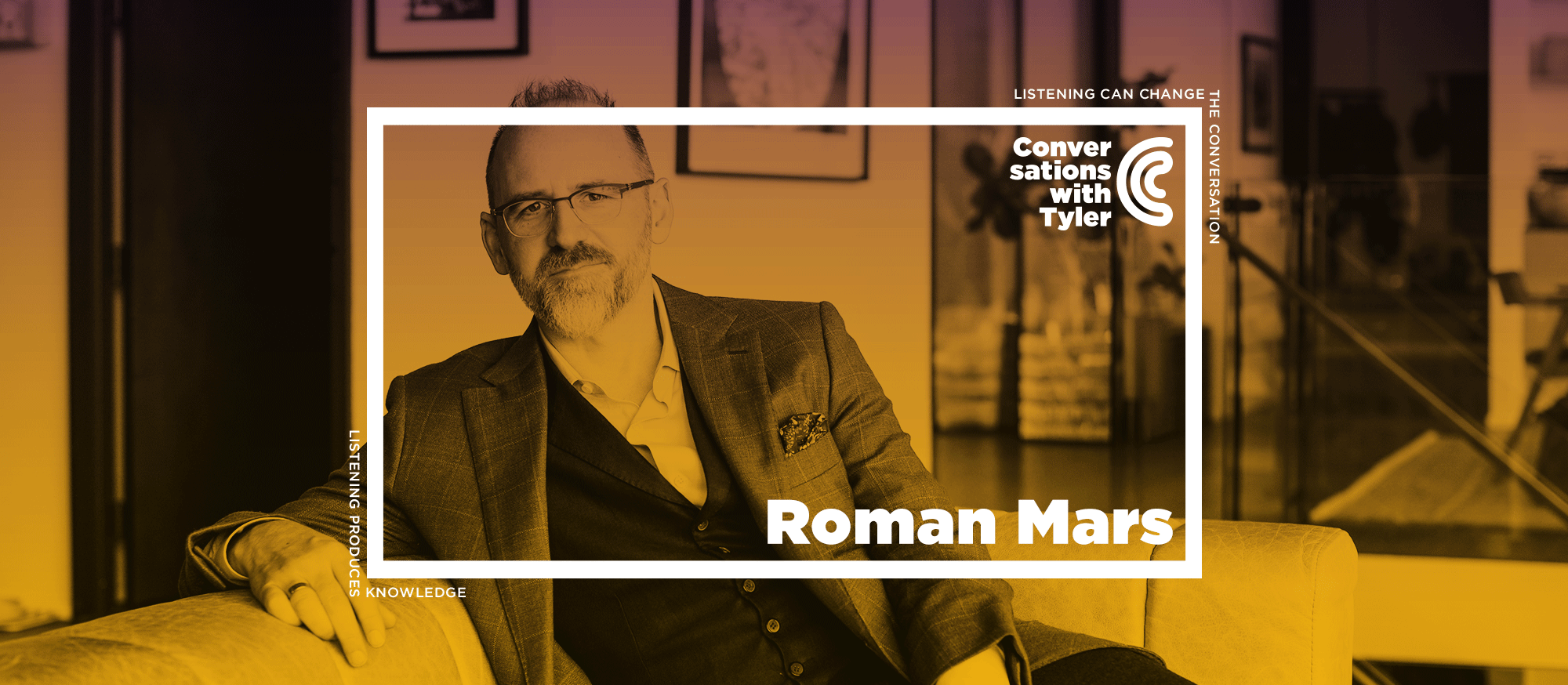



Roman Mars has built one of podcasting’s great empires out of noticing things everyone else walks past. His show, 99% Invisible, has racked up over 500 million downloads telling stories about the unnoticed design choices that quietly shape how cities and objects work, from speed bump psychology and flag design to the shape of a good street sign. His TED Talk on vexillology (the study of flags) is so influential that it has reportedly spurred 250 to 300 municipal flag redesigns across the country, including in Pocatello, Idaho, a city he once publicly called out for having the worst flag in America. Tyler asked questions about nearly every visual surface of modern life, and Mars’s answers keep circling back to the same tension: beauty and efficiency are often at odds, and most of what looks ugly to us is just a compromise we haven’t yet learned to love.
Tyler and Roman discuss street signs, why classic cars were so much more distinctive than today’s SUVs, Waymos, New Jersey jughandles, yellow streetlights, lane-stripe colors, why Houston keeps growing despite its lack of charm, whether any post-war American suburb is actually beautiful, the Chrysler Building’s rocky reception, brutalism done right and wrong, Central Park as an urban miracle, what Jane Jacobs got wrong, e-bike lanes, Tokyo’s bike-free transit model, the placelessness of global coffee shops, why the iPhone looks boring now, the ugliest country he’s visited, his love for Australia’s polymer notes, his soft spot for the dollar’s “locked in amber” weirdness, underground power lines, how to warn future civilizations about nuclear waste, why highway signs lie to you about speed limits, the principles of a great city flag, the Pocatello redesign saga, his own studio, why 99% Invisible works precisely because it’s audio-only, the most unusual habit behind his long productive career, and more.
Watch the full conversation
Recorded August 28th, 2026.
TYLER COWEN: Hello, everyone, and welcome back to Conversations with Tyler. Today, I am speaking with design expert Roman Mars. He is the host and creator of the podcast 99% Invisible, which he describes as a sound-rich narrative podcast, and it’s about the unnoticed architectural and design choices that shape our world. It is one of the most listened-to podcasts, and it now has over 500 million downloads. He also has an excellent book, The 99% Invisible City: A Field Guide to the Hidden World of Everyday Design, also with Kurt Kohlstedt. Roman, welcome.
ROMAN MARS: Oh, thank you so much for having me. It’s a pleasure to be here.
COWEN: I have many design questions for you. Let’s start.
MARS: I hope I have design answers for you.
COWEN: This, I think, is a hard one because I found it hard, but where do you think in the world the street signs are the most attractive, and what makes them that way?
MARS: Oh, my Lord. I don’t know if I know a good answer for this. I’d be happy to hear your answer. What I find, mostly as I’m getting older, is that the most beautiful street signs are the ones I can see the best. I’m always confounded by the fact that, especially as a pedestrian, street signs are often, the vantage point that they’re really concerned about is a driver versus a walker. As a walker, you’ll find that the street sign is placed before the intersection, that it’s for the driver approaching. You’ll be on a corner and you’ll be looking around New York, and you’re like, “I don’t know where I am,” because it’s a little bit behind you.
Yes, I don’t know if I have a favorite, like really beautiful one in particular, but I do love a really good grid. I like a street that you know how to navigate without too much looking at your phone. That makes me very happy. I also love to get lost in the alleys of Venice too. You just have to forge ahead, and you’ll get there eventually.
COWEN: Venice has good street signs, but for size, I would go with Los Angeles.
MARS: Yes, they’re quite big.
COWEN: They’re designed for drivers. I think for quality, most people would say some mix of Spain and Portugal, which have these ceramic themes. They’re not my favorites, but they would be classic choices.
MARS: I’ve only been to Spain a little bit. Yes, they’re really quite beautiful. There’s an abundance of good choices, but to me, it’s about functionality.
COWEN: I like the more artistic Switzerland, where there’s just the name and a color, and there’s blue and green, and it tells you how big a street or highway it will be, and everything is stark and it’s in this very Swiss font. That’s my personal favorite, but I don’t think it would win a poll.
MARS: It just matters if it works for you.
COWEN: Yes. Here’s another question I’ve thought about: Why is it that older cars, maybe most classically from the early 1960s, but not only, they’re so much more attractive than today. Today, so many cars are SUVs, they look literally the same. They’re so boring. They’re not offensive, but in the aggregate, maybe they’re offensive. What happened?
MARS: This is confounding to me. I’ve talked to a lot of industrial designers and designers over the years, and cars are often the way they got into design, caring about design as kids. That’s the first thing they ever noticed and really loved and cared about. A lot of it has to do with those forms that were so bold; it was a game on the highway where you could look ahead of you and from just the shape, you could say what model and make of car, maybe what year of car. It was so distinctive. Now, I think you couldn’t do that at all as a game.
I think that there’s boring and plain reasons for this, which are just energy resources and things. We put a lot of steel unnecessarily in cars during our extractive phase of manufacturing, where we made big and bold choices because we didn’t care that the things got 10 miles to the gallon and the shapes of the fins and the structures were ridiculously unsafe for the people inside. Those get shaved down by necessity and the needs of the environment, the needs of society.
Then I think that there’s something about people gravitating toward a mean and trying to mass-produce something that appeals to the biggest number of people, and then it gets increasingly more and more same-y. I do think it’s a real shame. The moments where there are all these breakout moments of something looking really different, I have to admit, I don’t really like them necessarily when they do. I think the Cybertruck is a horrible-looking vehicle, but it looks a lot different, mainly because its utility is quite terrible. Yes, it’s a real risk to go far afield and try to create something brand new. I think there’s a few pressures working to make things the same.
COWEN: Do you find Waymos attractive? Because I do. They look different. They look futuristic.
MARS: Because of all the gadgetry on top?
COWEN: The whirring thing on top. It’s almost satire how they look, but I enjoy it. I smile.
MARS: I’ve never been in a Waymo. This is my own personal thing: This is getting very personal very fast, but my one recurring nightmare when I’m very, very stressed is I’m in the backseat of a car with nobody driving, and I’m trying to climb over to control the vehicle. They’re not made for me in that sense because I feel like if I was choosing to make that choice. But Waymos seem very great. I think studies are very clear that a robot-driving car is way better than a human-driving car, so I have no problem personally with them.
COWEN: Do you think the nightmare goes away if you confront it?
MARS: Maybe. I think there’s a chance of that. It is my one recurring thing is being in a speeding, uncontrolled car, and I have to climb over from the backseat to control it.
COWEN: Now, I grew up in New Jersey, where we have what’s sometimes called the panhandle.
MARS: Jughandles.
COWEN: Jughandles, as a way of making left turns. You go around and then through from the side. Do you feel we underuse those, or should even New Jersey not have them?
MARS: There’s some good thought and efficiency built into jughandles. The problem is they really only work if you know they’re coming. If you’re familiar with the streets, it is a nice thing of avoiding long left turns or people waiting to make left turns. If you don’t know the street, like I’ve driven around in Jersey a lot, and it’s just you don’t know if you should be on the left or the right.
I’m a driver who likes to be in the lane I’m in very, very early. Making a rapid decision realizing that, all of a sudden, that you’re going to have to make a right to make a left is something that also just really stresses me out. If it was consistently used and there were never lefts, I’d be all for it. It’s the inconsistency which I think is a little bit of a problem.
COWEN: Maybe no one really visits New Jersey, right? You wouldn’t do it in California or Florida where plenty of people visit.
MARS: Yes, that’s true. It is definitely made for the people who are there.
COWEN: People in New Jersey, they don’t even visit other parts of New Jersey unless it’s what they call the New Jersey Shore. Only in New Jersey do they call it the shore, right?
MARS: Fair enough.
COWEN: Not beach, it’s the shore.
MARS: That’s right.
COWEN: Thus it may work there. I worry that as the value of land goes up, the jughandle or panhandle, it takes up more land.
MARS: It certainly does. UPS has algorithms where they make sure their drivers never make a left turn because it is just so inefficient and so bad for their routes. I’m of that belief. I’ll go way around the block to make sure I’m not making a left in a place that I’m not confident making a left. I think the jughandle does serve a real good purpose. It’s just the amount that has to be telegraphed to a person not familiar with them means that its utility is somewhat diminished.
COWEN: What do you think of yellow lighting on our roads? When I was a kid, that was a trend for a while. I never saw it take off. Is there any advantage?
MARS: Yellow lighting, like as in the overhead streetlights?
COWEN: Instead of white.
MARS: I don’t really know what the advantage is. I haven’t really thought about it too much. I think getting things toward more natural light and less glaring light is important in terms of our sense of the world and how much we want to engage with the night sky and stuff like that. As long as it’s thoughtful in terms of light pollution, mostly it’s a good thing, but I’m not quite sure in this case. I did interview a group of designers who had a company called Civil Twilight, and it was all about making streetlights a little bit more responsive, a little less glaring, allowing us to have a little bit more vision of the night sky in our cities. I’m all for that type of thing.
COWEN: What color should the central stripe be?
MARS: On a road?
COWEN: On a road, yes. Just white?
MARS: I think the utility makes sense. It’s white on the outside, it’s yellow on the inside if you don’t want it to cross, like double line if you don’t want to cross. I think that’s pretty good. I like the cat’s eyes reflective little markers that I think help me out a lot, again, as my vision is not as good as it used to be. I really rely on these retroreflective paints and cat’s eye, different things to make it so that I can see them. That’s the most important thing is being able to see them.
COWEN: Now, if I think of small towns in New England, many are quite charming or beautiful. If I think of Houston, not that much of it is attractive to me. Yet, Houston is growing pretty rapidly and the small towns are shrinking. How should I interpret that trend?
MARS: Houston is a place famously with no zoning laws whatsoever. That does create a type of growth that is valuable to some. I think it has its limits. What it does is it creates car culture, which is, I think, a net negative to only build a city around a car.
COWEN: If it’s a net negative, why is everyone moving there? Or like northern Florida, which is also car culture, growing rapidly in population?
MARS: Definitely when you ease those burdens of growth, growth is easier. I think that’s pretty clear. Then when growth is easier, cost is down. It’s all about making choices. I think that there’s going to be a group of people that find that to be perfectly great and perfectly that’s the world that they want, and there’s enough populace in the United States and a heterogeneity of what they care about that that’ll be attractive, and then there’ll be places where that’s not attractive. There’s definitely enough population to support it regardless, and so it’s fine that they have a place to go, for sure.
COWEN: Can you see a world coming, just say in the United States, where actually where people live becomes more attractive on average and we build new things, maybe in different styles, but they’re attractive as small New England towns might be attractive, and the country overall, the living structures become more beautiful? Is there a path toward that, or is that just impossible now?
MARS: No, it’s not impossible. I do think these things change and our sense of them of what is attractive and what isn’t will modify us over time. I do think there’s real care and design in new structures. I’ve definitely seen them in places that I’ve visited. I was in New York recently. I think the best example of this is London, which has a lot of historic buildings, and the integration with the new modern buildings, often inside of the same building, is gorgeous. Really, really well done. There’s a way to do it so that there’s a harmony amongst these things. I think it has to do with the trends in cities and what they’re going for.
There’s a habit of care that is retained. When you go to Chicago and you see all the skyscrapers, there was an onus on each of the different architectural firms to have the skyscrapers talk to each other, even across decades. I think it was a cultural thing, not just about money or economics or something like that. I think there was just a sense that the Trump International Hotel, it had these different levels, and one of those levels is the exact same height as the Wrigley Building, and the next level is the height of the next building around.
It has these things that speak to the area, that speak to beauty. I think there’s something about them that there’s a culture of that can be retained and brought forward. I think it’s present. I think there’s definitely ways to make things beautiful and continue to make things beautiful.
COWEN: Would you say, is there any residential neighborhood, take just the United States, post-World War II, that you would say is beautiful in the same way you would say Shaker Heights is beautiful or some suburbs of Chicago are beautiful? Because I can’t think of one, frankly.
MARS: I can’t think of a beautiful suburb.
COWEN: Now, I would say parts of Copenhagen are quite new and beautiful, parts of Helsinki, but there’s not much in the Western world. In the US, I can’t think of anything.
MARS: I don’t know if I can think of something off the top of my head like that.
COWEN: You’re a design expert. I’m not criticizing you. I’m agreeing with you. What has gone wrong with us? What’s your account of this?
MARS: I think it’s just about what people want. I think a little bit of the cohesion and harmony of a place has to do with proximity and putting things close together and people noticing. When you have places that are further apart, like buildings, even just houses that are further apart, and you have the pressures of industrial manufacturing—housing is one of those things that economists and people thinking about it have always tried to make it cheaper and cheaper and cheaper, and in a way, it has a speed of light that they can’t quite crack because building is local.
They try to make things more modular. They try to make it more cookie cutter. At a certain point, they just can’t break through a certain level. I was talking to Stephen Dubner from Freakonomics about this at one point. We were discussing this idea. I was like, “I don’t want building to get more efficient. I want it to be inefficient in ways because I want people to make individual decisions and I want local workers to be paid a certain amount of money.” I think there’s an impulse to push things to be more uniform and, I think, in a way, less beautiful, but there’ll always be those pockets where beauty and good design can be found.
I think these things shift back and forth in terms of what people care about and just a matter of finding the right collection of people that are willing to put up with it at a level of inefficiency to pay for the beauty.
COWEN: Why wasn’t the Chrysler Building more popular at first?
MARS: It landed at a time period of the upswing of modernism. It has all these, what are considered at the time to be garish adornments, like the silver hubcaps and the eagles and things to evoke cars like the Chrysler. Modernists, especially architecture critics at the time, were like, “Oh, this is silly filigree on this building.” I think it’s gorgeous. I love that building.
COWEN: Same here.
MARS: Its harsh criticism and was a victim of the era. Since then, I think it’s endured, and that’s why it’s great to have buildings around for a while to have them reassessed. Most of the buildings that I’ve ever done stories about have been reassessed over and over and over again. You just have to be there long enough.
COWEN: Do you enjoy brutalism?
MARS: I do. Again, it’s something that it can be done right or it can be done wrong. I think one of the things about brutalism, why it appeals to invested architecture fans and architects is, in the abstract, the shapes and the forms are really beautiful, especially as a drawing. I think what brutalism fails is that it doesn’t age particularly well because the way the concrete aggregate, it can fall apart, it can get cracked, it can feel heavy and just intense. There’s places where that brutalism form makes things just oppressive and feel inhuman, and there’s places where it feels extremely human and lovely.
I love the Barbican in London. I think there’s a functionality to that place that’s really gorgeous, and the shapes of it are gorgeous. You can do it well and then you can do it in ways that are shocking to people.
COWEN: Which do you think are cities that do a good job incorporating greenery?
MARS: I think that all of them have gone through phases where they really cared and where they haven’t. One of the things I think about when it comes to New York City in particular, I just think that everyone should take a minute, all the time, to recognize the miracle of Central Park. The most expensive real estate in the world, probably, for much of its time in existence was held off to create this space for people and that that place was revolutionized through Olmsted; revolutionized in the sense of what we treat parks and how they speak to nature in a real way. That’s just a stunning achievement to me. I think of that. I live in the Bay Area. Golden Gate Park, similarly, the existence of it is stunning to me.
COWEN: Would Paris be better if it had such a park? Because you’d be pushing out a lot of Parisians.
MARS: Yes. Probably. When you make those decisions long ago, it’s easier to value those decisions. If you were to raze a whole neighborhood to the ground, several blocks, it would be a harder ROI to calculate. I do think that green spaces and public gathering spaces are extremely important to a city, and when they don’t have them, they suffer greatly for them.
COWEN: What did Jane Jacobs get wrong?
MARS: There’s a dichotomy that people draw of the Jane Jacobs versus the Robert Moses style of bottom-up versus top-down. I do think that Jane Jacobs’ sense of what a city or neighborhood should and could be coming from the ground up is extremely astute and on the money. I think her sense of the sidewalk ballet and all those things are really important, and they’re keen observations. I do think that, taken to an extreme, there is a sense that there is no good from top-down planning, and I actually think that there is.
I think that a functioning city operates both top-down and bottom-up, and they both listen to each other and they make big plans. There’s not a lot of room in the Jacobs’ worldview, in the extreme, for top-down plans that really do matter and are effective and make the world a better place. There can be a historic preservationist streak in that, a NIMBYism inside of Jane Jacobs that I think could have a pernicious effect. It isn’t present in her writing, but I think that the natural follow-through has that potential.
COWEN: What would she have thought of e-bike lanes, which we now have a lot of in many places?
MARS: I don’t know. Do they contribute to the sidewalk ballet? I’m going to guess. I’m going to say a little bit no and a little bit yes. I don’t know how she would land on e-bikes. I don’t know. It’s a good question.
COWEN: What’s your view? Do they make cities uglier or more attractive? I would say uglier.
MARS: The e-bike lanes in particular or just the e-bikes?
COWEN: Both, if you have the lanes.
MARS: I think that streets do need to be reclaimed as a place of multimodal transportation, not just given over to cars. I think that’s a good impulse. The street existed in human history as a place for humans, and horses, and carts, and eventually cars, and then a change came and then they were just only for cars and you were at fault if you were a human inside of that street if anything went wrong. I think that making streets more flexible, more multimodal is a good impulse.
I think the bikes are fine, I think the lanes are fine as long as they work well. I think they’re important toward deconstructing the hegemony of a car. I think a car is a good thing. I have a car. I like it. It’s good in some environments. It’s not ideal for cities in a lot of ways. It’s important to have different ways to break apart the mobility of a city.
COWEN: The land costs a lot. What do you think of the Tokyo and Japanese model where there’s really very few bikes in that country? There’s plenty of mass transit. There’s lots of walking. Many of the streets are walking-friendly. Bikes hardly play a role.
MARS: I think that’s a little bit of the culture. The good thing is the pressure release valve that they created was extremely effective. Beautiful public transit system. I love being in Tokyo. It makes me feel great because I just love the ability to get anywhere and do anything like that. If it serves that way, then that’s great. If we have a patchy network, then coming up with cheap ways to get between them, whether it be e-bikes, or really buses, is also the secret to public transit that people don’t employ as much as they should probably because they’re not as sexy as cool trains. Those types of things, I think, are important to putting together a patchy network that isn’t as devised as well as it could be.
COWEN: I sometimes hear the claim that internationally, current design trends are leading us toward a kind of placelessness, that these coffee shops look the same in Bangkok, Tokyo, Paris, Buenos Aires. I’m not sure it’s true, but what’s your opinion? It’s not obviously wrong, right?
MARS: No, it’s not obviously wrong, but you do feel it. I think there’s another thing at work here, which is a corporate globalism does create a brand style and aesthetic that’s carried over in places, and there can be a soullessness to that thing as it’s transported from place to place. I think if you’re an astute traveler and observer of things, you notice the little differences of things. I’m not a big McDonald’s eater, but I do like to go to the local McDonald’s to see whatever weird thing is on the menu that I’ve never seen before. You can find these little nuances and strange things in places, and you can find them in your coffee shops and stuff.
There’s a flattening of culture as you become more global. There’s a flattening of accents as you become more global. There’s a flattening of all kinds of things. I think that’s hard to deny, but I do think that the little differences are there and present, and they’re worth paying attention to.
COWEN: Now, when the iPhone first came out, and I bought one on day one, I thought it looked quite beautiful. Now, to me, it looks quite boring. Have I changed? Did it change? Am I just too used to it? Has it gotten worse? What’s your opinion?
MARS: I think you’ve just gotten used to it. Style trends and what we care about in design, they do evolve. You do get bored of seeing the same thing, and there’s an impulse to change. Just like when we talked about with the Chrysler Building, the idea of that ornamentation feeling of the old era and people just loving the sleekness of these new modern skyscrapers and loving just the whole utility of them and the utility represented the form. They were in love with that, and they were in love with it for good reasons, too. I think mostly good reasons.
When you grow up in a world in which ornamentation is reserved for the lucky few and everyone else gets nothing, all of a sudden, ornamentation seems offensive. You see this thing, and you go, “God, it’s so beautiful. The function is so lovely. You can give it to a chimpanzee, and they’ll know how to use an iPhone.” It’s a stunning achievement in design. Then you get used to it, and you’re like, “You know what? A button would be nice here or there or something.”
The new one seems to be like the clamshell. It opens up like a phone, it gives you more real estate, but it’s seamless looking. I think that seems to be the next one I see people being into. For a while, that’ll seem very futuristic. I remember the first cellphone I got was—not the first one, but one of the early ones where I was picking something out because of its beauty—a Motorola Razr phone. The sleekness of it, I thought, was just stunning, honestly. Trends change and people adapt. That’s the way it is.
COWEN: They’re more robust now. You can drop them, even throw them, put them under water, they’re fine. I worry that maybe they look less sleek in the service of robustness. Now, I would prefer the robustness, in fact.
MARS: I think I would err toward robustness rather than sleekness as well. The funny thing about the phone is that being a phone is its least important quality. What you need out of a pocket computer versus what you need out of a phone are different things, and they’re diverging more all the time. As the functionality of the iPhone is quite wide, which is why the screen is so nice for dealing with all that different functionality, you’ll see things differentiate as you want them to be more of a thing versus another.
You see there’s a minor trend of people ditching smartphones for what they would call “dumb phones,” which function better as a phone, where the phone is the primary function that you’re trying to create for. That’ll happen as you add more functionality. These things will start to split into different devices maybe again. You never know.
COWEN: What’s the ugliest country you’ve been to?
MARS: Oh, my goodness. Ugliest country. I don’t have a candidate for ugliest country because countries are really different. I was in Bali recently. Bali is beautiful: a beautiful, lovely place; beautiful, lovely people. But I was in some of the cities, so much of getting around is on little bikes and motorcycles and stuff, and I’m a walker. It is very hard to get around walking in different cities in Bali. The gutters are right there. There are often like a cut in the ground. It’s pretty dangerous. You can be forced into them. There’s just an assault on your senses and a constant vigilance that’s required to get around.
That felt ugly to me when I was there, in parts of the country. Other parts of the country were it’s a gorgeous, amazing place. It was that lack of care for the type of person who doesn’t have a car or doesn’t have a driver. I found that uglier than I wanted it to be.
COWEN: Riyadh, Saudi Arabia is quite ugly to me—
MARS: I’ve never been.
COWEN: —and it doesn’t have the excuse of being poor, right?
MARS: Yes.
COWEN: Very poor countries, they just can’t do certain things. Riyadh is just awful, I felt.
MARS: I’ve never been there, so I’ll take your word for it.
COWEN: You should go for this reason.
MARS: To experience ugliness firsthand?
COWEN: Yes. One of my favorite topics, currency design. What’s your favorite currency in terms of how it looks?
MARS: Favorite? It’s like I love almost any of them with the US currency in dead last. I find things to love about them. I’ve done a story on Australian currency, which was one of the early polymer notes. I just like utility in currency. I like different sizes. I like different colors. I like the fact that they put on artists and people of note that are not founding fathers and presidents and stuff like this. I don’t know if I have a particular favorite, but I was entranced by the thoughtfulness and utility of Australian currency when I did a story about it. You could be blind and know what note you’re holding because of the size. They stand up pretty well, and they care about all kinds of things rather than just presidents and stuff.
COWEN: I loved Swiss currency pre-2021. They had Le Corbusier on, Giacometti, Honegger. In the 1980s, they had Euler on, the mathematician. Imagine putting Euler on your country’s currency.
MARS: That is a canvas that’s so available to us to represent more values than we have in the United States than just founding fathers and presidents and stuff. I think it’s just such a wasted opportunity.
COWEN: I like the dollar, though. I’m surprised you’re so negative. I like the weird esotericism: the eye, the pyramid. The design is bizarre. It announces to the world: “We’re crazy.”
MARS: There are things to love about it. I just think that its fussiness and filigree, we’re locked in, I think for important reasons, which is because the dollar is the most important currency in the world, to which all other currencies are pegged, and therefore you don’t change it lightly. You have to be very, very careful. It really locked it into amber in a way that is both beautiful to admire, but also really limits its utility as things move on, we get better things than linen-paper hybrids and especially different sizes and utility for people with different needs. I think that’s important. There’s definitely things to love about the dollar. The dollar has some charm.
COWEN: I like the arrogance of it also. A sense of we don’t need to make the denominations look so different. If you’re a foreigner, we expect you’ll come here a lot, you’ll master dollars. Maybe you use them in your home country as well. They don’t need to be different colors.
MARS: It is definitely a bold statement that you’re going to adapt to our way of being if you’re going to use the dollar, for sure.
COWEN: Should America put its power lines underground?
MARS: Probably, yes. Especially in this world of climate change and more fires. Some of the biggest fires in California were started by downed power lines, and that wouldn’t happen if they were underground. That would be really useful. I think it also just would be prettier. I like it when they are underground too.
Again, it’s mainly a cost benefit if you can make it work. One of the things that is good is you can run a power line to something and you can put something up pretty quick. That’s an amazing thing that we have a network grid like that. If everything had to wait for a channel to be dug underground, I think things would be harder to build and building is of premium importance. It’s really a matter of balancing those things.
COWEN: How should we signal especially large speed bumps in the road? Big issue in Virginia, where I live.
MARS: Really? You just run across them and then hit them too hard?
COWEN: I live in the suburbs. Over time, the number of them goes up, the size of them goes up. It rarely goes down. It’s an asymmetric process. You don’t always know what’s coming.
MARS: Signage. I think we do get immune and blind to signage after a while. I think the road markers, like when you have the chevrons that go over them, help some indication, but I don’t think they really give you a full sense of what it is. I think your unbalance and unsureness is almost their goal, to make you not certain how to go over them, and so therefore you go over them very, very slowly.
COWEN: Or you could say, “I go over them pretty quickly because I know it’s not a credible warning. The incentive is to put up that it’s really big and then not have it be that big.”
MARS: Yes, but uncertainty seems to be its goal, which is important in traffic devices sometimes. Uncertainty is a good thing because it makes people more cautious.
COWEN: It’s like traffic circles.
MARS: Traffic circles, for example. I’m a big fan of the traffic circle, and it’s all built on anxiety as its central principle.
COWEN: How should we signal the presence of atomic waste, knowing it will still be there thousands of years from now or however long? What should we put up that people will understand in the distant future?
MARS: This is a real conundrum because there’s this chance that no language or warnings would make sense. There was a project of this, the WIPP program, to try to figure out how to signal people that were basically almost nonhuman in their evolution in terms of what to warn them against these things. They ran into this problem that seems very fundamental and hard to conceive of. Even putting a pictogram of a person, they run into a contact of radioactive material, and then—a three-panel comic strip of a person who is healthy runs into radioactive material—and the next panel shows them sick or dying. We don’t even know if people will perceive a left-to-right orientation in our picture.
You really have to come up with novel ways to make these things persistent over time. People have thought about creating folk songs. They’ve thought about putting radioactive responsive markers in animals and releasing them, so like radioactive cats. If a cat was around radioactive material, they would glow, and then build a folk tradition around it that the glowing cats are things to avoid and maybe that persistent story would last over millennia. It’s an interesting and confounding problem, but people came up with really creative solutions.
I think it’s evidenced by what we did when we discovered different tombs in Egypt and stuff. There’s no amount of warning that will stop a person who’s determined to get into a place, even if it seems intimidating or has traps or whatever it is. It just makes us more motivated. It’s an actual problem to think about, for sure.
COWEN: Or you might think there’s some kind of treasure there, and they’re trying to scare you off because it’s valuable.
MARS: Exactly. There’s no way to convey 100 percent what you mean because places that are protected seem like there’s something valuable behind it, and in this case there’s nothing valuable.
COWEN: A related problem: When you’re coming off the highway, as you well know, typically you have to go more slowly on the ramp. If you ought to be going, say, 40 on the ramp, they’ll tell you ought to be going 25. Should they just tell us the truth, or should they systematically lie to us and say 25, even though 37 might be okay?
MARS: I don’t know. That type of misinformation—very early on in my driving career, I learned that 10 miles above the suggested limit was what they were going for.
COWEN: Usually. Yes.
MARS: I think there’s some utility in me figuring that out and doing the math as I become a better driver or a more confident driver or know the roads better that serves some purpose. It’s just that that purpose, like the intention and the effect are hard to calculate. Would it be better to tell people the truth? Maybe.
COWEN: Another rule is to double the number and subtract 10, if that’s more ambitious in your system.
MARS: There is a lot of driving, at least traffic devices, and driving in general on the highway in particular, is all designed around calming your brain so that you will go that fast because humans are not evolved to go that fast. If you were to get out on a highway and stand next to a sign, most people marvel at the size of a highway sign. They have no idea that it’s really that big. Part of that and the dashes in between lanes, most people estimate when surveyed that a dash in the dividing line of a highway is two feet long, when in fact they’re 10 to 15 feet long.
It is all there to calm your brain at going at high speeds so that you can go very fast and have it not freak you out. When you’re going to transition to tricking people’s brains into going very fast so that a highway functions, you have to do things that shock people out of their hypnotic state to get them into a different driving mode. An artificially low speed limit or suggested limit, it makes some sense to do it that way. Also, as people begin to game it and know what’s going on, obviously it starts to feel ridiculous.
COWEN: You have a very famous TED Talk on city flags and what makes for a good city flag. You’ve propagated the term “vexillology,” the study of flags. Why should there be no lettering on flags? City flags, that is.
MARS: Because a flag is meant to be flying on a pole, and so it should be seen. It should effectively work from backwards and forwards. It’s just because it has a backside that you can see, and so it’s not good.
COWEN: What about the other perspective, that outsiders never see flags? I’ve been, I think, to the 50 largest American cities. Often, repeatedly, there’s not one city flag I could identify from any one of them until I saw your talk.
MARS: You could identify Chicago flag if you’ve been to Chicago.
COWEN: No, I couldn’t.
MARS: Really?
COWEN: I absolutely couldn’t.
MARS: Oh, it’s everywhere in Chicago. That’s interesting.
COWEN: Maybe the purpose of the flag is to signal to interest groups internally that they’re respected by the city or the mayor or the government. Then you want some lettering. It looks ugly, but who cares?
MARS: My contention in that talk was, a little bit, I was just making fun and having fun with the idea of the design of flags. In general, what I was discovering as I was thinking about this was that when cities have good flags, they use them well and they’re very, very useful as a municipal device. Chicago is one of those examples where the Chicago flag is displayed everywhere and different elements of it are taken apart and presented. It actually reinforces and feeds Chicago pride in, I think, a meaningful and important way.
When you’re in a place that has an effective flag, usually because it adheres to these guidelines that Ted Kaye laid out in his vexillology handbook, it has this positive reinforcement effect, this positive feedback loop of having pride in the city, in displaying a good-looking flag. You want to display it because it’s good-looking, it gives you more pride in the place. It has this nice effect. I think that’s useful and good. The way to make a good designed flag is to follow basic principles this way.
If you can love a flag that has lots of colors, and it’s really busy, and has words on it, and that gives you the same amount of pride and has the same amount of utility, absolutely fine. I’m not there to police that part of it. I was just giving people the idea of the tools to make a flag loved because it is an underused thing in a city to rally around to give people pride other than sports teams and other corporate things. This is a thing that we all own. It’s a piece of design and branding that is a lovely thing to embrace if it’s beautiful enough to embrace. That’s the pathway to it is to make it so that it works in a lot of instances.
Taking words off of it is one of the things that I think is a good idea. I think it makes for a cleaner, more beautiful thing. There’s examples in which—mostly words I don’t like at all—but there’s examples in which things that violate flag rules are, in lovely and amazing ways, that I think is really beautiful. I think Maryland’s flag is really beautiful and it harkens back to the heraldry of Lord Baltimore and Calvert. It’s super busy and it looks like a racing flag. I think it’s super gorgeous. You can do it lots of ways.
COWEN: The Brazilian flag, it’s “Ordem e Progresso,” or “Order and Progress,” which sometimes is taken almost satirically, but I quite like it.
MARS: I think the Brazilian flag is great. That’s another place where they really embrace it. That’s really it. My goal or my hope for places is just that recognized flags can be really beautiful. They’re worth the effort to make them so. They’re worth lauding and flying. I have a flagpole at my house. I love putting out flags for various independence days around the world and various things that are happening in my life. If I’m going to visit someplace, I’ll sometimes put a flag up beforehand. I just think that they’re great and worth spending some time thinking about. If it has little words on it, so be it. The Brazilian flag is an amazing flag.
COWEN: You almost convinced me that Pocatello, Idaho has the best flag in the country rather than the worst. I agree with everything you say about it, but there’s otherwise no chance you and I would be mentioning Pocatello, Idaho, right?
MARS: Yes. That’s the thing. I went there to talk to them about their flag. I called them out as having the worst flag. The NAVA survey identified it as the worst flag in the country. I called them out in this TED Talk. I was really just having fun with it. They got in touch. They wanted to redesign the flag. The truth of the matter is that flag; it was only official flag in the barest sense. It was a branding that meant for municipal cars and things like that, and then they put it on a flag. They presented it as their official flag, but it wasn’t made for that. There’s evidence that it wasn’t made for that because it has a trademark symbol on it. It has things on it that you wouldn’t put on a flag, but it was put on a flag.
Then I went to visit them as they were doing a redesign. I met one of the city leaders. He was like, “I have to thank you for this because it would be the worst if we were the second-worst flag in the country,” then, “That would be so much worse than being the absolute worst because then we have motivation to change, and we had people talking about it, and it was really fun. The process of figuring out a new flag was so much fun.” They had a really good spirit about it. I was very grateful. They took it really well. I really meant no harm. It was a fun moment in the talk.
Since that TED Talk has been out, there have been something in the neighborhood of 250 or 300 municipal flag redesigns in the country. I think it was just this moment to just take a look at our place, know that we’re part of this thing, and make something that we’re proud of. Even if at the end of it, they go, “You know what? We love the thing that we had,” that’s totally fine. I’m happy with it. I like that people were thinking about it in terms of a city because I like that as an organizing principle of people’s lives and their sense of pride.
I love sports, too, like overall sports teams. Our office was in Oakland downtown for a long time and our sports teams left. You can count on Oakland to be Oakland, but you can’t necessarily count on the A’s being here or the Warriors playing in the stadium here.
COWEN: How well designed is your own studio by your own account?
MARS: My own studio?
COWEN: Your own studio.
MARS: I like it. There’s a little closet that was meant to be a utility closet in my house, and then they realized that they could put the water heater somewhere in a crawlspace in another part of the house, and they had it open. As soon as I was touring it when I was going to buy it, I walked in, I was like, “I know exactly what this room is going to be.” It became my studio instantly. I have this—it’s called Cityscape—audio-dampening material that me and my stepdaughter put up over a couple of days. Then I actually have still images—that’s the cover of my book—but it’s done in Softscape, so it dampens the sound. Yes, I love my studio. It’s great.
I have a standing desk, so I stand all day. It’s perfectly meant for me. My house is not the greatest place to put a studio inside of because it’s a pretty open-plan house. I have a wife and six children live here, or at least they did when they mostly lived here, and now they mostly live in colleges around the country. I can hear everything in the house, so it’s not perfect in that sense. If they turn on a faucet in the kitchen, I can hear it. Other than that, I love my studio. It’s great.
COWEN: What do you think are the advantages of doing a podcast or radio show about visual objects, but the show itself is audio only?
MARS: I think it has to do with overcoming people’s biases. If I show you a building, I think you have a reaction to the building because of what you’re exposed to and what you like and don’t like, and for all kinds of reasons, good and bad. If I could tell you the story of a building, I can make you fall in love with it. Then you see it, and then all of a sudden you see the merits, usually in its function, over your initial take on its aesthetics.
I think that there’s something about when I was developing the show 16, 17 years ago, I was really into that idea of telling the story of design versus having people react to the visuals of design, and that it told a different story that was nice and needed to be told about intentionality and the things that we make and do and surround ourselves with.
COWEN: Now, you’ve been extremely productive, and for a long period of time, in the worlds of podcast, radio, and also writing. What do you think is your most unusual successful work habit?
MARS: Huh. Unusual?
COWEN: If you said, “Oh, I wake up early every morning,” not everyone does it, but it’s not unusual, right?
MARS: Yes. I’m trying to think. What would be unusual? When I think about what I am most proud of, I love being a producer. What I love about it is it means everything. There’s stages of your job and life in which you’re cutting tape, or you’re writing stuff, or you’re reading stuff. There’s times when you’re trying to solve a problem of what goes on in the next episode. As my career developed, I became a producer. My job was to keep a cohort of people happy and productive, and managing them in a way where their talents are brought forward.
I loved solving the problem of funding the show and making sure everyone got paid, so all those things that I think people think they’ll go like, “Was it bad when you could no longer do stories and you ran a business?” I was like, “I loved it. I loved each part of it.” The unusual part is I think I was very much like a leaf on the wind when it came to what my job, how it changed over time, and being very content in each of those roles.
I think that’s the key to my success is taking what is going on in the world, adapting to it, and really thinking about solving the problem of putting a show on the air every week, and thinking of it as a total problem. No part of it is outside of my scope. No part of it is too small to bear attention. I think that’s it. I don’t think that’s unusual necessarily. I think that’s the secret to my success.
The other part of my success is I try to lead with kindness first. The people who work with me, like Delaney Hall is our senior editor on 99PI. I hired Delaney out of college in 2005. We’ve worked together in different parts. She’s gone to another show and come back. I think I’ve created a culture where the people work together, are kind and tender with each other. That’s a thing that I think is really, really important to making a thing because we make a thing that’s an expression of art and what we care about and what we notice in the world. I think that only is achieved when people’s personalities are there, and they’re feeling their best and they’re feeling supported.
COWEN: Great answer. Roman Mars, thank you very much.
MARS: Thank you so much for having me. It’s been fun.