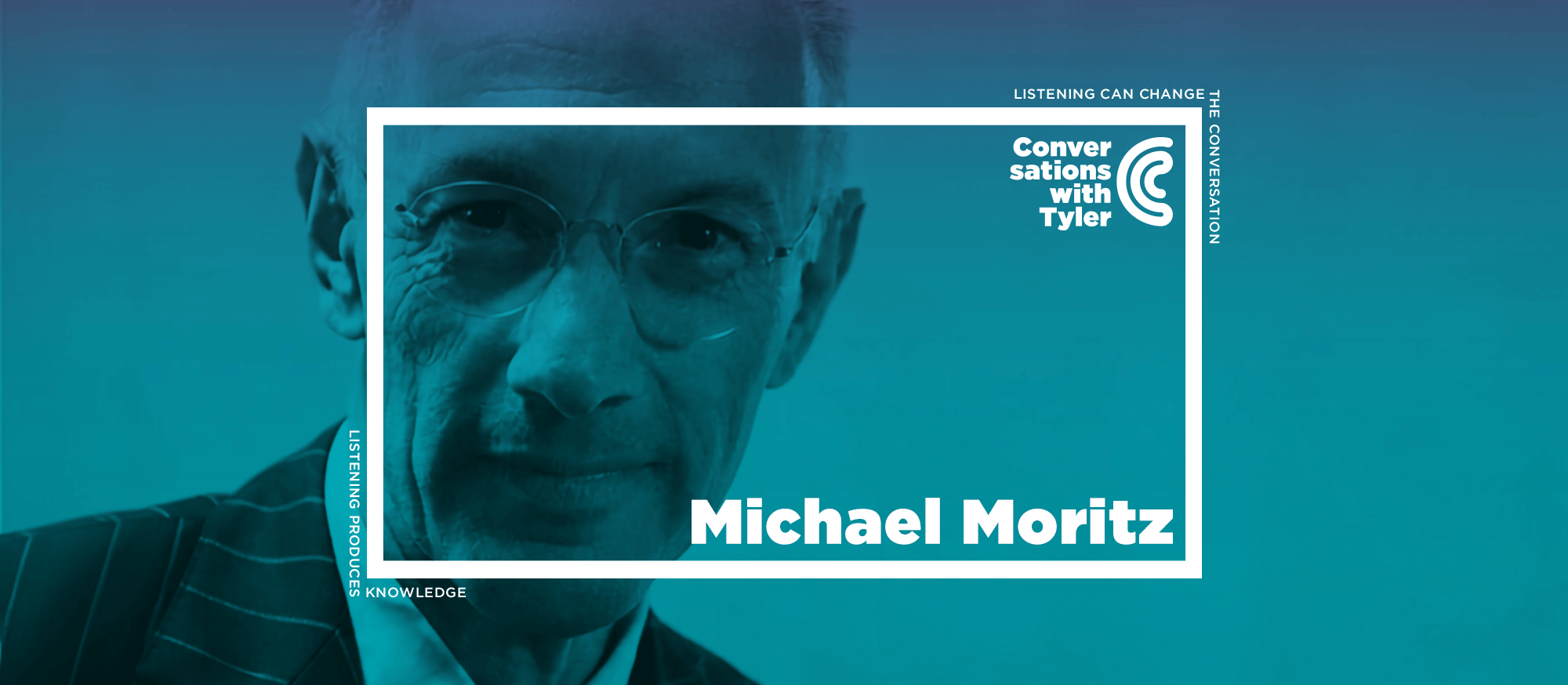



Michael Moritz has written books through every phase of his life: the first history of Apple and an account of Chrysler’s near-death while he was a journalist at Time, a study of Alex Ferguson’s Manchester United in the middle of his 38 years at Sequoia, and now Ausländer, a family memoir, after leaving the firm. Moritz calls himself a dilettante with too many interests, but listen to him on learning to paint in his 40s, or the questions he would ask a ten-year-old boy in a German village in 1890, and you may decide that unsatisfied curiosity is not a small thing to build a life on.
Tyler and Michael discuss his childhood in Wales, where his love for visual arts came from, why he disappointed his Latin teacher, having Thanksgiving dinner with Philip Roth, why children don’t interrogate their parents about their history, what he feels visiting Germany and why he now holds German citizenship, how a history major with no technical background talked his way into Sequoia, his unpublished Don Valentine profile, what people underrate about Steve Jobs, obsessives versus dilettantes, why capitalism was more ablaze in China than America, what funding the Booker Prize taught him about his own ignorance, how to improve San nonprofits, how an incurable cancer diagnosis changed his calendar, why Britain’s stuck, what he’ll learn next, and more.
Watch the full conversation
Recorded July 21st, 2026.
TYLER COWEN: Hello, everyone, and welcome back to Conversations with Tyler. Today, I am chatting with Michael Moritz. Michael is perhaps best known for his work as a venture capitalist through Sequoia. Before that, he was a very active and successful journalist with several books to his credit, including the first study of Apple and an excellent work on Alex Ferguson of Manchester United.
Michael is extremely well known, in addition, for his work in philanthropy. For instance, his institution Crankstart has been supporting the Booker Prize since 2019. He also is involved in San Francisco Standard, but most importantly, from our point of view, Michael has a new and excellent book out called Ausländer: One Family’s Story of Escape and Exile, which I absolutely recommend to you all. Michael, welcome.
MICHAEL MORITZ: Thank you for that very kind and flattering introduction.
COWEN: I have many questions for you in many areas. Let’s start with Wales. Did the nonconformism of Methodist Wales make it easier for Jews to settle and feel at home there?
MORITZ: I’m not sure that that actually was the case. I think that the principal reason that Jews, particularly the ones of my parents’ generation, settled in Wales were that those with entrepreneurial attributes were encouraged to settle in South Wales and in some other parts of Britain to set up businesses, to encourage local employment, and stimulate job growth. I don’t think that any aspect, probably of the established church or churches made the new immigrants to Wales feel any more comfortable.
COWEN: How was Welsh antisemitism different from English antisemitism?
MORITZ: Well, first of all, I want to be really careful here because Britain opened its doors to my parents. My parents were refugees from Nazi Germany. They both were permitted to come into Britain as children, as teenagers. Both of them were around 14 years old when they were fortunate enough to land in Britain. Britain was one of the few countries, albeit with quotas, that opened the doors to Jews desperately trying to flee the Nazi stain that was spreading all over Europe.
Britain, back in the late 1930s and certainly during the time that I was growing up there, which was predominantly in the 1950s, ’60s, and early ’70s, was far less a multicultural country than it is today. Anybody from abroad, they could have been Italian waiters in Soho—there were very few blacks or anybody from Asia in Britain at the time that I was growing up—anybody who looked out of the ordinary was considered by the majority of the people, as always happens, a bit of an outsider. That was displayed in a whole variety of ways. Nonetheless, whether it was in Wales or, to answer your question, in England, I’m not sure that it differed all that much.
COWEN: According to some sources, the population of Welsh Jews peaked in around 1919 at around 5,000, and then it declined radically. Why did so many Jews leave Wales? Is it just movement to London?
MORITZ: I don’t think it declined that rapidly. I think there were, I don’t know how many in the ’60s when I was growing up, maybe there were 600 families around Wales that were Jewish out of a population of around, probably back then, about 2.5 million. I think the younger people tended to leave for opportunity. Small countries or Wales and other parts of the United Kingdom that presented limited opportunity for people with ambition meant that the younger people in particular tended to leave, and they tended on the whole to head toward London.
COWEN: You left Wales at age 19, correct?
MORITZ: Yes, 18, 19.
COWEN: What was your thought process at the time? Was it screaming, “I have to get out of here,” or a marginal decision?
MORITZ: No, it was far more conventional than that. I left Wales after I finished high school and I went to university. That was the first time I’d lived in England. Then outside of vacations, I never really went back to Wales. Since 1973, my life has been really spent outside of Wales.
COWEN: At that young age, were you already interested in art and fiction?
MORITZ: Funnily enough, I was in both. Take the art first. I think I owe this to my mother, whom otherwise I had a fairly strained relationship with, but bless her heart. She was the victim of this age-old prejudice against women and left school at the age of 15 and always felt a little inferior to people with college and university educations. She had a really—and I don’t know, I never talked to her about it—I don’t know where it came from. She had a lifelong affection for the visual arts and for music. At home, the radio was always on with her listening to music.
When she took me and my sister to the museum in Wales, the National Museum of Wales, which actually has a pretty good collection, some really interesting impressionist pictures and, oddly, some Francis Bacon. I think that’s what woke my interest in art. I bought my first picture, which I gave as a gift to my parents when I was 13. I did so in Cardiff. It was a little watercolor and pencil drawing of a winding mechanism at a pit head, these big winding mechanisms that used to sit astride the places in coal mines in Wales where the coal came up from below. I still have that picture. After my mother died, I got it, and it hangs in my office at home, right by my desk.
COWEN: Is it easy to live with an Otto Dix painting or sketch? It hangs on the wall. Many people think it’s ugly. It reminds one of unpleasant things in history, right?
MORITZ: Yes, for Harriet and me it is. I think the tougher, more strenuous, grueling works of art that other people would have difficulty living with have many layers to them. You explore them, and they’re difficult pictures, and they’re not easy at first sight. Unlike easier pictures that may be a bit more decorative, they leave room for plenty of exploration, as the years go by. Then they’re redolent, they tell stories. They’re redolent of history. They’re images of a different epoch. I think most of the paintings that we’ve been lucky enough to find over the years, they are tough paintings.
COWEN: I feel that way about Haitian art, which has many brutal scenes. For you, is Chagall too sentimental?
MORITZ: Yes.
COWEN: You don’t want to put it on your wall?
MORITZ: The earlier Chagalls I’ve been drawn to, but neither of us have felt the urge or the need to go out in pursuit of Chagall.
COWEN: What is your own painting like?
MORITZ: Oh, exasperating.
COWEN: Neue Sachlichkeit or something else, it’s like Kossoff?
MORITZ: No, I don’t know if you’ve ever tried painting or drawing. I didn’t take it up until I was in my mid 40s. I’d never picked up a crayon or outside of the obligatory, abbreviated art lessons that always seem to be held later on Thursday afternoon, with everybody waiting for the bell to ring to end school. I’d never taken up a crayon or drew, or let alone painted.
If I look back today at what I did early on, it’s a lot better. Then if I look at the paintings that I try to make, my goodness, it is an extremely humbling experience, but I enjoy it. I really enjoy it. There’s nothing like getting lost in making a painting, and before you know it, two hours have gone, and you have no idea where the time went.
COWEN: How has living with the visual arts improved your investing skills?
MORITZ: I’m not sure that it’s had any influence whatsoever on investments.
COWEN: Talent identification, isn’t it some area where there’s always a deeper understanding in the visual arts, and you then later can apply those frameworks to individuals or companies?
MORITZ: I understand the argument, but I began my life as a journalist and maybe subliminally, because I look fairly intently and always look fairly intently at works of art that have caught my eye, I think I’ve always looked carefully at whatever it is in front of me. It could be a landscape, could be a building, could be a person, and have been pretty watchful and have listened carefully. I think all three are connected when you are trying to take the measure of somebody when you’re thinking about forming a business relationship with them.
COWEN: Your father was a classics scholar. Were you interested in Homer as a teenager?
MORITZ: I was not. I suppose, like a lot of sons, I tried to get as far away from the classics as possible. My Latin teacher at school was sure that he had a little Latin genius on his hands since I was the son of a classics professor, and then I proceeded to severely disappoint him for the next three years.
COWEN: What in Jewish literature means the most to you?
MORITZ: Well, when I was growing up, I devoured the works of the American Jewish authors who really made their mark during the 1950s and 1960s, and predominantly Philip Roth and Norman Mailer, although there is obviously a string of others as well. Those were the two that, as soon as they published a new book, I immediately went out to buy the book.
COWEN: You knew Roth, right? What was he like?
MORITZ: I was very lucky when I went to university in America, I went to the University of Pennsylvania, and here he was, one of the heroes of modern literature. He was teaching a small seminar class at the University of Pennsylvania and I enrolled in it. And as a teacher, he had edited a Penguin series on Eastern European authors, so he taught from that canon. And one of his abiding virtues as a teacher or as a professor, was he prescribed short books to read, so he didn’t ask his students to read 600-page tomes.
Most of the books that I remember him asking us to read were fairly short, so you could really read them without feeling out of breath and then have time to ingest them. And he listened very carefully and was very polite and courteous toward all of his students. Then he very, very kindly wrote me a reference when I applied for a job at Time Magazine. I’m not sure that many people who applied at Time had a reference from Philip Roth.
Then later in life, way later in life, our paths crossed again through a mutual friend and for several years, when our family was in the habit of going to New York to celebrate Thanksgiving with friends, Philip was a mutual friend of the hostess and so for, I don’t know, half a dozen years, we always had Thanksgiving dinner and among the guests was Philip Roth. And unless he was in a deep funk, he was always wry and amusing and sardonic.
COWEN: How would you describe your current relationship to the Hebrew Bible?
MORITZ: More distant than removed. I am not an observant Jew and haven’t been. I obviously identify very proudly as a Jew. My father was what in America would be called a conservative Jew, and he was deeply educated in the Jewish Bible and interpretations of the Jewish Bible. I think maybe his fascination with it, just like his devotion to Latin, I think drove me away from it. But he had also grown up in an era in Germany where there weren’t very many distractions, and I think the main entertainment of the week, best as I could tell, was going to the synagogue.
COWEN: Why do you think sons and daughters do not ask more questions about their parents’ and grandparents’ history when they can?
MORITZ: They’re too self-absorbed. They aren’t curious. They don’t understand that every individual has a story, and on the whole, with every individual, the more that you dig, the more interesting it becomes. They don’t know how to ask questions, and they don’t know how to listen.
COWEN: If you could ask your parents something now, what would you ask?
MORITZ: It wouldn’t be one question. Because I obviously have written this book that’s a family memoir about what happened to my parents’ generation, and how that shaped me. It wouldn’t be one question, Tyler. It would be hundreds of questions. And you know better than I do from all the interviews that you’ve done, it’s the answer to a question that then prompts another question. I probably can’t imagine running out of questions for either of them, but these are for people who’ve been through extraordinarily traumatic times. People also suppress memories. It’s sometimes difficult to, even though their spirit may be willing, it’s very difficult to excavate an answer.
COWEN: Say it’s your grandparents, Max and Minnie, who were killed in the Holocaust. Where would you start with them?
MORITZ: I think I’d probably start where I do, oddly enough, with founders at the beginning, because right or wrong—and different people will have different opinions—I just think the first 10, 15 years of life that anybody experiences shapes the individual in profound and deep fashions that then whatever happens to them, subsequently, echo through their life. It’s really the details of the circumstances.
Imagine being a 10-year-old boy in 1890 or 1891, and you’re in a little village beside a river in the middle of Germany. Well, what was life really like? Who woke you up in the morning? Did you have somebody else sleeping in the same bedroom or in the same bed? Do you remember what you had for breakfast? What were the clothes that you wore to school? I mean, you can just think of hundreds and hundreds of questions.
Obviously, my grandfather, the gentleman that you alluded to, Max, he joined the German army, and he served in World War I and was one of the survivors of the most gruesome, brutal battle in the history of mankind, which was Verdun. He survived it. You can just imagine the number of questions you’d want to ask about that. That’s just one experience and obviously an enormously dramatic experience, but you can just imagine the number of questions you’d want to ask about that.
COWEN: Why do you think it is in the late 19th century that there’s such a resurgence of antisemitism in Germany, which for a while, at least by many people, was considered better than average by European standards on this question? Maybe that was an illusion, but something strange seems to happen, right?
MORITZ: I don’t know that it was in the 19th century, Tyler. I think it was much more in the early 20th century after the end of World War I. I think antisemitism in the late 19th century, with the Dreyfus Affair, in Western Europe, was far more prevalent in France than it was in Germany, but I think probably the influx of refugees from the East, from Russia, from Ukraine, who fled West because of the pogroms, probably didn’t help matters in late 19th- and early 20th-century Germany.
Until Bismarck, Germany had always had very strict—like every other country under the aegis of the Roman Catholic Church—they’d had very strict prohibitions against assimilating Jews. They were only permitted in Germany—and this dates back hundreds of years. It wasn’t anything to do with the late 19th century—in some places, they were only permitted to live in particular places, but there were a whole bunch of professions that weren’t available to them. They were tolerated as itinerants, as peddlers, as cattle dealers, as merchants.
Then, obviously, there were a few who became the favorite so-called court Jews, who helped the various monarchs throughout Germany with their military undertakings, and helped finance various other exploits, but they were in a very, very small minority, but Jews in Germany as for Jews elsewhere, had always lived on the outside. It was Otto Bismarck who made life considerably easier for them. Even after that, they clearly weren’t in the mainstream.
COWEN: Why is there such a resurgence of antisemitism today?
MORITZ: Antisemitism has a very long history. It’s 2,000 years old. I think it’s in the atmosphere of humanity, always has been, always will be. I’m not complaining about it. I’ve benefited vastly from being a Jew, so don’t get me wrong, I’m not whining about it or anything like that. I just think it’s a condition of the human race, and I think it flares up in societies where people feel left behind. They’ve felt that they’ve got a rough deal. Maybe it flares up too amongst people who are less well educated and for whom rabble rousers, who want to point accusatory fingers at particular people, whether they’re Haitians or Jews or Somalis, and can stir the pot by doing so.
Clearly, social media has made it easier to spread these sorts of accusations and rumors. I think the situation in Israel clearly has not helped. This is obviously well known, and there’s this obviously amorphous border between not agreeing with the policies of the Netanyahu government, which many Jews both in Israel and outside Israel don’t agree with, and antisemitism. That, at the moment, I think inflames things further. It doesn’t help when you have the mayor of New York say he would arrest Netanyahu would Netanyahu ever set foot in Manhattan.
COWEN: Why are the Irish in particular so anti-Israel and sometimes antisemitic?
MORITZ: I don’t know that. I just don’t know. First of all, I don’t know whether it’s true. I don’t know the stats. I don’t know the data. I would point out that the only connection between Ireland and Judaism or Israel that I know about is that the current president of Israel, his grandfather was the chief rabbi of Ireland.
COWEN: There’s Leopold Bloom also in Ulysses, of course.
MORITZ: There is, yes.
COWEN: Now, these days, how is it you feel when you revisit Germany?
MORITZ: I hadn’t been to Germany for a long time. I went last summer. Oddly, I’d never been to Munich, which is where my father grew up and from which my grandparents were deported and eventually met their death and other relatives too. Munich today is, on the surface, like a charming city, very beguiling, the sort of place one might want to live. Then, obviously, every corner has a particular history in Munich, as it does in many European cities.
Last summer I went to—I don’t know who the architect was, I forget—the extremely moving building that is the new synagogue in Munich. I actually never go into a synagogue but I had been curious about attending a service there. I tried to get into the synagogue, but because I hadn’t filled out application forms, because the security was so tight, because the police were all around it, and because I didn’t have the documentation to really prove who I was and hadn’t had authorization to be admitted, I couldn’t get into the synagogue.
Then I went to Dachau, which is not very far from the center of Munich, which is where several relatives of mine had been sent. I did what tourists do and went around it. Beyond obviously being very aware of the history of it, the one emotion it stirred up was when I was standing in a gas chamber. It was a gas chamber with multiple ovens, and it was spotless, really, really clean. Everything was spotless.
There were these high school students who were obviously bored out of their minds on their iPhones in there and with their AirPod earplugs in. I just stood there for a moment, shutting my eyes, wondering what the heat was like, what the smell was like, what the screams were like, what the work was like, what the stench was like. That could have been a million years ago, but that was the one place that really struck me, the vast difference between the scene that I visited and the scene as it was in the early 1940s.
COWEN: The media report [that] you’re applying for German citizenship?
MORITZ: I actually have it. I’ve received it.
COWEN: You have it? Congratulations. Where in Germany do you feel most at home? Munich?
MORITZ: I’m not sure that I feel at home in Germany. People have asked, why did I apply for German citizenship? Do I expect to be driven out of the United States? I have British nationality as well. No, I don’t. Do I expect to be made to feel extraordinarily unwelcome and threatened and terribly frightened in San Francisco? Absolutely not. Do I envisage a time where I would be living in Munich? No.
The one lesson that I took from working on my book was you can never have enough passports. The reason that I applied was, both in Western Europe and also including the United States, the one place where the history of the ’20s and ’30s and the Holocaust is really drummed into a population is in Germany. Doesn’t happen in France, doesn’t happen in England or Wales, doesn’t happen in the United States.
COWEN: Other than a lot of history and, of course, detail, at the philosophical level, what else do you feel you learned writing this book? More passports? What else?
MORITZ: Oh, one more. Yes, on a philosophical level, I’m not a philosopher, so I don’t really know what you mean.
COWEN: Every venture capitalist is a philosopher, in my view.
MORITZ: Oh, I see. Why is that?
COWEN: You have a theory of how the world will be and a theory of what makes people successful, however implicit. You couldn’t have written your Alex Ferguson book if you were not in some way a philosopher. It’s about successful organizations, sustainability, how irascibility can sometimes make you a better mentor.
MORITZ: I think of philosophers as being people like the great thinkers of the past, Aristotle, Cicero. I don’t think of writing a book about leadership as being particularly philosophical. It’s a summation of observations and lessons. As I said, I’m no student of philosophy.
COWEN: They wrote about exile, right, and having to leave?
MORITZ: Yes, they did, they did. I think the thing I learned most from writing the book was it educated me on how I became what I became, the forces that shaped me, the influences of my parents, the influences of the milieu in which I grew up. All of that shaped who I am, and I understood that a lot better after I finished working on the book.
COWEN: In your life, how exactly is it that you moved from being a journalist to being a very successful venture capitalist?
MORITZ: There was no plan. It was great good fortune. I had wound up working in the San Francisco bureau for Time Magazine. I worked for Time Magazine for a few years at the beginning of my professional life. When I moved to San Francisco, I really didn’t know anything about Silicon Valley. I didn’t know anything about the tech industry or the tech business. Obviously, it was a lot different and smaller then than it is today.
Although I was supposed to write about all sorts of different topics, because the bureau in San Francisco covered pretty much everything from, believe it or not, Alaska down to Santa Barbara, the thing that I got attracted by was Silicon Valley. There were no technology companies in 1981, ’82 in San Francisco unless you count Charles Schwab, who had set up his discount brokerage there. I got really interested in writing about these companies, and they were really, really small.
You mentioned earlier that I had written a book about Apple. I had got to know Apple fairly well, but at the time it went public, it had sold about 100,000 computers, 150,000 computers. It was really tiny, but I then got introduced through writing about these companies—Atari, Apple, Microsoft, Oracle, others. I’d never met anybody in Wales. I’d never conceived of the idea that anyone would start a company, let alone anybody who is 18 or 20 years old.
Then I began to understand how some of the mechanics worked, and I couldn’t start a company. I joined a company, but it was a little publishing company that didn’t require any technical skill or computer science background or electrical engineering or semiconductor know-how. I just didn’t have that sort of a background.
Through covering these individuals, I then began to understand that there were these investors who invested in their companies, so I started writing. I did a few stories about the venture capital industry, and I got to meet several of the then-leaders of the industry, Tom Perkins, who started Kleiner Perkins, and then Don Valentine, who started Sequoia. I had quit Time, had cast my lot with this little publishing company that many, many years later, thanks to the co-founder, was bought by Dow Jones, but that had nothing to do with me. I’d left that too.
I literally wrote letters back then—you couldn’t write emails—to the people who ran five venture firms, got rejected by four of them, and then I got really, really lucky and Don Valentine hired me at Sequoia. I think when some of his peers heard that he’d hired a history major who’d been a journalist who didn’t have an answer of technical acumen, never worked for a Silicon Valley company, they thought he’d lost his mind.
COWEN: Why not publish your book on Don Valentine? Rumor has it there are only a few copies in your Tuscany hotel.
MORITZ: It’s not really a book. It’s a fairly long profile of not just about Don, it’s about the early venture industry.
COWEN: Many people would love to read it, right?
MORITZ: That’s kind of you to say that. I’m not sure that there’s enough in there to merit a book.
COWEN: What do most people get wrong about Steve Jobs?
MORITZ: Maybe what a stoic he was and the heroic manner in which he spent his last years, which I can barely imagine. The fact that his native wit, his raw intelligence, the melding of an artist and a capitalist, I think those are the principal things that aren’t appreciated about him. Also, I think the education he received during his years in the wilderness after he got cast out of Apple.
COWEN: If we think of your interest in Steve Jobs, your book on Alex Ferguson, the art you buy, that you’ve now written a book on the Holocaust, is there some general pattern where trying to come to terms with really difficult things, is this a recurring theme in your life? Learning how to paint, that’s very hard, right?
MORITZ: I haven’t really thought about it that way, but I think life is made richer by having a challenge that you’re not sure whether you’re up to conquering. I’ve always been up for that. Each of these books has really just sprung out of being curious about something. I’m not sure that there’s any greater pattern than unsatisfied curiosity.
COWEN: I love Otto Dix, but most people don’t like Otto Dix.
MORITZ: Let me know the next time you come to San Francisco.
COWEN: Great.
MORITZ: You’ve got to come, and I’d be very happy to show you what we live with—
COWEN: I’d be delighted to see it.
MORITZ: —that other people wouldn’t want to live with.
COWEN: I love Lucian Freud as well, the greatest painter of flesh ever, perhaps, right?
MORITZ: Certainly in the 20th century.
COWEN: Yes, maybe Rubens, you could say.
MORITZ: No doubt. No doubt.
COWEN: You have Frank Auerbach also?
MORITZ: Oh, yes, big Frank fan, huge.
COWEN: Underrated in the United States, right?
MORITZ: Yes, but he’s having a show at the Metropolitan, I think it’s in two years, in New York.
COWEN: I will go.
MORITZ: Oh, spectacular artist. I met Frank on several occasions. In a way, you were asking about Steve Jobs a few minutes ago. Steve, I think most great entrepreneurs, Bill Gates, Elon Musk, were obsessives. Frank Auerbach carried his obsession to new heights. He painted every day of the year, save for one, which was Christmas Day, when he treated himself to a day off and went to Brighton to go to the Brighton Pier on Christmas Day. Then later in life, he decided that, actually, the one day he was taking off was stealing time from painting, so he abandoned his trips to Brighton. There’s an obsessive for you.
COWEN: How would you describe your greatest obsession?
MORITZ: I’m more of a dilettante than an obsessive because I’ve got too many interests. This isn’t false modesty on my part. It really isn’t. I just think each of these pursuits that I dabble in, each of them I could do a lot better.
COWEN: That could be an obsession too, what you call dabbling in different pursuits?
MORITZ: Yes, or satisfying curiosity.
COWEN: What is it you feel you saw early in China? Many people thought China would grow, but the notion that you could invest there and actually get a profit was arguably the better, more important insight. Around what corner did you see to grasp that?
MORITZ: I think it was a collective effort at Sequoia. It wasn’t just me. I think it was going to visit China and meet people, see what was happening with your own eyes. I’ve been to Hong Kong before, but I hadn’t been to the mainland. Going to the mainland, where so many preconceptions were washed away, and gradually beginning to understand, or understanding fairly quickly, that if you wanted a country where capitalism was ablaze in the early 21st century, really ablaze, it wasn’t in the US, it was in China, despite what everybody says about the Communist Party and state control. It was a country where there was a very skimpy, if nonexistent, social safety net and where people had to live or die by either the strength of their education or their wits. Then as the years went by and I got better educated about China, having a far keener appreciation of the strengths of the country as it came to grips with what technology had to offer, Sequoia flourished.
And I think it was one of the better decisions that we made for close to two decades in China, where it was possible to invest in pretty much anything anybody wanted to invest in any industry. It’s tightened up a lot, obviously, in the last few years, and so the atmosphere and circumstances are different.
COWEN: Through Crankstart, you’ve been supporting the Booker Prize. What have you learned doing that?
MORITZ: Oh, how little I know about literature. I don’t read all of the submissions, obviously, and I have nothing to do with the judging of the prize whatsoever. It’s as big a mystery to me as it is to everybody else. I enjoy the challenge of going through the 12 shortlisted books that come out in the summer or the books for the International Booker Prize, because they just open your eyes new authors, countries perhaps that you don’t know very much about, circumstances that you don’t know too much about. I try to maintain a balance of reading fiction and nonfiction, so the Booker keeps me honest.
COWEN: Does it feel to you like fiction is in a pretty good place right now? I argue this to my friends. They’re often skeptical, but if I think about Ferrante, Knausgård, the Sonia and Sunny book, Houellebecq, Cărtărescu, I think there’s a lot of great works just in the last 10 years.
MORITZ: Yes. Oh, I would completely agree. Douglas Stuart’s one of my favorite authors as well. Storytelling, despite what everybody says about AI, great storytelling is never going to go out of style, and it begins with words on paper.
COWEN: How would you improve the San Francisco nonprofit community? There’s a lot of money. There’s going to be a lot more money. There aren’t that many talented people to run nonprofits. Is the whole thing just a mess? Is it doomed? Will it succeed?
MORITZ: I think two things. One, it’d be great to have more people in San Francisco interested in contributing in some fashion. The second is, I think, having people from the for-profit world operating philanthropies is very helpful and sets a different performance standard.
Missy Narula, who’s the wonderful CEO of Crankstart, her background before she joined us five years ago was TPG and Bain. It wasn’t in the not-for-profit world. She has this wonderful ability to straddle both worlds. She has the sensibility of a person who cares deeply about others and those who are left behind. Also, the need for performance that comes out of having spent many years in the for-profit world.
I think it’s very easy for people to point fingers at philanthropies or not-for-profit services and say that they can be run more effectively. I think that’s probably true for lots of them, but you can say the same for many companies as well. What you try to do, I think, is set a standard and be the best. Also, knowing that some of the things that you’re going to try in philanthropy, just like in business, are not going to work. Harriet and I have been so fortunate. It really is our job to try and help others who just haven’t had the good luck and fortune and circumstances that we’ve both had.
COWEN: There’s a great history of the arts in San Francisco: the Beat Poets, Wayne Thiebaud, Jefferson Airplane, Grateful Dead, one could go on and on. Are the next 30 or 40 years going to look like that, or is everyone just priced out? Maybe they’ll live in Fresno and have a patron in San Francisco.
MORITZ: I think that’s quite possible. Look, we’re working very hard. Daniel Lurie, the wonderful mayor of the city, is working very hard to make it far easier to build housing. If you can’t build housing, and if developers and people who want to put up new houses are left in a straitjacket, people are going to be priced out of the city, no doubt about it. I think most people are already priced out of the city, the same as they’ve been priced out of Manhattan.
Artists have always needed to go to places where they can afford to live. I noticed that there was a piece in the New York Times over the weekend about Syracuse, New York, being a great haven for writers. Part of the reason being that it was affordable and rents were low compared to New York City and Boston. Look, housing is a huge problem throughout the country. Housing is, I think, the biggest issue in California, and it’s an acute issue in San Francisco.
COWEN: Now, your book starts with an anecdote where about 20 years ago, you were diagnosed with what is supposedly an incurable blood cancer, and yet here you are alive and kicking and just finished a book. How did it change how you allocate your time over the last 20 years? It’s at least some level of uncertainty, right?
MORITZ: It made me want to control my own calendar rather than have others control my calendar.
COWEN: Was that good for your efficiency or just good for your happiness?
MORITZ: I think more for my contentment. I’m not sure that I became any more efficient. Probably pretty inefficient. I did not want to be imprisoned by obligations that only formed part of the life I wanted to lead.
COWEN: How do you distinguish between true friends and others?
MORITZ: I think it’s the ones you want around your deathbed.
COWEN: How do you know which ones they are, other than family?
MORITZ: Oh, there are very few of them. Through life, I think it’s very difficult to have deep relationships with a lot of people. It’s just very hard because it’s built on history, it’s built on the wavelengths missing, it’s built on shared experiences, and there’s just not enough time to do that with lots of people.
COWEN: Why does the United Kingdom seem to be so stuck now economically, politically, otherwise? In its most fundamental terms, what has gone wrong there? There’s a lot of particular mistakes they’ve made, but why so much correlation in the mistakes?
MORITZ: I think it’s the residue of the arrogance of empire. Obviously, it’s the mantle. The pound sterling was the reserve currency 100 years ago or so and the world’s reserve currency. Britain had the world’s largest navy, obviously had, for better or worse, its tentacles all over the world, and it was the world power. Then the mantle was lost to an entrepreneurial country.
I don’t think Britain has ever recovered from the loss of the position of primacy. Everything, since then, has been a somewhat feeble, muted reaction to it, and where—and there’s a new prime minister who was appointed very recently, obviously—you’ve had these cycles where government is all the answer, and then certainly under the Thatcher years, and later to a lesser extent, under Blair and Gordon Brown and David Cameron, years where government wasn’t seen as the answer. It’s sad to watch, it’s sad to witness, but I think Britain overall has suffered from too much government.
COWEN: Before my last question, just to promote your book again, Ausländer: One Family’s Story of Escape and Exile. I very much enjoyed reading it. Final question, what is it you wish to learn about next?
MORITZ: Iran.
COWEN: How will you do that? It’s hard to go there, right?
MORITZ: I am not talking about contemporary Iran. I’m talking about Iran—I don’t know whether or not I’ll go ahead and do it, but I’ve been reading a lot about it recently—circa 1900, 1890 to 1960, 1970.
COWEN: The constitutional liberal era, like 1908, 1911. I’m so curious as to what it was actually like back then.
MORITZ: Yes. I do not pretend to a great degree of deep knowledge about it, but I am extremely curious because I think so many of the issues that we confront today stem back to that period and to what happened in the early 1950s.
COWEN: Michael Moritz, thank you very much. It’s been a real pleasure.
MORITZ: Tyler, you’ve been extremely generous, and your questions were just wonderful. Thank you.
COWEN: Much appreciated.