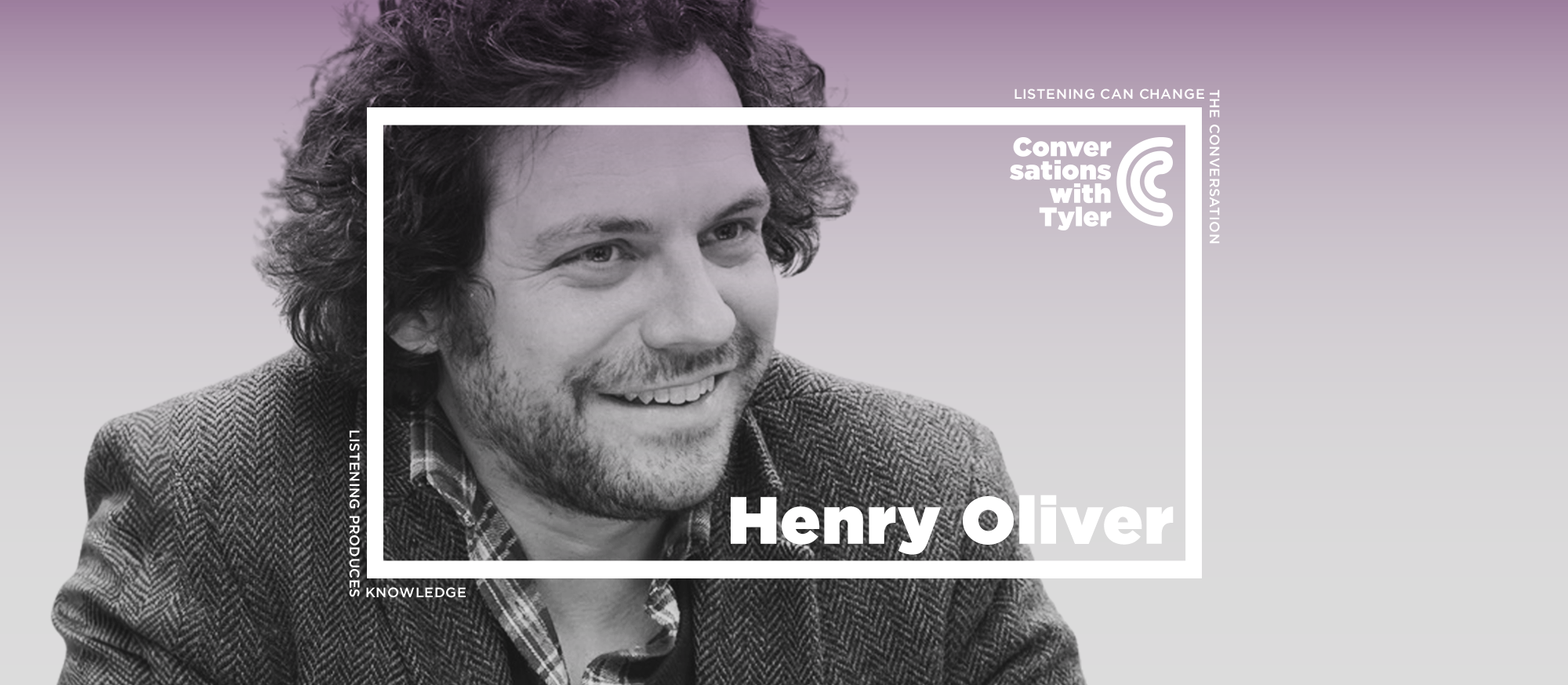



Henry Oliver is the preeminent literary critic for non-literary nerds. His Substack, The Common Reader, has thousands of subscribers drawn in by Henry’s conviction that great literature is where ideas “walk and talk amongst the mess of the real world” in a way no other discipline can match. Tyler, who has called Henry’s book Second Act “one of the very best books written on talent,” sat down with him to compare readings of Measure for Measure and range across English literature more broadly.
Tyler and Henry trade rival readings of the play, debate whether Isabella secretly seduces Angelo, argue over whether the Duke’s proposal is closer to liberation or enslavement, trace the play’s connections to The Merchant of Venice and The Rape of Lucrece, assess the parallels to James I, weigh whether it’s a Girardian play (Oliver: emphatically not), and parse exactly what Isabella means when she says “I did yield to him,” before turning to the best way to consume Shakespeare, what Jane Austen took from Adam Smith, why Swift may be the most practically intelligent writer in English, how advertising really works and why most of it doesn’t, which works in English literature are under- and overrated, what makes someone a late bloomer, whether fiction will deal seriously with religion again, whether Ayn Rand’s villains are more relevant now than ever, and much more.
Watch the full conversation
Recorded January 12th, 2026.
Thanks to a listener for sponsoring this transcript in memory of Tish & Bill, the people that jump-started his curiosity with endless open doors and a set of World Book Encyclopedias.
TYLER COWEN: Hello, everyone, and welcome back to Conversations with Tyler. Today, I am chatting in person with Henry Oliver. Henry is a research fellow at Mercatus. He is author of a wonderful book, called Second Act, about late bloomers, which has been very popular. He writes a wonderful Substack. You can just Google that: “Henry Oliver Substack.” He has a new joint Substack with Rebecca Lowe on the pursuit of liberalism. Henry, welcome.
HENRY OLIVER: Thank you very much for having me.
COWEN: Now, the premise of this episode is, we’re going to discuss Shakespeare’s Measure for Measure. That’s not the only thing we’ll do, but that is what we will start with. Measure for Measure—why did that play fall into non-popularity for so long?
OLIVER: Because it’s very difficult to enjoy on the stage. The ending is unsatisfactory from an entertainment point of view. It’s often not so easy to follow the arguments if they’re delivered in the rapid clip that Shakespearean acting would rely on. I think a lot of people want a happier story than this. Shakespeare was experimenting with a comedy that had an unhappy ending. You probably can’t think of many other comedies like that, and there’s a reason.
COWEN: Is the ending unhappy?
OLIVER: It’s not the sort of ending that you would typically want in a comedy, or these days in a rom-com or a sitcom or something, where the people who want to get married get married, and there are bells and nice dresses. It’s more like “You’re all going to get married, and I’m telling you what to do.” And there’s a lot of commentary saying, “Well, do any of these people actually want to be married?” So. it’s not happy.
COWEN: You’ve read this play before. Maybe you’ve seen it on stage in England. What most surprised you when doing this reread?
OLIVER: That the scenes between Isabella and Angelo are so enthralling and so passionate, and really some of Shakespeare’s best work. I had ossified into remembering it as a play of ideas, but actually, it’s really, really an exciting play, particularly between those two.
COWEN: Let me ask a very general kind of stupid question. If you had to do the Monty Python bit where they summarize Proust—I don’t want you to summarize the plot, but what Measure for Measure is about in your mind. I’ll consider some of my takes also, but you start. What, ultimately, is this whole play about?
OLIVER: I have a moderate-length answer to this.
COWEN: That’s fine.
OLIVER: I think, basically, it picks up where The Merchant of Venice leaves off. It takes the problem of mercy. You remember Portia says, “The quality of mercy is not strained. It droppeth as the gentle rain from heaven.” In this play, the quality of mercy is very strained, and it does not drop like the gentle rain. It is a contrivance of human government. The question is, “Can we actually have mercy?”
There’s a wonderful bit at the end of The Merchant of Venice, when Portia and Nerissa come back to Belmont, and Portia has those famous lines: “That light we see is burning in my hall. How far that little candle throws his beams. So shines a good deed in a naughty world.” Measure for Measure is the naughty world. And Nerissa says to Portia, “When the moon shone, we did not see the candle,” and she replies, “So doth the greater glory dim the less. A substitute shines brightly as a king, unto the king be by, and then his state empties itself, as doth an inland brook into the main of waters.”
That basically is the plot, isn’t it? Angelo shines like a king until the real Duke comes back, and then his authority is immediately drained away. We see him for what he really is, and those lines are echoed at the beginning when the Duke says that our virtues go forwards from us like lights, and if they didn’t, there would be no point in having them. The way I read it is, Portia has been a great hypocrite in The Merchant of Venice. She tells Shylock to show mercy, and then she breaks him because he’s a Jew.
In this play, Angelo is the great hypocrite, but in fact, they all have problems being consistent with their principles. Merchant is saying the Christian state can’t really be consistent with its own ideas. Measure for Measure is saying no individual can be consistent with their own ideas, and Isabella makes a point of that again and again. “We cannot weigh our brother with ourself.”
The whole, I think, point of the play is to say you must weigh yourself in the balance. That’s a very difficult thing to do, and it’s not going to work very well, and there’ll be some arbitrary law imposed on you at the end, but spouting off these abstract principles—where does that get you? You’re going to be a hypocrite. You’re going to have these inconsistencies. We’re just going to have to make it work. So, I see it as a great work of pragmatism in that sense.
COWEN: I have several takes. Let me start with the first literal one. I think this is quite a feminist play. I hesitate to use that now much-overused word, but the title is ironic. Measure for Measure—that’s a reference, of course, to Christ’s Sermon on the Mount. Everyone gets something back from what they gave, but the final deal is just terrible for Isabella, whose expectations are violated in every way. She can’t join the convent. Toward the end of the play, she has to confront the ruler of her society, which must be a very stressful thing to do.
For a while, she thinks her brother is being, or has been, executed. That must be a horrible feeling to have. Then, at the end, the Duke is taking her as his own without any of her consent. Likely, that’s a form of rape or, even worse, enslavement, whatever. She’s not having a lot of property rights in this relationship. She gets a terrible outcome in all regards.
If you look at Angelo, he doesn’t get what he wants, so he has to marry Mariana, whom he views as a strumpet. He had a fling with her five years ago. You could say, in some very loose manner, he’s being raped. He doesn’t want to marry her, but it’s not that terrible for him compared to what Isabella has to go through.
Just that difference, that when you dole out justice according to this Christian standard, you can do so literally. The women just get these terrible outcomes. I think that’s one way to read the play, that it’s, if not anti-Christian, highly skeptical about Christianity.
OLIVER: I think it’s skeptical about the ability of a secular authority to actually impose these rules in a world where men have many masters of vice. We must remember that on the South Bank of the river, where the playhouse was, the main institutions were pubs, brothels, and bishops’ residences. I think that’s reflected in the inability of the law to work in this play. Shakespeare says, “Well, we’re all living in a London where these laws cannot be implemented at all. We all know it’s wrong.” He’s trying to bring that to the fore.
COWEN: Let me give you my second reading, which is somewhat less literal. You’re contrasting it with Merchant of Venice. I thought immediately of “The Rape of Lucrece,” which is, I think, from 1594. In that story, there’s an actual rape of Lucrece by Tarquin, and she kills herself. There’s no substitution. There’s no body trick. The terrible thing simply happens. She wants it to be made public. You could argue she’s killing herself so her body is paraded through the public, so everyone knows what happens.
Then, at the end, the autocracy falls, in part because it’s seen as evil, because he raped her, and she killed herself. That’s one way in which the tensions between the political and the erotic can be resolved. You could call it Shakespeare’s first scenario. What happens in Measure for Measure is different kinds of rape are imminent. They’re avoided through the body trick and through substitutions and through various deceits. You may end up with some rape at the end, but at least the initial crisis is forestalled, and the autocracy stays in power.
He’s asking the question, “Is that a better scenario? Is that a plausible scenario? Can we, through artifice, actually reconcile the erotic and the political?” It’s a terrible deal for many people, but maybe that’s all we’ve got because the rape of Lucrece is not a wonderful story either.
OLIVER: This is why I think it’s a work of pragmatism because Shakespeare’s saying, “Look, either we force everyone to get married, or they all end up worse off.” In this scenario, no one is dead. It wouldn’t just be if Isabella had had to submit to Angelo, she would probably have killed herself, but several other people would have died as well. The alternative ending here is not more happy marriages, but the play is actually a tragedy.
So, I do agree with what you’re saying, but I think Shakespeare is ideologically pragmatic in a way. He’s saying this is just the only way things can work. You can contrast it with the end of Taming of the Shrew, where it’s argued, when she submits, is that a happy thing? Because she’s found the only other person in the world who’s actually like her, and so she’s happy to enter into a mutuality with them. Or has she just been broken by the patriarchy, and she will, in fact, suffer in this marriage?
It’s an open debate in that play. It’s not, for me, really an open debate when Isabella kneels down and pleads at the end. She’s just been broken, and Shakespeare’s saying there is no other way to make that work unless people die.
COWEN: You can cite All’s Well That Ends Well, for your point of view also, where there’s a coupling based on a trick and deceit and body substitution. You can debate how happy the ending is, but it’s not obvious Shakespeare sees a better possibility.
OLIVER: In that play, Bertram is much more obviously deserving of what he gets at the end. It’s a sort of twin. It’s written about the same time as Measure for Measure. As you say, the plots are very similar. But in that play, although the marriage is imposed upon Bertram, and he doesn’t want it, he then behaves so badly that even those critics like Samuel Johnson, who just find the play too much, and they don’t like it, they say, “I’ll just never reconcile myself to Bertram. He’s so bad.”
There’s a sense in which there is actually a bit more justice at the end of that play, and maybe they could become happy. I don’t think Shakespeare leaves us with that at the end of Measure for Measure.
COWEN: Now, let me give you my third and least literal reading, which I’m not convinced was ever in the mind of Shakespeare—not necessarily his intent, but it’s the one I like best, and it’s what makes the play, for me, genius. That we’re in the society where the norm is there’s much more prostitution than what we’re used to, and also a lot of affairs. Bastardy and cuckoldry—they’re almost everywhere.
Throughout the play, there’re so many references to brother and sister when people are not, in fact, literal brothers and sisters, but you’re led to wonder, are they maybe half-brothers, half-sisters? Because we’re in this strange world where people are just going crazy with illegitimate births and couplings. It’s really about, if there’s that much sex and procreation in a society, is not a form of incest everywhere? How do people negotiate this in their lives and in politics, since incest is one of the greatest sins?
When Isabella so refuses to sleep with Claudio—which is often seen as an implausible decision by some critics—that she won’t even consider it, that she is the most aware character in the story. She knows the society she is based in has, in a sense, incest everywhere. She may not think Claudio is literally her half-brother, but she can’t stand the notion that she’s being asked to do this and already wanted to retreat from it altogether into the convent.
OLIVER: She does actually make a comparison to incest at one point, as well.
COWEN: Absolutely.
OLIVER: I read Isabella more sympathetically than those critics. There are a lot of other critics, as well, who take Helena in All’s Well That Ends Well similarly. They’re appalled at the idea that this woman would force a man into marriage, and so they just can’t come to terms with her. Equally, a lot of people, I think, are appalled with Isabella going into the convent.
I don’t think I can go along with this incest argument. I know what you mean. For me, it’s more of a fertility crisis play. There is a genuine question—I think Lucio voices it most loudly—but there’s a genuine question among them all that if we shut down the brothels, what will happen to the birth rate? It’s not obvious that that will work out well. Doesn’t Lucio even say, “Oh, I’ll be living in the best house on the main street for a penny because the market will collapse”?
There’s a lot of other coinage imagery, and the relationship between the idea of stamping a coin as a metaphor for procreation, and the importance of demographics to sustaining the economy is, I think, quite well established.
So, I read it more in the sense of Isabella feels like she’s being forced into the sex market, whether through marriage, whether through blackmail, whatever. Because of this, the state must have people. The state must have a population to exist. Going to the nunnery is her way of maintaining her principles and avoiding that. At the end, the Duke says, “Well, sorry, but if we’re shutting down the brothels and being good, you are going to have to get married and have babies because we don’t have another way out of the fertility crisis.”
COWEN: What we make of her, I think, is central to how we read Measure for Measure, no matter where we end up. There’s a passage early on, where she notes she’s entering the nunnery because she desires more restraint. Then someone mentions, “Are you, in fact, a virgin?” is the reference. He’s not saying she isn’t, but if all the sex and couplings are going on, we have to wonder how virtuous is she actually? And is she, in part, protecting against her own tendencies to go crazy?
Then, in act 5, scene 1, there’s even a mention where she says—I’m not sure how literally to take this—that she did yield to Claudio, and I’m never sure what to make of that one sentence.
OLIVER: To Angelo.
COWEN: To Angelo, sorry. It’s a lone sentence. It pops up; it goes away. It’s as if you’re not supposed to notice it. What really ever happened? When she goes initially to Angelo and talks about how virtuous she is and the entreaties I’m making you, and they’re the strongest of all possible entreaties. They’re based on prayer. But the wording is so carefully done and so brilliantly ironic, at least as a contemporary reader, you cannot help but wonder if this is her indirect, super subtle way of offering him sex. I knew you weren’t going to agree with this point.
OLIVER: No, absolutely not. My reading of act 1, scene 4, when she goes into the nunnery, when she says, “And have you nuns no further privileges?” The nun says, “Are not these large enough?” She says, “Yes, truly. I speak not as desiring more, but rather wishing a more strict restraint.” I think she’s saying, “Well, are you really strict enough to be nuns? This nunnery doesn’t seem very nun-ish.”
Lucio then says, “Hail Virgin if you be,” which is him saying, “I’ll believe there’s a virgin in this nunnery when I see it.” I think the criticism is not at her, but at the institution. This is consistent with the rest of the play. The individual always stands out against the institution, against the abstract argument, against some high ideal of justice that can’t be implemented. I see Isabella much more as trapped in a Kafka-esque reality where she, in fact, is good and everyone else is the problem.
COWEN: If we go to act 5, scene 1, line 120, what do you make of Isabella’s line, “And I did yield to him”? This confuses me. I’m not convinced she means it literally, but what could be a more literal admission than that? From the context, it’s clear that she means Angelo.
OLIVER: I need you to show me the line, sorry. I obviously have different references.
COWEN: It’s the underlined bit in my copy. I have the Folger edition, you have the Arden.
OLIVER: Oh, yes.
COWEN: Again, massive confusion on my part. Confusion is how one learns things. You can see what I’m worried about, right?
OLIVER: Well, let’s go through it because I think sometimes, with Shakespeare, you have to take it line by line.
COWEN: I agree.
OLIVER: She says, “I went to this pernicious caitiff deputy.” And the Duke takes issue with her phrasing, and she says, “Well, the phrasing is everything, isn’t it?” The phrasing is what we’re talking about. To me, this is the first sign of Shakespeare’s pragmatism. People keep unstitching each other’s words in this play. That’s even what William James actually says pragmatism is, right?
There’s this constant thing of “I’m trying to tell you he’s wicked, and you won’t hear me.” So, part of the context for these lines is that she has to say it in a way the Duke will accept. Then he says, “Okay, give me the matter.”
“In brief, to set the needless process by: How I persuaded, how I prayed and kneeled, how he refelled me, and how I replied.”
COWEN: If I can just interrupt, that already is sounding a bit like she had sex with him.
OLIVER: What she’s doing there is re-speaking Claudio’s lines from earlier in the play when he says she has a “prone and speechless dialect” in her youth. This was what will tempt Angelo. There’s a huge amount of confusion about what that means. Does it mean that she will speak in a way that will be persuasive? Or does it mean that, without her knowing, without her having any awareness of it, her presence will inflame Angelo into taking her side?
I think you’d be interested in this as an economist, Tyler. This goes back to all the coinage imagery.
COWEN: Sure.
OLIVER: Is it the metal, or is it the face stamped on the metal that gives it the value?
COWEN: Which is a metaphor used in the play itself. I think it’s a double meaning, and we’re supposed to wonder if she is not, in fact, a highly effective seducer.
OLIVER: We’re supposed to wonder, but Shakespeare is giving her the opportunity to rephrase it all. I don’t think Shakespeare, at this point, is using “prayed” and “kneeled” to mean anything other than what is literally being said. I think she is an image of virtue. This is what the Duke said: “If you can’t take your virtue forth like a light, there’s no point having it.” That’s what she’s done the whole play.
“The vile conclusion I now begin with grief and shame to utter: He would not, but by gift of my chaste body to his concupiscible intemperate lust, release my brother; and, after much debatement, my sisterly remorse confutes mine honour, and I did yield to him.” That is a reference to the argument that they were having when he backed her into a corner, and she had to admit that there was an inconsistency in her position. I think that’s act 2, scene 2. She had to yield the premise of his argument. I don’t think there’s any sense in which Shakespeare has done anything other than lead us to believe that—
COWEN: What follows, though, is the word “but.” “But the next morning . . . he sends a warrant for my poor brother’s head.” So, she’s implying she did her part of the trade. Again, I admit it’s not clear.
OLIVER: But she and the Duke arranged that she would do that in order to then substitute Mariana. For your reading to work, these lines would have to mean “Everyone thinks it was Mariana, including you, who’s going to use that as leverage to get Angelo married, but we both secretly know and won’t tell anyone else that it wasn’t Mariana.” That can’t work, can it?
COWEN: No, I think it’s that he got both women.
OLIVER: It reads too cleanly into the known details of the plot for me to go along with that.
[laughter]
COWEN: Well, I told you it was a non-literal reading.
OLIVER: Indeed. Indeed.
COWEN: How does this relate to James I? This is put on for his court, right?
OLIVER: We know it was performed for him at court. We know it wasn’t otherwise hugely popular because there was no quarto. It was perhaps written with him in mind more than in other ways. The idea of measuring yourself that I mentioned earlier—that’s quite a common idea in Shakespeare’s England. There’s a morality play, for example, where Mercy says, “Measure yourself ever, beware of excess.” Obviously, the Puritans love to measure themselves.
But self-judgment can’t be the basis of public policy, and then we have this king now who’s very interested in these ideas of justice and law. There was a sermon delivered when James became king, and there’s a section in the sermon about the duties of a prince who represents God. One of them is the execution of just judgment by which all must be measured. So, I think Shakespeare is taking up a theme that is current at court and which we know James is interested in: how to deal with religious tension, how to deal with sexual behavior south of the river.
I think he’s basically saying, at the end of the day, the king’s going to come in and impose the law, and that’s just how it should be. That’s a plausible reading which the king could take away from it during a performance, right?
COWEN: There’s a line in Measure for Measure that suggests the Duke maybe is not inclined toward women, which is possibly a reference to James, who had an affair with the Duke of Buckingham, in addition to possible other affairs with men.
OLIVER: Maybe.
COWEN: Maybe, but the notion of the Duke not wanting to appear in public—James, some people suggest, did not much enjoy appearing in public.
OLIVER: I think that’s quite disputed now.
COWEN: It’s disputed, but what James wrote about an ideal ruler, sums up the Duke’s views. There are some loose parallels between the two.
OLIVER: Certainly, James’s ideas of justice and government are not unfamiliar to this play, and I would not be surprised if this play was, at least in the way you watch it and interpret it in quick succession, somewhat flattering to James. Yes. These other things—I think there’s often a lot of attempt to link Shakespeare’s work to current events of his day, and it’s always a bit, “Well, it’s sort of this, and it’s sort of similar.” And it can’t be sustained, can it? Shakespeare’s cleverer than that.
COWEN: But this is being shown at the court of James. James might have been there—I’m not sure if we know—in 1604. If you’re Shakespeare, no matter what you intended, you’re a smart fellow, right? James is sitting there, possibly listening. Even if you intended no connection, James would have to be an idiot not to think there might be a connection. So, you can’t escape the thought that you’re making the connection, whether you initially intended it or not.
OLIVER: I agree with that, but the personal ideas about, is this a reference to James’s secret homosexuality or whatever? That’s too speculative for me.
COWEN: Why have the Duke not be inclined toward women, at least according to one speculation in the play?
OLIVER: No, yes. It’s said more than once.
COWEN: There’s no other reason to put it in.
OLIVER: I think there is. I think that he and Isabella are clearly mirrors of each other. He’s justice, and she’s mercy. He’s temperance, and she’s passion. They both, it turns out, are happy to be deceitful in the cause of justice. They hate lying, and they hate wrongdoing, but they’re happy to do it in a good cause, so they share a kind of pragmatism. They get married because, in a funny way, they’re the least sexualized characters. I think it’s all done to make them a pair. In a funny way, not a badly matched pair. If you had to force Isabella to marry someone in this play—
COWEN: It would be the Duke.
OLIVER: It would be the Duke.
COWEN: At least she gets to be wife of the Duke, which on a personal side, may not be wonderful, but in the standards-of-living side is as well as she’s going to do.
OLIVER: That’s what I mean. Going into a corrupt nunnery, submitting to Angelo, possibly dying, or marrying the Duke. Shakespeare’s saying that this is the best we can hope for her. That may not be what we want, and we may rail against it, but that’s not a bad ending. It looks like an unhappy ending, but it’s not a bad ending.
COWEN: Now, it’s sometimes suggested that Measure for Measure is a play that shows Shakespeare actually was a Catholic, or he wrote it with Catholic themes in mind. What’s your view on that?
OLIVER: No.
COWEN: Explain. I agree with the “no” answer, but give me your view.
OLIVER: I don’t think we have the evidence for it. I think it’s not good enough to go around talking about friars and pre-Reformation this and setting it in a particular country or whatever. Obviously, Shakespeare is always writing about the Reformation, and he’s always writing about the tension between pre- and post-Reformation culture, not the least in terms of, there’s now an official policy, but everyone remembers what it was like, and they miss ordinary life in pre-Reformation times, and their mothers did things differently, and there’s a cultural problem there.
He’s always writing about that. Hamlet is about that, right? That is not a basis for saying, “Oh, Shakespeare’s a secret Catholic, and this play is really trying to be popish.” Or whatever. To me, that’s a bit like using numerical analysis in the Bible to start saying we know when the day of judgment’s coming. It just doesn’t hold water.
COWEN: I read it as slightly anti-Catholic, not as a major theme, but Shakespeare’s saying, “Here’s Vienna. They have friars, they have nuns, they have whatever.” It doesn’t avoid any of these problems. The problems there may be a bit worse. Those systems are corrupt also.
OLIVER: It’s a totally normal thing in English literature to point up the abuses and the corruption of Catholic institutions, and as Isabella’s going to the nunnery, right? I don’t buy the Catholic thing at all. The whole effort to tell us that Shakespeare was Catholic, I don’t buy, partly because I just don’t think you’re ever going to get the necessary evidence.
COWEN: Is this a Girardian play?
OLIVER: I didn’t actually go and look at what Girard said, and it’s a long time since I read him. There’s a lot of substitution.
COWEN: Right, and doubles.
OLIVER: Well, isn’t the whole point of the substitution that they’re not doubles? No one actually is substituted properly. There is no such—
COWEN: But that can be Girardian, too.
OLIVER: Can it?
COWEN: Yes, it can.
OLIVER: I feel like the Girardian analysis is stretched and stretched like bread dough, and it never quite snaps, but it’s been stretched so far at this point. Measure for Measure is not like Midsummer Night’s Dream. Midsummer Night’s Dream is a perfectly Girardian play, and he has a very, very clean analysis. He points out that the lovers had switched their allegiances before the play begins, and we’re told that in the text.
Then in Troilus and Criseyde, he has a very good reading of that, which is contemporaneous with this play. Criseyde says, “I won’t sleep with you because, at that point, you’ll lose all interest in me.” That’s what happens. Troilus never wants to go to war until he’s slept with Criseyde. Then he gets up and says, “Right, better go and tell the boys about this.” It’s only when he realizes that the Greeks are going to try and take Criseyde for their own that he becomes interested in her again. Perfectly Girardian.
In this play, I think everyone is strongly motivated by their own inner desires. I think of this almost as anti-Girardian. Isabella is not mimetic in any way. She has to be made to kneel at the end. It’s only because she is adhering to her own inner consistency that Angelo can talk her round into those difficult positions. The whole point of the substitutions is to show us you can’t measure your brother against yourself. The substitutions have to be obviously fake to work.
COWEN: Do you have a favorite line or two from this play?
OLIVER: I should have been able to quote it off the top of my head. I love the bit when Isabella says to him, “But proud man dressed in a little brief authority, hardly knowing what he does, can do such things as make the angels weep.” Periodically, those lines become very relevant again.
COWEN: One of my favorites, not that poetic, but when Angelo simply says, “We must not make a scarecrow of the law.” Then, when the Duke says, “The baby beats the nurse and quite athwart goes all decorum.”
OLIVER: Yes, those are great lines. Those work really well in performance. They’re very dramatic moments.
COWEN: Also, the Duke as friar, when he says, “For thou dost fear the soft and tender fork of a poor worm.” Of course, he’s talking about death.
OLIVER: That’s right.
COWEN: Shakespeare is often at his peak when talking about death.
OLIVER: Talking about death, but also being slightly surreal. We don’t think of him as surreal, but some of those lines you’ve quoted—they’re slightly absurd. It’s a bit like in The Merchant of Venice, when Shylock famously says, “I had that ring of Leah when I was a bachelor. I would not have traded it for a wilderness of monkeys.”
Or in The Taming of the Shrew, one of the maids is described as having gone down the garden to get some parsley as a maid and come back as a married woman. She was getting the parsley to stuff a rabbit. The whole image is just slightly absurd, of this woman getting married while she’s stuffing a rabbit full of parsley. Shakespeare somehow is very good at that kind of thing.
COWEN: Now, I hold the strange view that the ideal version of a Shakespeare play is to read it to yourself, not even aloud, but silently, and that any theatrical performance is a kind of dilution or corruption. It seems unlikely that’s what Shakespeare would have thought, but what’s your take?
OLIVER: I don’t entirely agree, but I agree a lot more than some other people might. Shakespeare did write to be read. The idea that he wrote to be performed is only part of the truth. For one thing, he knew that there were anthologies being made, and he knew that people came to the playhouse and copied down the good bits to pirate them in the anthologies.
He was well aware that he was being read, and he was writing those bits in the play when you think, “Oh, this character is suddenly giving an anthology speech.” Well, yes, they are, because Shakespeare knew that he needed one. He also knew that his books would be printed and sold. He didn’t know about the folio necessarily, but he knew the quartos. I think a third or a half of the plays came out in quarto. He wants to be read, right?
He has a very, very divided audience. On the one hand, they’re paying a penny in the pit. On the other hand, there’s an elite overproduction from grammar schools. There are all these clever young men who want the pun in Latin. They want these things they can pick up on and boast about. The guys at the Inns of Court will come and see this play, and they’ll debate the law elements long into the night. He knows that he’s got that audience, and that audience persists today.
It is true that a lot of modern productions are just terrible and will give you a bad idea of Shakespeare. The directors, I think, are too interventionist. They come up with these crazy schemes and metaphors, and it just distracts.
The one good production of this I’ve seen was done by amateurs, students at RADA in London, and it was directed by Jonathan Miller, the famous opera director. I said to one of them afterwards, “This was really good.” I didn’t mean to be rude saying like, “How were you guys this good?” “It was really good. What did Jonathan Miller do?” They said, “Oh, he came in, and he just said, “No, no, we shan’t bother with anything else. I’ll just make sure you know what the words mean, and then you can get on with it.”
I actually think that can be a great performance. Hamlet is often done like that—just this dark stage, and everyone’s saying the words properly. Then it’s very dramatic. But in general, I agree with you that reading is better than watching.
COWEN: Is there a good movie treatment of Measure for Measure?
OLIVER: Not that I’m aware of, but I haven’t yet seen the BBC version from the ’80s, and they are often quite good. I believe Helen Mirren is in that version of Measure for Measure. I can see that she would make a great Isabella.
COWEN: What do you think is the best movie treatment of any Shakespeare play?
OLIVER: Probably the ones that are least Shakespearean, like Orson Welles and things like that.
COWEN: That would be my pick. Chimes at Midnight if I had to pick one of the Welles, but all of the Welles ones.
OLIVER: Yes, stuff like that. Some of the BBC ones from the ’80s are pretty good. There’s a new Henry IV. The whole sequence of four plays was done on the BBC a few years ago with Tom Hiddleston. I thought that was pretty good, but I don’t watch a lot of them because I don’t always like them. I do like it when they film it at the Globe, and you can watch those online. Some of those are excellent, particularly Mark Rylance and Stephen Fry in Twelfth Night. That’s a very, very good production.
COWEN: To get to some of the rest of your work, what did Jane Austen take from Adam Smith?
OLIVER: Almost everything. Jane Austen is interested in the question of how to be good in a commercial society. She is clearly drawing on Smith’s ideas, not just for the moral content of her work, but for the way she uses narrative techniques and how she positions the camera, as it were. Whose head are we in? What information are we being given? It’s all done in the service of showing us that we have to create our own impartial spectator inside ourselves, and we have to be the ones who develop our own sense of moral judgment. I think that’s a very, very Smithian idea.
COWEN: What did Jane Austen take from Shakespeare?
OLIVER: Well, Jane Austen loved going to see Shakespeare, but I think she probably loved going to see Mrs. Siddons and things like that. She had a great sense of the dramatic and the theatrical, which is why Mansfield Park works so well in those scenes. I think she’s clearly read Shakespeare, and she’s clearly absorbed a lot of his language, but in a funny way, she’s one of the least Shakespearean of the English novelists. I think that’s much to her credit because she is so distinguished as very much her own writer and her own sort of thinker.
COWEN: Is the Scottish Enlightenment or Smith taking much from Shakespeare?
OLIVER: Smith is clearly taking a lot from the novelists of the 18th century. He loves Gulliver’s Travels. He loves Samuel Richardson. There’s no longer a current academic, but an academic called Shannon Chamberlain did a wonderful thesis on a lot of the details of those novels that end up in Smith’s work. He ends up using these same examples as the novelists do to inform how he talks about a novel.
COWEN: What’s coming from Gulliver’s Travels, say?
OLIVER: A lot of the objects that Gulliver has in his pockets, the watches and things. Smith talks about the triviality of these objects, but also their use and benefit. I think he’s clearly interested in that. Surprisingly, for such a liberal-minded person, he endorses Richardson and says Richardson is a good novelist to read to learn morals. It may be the most surprising thing he says in a moral and literary context. I don’t know how much he took directly from Shakespeare. To me, he seems more interested in some of the later writers.
COWEN: By what mechanism does reading fiction change beliefs?
OLIVER: Well, by the same mechanism that reading anything else changes beliefs. We sometimes talk about fiction as if it has a magical quality. “It will give you empathy. It will make you a nice person. It will show you how other people think.” But of course, you can get that in nonfiction or in conversation or in a movie or TV or something. But if you’re not doing the hard work of actually absorbing that, thinking about what it means, testing your opinions against it in the Smithian sense, it will just pass straight through you as a nice story.
I’m very persuaded that empathy works in a Smithian way and that we should talk about it in a more Smithian way, but that the basic conclusion of that is to say, well, it’s really, really hard and it won’t work a lot of the time, and it takes a lot of reading and a lot of work. In the same way that we know that most moral philosophers—they’ve done all this moral philosophy, and they’ve published great work. It doesn’t seem [laughs] to have changed their personal morality very much. I think something similar is at work in fiction.
COWEN: You’ve read Gulliver’s Travels many times. You’ve studied it. How did it change your views and on what?
OLIVER: I found it very useful to have read that book before I worked in politics. I was often startled. I was a very low-level bag carrier sort of person, so I would occasionally overhear interesting things, but I was never doing anything interesting. I was often startled by how much Swift understood about the day-to-day life of politics, the way people interact. I suppose what you might call the sociology of politics. [laughs] The most helpful thing it did was, it was one of the many factors that made me think I shouldn’t be working there anymore.
COWEN: Why do you think Swift is the smartest of all English language writers, Shakespeare possibly excepted?
OLIVER: Well, Swift has a very different sort of intelligence to Shakespeare. I think he can deal with a practical question to do with coinage, to do with government, to do with composition of politics, to do with the conduct of a war or something in both a fictional and a nonfictional manner. He can make those arguments either with the kind of directness and polemicism that we associate with his pamphlets, or with the incredible ambivalence of Gulliver’s Travels, a book in which he manages not to express his own opinions.
Shakespeare didn’t, as far as we know, do any of the nonfiction arguing. Swift, I think, has the balance there, noting that Shakespeare far exceeds him on the fictional side, even though Gulliver’s Travels must be one of the very few great books ever written in English.
COWEN: If someone wants to read some Swift in addition to Gulliver’s Travels, where should they go and why?
OLIVER: I would get a small selection of the poetry because you’ll see just how vicious and sharp and wicked he can be and how much he enjoys berating prostitutes. You see a little bit of the double-edgedness of what he’s doing. Then I would maybe read The Journal to Stella because it’s very lively and very, very good observation. I love that book. Then the normal pamphlets that people read. Everyone’s going to tell you to read the one about eating the babies, but there’re a lot of other good pamphlets. Drapier’s Letters—some of the best work he ever did, right?
COWEN: Yes. Now, when two readers disagree about what a novel means or how good it is—you could take the two of us. Our worldviews are not diametrically opposed as people go in the broader universe. What’s your theory of what accounts for that difference? You can reference me specifically just to give this some bite. We disagree about something in Swift or Shakespeare or Jane Austen. What’s likely at the root of that disagreement?
OLIVER: Well, one thing is that fiction is intentionally ambivalent, by which I mean Swift in Gulliver’s Travels does not want to express his own opinions. He wants to set out a polyphonic set of different views. You can take a few natural readings from it, but he also is giving you room to get it wrong, and he’s doing that on purpose. Most of the novelists are doing that most of the time.
The second thing is that we lose context for these books so quickly. We very often are reading them so far out of their context that we can’t help but bring ourselves to it. The third thing, Tyler, is that some readers want to find more controversial readings than others. I suspect you might be like that. [laughs]
COWEN: I am like that. I think a lot of the differences in readings come from temperament. That one is born with, essentially.
OLIVER: Well, born with, developed.
COWEN: Developed, but 60 percent you’re born with it, would be my guess.
OLIVER: Yes, I agree with that. And I think temperament is important because that’s what informs the creation of the book originally, right?
COWEN: Yes.
OLIVER: Jane Austen’s temperament is clearly fundamentally different to Swift’s, even though they might agree on certain issues. So, we’re reacting to her temperament. We’re not just reacting to her content.
COWEN: Now, before doing your current work, you were in advertising for almost a decade. How do you feel that work in advertising has shaped how you read literature?
OLIVER: [laughs] I try to keep them very separate. I try not to let advertising—
COWEN: You try, but I’m sure you fail.
OLIVER: —pollute my readings of literature.
COWEN: Why is it a pollution?
OLIVER: Because advertising is not a great art, and to apply the principles of advertising to literature would be a diminishment.
COWEN: You don’t have to apply the principles. Advertising gives you insight into what people value, how people respond, and that’s also a part of literature.
OLIVER: It is if you take advertising not to mean headlines and banner ads and things like that, but to mean the calling of attention to some particular thing of importance. You can see that a lot of the great writers were very good advertisers of their own work, of their own ideas.
COWEN: Swift in particular.
OLIVER: Swift is very, very good at advertising. If you wanted to be obtuse, you could reframe his whole career as an exercise in lobbying and PR, and realize that no one’s ever been as good at it as he was.
COWEN: So, your favorite authors are the ones who are best at advertising is what you’re now telling us.
OLIVER: I have a very catholic view of literature, and I admire those writers who are practical and can do a lot of different things. I love Samuel Johnson, and one reason is that he can write a sermon, a legal opinion, an advert—almost anything you want. I think the literary talent can often be turned to those multiple uses.
COWEN: Why isn’t there more creativity in advertising? So much of it, to me, seems stupid and boring.
OLIVER: Yes.
COWEN: You would think, well, if they had a clever ad that people would talk about, it would be better, but that doesn’t happen. Is it a market failure, or it’s actually more or less optimal?
OLIVER: I don’t think it’s optimal. We don’t know how well advertising works, and we’re still impeded in that because of the laws about who you can and cannot target on the internet. I think most people would actually be surprised, if they went into an advertising agency, to learn just how poorly we can target people. Everyone thinks they’re being targeted all the time, but being followed by a toaster advert is really quite basic, and everyone uses the same toaster example because everyone’s being followed by the same bloody toaster. That’s not targeting.
I think they’ve been taken over by bad ideas. There are two competing schools of advertising. One of them is the hard sell, where you put a lot of information and facts, and you name the product a lot. “Buy this aspirin. It cures headaches three times quicker than other brands. We did a study—38 percent of people . . .” And you just hammer it all the time.
The other advertising school is image-based. Arthur Rubicam wrote those wonderful Steinway adverts. The instrument of the immortals. Have you brought great music into your home? The woman in the dress at the piano. You’re buying a whole mood or a vibe. The peak of that is like the tiger on the Frosty cereal packet. You don’t need words. Or the Marlboro Man—you buy these cigarettes. You’re going to look like that cowboy in that shirt, and you’re going to smoke. You’re going to feel like a man, and it’s just going to be great. Coors Light does that now.
Then there was this terrible, terrible thing called the Creative Revolution in the 1960s, where supposedly—this is like the modernism of advertising.
COWEN: I like modernism, to be clear.
OLIVER: I like modernism too, but it made some terrible mistakes. What they did was they said, “We’re going to get rid of all this hard-sell stuff. It’s boring. The adverts—no one wants to look at them. We’re going to be new all the time. We’re going to be unexpected all the time.”
Everyone can point to a handful of adverts like Think Small, where instead of selling you a big car that got bigger every year with lots of features, they sell you the little Beetle. It’s counterintuitive, and it’s clever, and it’s funny. But really, the Beetle would have sold itself. Some of the people who wrote those adverts actually say that in their memos, “Why are we writing this ad? The car sells itself.”
It led to this kind of advertising that was very prevalent when I was growing up in the ’90s and the ’80s. Do you remember that Levi’s advert? It’s set in the ’50s maybe, and he goes to buy a condom in a tin, and the grumpy old man behind the desk looks very disapproving. Then he goes to get his girlfriend, and she’s the minister’s daughter, and they run off together on a train.
COWEN: This was in America?
OLIVER: I can’t remember where it was.
COWEN: It sounds very British to me.
OLIVER: I think it’s England. It’s like a little short film, and it’s this story about rebellion and whatever. Then, at the end, it says “Levi’s.” Obviously, they show you the pocket of the jeans in the ad. Maybe that’s a good ad. I don’t necessarily think so, but it’s indicative of the way things have gone that, in pursuit of that mood or that vibe, you just get this short entertainment. At the end, you’re like, “I don’t know what I was being advertised. I don’t know what product it was. No one showed me anything useful.”
The real creative revolution happened in the ’50s under David Ogilvy. He joined the hard sell with the image, and that’s when advertising still works. Those are the adverts you remember. Those are the adverts that make you want to buy things.
You’re actually quite good at advertising. You do it on your podcast. You do it on your blog. You do a little bit of the hard sell, a little bit of the image. I think everyone knows that that’s what works, but they want to be cool. They want to do the creative revolution, and we just get these adverts that suck.
COWEN: Are you up for a round of overrated versus underrated?
OLIVER: Always.
COWEN: Here’s some easy ones. John Milton’s Paradise Lost—overrated or underrated?
OLIVER: Underrated.
COWEN: Why?
OLIVER: Oh, it’s easily one of the best poems in English, and it’s not read enough.
COWEN: Samuel Johnson said, “No man ever wished it was longer.” Do you agree?
OLIVER: I do happen to agree with that particular statement. Johnson’s allowed to be wrong a couple of times, and that’s one of his clunkers.
COWEN: Spenser’s Faerie Queene.
OLIVER: Seriously underrated. You know this.
COWEN: That, to me, is a top-ten work of all time, and basically no one reads it.
OLIVER: Of course, because it’s very, very long.
COWEN: You could read bits of it, and they don’t do that either.
OLIVER: Yes. I do think even if you just read the bits of Spenser that are in The Oxford Book of English Verse, you will feel the great power of his writing, the great magic of what he can do, and you will want a little bit more of it.
COWEN: Now we’re advertising for Edmund Spenser.
OLIVER: That’s right.
COWEN: I’m delighted. Galsworthy, Forsyte Chronicles, the book.
OLIVER: Oh, overrated. They’re even worse than you think. They’re so boring. Absolutely crushingly dull.
COWEN: I think they’re good melodrama.
OLIVER: Oh, Tyler.
COWEN: They were made into a TV series, which is a downgrade, but it tells you something about them, that they can be made into a TV series that many people watch.
OLIVER: Did you read all four?
COWEN: Yes.
OLIVER: Oh my God.
COWEN: I didn’t think they were great literature, but I thought they were quite good, and I never regretted reading them.
OLIVER: I was so bored, I couldn’t finish.
COWEN: D.H. Lawrence.
OLIVER: The short stories are truly phenomenal. Really wild, strange, compelling. I thought I didn’t like Lawrence, and I went back and read the short tales, and I was completely consumed by them.
COWEN: Dickens’s Bleak House.
OLIVER: I will say underrated in the sense that I know a lot of literary, bookish, well-read people who haven’t yet read it, and I think it’s one of the top works. I think it’s the best novel in English. It’s really just an extraordinary piece of writing.
COWEN: I think that with Spenser are the two most underrated great works, if I had to say.
OLIVER: Yes, I can go with that.
COWEN: Tolkien. I mean Lord of the Rings.
OLIVER: Yes, I know. Sure, sure, sure. Lord of the Rings plus The Hobbit, right?
COWEN: Yes.
OLIVER: I will say properly rated by the fans and underrated by the highbrows who dismiss it or the ones who haven’t read it, which is, some of them who dismiss it have not read it. That is a known thing or secretly known thing, but it’s clearly one of the great novels of the 20th century.
COWEN: Harry Potter.
OLIVER: [laughs] I’m going to have to say appropriately rated.
COWEN: I can’t get through them. I feel it’s my fault. I’m not down on them, but they just don’t interest me somehow.
OLIVER: Why should they? They’re not written for adults.
COWEN: There are other things in children’s literature that I find easier.
OLIVER: Yes, yes, not all…
COWEN: But a lot of adults quite like them also, right?
OLIVER: They’re overrating it. The general idea that these are really, really good children’s books, and they should be read for fun and it’s all very exciting—that’s great. I used to buy them on the day they came out. I was young when they came out. Just read straight through them and then never think about them again, but say, “These were really good.”
That, to me, is the right rating. Dressing up and going to Kings Cross Station without any children, I find to be an act of overrating the books, but they are really, really good. This Harold Bloom thing about, oh, they’re full of cliches, and it’s deadening young minds and stuff—that’s just rubbish.
COWEN: What is there in American fiction that you think is quite underrated and would like to give an advert for?
OLIVER: I have not read enough American fiction, and I’m trying to read more. I just read Democracy by Henry Adams, that I actually thought was really good.
COWEN: Agree.
OLIVER: I think a lot of people in Washington would find it instructive and amusing to read that novel, and it’s quite short.
COWEN: Overrated in American fiction?
OLIVER: Presumably underrated.
COWEN: No, no, I’m saying, what do you find overrated in American fiction?
OLIVER: Oh, I see. A lot of the 20th-century stuff that I’ve tried to read, I have not got very far with, and I don’t know whether that’s because my temperament is wrong or whether they’re overrated. I’m suspicious of some of these big white male writers that people want to revive at the moment.
COWEN: I think if you’re a wealthy country with a lot of people and you dominate academia, many of your writers will end up overrated.
OLIVER: Yes.
COWEN: The country has the New York Times, numerous other outlets.
OLIVER: It’s going to take another generation to properly shake out what’s going to last from that period, I think.
COWEN: Do you think it’s also true that many British writers are overrated? Because your country punches above its weight. It has the TLS, it has the London Review, it has many of the best bookshops in the world, a highly literate population. Who of your writers ends up overrated because of that?
OLIVER: Are you thinking of the Barbara Pyms?
COWEN: For instance.
OLIVER: Yes. I actually quite like Barbara Pym. One thing that’s surprising is, I think it’s Persephone Books—the lady who runs that, who has republished many, many interesting 20th-century women writers—they don’t do Barbara Pym because she doesn’t like her. I think maybe there’s more division of opinion on some of those novels than you might think.
I like reading everything. I like middlebrow, I like lowbrow, I like trash, I like Shakespeare. I think that’s the true literary life. So, I would say Barbara Pym is properly rated by me. Whether she’s too popular and people should read a little bit more Edmund Spenser, yes, maybe, maybe.
COWEN: Science fiction?
OLIVER: Another thing that I’m trying to read more of because it’s a gap for me. I was not one of those children who read a lot of science fiction.
COWEN: Day of the Triffids is from your people, and that’s quite good.
OLIVER: I read that at school and I did like it. I just read, is it Mortal Engines by Stanislaw Lem? The Robot Fairy Tales?
COWEN: Yes.
OLIVER: Those were pretty interesting. It’s not Solaris, but it was good. I’m watching Pluribus because I feel if I’m doing sci-fi, I have to do some TV as well.
COWEN: And movies. How do you understand Pluribus? Which is a show I’m watching now as well.
OLIVER: I’ve only seen the first two episodes, so I feel like I don’t quite understand it. I don’t really understand how an RNA can join everyone’s minds together.
COWEN: Well, that’s silly, but that’s just a premise.
OLIVER: I’m just supposed to assume that there’s some crazy physics that we’re not going to tell you, or something.
COWEN: You’re allowed to assume that the world of Star Wars exists, right?
OLIVER: Yes.
COWEN: As long as the rest of the story is consistent.
OLIVER: Yes, but so far, I really like it. I think the idea of, some of the people want to join what’s been called the hive mind. I don’t think that’s the right phrase, really, but some of them want to join, and some of them don’t. I think that’s the right dynamic to focus on.
COWEN: What’s the best portrait of mental illness in English fiction?
OLIVER: It might be Swift in A Tale of a Tub. I don’t think I have a good answer for that. I don’t think we’re very good at mental illness in English fiction. Septimus in Mrs. Dalloway?
COWEN: Is anyone good at it? Are the Russians good at it?
OLIVER: Yes, Gogol. Gogol’s really good at it.
COWEN: Your book on late bloomers—it’s called Second Act. Why did it do so well? What chord did it strike with its readers and the public?
OLIVER: Maybe it didn’t do as well as you think.
COWEN: The fact that we’re talking about it means it did well would be my claim.
OLIVER: I think a lot of people want to be a late bloomer. I explicitly argued against this, but it was always implicitly selling the idea that you might be a late bloomer if only, if only. I think a lot of people want a serious answer to that question. So far, the other things that have been written about late bloomers tend to be “Here are some people who did really well, and they had resilience, and they had stamina, and you can do it too, and never give up.” I think a lot of people want a real answer to the question, not that kind of thing.
COWEN: When late bloomers do bloom late, what is it that is changed to make it suddenly work?
OLIVER: There are several examples when something very dramatic happens in the external life of the person. Someone shoots themselves. They get caught in a hotel fire. Something like that. They turn around after that event and say, “Okay, I simply have to change everything. This cannot carry on.”
There is another category of late bloomers where there’s an external crisis, or it’s not such a sharp moment of crisis, but they become their own interruption. I think those people are very interesting. They can look at themselves in the mirror and say, “Really? You’re going to die without doing it? You’re not getting any younger. Let’s go. Let’s go do it now.” That attitude is worth a lot.
COWEN: There’s a Grandma Moses exhibit on right now in Washington, DC, at the American Art Museum.
OLIVER: I will have to go. I love her paintings.
COWEN: She blooms very late, right? What was her age when—
OLIVER: Oh, in her 70s. Very, very late.
COWEN: What do you think clicked in her?
OLIVER: She’s a great example of external circumstances. She was working as a house servant, I think, at the age of 12 or 14. Then she married a farmer. They were in the fields all day, every day. She had children. She lived at a time without the convenience of white goods in the home. She did not really have the ability to sit down and do painting. It was when she retired that she started making—
She would stitch her pictures. I think it was her sister-in-law who brought her some art materials and said, “These stitching’s are very good, but you should paint.” She had done arts and crafts as a child, but it had been cut off by going to work. So, she’s a really good example of someone where, once she has the time back, it can flourish again.
COWEN: Will fiction be able to deal seriously again with religion?
OLIVER: Presumably.
COWEN: Well, it hasn’t done so for a while. Marilynne Robinson arguably has. She was a guest on the show. Most of the examples you think of are quite a bit earlier. Graham Greene, Evelyn Waugh, Willa Cather. Maybe Dostoevsky, for that matter.
OLIVER: I don’t like Dostoevsky.
COWEN: But he dealt seriously with religion, right?
OLIVER: Yes, sure, sure. I’m hesitating because I know that there are writers on Substack who are more religious than I am, who would point to various modern novels. I don’t think they would say they are great novels, but they would say that there is fiction out there that’s dealing with it now. When we’ll get another Graham Greene or a Muriel Spark, for that matter, I don’t know. I don’t think it’ll be too long.
There are a lot of religious young people now, and fiction will give them an outlet for that. Haven’t there been a lot of atheist writers? Isn’t that sort of like the Martin Amis obsession with being an atheist?
COWEN: It’s been bad for literature on that.
OLIVER: Oh, agreed, but it’s a way of dealing with religion, right?
COWEN: Sure.
OLIVER: I’m not sure how much it ever left, but I wouldn’t be surprised if, you know, 20 years?
COWEN: Maybe a late bloomer will do it.
OLIVER: No, I think it’ll be a young person.
COWEN: Young person.
OLIVER: I suspect it will largely be converts.
COWEN: Do you think late bloomers enjoy their success more or less?
OLIVER: More.
COWEN: Why?
OLIVER: Because you can leave behind the bad thing and move forward into something new. Men who have multiple careers are to be envied, said David Ogilvy. It’s the ultimate anti-boredom.
COWEN: Is Ayn Rand a late bloomer?
OLIVER: Maybe. I haven’t read enough of her books to make a good judgment, but if we accept that Atlas Shrugged is singular, then yes, she’s a late bloomer. I think that’s an extraordinarily good novel. I loved reading that book.
COWEN: What made it interesting to you?
OLIVER: Well, Hollis Robbins told me to read it. I had always not read it because I had met actual Randians, like fully paid-up objectivists. I just thought, “Get me away from this party. I’ve got to leave.” Of course, she’s famous for being nasty and having bad ideas and all that kind of thing.
When Hollis recommended it, I thought, “Okay, this is a totally different kind of recommendation, so I will definitely take this.” It was just so exciting on the plot level. It’s maybe the best genre novel ever written. Then you get all this first-rate B-movie dialogue. If Humphrey Bogart had been in the film of Atlas Shrugged, it would have been brilliant.
Then, it is actually interesting. Some people, I think, are blocked from enjoying it because they’re so anti her philosophy. It is actually interesting to see how unclunky her handling of ideas is in the best moments of the novel—the party scenes, some of the arguments about the train. Obviously, the three-hour speech is quite wearing for anyone. At other times, I think she’s more subtle than she’s given credit for.
COWEN: The villains are remarkably true to current life, I find.
OLIVER: Yes. The villains were a revelation to me.
COWEN: What is your best child-rearing advice?
OLIVER: I worked in a school a long time ago, and I think I was told the way to deal with boys is fun, firm, and fair. I think that’s boys and girls. I think you should be involved, but not too involved. Give them their own space. Let them be children.
COWEN: Last two questions. First, let’s say we have listeners who now want to read Measure for Measure, or they want to reread it. What advice or insight would you give them to make this a more fruitful reading or rereading, or to make it more accessible or more interesting, whatever?
OLIVER: Some people want footnotes, and some people don’t. Don’t let me tell you you must read every footnote in the Arden edition and understand every little thing if you just want to get to the end and find out what happened, and then go back and look at it more closely. I think some people, in my experience—I’ve run Shakespeare book clubs online—they don’t want the painful blow-by-blow, but some people really do, so make that decision for yourself.
COWEN: Final question. What will you do next?
OLIVER: I’m tempted to keep it a secret.
COWEN: That’s fine.
OLIVER: All I’ll say is, I have a lot of things in my draft folder, and maybe some of them will get published somewhere.
COWEN: To close, I’ll just recommend again Henry’s book, Second Act, about late bloomers, Henry’s Substack—just Google “Henry Oliver Substack”—and Henry’s new joint Substack with Rebecca Lowe. Henry Oliver, thank you very much.
OLIVER: Thank you, Tyler. This was a lot of fun.
Image Credit: Sam Alburger
This episode was made possible through the support of the John Templeton Foundation.