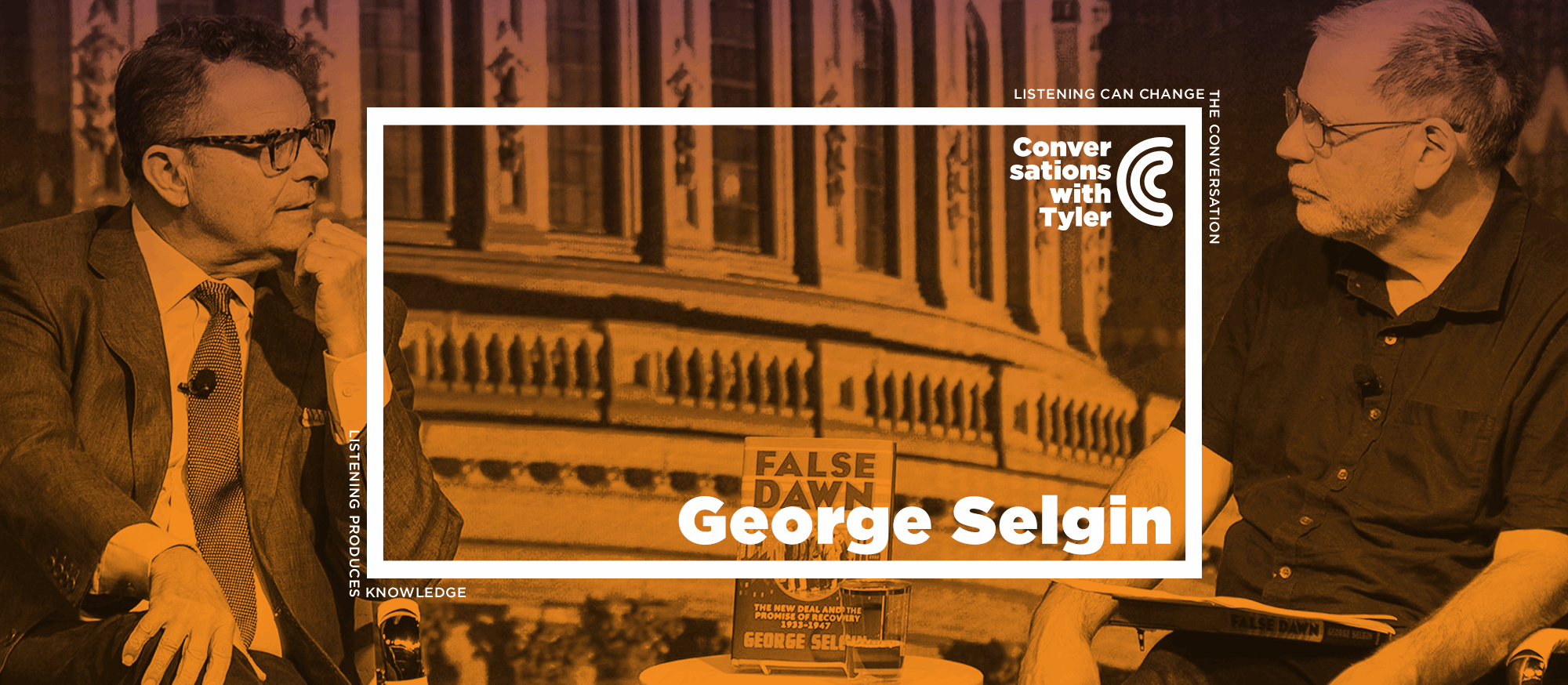



George Selgin has spent over four decades thinking about money, banking, and economic history, and Tyler has known him for nearly all of it. Selgin’s new book False Dawn: The New Deal and the Promise of Recovery, 1933–1947 examines what the New Deal actually accomplished—and failed to accomplish—in confronting the Great Depression.
Tyler and George discuss the surprising lack of fiscal and monetary stimulus in the New Deal, whether revaluing gold was really the best path to economic reflation, how much Glass-Steagall and other individual parts of the New Deal mattered, Keynes’ “very sound” advice to Roosevelt, why Hayek’s analysis fell short, whether America would’ve done better with a more concentrated banking sector, how well the quantity theory of money holds up, his vision for a “night watchman” Fed, how many countries should dollarize, whether stablecoins should be allowed to pay interest, his stake in a fractional-reserve Andalusian donkey ownership scheme, why his Spanish vocabulary is particularly strong on plumbing, his ambivalence about the eurozone, what really got America out of the Great Depression, and more.
Watch the full conversation
Recorded September 26th, 2025.
Read the full transcript
TYLER COWEN: Hello, everyone. Today, I’m chatting with George Selgin. This is an episode of Conversations with Tyler, but we’re holding it at the Cato Institute. George has worked for Cato. I’m a longtime associate, still on their advisory board. I thank Cato, our host, and we’re both honored to be here. I’ve known George well over 40 years, which I find stunning. I first learned of him through his work on free banking. He was at NYU as a grad student, and I lived nearby. He and I have had fruitful discussions for a long time, but we’ve never taped anything.
He has a new book out called False Dawn: The New Deal and the Promise of Recovery, 1933–1947. It is the best book on its topic. I am proud to announce I have read all of George’s books, and they are all definitely worth reading. George, welcome.
GEORGE SELGIN: Thank you, Tyler. Very pleased to be back here at Cato and to have a chance to have this conversation with you.
COWEN: First question: if someone tried to sum up, in as simple a sentence as possible, what in the New Deal mattered, and they said, “Well, revaluing gold helped recovery a lot, and the NIRA hurt recovery a fair amount,” is that the best quick summary they could produce?
SELGIN: Of the whole thing —
COWEN: Of the whole thing.
SELGIN: — or my book?
COWEN: The truth. Your book is the truth, right?
SELGIN: [laughs] No. I say no because a big part of the truth that that leaves out is what the New Deal didn’t do to achieve recovery. This surprises many people to hear, but it made very little use of fiscal or monetary stimulus. I would add that, that the New Deal, whatever it was up to, did not amount to a modern-style program of economic stimulus.
COWEN: But once we revalue gold, as you know, starting in 1933, you have manufacturing-output growth rates of 7 percent to 8 percent until we screw it up later on with some disinflationary pressures. How much better could we have done? Wasn’t that a pretty good performance?
SELGIN: It was pretty good, but it didn’t last very long. In fact, the New Dealers knew that it wouldn’t last very long. There are a couple of reasons why.
First of all, there was a big burst of output that was connected to the expectation that the NRA, the National Recovery Administration, was going to be coming into effect, because it was one of the early New Deal measures. It was going to artificially raise prices through controls. There was a boom that was based only on manufacturers’ desires to jump the gun and buy inputs and produce inventory before their own costs went up. That was part of the story.
Of course, when you’re coming out from the deepest depths of a depression with a banking crisis and all that, you would expect rather rapid growth to follow from the stabilization of the banking situation itself. I don’t want to deny that there was genuine progress during those early months of the New Deal, and I don’t want to deny that the New Dealers deserve credit for much of it, but it didn’t last. Of course, we all know it didn’t last.
Beyond that first period, once the NRA and associated programs for price controls kicked in, things started to slow down very rapidly. What kept the progress going after that — though at a slower rate — was mostly gold starting to rush in from Europe. It was rushing in only initially because of devaluation. After that, it was mostly rushing in because of fears of the consequences of Hitler coming to power and the possibility of war breaking out.
That’s the story of the early phase of the New Deal: a good start that didn’t last that long, except as a result of help from abroad that was quite unintentional help.
COWEN: Was revaluing the gold price the best way of reflating the economy? Because there were many proposals at the time. You shut down the domestic gold market as well. Could it have been done better?
SELGIN: Yes, it could have been done better. I think that what should have happened was immediate devaluation of the dollar. It was clear by the time Roosevelt took office, the gold standard, as it had been, had to be at least suspended because the New York banks had run out of gold essentially. That was not something there was much choice about.
Then the question was, “Okay, what are we going to do going forward?” As I said, what I think they should have done was to just plan on a devaluation of the dollar, get it over with as quickly as possible. You don’t announce that plan before you’ve suspended gold payments because that’s just going to make the run on gold worse. Once you’ve suspended, then you can go ahead and proceed with the devaluation.
What Roosevelt did was to engage in this crazy gold purchase program for quite a few months, based on a harebrained theory by a fellow named George Warren, who was very influential. They toyed with the price of gold. The theory was that if you raise the price of gold, other prices will start going up. Didn’t happen. Eventually, after many months, general prices had hardly risen at all.
Finally, Roosevelt picked a value for the dollar, a proper devaluation. Confirmed it, put it into effect, and at that point, things started to improve. That’s what should have happened.
By the way, this is as good a time as any to mention, this is what Keynes would have recommended and did recommend. He scolded or criticized Roosevelt for following Warren’s theories instead. I think that on this and many other scores, Keynes’s advice about dealing with the Depression was actually very sound. The myth is that Roosevelt was following it when, in fact, most of the time, he wasn’t.
COWEN: Let’s do a rapid-fire look at some New Deal policies. I’ll mention the policy. Give me a quick answer — helped recovery, hurt recovery, and why. Ready?
SELGIN: Yes.
COWEN: Glass-Steagall Act of 1932.
SELGIN: That act has two definitions. It can refer to the whole legislation, which had several components. It can also refer just to the more famous part that separated investment from commercial banking. That’s what people think about these days when they think about Glass-Steagall. I’ll answer the question for that second meaning of Glass-Steagall.
COWEN: Sure.
SELGIN: The answer is, it was totally irrelevant for recovery because the involvement of commercial banks and investment banking was not a factor that contributed to the Depression, so ending it wasn’t going to help end the Depression.
COWEN: Reconstruction Finance Corporation — helped or hurt?
SELGIN: Mostly it hurt.
COWEN: How?
SELGIN: It started out as Hoover’s plan. The basic idea was that it was going to lend to banks and help them become or stay solvent, but at first, the banks were very reluctant.
I should step back a bit. At first, the amount of lending that went on under the program was very limited. Then, at a certain point, Congress made the RFC divulge which banks it was lending to ahead of making loans. Then the banks became very reluctant to take part in the program.
COWEN: In principle, was recapitalizing the banks a good idea or a bad idea?
SELGIN: Recapitalizing the banks was different from lending to them. That was a later program, and that worked. I think that helped. That was when the RFC actually bought shares in the banks and so raised their capital directly instead of lending to them.
I think that the recapitalization program was one of the good things, one of the only things that the RFC did that helped end the Great Depression, by stabilizing the banking system and allowing more banks to reopen. I would rate that a successful program, but with the qualifier that the RFC did many things and grew into a vast agency, the biggest agency of the New Deal, and as such, it had more failures than successes.
COWEN: Agricultural Adjustment Act — good or bad?
SELGIN: Bad.
COWEN: Why?
SELGIN: Because the theory behind it, first of all, wasn’t very sound. The idea was that we’re going to tax food processors and do that to raise the income of farmers, really of farm owners, and that the farm owners will have a higher — I’m now using language that wasn’t current at the time — will have a higher marginal propensity to consume than the people being taxed, and therefore, there’ll be more spending overall. It was a rather doubtful theory to begin with.
Of course, what these farmers were being paid to do was to produce less output, to farm fewer crops, and to destroy crops and livestock, with the aim of raising their prices through supply reduction and not just by getting aggregate demand to grow. So, you had this feeble aggregate demand component, which just wasn’t effective enough to matter, and then you had this adverse aggregate supply effect, which was important, but wasn’t doing something desirable.
The studies of the AAA’s effect on recovery overall don’t show any. It’s quite controversial whether it had a small effect or none at all. I think it probably had none.
COWEN: Here’s a tricky one: Banking Act of 1933.
SELGIN: Yes, that’s tricky because that’s another one. There are several components to the Banking Act. The most well-known is deposit insurance. It’s probably the only one worth talking about. The role of deposit insurance in the recovery is misunderstood in a lot of ways.
One thing that’s misunderstood is Roosevelt’s part in it because he actually opposed deposit insurance — that component of the Banking Act — until the eleventh hour. He only finally gave in because he could see that he’d either have to scrap the whole bill, and if he did try to do that with a veto, he’d probably have the veto overridden. He finally signed it, and then he took credit, “This is my idea,” and all that. That’s one thing that’s misunderstood.
The other is that deposit insurance was only one of many factors that helped stabilize the banking system by discouraging people from running on the banks. It contributed to the reopening of the banking system, which was crucial to recovery, but not as much as people think.
COWEN: You’re going to say “good.”
SELGIN: I’m going to say good in the sense that — apart from long-run consequences, moral hazard, and all that — it did not hurt. I’m going to say good, but it didn’t help that much because there were other factors that played a much bigger role in getting people to put their money back in the banks or keep it there. We could talk about those. Deposit insurance was much less important than other things.
COWEN: Federal Reserve Act of 1935, which kind of made the Fed semi-independent, right?
SELGIN: Yes. The Banking Act of 1935 gave the concentrated control of the Federal Reserve to bureaucrats in Washington. The good news, if you want to call it that, with that act, was that now FDR and the New Dealers, could exert a lot more influence over monetary policy. The bad news is they didn’t take any advantage of that.
Marriner Eccles was appointed as . . . We now call him chair of the Fed. I think that’s when they first became known as the chair rather than the governor.
He was a monetary conservative in the sense that he didn’t believe in monetary stimulus. He was a big fiscal stimulus guy, but he’s now in charge of the Fed. There was no Federal Reserve active fiscal stimulus under Eccles’s watch.
If you look at Federal Reserve credit, including open market purchases, it’s a flat line. Yes, now Washington’s in charge. Yes, you don’t have to worry about getting these 12 banks to cooperate, which is like herding cats, but no effort was made to take advantage of that to pursue an expansionary monetary policy.
COWEN: Let’s say you’re a dictator, George, in 1932, 1933. You can do what you want, free hand. With fiscal policy, what would you have done?
SELGIN: I would have spent more.
COWEN: On what?
SELGIN: On deficits. That’s the challenge with fiscal policy back then. Today, they don’t seem to be short of ideas for spending money somehow. In those days, [laughs] they were short of ideas. In fact, Roosevelt was a fiscal conservative throughout those years. Roosevelt, at first, said with regard to big spending plans, “What are you going to spend it all on?” He had a point.
I would have favored more fiscal stimulus to the extent that they could come up with stuff to spend it on. I might have told Harold Ickes to spend money a little bit more generously and not be worried about wasting it.
But I want to say, I would have put more emphasis on monetary policy, which wasn’t taken advantage of, because I think it would have been much more capable of addressing the problem of a lack of demand than fiscal policy, given the difficulty involved with spending a lot of money and the potential waste that fiscal stimulus can involve.
COWEN: Taxes were basically tripled, right? Would you have done that?
SELGIN: No, certainly not.
COWEN: Cut taxes, kept them the same, what? You’re a dictator.
SELGIN: I would have gotten rid of some of the more regressive taxes, which they were relying on heavily, starting with the 1932 excise taxes that were passed, of course, by the Hoover administration, but they were maintained and even expanded by the Roosevelt administration.
Roosevelt had some taxes that were meant to soak the rich. They get a lot of attention, but they were, in fact, not the main sources of revenue by any means. Most of the taxes that the administration was relying on, in its effort to balance the budget, which it kept trying to do — this is the Roosevelt administration — most of them were quite regressive, falling on lower-income people.
I would certainly have rolled back some of those taxes. I don’t think fiscal deficits were at all inappropriate at this time, but again, I would have placed more emphasis on monetary policy than on fiscal and resorted to fiscal stimulus to the extent that monetary policy didn’t seem to be able to cut it.
COWEN: Just as a cause or potential cause of the Great Depression, did Smoot-Hawley matter at all, a tiny amount, significant? Is Jude Wanniski just making this up? Tell us.
SELGIN: On Smoot-Hawley, my tendency is to defer to the research of Doug Irwin, who I consider to be the great expert on this subject. Doug is by no means a critic, let alone an opponent of free trade. He’s very critical of Smoot-Hawley, yet even Doug says that his opinion is that Smoot-Hawley was a small factor in the Great Depression. If he says that, I’m inclined to agree, though I have to say I haven’t done any independent research on this. It’s just simply a matter of my inclination to defer to that particular authority on this question.
COWEN: If Smoot-Hawley was small or very small or maybe nothing, should we also conclude that policy uncertainty was small? Because here we saw a policy come with certainty. We know it was very bad. Why is policy uncertainty such a big deal?
SELGIN: I think that a policy that’s certain can have a small effect for obvious reasons. It might not be a policy that has all that many consequences that are predictable. In other words, Doug Irwin, before Smoot-Hawley was passed, knowing what’s going on, might have said, “Yes, this is going to have small consequences.” If we assume — and this is a stretch — that people are as smart as Doug Irwin, they might have anticipated the policy and still not expected it to have big effects.
Regime uncertainty is a whole different matter because the problem there is not that you anticipate a policy and anticipate its consequences, but that you just don’t know what the heck’s coming. Now, from the point of view of investors, that’s a huge thing, because the first thing investors want to know is whether they’re going to reap the benefits of their investments. If the answer to that question depends on having a rough idea about what policies are going to be in the future — and you don’t have even that — you’re going to hold back.
Bearing in mind now, the big problem with recovery was not about consumption — that’s relatively easy to get going. It was about investment spending, which had totally collapsed. There was hardly any net investment for the whole 1930s, so anything that is discouraging businessmen from investing — including uncertainty, which can definitely do it — is going to be standing in the way of recovery. I believe this was a big barrier to recovery during the ’30s.
COWEN: Why was the second Great Depression, as it’s sometimes called, in 1937–38, so severe?
SELGIN: That’s a really good question, and now, you’ve come to the first one that stumps me, because it was so dramatic and so sudden. There were a bunch of factors that contributed to it. I think that the best answer to the question is that there were so many operative causes all coming together at once, a sort of perfect storm of bad policies.
On the monetary policy side, two things were done at the same time by different actors who didn’t seem to be coordinating very well. First, remember that gold flowing in from Europe that was the main driving factor in expanding demand in the ’30s? Well, they started worrying about inflation, “Oh, we’re going to have too much,” which was crazy under the circumstances, but it’s true. As a result, at the Fed, they started doubling reserve requirements. They did it in three steps. That in itself may not have done that much harm. There’s controversy about how much it mattered.
At the same time, at the Treasury, they started sterilizing the gold inflows. That is, they took steps that prevented the inflow of gold — which went directly to the Treasury at this time — from influencing the amount of reserves in the banking system, so the reserves didn’t go up even though the Treasury was getting more gold. It was exactly coincidental with all this monetary restraint that you had the outbreak of the ’37–’38 Depression.
But that’s not all. There was fiscal constraint as well. Coming up towards ’37, they decided that, along with thinking that the inflation was becoming a threat all of a sudden, they’re thinking as well that the recovery is just about around the corner, that they’re almost there, because by ’37, things are starting to look a lot better. In one of many efforts to balance the budget during this time, they resorted to fiscal retrenchment, so you had a tightening of fiscal policy.
I think the best answer to the question of how come you had such a severe decline is that you had this conjunction of monetary and fiscal tightening all happening at the same time.
COWEN: Who’s the economist whose writings on New Deal policy come out looking the best from that time?
SELGIN: I’m going to mention Keynes, partly just to be controversial with this audience. [laughs]
COWEN: But there’re some articles by Keynes in the ’30s that are just terrible. His piece on protectionism, his call in The General Theory to nationalize investment.
SELGIN: Of course.
COWEN: Those are some pretty bad recommendations, even though he got some things quite right.
SELGIN: I’m only talking about what Keynes had to say directly about the American Depression and the New Deal, and how to get out of it.
COWEN: So, we made him sane when he turned his neck across the Atlantic.
SELGIN: Yes, to some considerable extent. I honestly — not just to be provocative — will say that the things Keynes had to say to Roosevelt directly, sometimes through letters publicly published, and also in his meeting with Roosevelt insofar as we know about it — his one meeting — Keynes’s advice on how the US should deal with the Depression and try to get out was very sound. I’ll give you a few examples.
He was very concerned about regime uncertainty, specifically with Roosevelt’s tendency to attack businessmen and even pursue policies that were directly aimed at punishing them. He told him, more or less — not in so many words — that he ought to back off, this was not the time.
Similarly, he said that the New Deal was confusing or getting priorities wrong about reform versus recovery. He said, “Look, maybe some of these reforms that you’re implementing will have good, long-run results, but this is not the time. You should be concentrating on recovery,” partly because reform shook up businessmen and made it, again, hard for them to regain their confidence. The whole discussion of animal spirits, by the way, is all about what we now more often call regime uncertainty.
Finally, Keynes attacked very strenuously some of the worst New Deal policies. The gold purchase program, he ridiculed and said this was just a very bad idea, and he was right. Also, the NRA — he was extremely critical of the National Recovery Administration and its price controls, and he didn’t mince words about it.
The other important thing that Keynes recommended was that Roosevelt spend more. That’s where the conservatives and libertarians would have a beef with him. If Roosevelt had spent a lot more — whatever you think about fiscal stimulus — if he’d done that instead of the things he and the other New Dealers actually did, there’s no doubt in my mind that it would have been better, because pouring more money into the economy may have adverse consequences, but nothing like some of the scary reforms, highly regressive taxes, price controls, and that sort of thing had.
COWEN: There’s a book you may know by John Flynn. It was called As We Go Marching. He argued the New Deal was bringing a kind of semi-fascistic planning to the United States. How correct was Flynn? How does that book hold up? Exaggeration or a prophet before his time?
SELGIN: I think this question about FDR being a fascist or a socialist comes up a lot. Everything is relative. If you look closely at FDR’s actions during the ’30s, when he’s most inclined . . . There is some genuine sympathy with Mussolini and what he’s doing in Italy before Ethiopia and all that. It was widespread. This wasn’t the peculiarity of the New Dealers. This was just what many people thought, that Mussolini was getting the trains to run on time and all that.
But more than anything, FDR was always looking over his shoulder at the people who might more accurately have been described as fascists and socialists, people like Huey Long and Townsend. There were all these people who were threatening — in Long’s case, very obviously — to mount campaigns that might keep FDR from being re-elected. It was largely in an attempt to fend off these attacks that he stole a lot of their fascist thunder, to call it that. He was thinking about what was needed to get re-elected.
The point here is that there’s a counterfactual that mustn’t be overlooked, which is that there were more socialistic and fascistic people around who were gaining a lot of attention and support. Maybe the New Deal has to be seen as a compromise, not an all-out move toward those extremes, but a sop being provided to the advocates of more aggressive authoritarian government. If you compare FDR to those folks, he doesn’t look so bad. Of course, if you compare him to an ideal classical liberal president, he looks like a fascist.
Again, the question is, where were the politics pointing at the time? And what could a person trying to get re-elected get away with, or what compromises did he have to make?
COWEN: Why did the Austrian economists underperform in their diagnoses of the 1930s? Or would you challenge that premise?
SELGIN: The problem with the Austrians, I think — and here, it’s most clear in Hayek’s case — is that their policy recommendations were not necessarily consistent with their theories. Hayek, in theory, came around to the view that, at the very least, you had to maintain the level of spending, or what Keynes would call aggregate demand, in an economy, or get it back up when it has collapsed. Stabilize the product of the money stock and its velocity. This is in Prices and Production and other works by Hayek, and he’s very good on that.
On the other hand, he seems to have been inclined to see the collapse of the early 1930s in Britain as well — perhaps more so than in the US — as an opportunity to break the trade unions, and was more determined to let that damage continue. Also, he was keen on keeping the gold standard, whether it was consistent with stabilizing spending or not.
So, there were these inconsistencies between the practical recommendations, which were for austerity, for keeping the gold standard, et cetera, with at least Hayek’s version of the Austrian theory, which said you must maintain stability of spending in the economy if you’re not going to have trouble.
COWEN: How did the early Chicago School do? Henry Simons, Jacob Viner?
SELGIN: The Chicago School as a whole — first of all, they were not the fiscal conservatives that they’re now made out to be. They took the lead well ahead of Keynes in pushing for big public works to counter the Great Depression. Many of them signed the petition to that effect, and they had been arguing for it for some time. So, they certainly were not laggards in the sense of recognizing that the government could help stimulate demand through public works.
Fisher, of course, wasn’t really Chicago. He was Yale. He is an honorary Chicago economist, but he was a highly influential economist at the time. Fisher was for a managed fiat dollar — what we have today, in effect. In that sense, you could say it was very forward-looking, but he wanted to get rid of the gold standard. There were a lot of Chicago economists, I think, who were sympathetic with that goal.
Simons wanted to do away with fractional reserve banking. I think that was a very bad way to respond to the banking crisis, which, if you looked at what was really behind it, you find that bad regulations, rather than fractional reserve banking, per se, were the problems. Simons only had to look north to Canada to see that you didn’t have to have a banking collapse just because you had fractional reserve banks.
I give the Chicago people different grades according to the different persons, because they all had different views about these things. What I would say is true of all of them is that they were not the simple-minded classical economists that Keynes caricatures in The General Theory.
COWEN: You mentioned the banking issue. I remember well the 1980s, when many people insisted to me that Japan, Germany — they had these systems of universal banking: quite well capitalized, pretty highly concentrated. It was supposed to be better than the decentralized American system, which, every now and then, would go insolvent. There’d be problems with the deposit insurance funds. One hears frequently claims about Canadian banking to the north, “Well, they allow all this branch banking. You only have a few large banks. They never go under.”
But from the vantage point of 2025, when America clearly has by far the best capital markets in the world — they’re very decentralized. Banks are just becoming smaller and smaller, 15 percent to 20 percent of the whole. Did we really do so bad not to move to that highly centralized model, even though it would’ve been stabilizing at the time?
SELGIN: Two things can undermine a banking system, broadly speaking. One is not letting the banks do the best they can to diversify and strengthen themselves. That’s what letting banks branch and that sort of thing were about. Until 1933, the US government mainly undermined the stability of its banking system by limiting the freedom of what banks could do, by imposing very harmful restrictions on their activities.
Now, what’s confusing is that the situation has totally changed, but not the fact that the government is still to blame. [laughs] What I mean is that now we allow branch banking. We allow banks to do a lot of things that they couldn’t do before, many of which I think are good in themselves, but since 1933, we have created a vast system of deposit guarantees, and so have introduced a huge moral hazard problem.
Here’s the thing: things that would’ve been utterly desirable freedoms in the absence of guarantees become dangerous when you have those guarantees, because then, the banks might take advantage of the guarantees to abuse these freedoms because they see that they’ll be protected on the downside from the risks they take in pursuit of profits.
So, we’ve gone from a system where freedom would’ve been, and was, desirable — more freedom because the guarantees that would’ve encouraged that freedom’s abuse weren’t present — to a system where the same freedoms are not necessarily a good thing because guarantees have corrupted the incentives that banks face.
COWEN: Say we hadn’t had, or hadn’t kept, deposit insurance, and we move forward into a world where there’re five or six big banks, not many small banks. Banks are capitalized at 40 percent. The cost of capital is higher — is that really better for this country?
SELGIN: I don’t think that that kind of concentration would’ve been better, but let’s be careful. That kind of concentration wasn’t just a consequence of letting banks branch. I have an article about this. In Canada, they had strict entry requirements. What happened is that, especially starting in the 1920s, the number of Canadian banks shrank, and the authorities wouldn’t allow any new ones to be formed. It wasn’t just branch banking — the freedom for banks to branch — that resulted in all this consolidation. It was absolute entry restrictions that were imposed by regulation.
I think that the question one really wants to ask is, what would a banking system look like if you let banks be free to consolidate, branch, and group or whatever on their own, but you also had no guarantees, no too-big-to-fail — which of course drives a lot of consolidation itself and no absolute entry restrictions, freedom of entry.
I don’t think you would have so concentrated a banking system as we’ve seen now in Canada and some other places. I also think there would be room for some small banks still, because small banks have their specialties. Among the big branch banks, I think you would also have survival of some small banks.
COWEN: If the main thing you want is security for your deposit, access to the payment system, and because of our Constitution, Congress cannot really pre-commit to no big bank bailouts — however much you or I might want them to, they can’t; there’s sovereignty embedded in our institutions — I would just keep on putting my money in a big bank, even under what might nominally appear to be laissez-faire, because I would figure ex-post, they’ll be bailed out — the smaller banks maybe not — and we’d end up with five or six dominant banks. Maybe that would be better, but I don’t think it would actually be truly competitive either.
SELGIN: If the question is, do I wish we could have a world where the government could credibly commit to not bailing out big banks, then my answer would be, of course, that is my wish. But I agree with you: It may not be possible to ultimately prevent this. The clamor for rescues is so great when a major bank fails. I don’t have an answer to that. I really don’t.
I think, though it remains important, the question still is important: What would a banking system look like if we didn’t have this kind of government interference? How well would it work? Because what we have today is a lot of economists running around saying that we have to have governments bailing out big banks, small banks. As long as they’re on the side of these bailouts, my wish, of course, is never going to become true. There’s a chance that we could put some meaningful barriers to government bailouts of big banks in place if we didn’t have a lot of economists saying we shouldn’t have such barriers.
COWEN: I have some more general questions about macro for you. The quantity theory of money — overrated or underrated?
SELGIN: Badly misunderstood, [laughs] first of all.
COWEN: What’s the correct version? And tell us if it shows up in the data these days.
SELGIN: The correct version, which is to say, my version —
[laughter]
SELGIN: — is that the rate of inflation is roughly approximated by the rate of growth of some monetary aggregate, say M2.
COWEN: But if we run that in regressions, which people at the Fed do until they’re blue in the face, it doesn’t go very well.
SELGIN: No, that’s right. I don’t think it’s true, but I’m just trying to clarify what the proper statement of it is. Now, it’s not true in the sense of being reliable, but if you look at the really broad record, there certainly is some correlation out there worth bearing in mind. The problem, of course, is financial innovation, regulatory innovation. All these things change and can change dramatically the actual relationship between any given monetary measure and any given inflation measure.
COWEN: Wouldn’t you think those would have level-effect changes, and the deltas still would look like the quantity theory? But they don’t. This is, for me, a big part of the puzzle. Regulations change pretty slowly, so that might make the money multiplier different, or velocity different, or which monetary aggregate matters different. But at the margin, I would expect to see more quantity theory relations than I do.
SELGIN: Well, it could be that the theory is just not that good.
COWEN: But we’ve all read Milton Friedman and David Hume. The theory sounds pretty good.
SELGIN: Yes, it sounds good.
COWEN: We teach it. What’s wrong with the theory?
SELGIN: [sighs] Well, don’t forget that on top of regulatory innovation and financial innovation, you have something much more fundamental, which is the demand for real money balances, which can change at any time for all sorts of reasons. The quantity theory is premised in its stricter version on the assumption that velocity is a constant or very stable value, and it isn’t. That’s all there is to it.
COWEN: That should make the quantity theory more true. So, if M2 goes up a lot, you would think that accelerates velocity. You would get a disproportionate effect. But in fact, you often see M2 go up quite a bit, and prices are like, meh.
SELGIN: If the rate of change of M2 — well, really, the rate of change of prices — is changing, that will be a factor changing velocity. You’re right, it’s a positive relationship. However, velocity changes for all kinds of other reasons. So, the assumption, the basic assumption that velocity is independent of the monetary growth or is stable for whatever reason, is often violated.
I’ve never been a strict proponent of the quantity theory myself, so I don’t feel too obliged to try to defend it. But I must say that when I was teaching this stuff for quite a few years in the ’80s and ’90s, I presented to students some rough correlation data for M2 growth rates and rates of inflation, a chart for a bunch of countries with the usual diagonal, and they all lined up pretty well. You could look at statistics for one country, and you could see the relationship. It wasn’t tight, but it was there, and it was there for a long time.
A lot has changed since I was teaching back then. I’m sure that if I updated those charts, I might have to give a different lecture. But there was something to it at the time when people like Milton Friedman were emphasizing it. It was definitely something that had been in the data for some time, and I think it was worth tracking.
By the way, I should add, since 2008, all bets are off on this stuff because we now have a system where the monetary base doesn’t necessarily have much to do with the overall ease of credit. It’s all about the interest rate and reserves and that sort of thing. So, the quantity theory is probably even more doubtful since 2008 than it was before.
COWEN: The notion of “independent central banks,” which I put in quotation marks — overrated or underrated?
SELGIN: I would say —
COWEN: It’s an issue today, right?
SELGIN: Yes, it’s very hard. The best way I can answer that question is by saying what I have said several times in other forums, that it’s precisely because our central bank, the Fed, is not very independent that we need to take seriously the preservation of what little independence it does have. Given that position, I don’t know whether I should say independence is overrated or underrated because there’s a sense in which it’s overrated because there isn’t that much of it, but it’s underrated to the extent that people say, “Well, let’s not worry about losing it all.”
COWEN: Given that the commodity demands for gold are often quite unstable — in recent times, it would be the Central Bank of China as a major culprit — can we have any kind of gold standard at all in one country, even a big country like the US? Or is that just out?
SELGIN: As far as I’m concerned, it’s out.
COWEN: It’s out.
SELGIN: It’s been out for a long time, yes.
COWEN: If there’s no gold standard, can we have free banking at all?
SELGIN: Yes, absolutely.
COWEN: It’s free banks issuing things backed by US dollars.
SELGIN: That’s right.
COWEN: But it’s still ultimately controlled by the Fed.
SELGIN: Yes, it is. You have to reform the Fed, too. You have to reform monetary policy. We didn’t solve that problem.
COWEN: In 2025, how do you reform the Fed? You’re in charge, Dictator George, tell us.
SELGIN: Well, I’m an NGDP stabilizing person. I have been for a long time. By the way, my first book, The Theory of Free Banking, puts forward a proposal or an ideal of a frozen monetary base, fiat money. It’s not a gold standard, and it argues that ideally you want to stabilize spending. It looks at how well the system does that. I’ve never been a return-to-gold advocate, and I’ve always understood that free banking could be based on a fiat monetary standard.
What has to be understood, though, is that if you have free banking with a fiat monetary standard, then you have solved problems because I think the freedom of the banks creates a lot of greater robustness in the banking system and less risk of financial crises. Mind you, freedom has to, here, include no bailouts, right? You still have to deal with monetary policy in the narrow sense of how the monetary base itself is managed by the central authorities.
In the book, I recommended freezing the base, which would be like turning the dollar into so many bitcoins, but a less dramatic, less drastic proposal would be a Friedman-type proposal. I think Friedman, in the ’80s, was fantastic on this stuff. He said replace the FOMC with a computer and program the computer so that you just get enough increase in the monetary base, or you choose interest rates such that you end up with enough money to keep nominal spending stable, but not more than that.
I sometimes talk about a night watchman Fed. You don’t have to have the FOMC doing anything. You just have a big computer in there and a night watchman who makes sure nobody can go in there and tamper with it. That’s my ideal reform.
COWEN: How many countries should dollarize?
SELGIN: Oh, gosh.
COWEN: An exact number, please. “Thirty-eight.”
SELGIN: Fewer than Steve Hanke thinks. A small number probably should. The number depends on how many of them have proven themselves utterly incapable of fiscal restraint and of managing either floating or pegged exchange rates without either hyperinflation or inviting speculative attacks on them.
COWEN: That sounds like a lot of countries to me. Just add up the Caribbean right there.
SELGIN: [laughs] It’s a larger number than it used to be, and it seems to be getting bigger all the time. Now, Argentina is the big question mark here because it’s a very big economy. Normally, you would not consider such an economy your candidate for dollarization, but if the economy, despite being big, has a long enough track record of failing with all the other possible arrangements, it’s time to take the dollarization alternative seriously and ask whether it’s the lesser of evils because it’s not going to be great. It’s not going to be perfect to have a big economy bound to the US monetary policy.
Of course, it’s not going to be any better if . . . It’s going to be worse if the US monetary policy itself is bad. That’s always a risk of dollarization — you’re not going to be any better off than the dollar itself as a monetary system. But again, if you’re a basket case, the relevant question is, what’s going to be worse? What’s going to be the least harmful system?
I really object to what I’m afraid is large numbers of economists who, when addressing questions like this, go to their blackboard economics. What they do is, they say, “Well, a perfectly managed central bank with a floating exchange rate can do this, that, and the other thing. Now, let’s compare it to dollarization. Oh my, dollarization is inferior.”
That kind of comparison is utterly irrelevant for countries of the sort we’ve been talking about. Now, it may still be the case that if you take seriously their records and how they’re likely to manage a floating exchange rate or a peg, you might still conclude that one of those is better than dollarization, but at least you should make the right comparison based on the reality of those countries’ fiscal and monetary records.
COWEN: Right now in DC, as we speak, there’s a big debate: Under the GENIUS Act, should stablecoins be allowed to pay interest? The banking lobby says, no, it will drain too many resources from banks, and in fact, they could end up insolvent, illiquid. A bailout would be needed.
Since banks are so often poorly managed, are they right? Should we allow interest payments on stablecoins? Doesn’t that just become a regulatory arbitrage against the banking system proper? How do we handle the transition?
SELGIN: Well, my immediate reaction to any argument from any industry that says, “Don’t allow X because it’ll hurt our industry” is, “So?” Because —
COWEN: You and I are on the hook for this. Or you’ve moved to Spain. Maybe you’re not anymore, but you’re probably still a US taxpayer, right?
SELGIN: I am.
COWEN: Yes, you’re on the hook.
SELGIN: You can’t get out of that — burn my passport. No, I think that, of course, stablecoins, if they succeed at all, are going to be competing to some extent with banks, and some banks are going to lose to that extent. That in itself can’t be an argument for imposing any kind of restrictions on stablecoins. It has to be the case that the damage banks suffer somehow is going to make us worse off, even though people are benefiting from the stablecoins instead.
If we can envision, just for the sake of argument, a stablecoin industry that gives us all everything we want that we used to get from banks, so we do dispense with banks altogether. Well, so what? It’s like replacing horses and buggies with automobiles. So, there has to be some kind of third-party effect or something that’s appealed to before we can say, “Oh, well, we better not let them do this.”
I haven’t seen very good arguments about such consequences. I do see evidence to the effect that stablecoins have been very badly managed, because some of them have been disasters. That means we do need to do things to make sure stablecoins are themselves well regulated, but it doesn’t follow that we’re doing this because we want to help the banks. We’re doing it because we want to make sure we have an industry that’s in itself reasonably reliable.
COWEN: For our final segment, we move to the George Selgin production function. George, what is it like owning 100 donkeys?
SELGIN: Yes, I own 100 donkeys, but so far, only for a year. I volunteered. There’s a donkey reservation near where I live in Spain. I found out about it, and I like donkeys, so I went down there. It’s a husband and wife who’ve been doing this for 35 years or something — mostly out of their own pockets — to try to keep the donkey population going, specifically the Andalusian donkeys.
So, I volunteered to help out there. It’s not help yet, but I hang around and move hay and things like that, cut corn. I wanted to make a donation. On the website, it said that for €20, you could adopt a donkey for a year. I sent in €2,000 and put a note on it, 100 donkeys. I now own 100 donkeys. The only problem is that it’s a fractional reserve donkey place, so it turns out they only have 30 donkeys.
[laughter]
SELGIN: If I were to stage a run right now, they’d go broke.
COWEN: What’s the positive social externality from donkeys in Spain?
SELGIN: If you’ve ever hung around a donkey or donkeys, you find that they are just nothing but walking positive externalities. They’re absolutely lovely, very, very amicable animals. They come and nuzzle you and all that. They actually use them for therapy for this reason. Unlike therapy dogs, you can’t bring the donkey into the hospital. People come down to the donkey reserve. They bring patients down there to hang around the donkeys.
It has really good effects — psychological patients or people who are recovering from serious injuries, and all that. I’m not going to discuss what my possible problems are, but whatever they are, it’s helping to hang around these donkeys, and I get it for nothing.
[laughter]
COWEN: Well, not for nothing.
SELGIN: Well, I do some work. Yes, I do some work.
COWEN: Now, feel free to challenge the premise of this question, but what would you say is the most important way that, over time, you’ve become less libertarian?
SELGIN: Ahhh. Part of the answer to that, I have to say, I was never that libertarian to begin with. I got into the money stuff with Larry’s book and all. I became libertarian on money by virtue of asking the question, do we need this much government and money, and coming to the conclusion that we don’t. Now, since most people think money is the thing that, above all, has to be regulated by governments, people naturally assume that if I’m libertarian on money, I must be a hardcore laissez-faire guy all around. But in fact, I don’t hold strong opinions about a lot of economic policy issues because I just don’t pretend to know enough.
COWEN: Your money views have a lot of government in them. There’s no gold standard. It’s a government paper currency. It’s a government-run computer. It runs monetary policy.
SELGIN: That’s true, but that was true from the beginning, too. Like I said in my first book, I assume you can’t . . . I like the gold standard. I thought the pre-World War I gold standard was amazing. It’s the best monetary system we’ve had. If it didn’t always look great, as was the case in the United States, for example — where we had crises — if you do the research, you’ll see that that was because of the specific dumb regulations in those countries that had a lot of problems, mainly the US and England.
Anyway, a gold standard was great, but I don’t think you can get that genie back in the bottle. I just think it’s impossible for the most obvious reason. Once governments are involved in the gold standard, once you have a central bank, then if it breaks its commitment — which of course they all have, all the ones that once were tied to the gold standard — then they can’t establish a credible commitment again to have convertibility to gold.
The way I sum it up is, if tomorrow the Federal Reserve said, “Okay, you can have so many ounces of gold for every so many dollars,” a wise public, I think, myself included, would go tomorrow and take the gold just in case, and that would be the end of it. I don’t think you can recreate. The problem is you’ll say, “Well, okay, we don’t have to have a central bank.” But you do in the sense that switching monetary standards is like trying to switch which side of the road you drive on. You need somebody to coordinate it to make it happen because people don’t do it all by themselves.
That’s why Bitcoin isn’t taking off as a general medium of exchange, whatever its virtues might be, for example. We have this network problem. If the government doesn’t deliberately create a gold standard, it’s unlikely that we’ll spontaneously go there, but if the government did deliberately create a gold standard, it’s unlikely we would trust it. That’s my big problem with gold standards.
COWEN: Last two questions before we go to audience questions. First, living in Andalusia, what’s been your biggest surprise?
SELGIN: The biggest surprise has been the people. The people are just absolutely lovely. I went alone. I don’t have family or anything. Having people act like they really care about you just from the get-go is wonderful. I’ll just tell you two quick stories now. One is I had a toothache early on, so I go to a local dentist.
To make it short — because we don’t have a lot of time — I ended up making about six visits to this dentist to try to get this thing straightened out. They finally had to pull a tooth and put in a crown. They wouldn’t take my money till they put the crown in. Then they took some money. I kept saying, “How much do I owe you?” They said, “Oh, don’t want to worry about it. Next time.”
The other one is the postman. The postman would come to deliver packages. When I’m not home, I get a frantic phone call to say, “I have a package for you. What do I do? You’re not here. Where can I put it? When are you coming back?” They’re really worried. These aren’t necessarily people I know, right? They could be a postman I’ve never dealt with before. Lovely people. Absolutely lovely people. That’s been the biggest surprise, fortunately, a positive surprise.
COWEN: Final question: now that you’re fluent in Spanish, other than donkeys, what will you learn about next?
SELGIN: Oh, that has to do specifically with Spain?
COWEN: Yes, or the Spanish language. It could be Latin America. It could be Salamanca, anything.
SELGIN: Gosh, that’s a good question. I don’t know. Usually, what I take on has to do with just an interest that’s unrelated to the interest in the language itself. I’ll only say I’ve been very keen on traveling more in Spain. They have luxury trains now in many, many countries. Have you been on the Maharaja Express?
COWEN: No, never.
SELGIN: No? I want to do that one, but Spain has a couple of them, and I want to do those. Maybe I’ll learn a lot of railroad lingo and add that to my Spanish vocabulary. All my Spanish is a result of having to learn it. I bought an apartment, and I had to have it fixed up, so my vocabulary is really good on things like plumbing and painting and plaster, and stuff like that.
[laughter]
COWEN: Again, a plug for George’s book, False Dawn, the very best book on its topic. Congratulations, George, and thank you very much.
SELGIN: Oh, thank you, Tyler.
[applause]
COWEN: Questions. I will call on you. No speeches. If you start a speech, I will interrupt you, and you will be expunged from the tape. Please. Yes, you have your hand up, and you’re looking around. The mic will come.
RYAN BOURNE: Ryan Bourne from the Cato Institute. George, the eurozone — net positive for the countries involved, net negative, or irrelevant to their prospects?
SELGIN: Well, I think the eurozone is a mixed bag. On the one hand, you have this common currency, which I think is itself a good thing, but you have all the regulatory baggage that goes along with it. I’ll answer indirectly and incompletely by saying, back in the early 1990s, I was advising Lithuania on currency reform. This was when they’d just broken free, or were just breaking free from the Soviet Republic.
I wrote an article for the New York Times. Remember, there’s no euro currency at this time. This is early ’90s, so it’s not quite 10 years before the euro is introduced, but there are Eurobonds. I said what they should do is set up a currency board backed by Eurobonds and issue euros before there were any euros. That kind of euro currency would have been very good if enough countries had done it.
I think countries are suffering from the bureaucracy that goes hand in hand with being in the eurozone, not just the common monetary policy, which I think itself might be bearable enough. That’s my thoughts about that.
I was very ambivalent about Britain’s decision to break out of the eurozone. I still have my doubts whether they’ve made themselves better off by doing so. I know that’s a dangerous thing to say, but I just don’t have very, very strong feelings — and I didn’t have them at the time — that that move would prove to be to Britain’s benefit. You can tell me more about whether I should have more confident views.
COWEN: Next question. Yes, in the back. Mic is coming.
AUDIENCE MEMBER 2: George, the US economy in the ’40s and beyond, were it not for World War II, what would we expect had there not been the war with the Depression of the ’30s?
SELGIN: What I argue in the book, and of course, what I believe, is that we might still be in trouble. The war did help end the US Depression, but not just in the way that people normally think. The common view is, “Well, we started finally doing fiscal stimulus, and how! And that got the spending going, and that got us out of the Depression.”
The problem with that simple explanation is that the big boost in spending ended. Wartime spending, or overall government spending — all levels of government — as a percent of GDP, fell back down almost to where they were in 1939 after the war ended, and that happened very quickly. All the soldiers are coming back, and the Keynesians now, who are getting in the saddle, are predicting a major depression.
But the war did something else, and that’s why that major depression didn’t happen, and we ended up with a big investment boom. That something else was to change the attitude of government towards business from the hostility it exhibited during the New Deal to, if anything, overly cozy cooperation that was planting the seeds for the military-industrial complex. So, by the time the war ends, businessmen, instead of being pessimistic, have got their confidence built up big time, and the government, instead of being hostile, is favorable.
So, you get this immense investment boom that makes up for the shrinkage in wartime spending, and that’s the real key to recovery. That’s what might not have happened if there hadn’t been a war. We might have had a more lasting regime uncertainty problem or regime hostility problem. Of course, the counterfactual here is raw because we don’t know who would have been elected. Roosevelt obviously died, and Truman would have taken his place one way or the other, and Truman’s attitudes were different from his.
At least I can say that by changing, helping to bring about the change in the government-business attitude, even before, even while FDR was still in office — in that respect, the war made a very positive long-run difference.
COWEN: Question in the front center, yes. David, oh, that’s you. Yes, hi.
DAVID BECKWORTH: George, you’re a big champion of the productivity norm, where you’d have the price level gently fall as productivity growth accelerated. If we happen upon an AI true boom, do you actually see a world where policymakers would allow this type of productivity-driven deflation to emerge? Or would they be too afraid of it?
SELGIN: My favorite policy or my ideal about prices falling as unit costs of production of goods falls is a long-run ideal in that I don’t think you can just jump into that policy because people now have expectations about trends and prices and costs. So, you’d have to gradually work into this. You would gradually work towards a policy where prices often, actually, are allowed to fall.
Do I think that the people at the Fed or any other central bank in the world today are ready to start heading towards such a policy? I don’t. I don’t. I think we still have a long way to go just to convince them that they shouldn’t be targeting a positive inflation rate. Until we’ve moved away from that, at least moved towards some kind of agreement on nominal income stability, only then will it be possible to start talking about allowing a long-run downward trend in prices if productivity continues to improve.
COWEN: Yes, in the front row. First you, then you.
AUDIENCE MEMBER 4: Thank you for the wonderful book. My question is, do you think technical innovation was the important part of the story in the recovery in the ’30s? Reversing this question, do wages that were too high or weren’t allowed to go down an important part in maintaining that innovation in labor-displacing, labor-supplanting ways?
SELGIN: Well, there was a lot of technical innovation in the 1930s. Alexander Field has written quite eloquently about it. What that innovation meant was that the production possibilities of the economy were expanding. If you interpret that in terms of output, what it boils down to is saying that potential output’s growing during the ’30s. The problem, of course, is, depression is not just a low level of output compared to some previous amount. It’s measured by the gap between actual output and potential output. Let’s just assume actual output wasn’t increasing during the Great Depression, and potential output was. The Depression was getting worse, not better.
Now, of course, what really happened was, output started to recover after ’33. As that potential output was growing rapidly, the real recovery in the sense of reduction in the output gap was less impressive than the recovery of absolute output may suggest. So, there’s a sense in which the fact that productivity was improving makes the Depression worse than it might seem if you just look at what the progress of output was.
COWEN: One over. Then, behind you will be the last question.
AUDIENCE MEMBER 5: Currently speaking, there’s the whole debate over the Fed’s independence and also a broader general debate about the independence of agencies in the federal government and being brought under the executive. Right now, there’s a Supreme Court case going on. Let’s assume, in a worst-case scenario, the Supreme Court rules that all independent agencies come under the executive. In a way, that complicates, for example, the Fed trying to implement an NGDP framework.
In your own opinion, how does monetary policy get conducted under such a totally new regime in which everything is under the executive? Thanks.
SELGIN: Well, it gets conducted according to the interests of the executive, which, unfortunately, as far as we can tell right now, tends to be one that favors very easy monetary policy, I think easier policy than would be consistent either with the Fed’s present target or with a reasonable nominal GDP target. I think it’s generally the case that both Congress, both congressional control and executive control are going to turn, in practice, into fiscal dominance of monetary policy, where the fiscal considerations, that is, the desire of the government officials to be able to spend more without taxing more, is going to encourage easier monetary policy than is consistent with macroeconomic stability.
That’s why I think at least as much independence as you can get, of the Fed, from both branches of government is necessary. I would like to see NGDP targeting happen. I think Fed officials have not been very good about considering it, but I would rather continue to try to convince them than take my chances with an executive-controlled Federal Reserve, which I think I’d have even less hope of converting such a Fed into doing the right thing.
COWEN: Two minutes left. Last question.
TOMAS MANDEL: Thank you. Tomas Mandel. No matter how you measure it, Argentina has one of the top per capita incomes in Latin America. Countries with independent central banks, with dollarized economies have lower per capita income than Argentina. My simple question is, what does that say about the wealth of nations?
SELGIN: Maybe it says that countries that are very poor decided that they’d better dollarize so they don’t get any poorer.
[laughter]
COWEN: Thank you all for coming. Thank you, George.
[applause]
SELGIN: Thank you, Tyler.

Photo Credit: Richie Downs