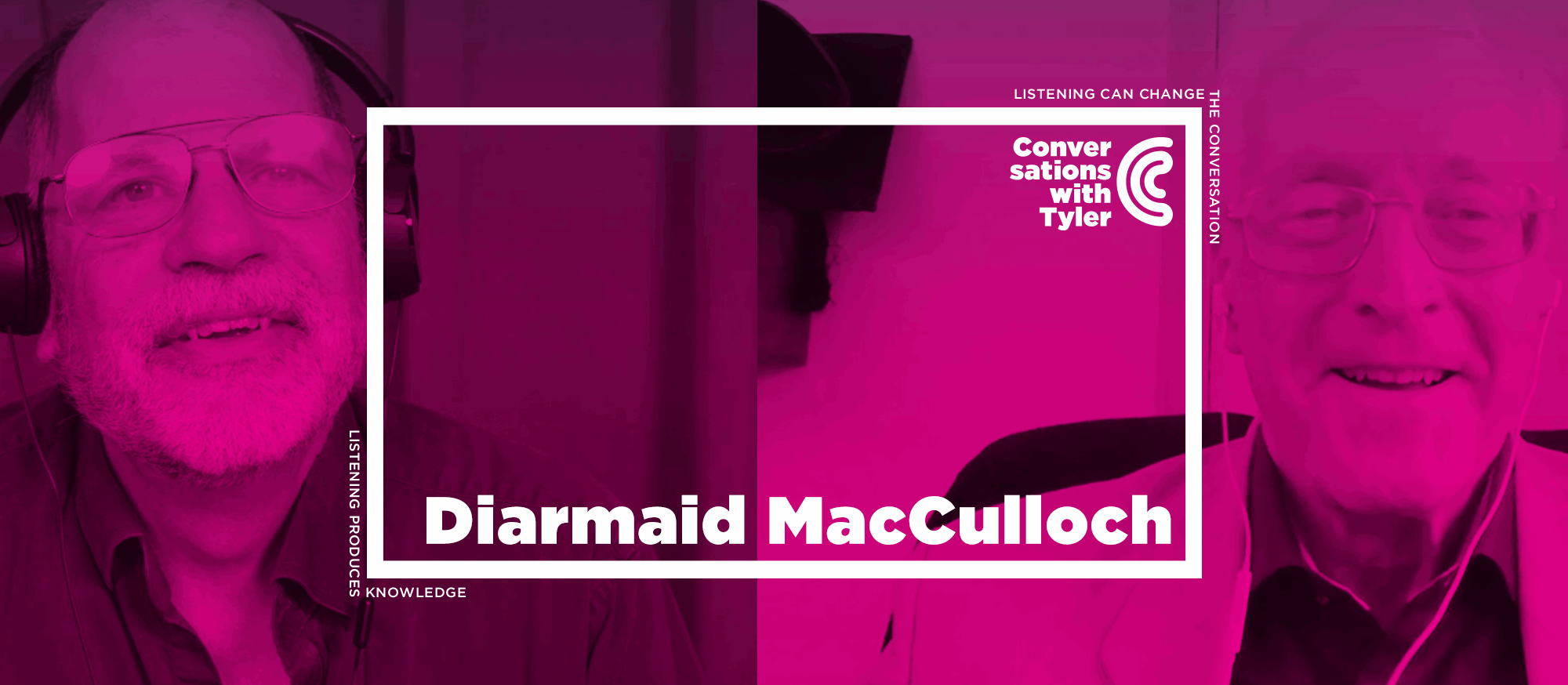



Tyler considers Diarmaid MacCulloch one of those rare historians whose entire body of work rewards reading. This work includes his award-winning Cranmer biography, his sweeping histories of Christianity and the Reformation, and his latest on sex and the church, which demonstrates what MacCulloch calls the historian’s true vocation: unsettling settled facts to keep humanity sane.
Tyler and Diarmaid explore whether monotheism correlates with monogamy, Christianity’s early instinct towards egalitarianism, what the Eucharistic revolution reveals about the cathedral building boom, the role of Mary in Christianity and Islam, where Michel Foucault went wrong on sexuality, the significance of the clerical family replacing the celibate monk, why Elizabeth I—not Henry VIII—mattered most for the English Reformation, why English Renaissance music began so brilliantly but then needed to start importing Germans, whether Christianity needs hell to survive, what MacCulloch plans to do next, and more.
Watch the full conversation
Recorded October 29th, 2025.
Thanks to an anonymous listener for sponsoring this transcript.
TYLER COWEN: Hello, everyone, and welcome back to Conversations with Tyler. Today, I am here with Diarmaid MacCulloch. He has a new book out, Lower than the Angels: A History of Sex and Christianity, which I recommend very highly. In fact, all of his books are excellent. He is one of those historians where each and every book he has done is worth reading. He is emeritus professor of the History of the Church at Oxford and now a senior research fellow at Oxford. Diarmaid, welcome.
DIARMAID MACCULLOCH: Thank you very much. Nice to be here.
COWEN: In the history of the West and the world more generally, why does it seem that monotheistic religion and monogamy are so closely correlated?
MACCULLOCH: A good question. They are not always closely correlated. They certainly weren’t in Judaism. Judaism is a form of religion in which — let’s call it, very precisely, polygyny rather than polygamy. Polygyny was a feature of Judaism, really, into the 20th century. In cultures where there were Jewish communities in Islam, then polygyny survived within living memory. There are Jewish people alive who would have known that polygynous context.
In the West, it is further back with Judaism. It’s the 12th century when Jews ceased to allow polygyny in such circumstances. I suspect that is because the pressures of Western society around them. Western Christian society forced them into a monogamous form.
Conversely, monogamy was a feature of two great civilizations behind Christianity which were not at all monotheistic, that is Greek and Roman civilizations, which, most unusually in the ancient world, were monogamous. I strongly suspect we may talk about this more, that this is the reason that Christianity decided to stick with monogamy against its cultural background in Judaism because it wanted to make an impression on Greek and Roman society. So, you’ve got to be monogamous. Otherwise, that society will just not listen to you.
COWEN: There seems to be a feature of Greek and Roman societies emphasizing intellectually a kind of subordination in sexual relationships, which Christianity at least pretends to abolish. Why that shift?
MACCULLOCH: Well, it didn’t abolish it really.
COWEN: Intellectually, it’s trying to, right?
MACCULLOCH: Intellectually, it’s trying to? Yes. Its great liturgical action is an affirmation of equality between the sexes, that is baptism. When you compare that with the entry right into Judaism, which is male circumcision, you see the difference, that to be, in a sense, fully Jewish is to be a man capable of being circumcised. Now Christianity introduced a new form of initiation to the religion, and that is baptism. It’s very difficult to see where it came from.
It’s not a prominent feature of Judaism before or any of the religions around, but it’s there very early indeed so that that leader who became subordinate to Jesus in the Christian faith, John, was known as “the Baptist” because this was the thing he did. We don’t really have any records of Jesus doing baptism, but John did. Here is what became the way you become a Christian. Of course, unlike circumcision, it’s something which both men and women can receive, and they did.
So, yes, you’re right. In that sense, Christianity had structured itself towards equality. But in so many ways, the history of the last 2,000 years is a stealthy march away from that idea in order to impose the normal patterns of the ancient world, which are male-centered and in which women have a subordinate role. That’s the history of Christianity.
That may be something which is now changing. Well, it certainly is changing. Since the 19th century, we’ve seen the ways in which women have increasingly asserted themselves in the Christian faith on an equal basis, so much so that so many churches now will allow women, will welcome women even, to be clerical people within it, clergy within it, have an ordained role within it.
COWEN: That initial egalitarian tendency — you think that’s a genuine innovation in Christianity?
MACCULLOCH: I do. I can’t see where it came from otherwise. The crucial test is circumcision versus baptism. It is there in remarkable fragments within the New Testament record, that set of writings which the Christian community created on top of the Hebrew scripture, which became its Old Testament.
The New Testament contains the writings of Paul, which are the oldest writings within the New Testament. There are texts within what we now call 1 and 2 Corinthians, that is two letters to the Christian community in Corinth, in which in the first one, chapter 7 now, there is an essay by Paul on marriage.
It contains a most extraordinary statement about the relationship of married people, the bride and the groom, the man and the woman. It says in a very conventional ancient way that the wife’s body is not her own; it belongs to the husband. Yes, it’s what you’d expect, any ancient culture, but then it reverses it. It says likewise, the man’s body is not his own, but is owned by his wife. Now, that is really extraordinary, and it is new.
It is our mystical statement that the relationship between man and woman is a relationship of physicality. This is about bodies, but it is also a relationship with the assumption that there is something mystical about marriage, which makes it a central part of Christianity. Actually, most generations of the church since, in the last 2,000 years, have put that aside, particularly in Eastern Orthodox Christianity. They’ve spiritualized it away, so it is no longer about bodies. You can see this in the great Greek theologian John Chrysostom, who said it’s about an equality of esteem or chastity or financial support — anything but a physical body.
Now, the Western tradition didn’t do that, very interestingly. The medieval Western church, for instance, the canon lawyers — who were creating a new legal system for the church and Christians generally — the canon lawyers looked to this text in Paul, 1 Corinthians 7:3, and they emphasized that marriage is about physicality, so much so that the church, for the first time, really said that marriage was characterized by procreation, must be characterized by the possibility of procreation.
You get this coming back, but actually, at most times in Christian history, they haven’t gone with this Pauline idea. They are not interested in equality, and they’re not interested in equality in marriage either. Actually, you have to realize that throughout Christian history — and not just Christian history — marriage has been a contract between two men: the father of the bride and the father of the groom. It is not primarily a contract between the bride and the groom, the young people, as they mostly are, who get married. It’s a family thing.
COWEN: Isn’t spousal consent an important idea, by what, the 12th century?
MACCULLOCH: Yes, exactly, by the 12th century. Yes, part of the great revolution of thinking about marriage and sex in the 12th century, but that’s 1,200 years, more than half of Christian history. Yes, we must — I’m sure we will — talk about the importance of the 12th century in the West, which transformed so many different things about marriage and sex.
COWEN: Where does that shift come from in the 12th or, arguably, even the 11th century?
MACCULLOCH: It is because of changing ideas about the Eucharist, the bread and wine, and what they mean in the Christian life. Increasingly, the Western church emphasized that bread and wine in Eucharist are body and blood of Christ the Savior, and that they are created or made into that by the act of a priest. Therefore, what a priest does in celebrating the mass, so-called as it’s called in the West, the Eucharist is so powerful that you want that person who does it, the priest, to be as pure as possible.
There is a very short leap in talking about purity to sexual purity. In the 11th and 12th century, for the very first time in Christian history, all the clergy of the West must be celibate. They must be virgins, just like monks. Monks are not the same as clergy, not the same as priests at all. But from now on, there is a gradual amalgamation of these roles. You might call it a confusion of the role of the celibate monk with that of the priest. This is a 12th-century development. It has extraordinary consequences.
They ripple away from this great change in the nature of Western priesthood through interviews about marriage because the logic of making all clergy celibate is that the laity are now the only people who are practicing sex — within marriage, of course. Otherwise, it’s illicit. Now, you’ve got this situation because of a celibate clergy. Logically, you have what you might call copulating laity. That’s something new in the history of marriage in Christianity. It means, in the end, that what you must say about a marriage is that it must be open to the possibility of procreation.
Now, if you look back in Christian history before that, there are a lot of instances of marriage which are deliberately celibate, chaste. The people involved get married and they remain virgins as a token of their purity. There are saints’ stories like this. In England, we have a very famous saint, St. Etheldreda, who became the first abbess of Ely, which is now a wonderful, great Romanesque and Gothic cathedral in eastern England. It started life as an Anglo-Saxon monastery founded by this princess, Etheldreda, who was not just a princess.
She’d been married twice to two different Anglo-Saxon kings, and in both cases, she had refused to give them sex, which is a bit disconcerting if you’re a king because what you want is an heir to the throne. She must have been an extraordinary lady. Anyway, second marriage, they gave up. The king said, “All right, you win. You clearly want to be a nun. Go off and be a nun and found a new monastery.”
This is an enormously popular story in Anglo-Saxon England, but it’s a story which would make no sense after the 12th century, if you look at it closely, because marriage is supposed to be about procreation. The church tells you that. Otherwise, there is no marriage. It’s one of the ways you get out of a marriage in Roman Catholic theology. If no sex has taken place. That’s how Henry VIII got out of one of his marriages, by saying it had never taken place. He’d never had sex with that woman, a phrase later reused.
COWEN: But explaining the timing of that shift — why in the 12th century in particular does that happen?
MACCULLOCH: It is because of the changing nature of thought about the Eucharist, and that’s a gradual —
COWEN: That’s endogenous, though, right? What’s the ultimate cause?
MACCULLOCH: No, that’s exactly what it’s about. That is a process of changing the Eucharist over the previous 200 or 300 years into making the Eucharist a uniquely powerful thing, which you do as much as possible if you’re a priest. Monasteries are redesigned. Monastic churches were redesigned so that now they didn’t just have one altar at which the Eucharist took place. They had multiple altars, side altars, at which masses could be celebrated for saving the souls of particular people, mostly members of the nobility who had paid for setting up the monastery.
The prayers of the monks are there to save the souls of the nobility of Europe for the very good reason that Christianity still disapproved of the shedding of blood. Anyone who was involved in that, which meant the entire nobility of medieval Europe, was deprived of a straight route to heaven. The way you can get around that is by getting monks to pray for you and do the penances which you deserve to do as a shedder of blood. There is a sequence of things — not just the 11th and 12th century — that’s the culmination of a process which you can see beginning really in the 8th and 9th centuries.
COWEN: Relative to the ancient Greek world, early Christianity is quite hostile to homosexuality. Where does that come from?
MACCULLOCH: It comes from two different places. First, it comes from Judaism, which increasingly emphasized procreation within marriage. It’s a religion which is very concerned with increasing the number of the chosen people. So, it is there, and that means that there is something of a strand of homophobia within the Jewish tradition on same-sex relationships.
But it’s also, curiously, from within the Greek world. There is a deeply world-denying, austere strain of Jewish philosophy, which is against, really, any form of sex. Within that, Christians took up that idea and applied it to the existing suspicion of hostility to same-sex relationships within Judaism. You see that particularly within the Christian church in Alexandria, which is one of the meeting places of Greek culture and Jewish culture, so there it is.
It’s there in Paul, of course, in the New Testament, very marginally. He has one purple passage on it, which is not really so much about same-sex relationships. It’s about idolatry. The example he uses of people indulging in idolatry is one of same-sex relationships. That’s the beginning of the epistle to the Romans.
Then various epistles have lists of people who aren’t going to get to heaven. It’s a funny old mix because it can be quite minor human peccadillos, people who won’t get to heaven. In two of those lists, there are two sets of people called arsenokoitai and malakoi. It is not quite clear what these mean. Arsenokoitai is a slang term, probably, because it’s a very rare term in Greek. It’s probably something which was used in the marketplace in the Eastern Mediterranean.
The other one means simply “the soft.” Put these together and you may have the two sorts of relationship that you get in the classical version of same-sex relationships, which is an unequal structure between a younger and an older partner, that is a passive partner and an active partner. They may be on one side arsenokoitai, on the other side malakoi.
It’s difficult to see why that should be applied to modern homosexuality. It’s a different institution. That ancient institution is not a lifestyle for life. It’s a phase that people go through in their heterosexual lifestyle or their general lifestyle. Both partners would be expected to go on to be involved in a heterosexual marriage. Notice it’s also unequal by structure. It’s about educating the younger partner in the ways of the Greek world.
You look at Christian history — there’s not much change there at all. Whereas, if you look at Islam, there is much more acceptance of same-sex relationships in a rather traditional way, in a way rather like that of non-Christian Greek and Roman society.
COWEN: As you know, Michel Foucault wrote four volumes on the history of sexuality. What did he get wrong about Christianity?
MACCULLOCH: Well, he got a lot of things wrong. He’s not at all reliable in those four volumes, which of course I’ve read from cover to cover. What did he get wrong? He didn’t really talk much about ancient Christianity. It’s all about text. He never looked at the nature of ancient society. He also has particular agendas — some of which I agree with, some of which I don’t — about power in relation to historical process. In general, I would advise people to take Michel Foucault with several pinches of salt.
He was a pioneer in looking at same-sex relationships, and he was of a decade in which there were several pioneers. There was the American scholar John Boswell, for instance, writing about such matters. There was an English scholar called Alan Bray. They’re real pioneers, the three of them, on such matters as same-sex relations, but they got a lot wrong. It would not be right to start with them and not realize that they are historical texts.
Now, in each case, actually, you can see that their perspective is distorted by their Roman Catholicism very specifically. Foucault, born into a Catholic family, never really left that world. Bray and Boswell, converts to Roman Catholicism from Episcopalianism, or Anglicanism if you like. The concern with Bray and Boswell was always to set up a story which wasn’t really true, which was that Christianity had, over the centuries, actually been fairly hospitable to same-sex relations.
You read Boswell now, 40 years later, and you see there’s a lot of special pleading in that; same with Bray. None of these historians are setting standards forever. Foucault made absurd assertions about the invention of homosexuality in the 19th century, simply because the word was coined in 1869. Well, that’s so stupid and so French.
You see, actually, things which look precisely like modern, for-life, equal relationships between same-sex people way back. You can see it in the ancient world. It’s not the same as the normal, what you might call “normal” same-sex relationships, these unequal things. The Foucault passion, seeing this as emerging as a sort of medicalization in the 19th century, just doesn’t stand up. It’s extremely misleading, and we should leave it behind.
COWEN: There’s a recent rise of interest in theories that attribute the rise of the West to the church banning cousin marriage, that this broke down clan structures. What’s your view of that hypothesis?
MACCULLOCH: It’s, as usual with such hypotheses, far too simple. I don’t see that so at all. Cousin marriages went on being a feature of Christianity, particularly if you’ve got a pope to dispense such marriages in the West. What could one say about such a theory? Clans, families were not broken up by Christianity. By far, the reverse. Those structures did not change very significantly. No, I don’t think that really works at all.
COWEN: Why does Islam so emphasize the sexual desires of women relative to Christianity?
MACCULLOCH: A good question. Because the Quran allows that to happen? The Quran has been interpreted by men when very often what it’s talking about is just people, so that may be one explanation. Islam did remain very much a militarized culture to start with, so it’s almost by definition run by men. There within it, is a powerful set of images for women in the Quran itself. On top of the Quran, there is so much added, and it’s usually added by male societies. So yes and no, really.
There is a constant strain of things one can say about the position of women in Christianity. Women are constantly carving out parts of Christian faith for themselves, against the fact that men are increasingly running the church. That’s a fact of life. Think of the mystics of the medieval West and the way in which so many of them are females. To be a mystic, you don’t need the male language of Latin, the language of the professions, the language of the clergy.
You can explore mysticism without the new invention of men in the 12th century — theology, which is something associated with, first, the cathedral schools and then the universities, both of which are male institutions. But mysticism, no. You can just get on with it. It involves many of the same themes in every religion that turns to mysticism, themes like fire and water, air. The vocabulary of the mystic really is quite universal. It is not restricted to Christianity or Islam or anything. It’s the way that one aspect of humanity works out when it tries to meet the divine.
COWEN: Why is Islam sometimes, at least at the intellectual level, so obsessed with Mary? You can debate whether she was a saint or a prophet. In a way, the role in Christianity is much more circumscribed.
MACCULLOCH: Oh, I wouldn’t say that. She appears more in the Holy Quran than she does in the Bible, of course, but that is clearly the influences on the creation of this book, which are probably forms of Christianity. Miaph is like Christianity in what is now the Arabian Peninsula. Yes, she’s there and she is named, unlike, I think, any other woman in the Quran. The relationship is therefore complex and interesting, but so is that of Jesus to the other prophets within Islam.
He is given a place of great honor, and naturally, also his mother gets it. Mary’s position in Christianity is, as you know, complex. It is a construction of the later church on extremely scanty evidence in the New Testament. The picture of Mary in the Gospels is not entirely positive. The picture of Jesus’s relationship with his family, with his brothers and sisters is not entirely positive. On one occasion in the Gospels, they turned up to say, “Hi, we want to see him.”
Jesus looks around and says, “Well, actually, these people are my brothers and sisters.” Implication: you’re second class. One’s got to deal with that. The church ignored it as it created an increasingly central place for Mary as Queen of Heaven, the linchpin of salvation. It ignored the fact that the foundations in the New Testament are scanty. It took the Protestant reformers of the 16th century, actually, to look at the Bible and look back at that and gleefully, in some cases, see that Jesus could be quite offhand with his mother and his family.
Now, one needs to ask, why does the New Testament treat family members like this? I think one way you can account for it is by saying that the New Testament is written by the winners in a very particular conflict, and that is the conflict as to who is going to lead the church after Jesus. Is it going to be the family? Is this going to be a dynastic religion? James, the brother of the Lord, is one of the first people who are powerful within the church. Or is it people who, like Paul of Tarsus, never actually met in his earthly life Jesus?
The balance in that conflict is eventually won by the general number of disciples, not the family. So, you would expect the text created by that side of the battle to be somewhat dismissive of Jesus’s family. The same thing is true of Islam, of course, between who is going to be in charge of the faith in future. Sunni Islam against Shia Islam have two different answers to that question. It’s not dissimilar to what happened within Islam.
COWEN: If I think of the 12th and 13th centuries in England and France, parts of Spain, there are so many just incredible cathedrals or religious structures built, many of them still with us. What accounts for so many marvelous creations in what, in a sense, is a relatively narrow window of time?
MACCULLOCH: You’re right. Scholars from the James brothers onwards have talked about this, the age of the cathedrals. It’s really quite difficult to account for it in any way. You’ve got to realize also that such wonderful, magnificent buildings, one of which I was speaking in last night, Gloucester Cathedral in western England, were there alongside monasteries. In fact, Gloucester Cathedral was a great abbey before it was a cathedral.
What are these saying? They’re saying one thing: that the church in the West now had a very strong, tight organization by bishops and dioceses, in which the mother church of the dioceses was a building of very great charisma and importance, and had a set of clergy attached to it — canons, who were as much a corporation as the corporation of monks within an abbey — and they benefited from this industry of prayer about which we were speaking earlier, that the elites of Western Europe needed prayer.
They needed people to pray for their souls. The laity, generally, also wanted prayer because the Western church was developing a particular view of the afterlife in which it is no longer that simple binary. It is not just heaven and hell. There is a state in the middle, purgatory, which is a wonderfully useful way to characterize the afterlife because purgatory is where you can go on being purged of your sins.
You do that with the help of your friends and the clergy in their prayers, particularly in the Mass. Purgatory is a big thing here. Cathedrals are full of altars, just like abbey churches. Look around them, and you see the innumerable side chapels there. These are factories of prayer, and that is worth spending money on. And hurrah, they did because we are left with this amazing legacy of wonderful buildings.
COWEN: Is there some institutional innovation from decentralized bishops competing against each other through monastic orders? Something’s paying for all this, right?
MACCULLOCH: Yes. The secular nobility are paying for it because they’re endowing these places with land for the sake of prayer. It is not exactly a decentralized system. It is a system, you must remember, which actually, literally covers the map of Europe. There are virtually no places not contained within the system. Within the diocese, that is the institution run by the bishop, are what are called parishes, which again, virtually cover the map of Europe. Not that they had maps, but they knew the boundaries of every parish.
A parish is a very interesting institution. It’s new in the 9th century onwards in the West. The idea is that you have one priest in each of these parishes, and the area of land that he patrols is more or less patrollable in a day, that he can meet and visit all his parishioners. I speak with feeling about this because I am the son of one of those parish priests in the Church of England, and his first parish — in which I grew up — was about a couple of square miles each way. He could have walked it and often did. This is an extraordinarily effective way of giving everyone in Europe pastoral care.
In fact, not just the nobility. The nobility get the deluxe end of it with the great monastery, the endowments of cathedrals, but everyone has a parish church. It’s an extraordinarily wonderfully integrated system. I think we, with a Western tradition, often forget how absolutely unusual that is within world religions, to have a single form of a religion absolutely dominating everything within a particular continent. Nothing else like it, except perhaps Saudi Arabia in the 20th and 21st centuries.
COWEN: Don’t you find it striking how few of those structures are mediocre? There may be some survival bias, but it’s very hard to just find an ugly-looking church from that time.
MACCULLOCH: Well, it’s maybe the way we look at them. I’m a huge enthusiast for them all and spend my spare time looking around them all. But could one say that they are actually superlatively wonderful? I think our way of looking at them makes them such. They are hallowed by the fact that they have been there for so long, that they are sacred places in which prayer has been valid to “an English poet.”
It’s a wonderful thing they’re still there. As you know, in England, we still have that rather unusual thing, an established church which is there to administer all of them, look after all of them. You can walk from church to church, and so many of them are still medieval. Yes, it’s a wonderful thing. True, of course, in Eastern Orthodox places too, in Greece, in Bulgaria.
COWEN: If you had to pick a favorite in England, what would it be?
MACCULLOCH: Oh, now you asked me an impossible question there. Probably, I would say it is the church which my dad served when I was a little boy, when I was four to twenty, the Church of St. Mary in Wetherden in East Anglia in the county of Suffolk, a church in which you had every architectural style from the 12th century through to the 20th, the furnishings of every age. Parts of the building added at various times. It was a wonderful textbook for a bookish boy like me to grow up with.
I mentally apply that church to every church that I visit afterwards, however huge, like Gloucester Cathedral last night.
COWEN: Why are there still a fair number of English Catholics, but so few in the Nordic countries?
MACCULLOCH: Now, an interesting question. Lutheranism became much more universal in the Nordic countries. Catholicism did not survive there. The monarchies of these countries were, I think, much more thorough-going in suppressing it. I think the nobility also decided to go over to the Reformation fairly uniformly in Sweden, Norway, Denmark. Of course, it does matter when the nobility make decisions.
In England, they were divided. Quite a lot of the nobility and gentry did stick with the old faith, maybe because they admired many of the bishops of the old church. I did a little work of research on this in my younger days, in which you could see that those gentry who stayed Catholic after the Reformation were often those who had personal ties to the great bishops of the pre-Reformation church.
Yes, the picture is very different in England to that in Scandinavia. Also, remember that extraordinary counter case, the case of Ireland, where the government became Protestant as it did in England, but the great bulk of the population did not go with it. The story of Ireland is a story of the rejection of the religion of the upper classes right through to the present day, when they’ve now rejected so much of Catholicism too. Fascinating different stories next to each other there.
COWEN: Now, you’re one of the best-known historians of the Reformation, and there’s a very standard account. The printing press comes. Well, Bibles can be published and printed more easily, more cheaply. That leads to the Reformation. Are there any aspects of that story that you’re skeptical about?
MACCULLOCH: No, I wouldn’t say I’m skeptical about that. It’s certainly true that the circulation of texts, particularly biblical texts, is really very important in late medieval Europe. It’s not that the Catholic Church, in general, forbade such texts. It just didn’t see where they might lead.
But I think there’s something very significant about the Reformation which is underplayed. Those who know about it and talk about it — look at Martin Luther, for instance — they use a piece of theological jargon about the Protestant Reformation. They talk of justification by faith alone. Who knows what that means? Well, what it means is that salvation is really in the hands of God, not in the hands of the clergy.
Now, that’s the important thing, that one of the things which Martin Luther did very quickly as he began unfurling his own instincts about the need for change in the church was to make sure that the clergy once more would marry. They would become like laymen in that they had an equal right to have marriage and families, and that made them the same as the rest of the world.
Martin Luther’s concept of the old church, the church he was rejecting, was one which had played a huge confidence trick on the laity of Europe by saying that clergy are special, and the way we’re going to make them special is by making them celibate. So, making all clergy married, which is effectively what happened in the Protestant Reformation, absolutely transforms the rules on marriage and sexuality generally because from then on, actually, the clerical family is the model of the Christian life. Previously, the model of the Christian life had been that of the monk, the celibate clergy, the celibate priest, and now that is absolutely reversed.
Protestants destroyed most of the monasteries. Yet a few in Lutheran countries, but very few. Otherwise, this absolutely central part of medieval Western Christianity, the monastery, was absolutely eliminated. What is in its place? The parish, the minister in his parish with his wife, with his children, one of whom is me. I’m particularly passionate about this thought, that Protestantism put the minister on the pedestal as the way that all Christians should live, not just clergy. All Christians could take the model of marriage and family from the clergy.
COWEN: As you well know, if we look at Henrician England, some key figures like Cromwell, Cranmer, Wolsey — they don’t come from very exalted backgrounds, right? They started off as quite common. There’s something meritocratic about the society. How does that happen? Or where does that come from? How do they climb?
MACCULLOCH: They climb by being clever, and they climb by the fact that the first two Tudor monarchs did encourage them to do so because Henry VII, the first of the Tudor monarchs, was the most unlikely person in English history to become a monarch. His claim to the throne was laughably weak.
There were very many people among the English nobility who had far more royal blood than he did. He frankly didn’t trust many of these people, virtually none of whom he’d ever met before he came to the throne, the English throne. He’d been in exile for a very long time. So, he’s going to look around for those people to lead his government who are not necessarily aristocratic at all. They are there by merit.
His son, Henry VIII, did inherit that thought. Henry did like doing aristocratic things with aristocrats, like jousting, for instance. That impulse began to weaken under Henry VIII rather than Henry VII. You see in Henry VIII’s quite long reign, an alternating pattern between the capable man of affairs who has made his way up with royal encouragement, and the nobleman who feels entitled to have his position in government. Henry’s always slapping down one and then slapping down the other.
Poor Wolsey didn’t deliver the goods, so he was slapped down. Cromwell famously also lost the plot, failed to deliver a marriage which Henry liked, in fact, created a humiliating marriage, and he lost his head. Cranmer survived, remember. He survived by loyalty to King Henry VIII, and I think he genuinely loved Henry VIII, and so served him with a good conscience.
Trouble about that is that a man like Henry VIII is a narcissist. I think we may have seen some in modern politics. The thing about narcissists is that they make good people do bad things. Henry VIII was talented at making good people, such as Cranmer and, I would say, Thomas Cromwell, do bad things.
COWEN: How does William Byrd survive as a Catholic? Is that also meritocracy?
MACCULLOCH: Oh, yes, it is. By being a composer of genius and having a patroness, the queen, who appreciated very good music. Elizabeth was a Protestant, but she was a slightly odd sort of Protestant. She disapproved very intensely of religious fanaticism of any sort.
She had an eye for beauty in music and architecture. Music is actually rather cheaper for a monarch to patronize than lavish buildings. Doesn’t cost so much. She also genuinely loved it. She was the person who saved the English cathedral in the wonderful form that I experienced it at Gloucester last night. She approved of cathedrals because she approved of their music. She gave patronage to the choirs and had her own choir, the Chapel Royal, which encouraged the cathedrals to go on doing this really rather elaborate form of music. It’s more elaborate than any other form of Protestantism, even the Lutherans, whose music can be very elaborate.
Now, if you want to look at the most important person in the whole English Reformation, the person who set the patterns for the Church of England and England as a whole in the 16th century, it’s Queen Elizabeth I. It’s not Henry VIII. It’s Elizabeth I.
COWEN: How is it that English Renaissance music is so wonderful, but by the time you get to the 18th century, you’re having to import Germans and Austrians, basically, for your musical life? What happened?
MACCULLOCH: [laughs] You’re right. What happened? A run of quite exceptional composers. In late medieval England, there is an extraordinarily lavish and beautiful style of music, which the Reformation more or less dismantled. But some of the practitioners jumped ship and served the Protestant Church. Thomas Tallis is the obvious example, a composer of international standard. William Byrd is the next generation. Byrd did serve the Church of England, of course, to start with, and went on serving it in the Queen’s Chapel Royal.
But then, you’re right. There is this curious paradox that, in the 17th century, the tradition became, well, you could call it international, in that Germans in particular came to this country to work for the new Protestant Hanoverian monarchs, and were extraordinarily good at it.
We were extraordinarily lucky to get George Friedrich Handel and turn him into George Frederick Handel, an English composer, to become more or less the English composer of his period. You think of the great coronation music that he wrote for that deeply undistinguished king, George II. That produced the wonderful anthem, Zadok the Priest and Nathan the Prophet, the most triumphant Protestant choral music you can think of.
But you’re right. There’s a paradox. Sixteenth century England was right at the center of beautiful music, just as much as Palestrina’s Italy. In the 17th century, it all tailed off a bit, and it wasn’t until, really, the late 19th century that England became once more internationally respected as a place of church music, and music generally.
COWEN: What is it in organ music that has the greatest meaning to you as a statement of either religiosity or Christianity, if you want to make it more specific?
MACCULLOCH: Well, an easy question for an organist. Of course, Johann Sebastian Bach. So versatile.
COWEN: Which pieces? I would say the Trio Sonatas, but what’s your nomination?
MACCULLOCH: I find them intimidating, frankly, because I find them very difficult to play. I look rather to the chorale prelude tradition, which can be extraordinarily intimidatingly difficult, but has some staggeringly beautiful and devotionally heart-rending music because, of course, it is the Lutheran chorale.
Bach was working from a musical tradition he knew very well, which was very specifically Lutheran, though he, of course, did other things too. He did the great B Minor Mass, which has nothing, really, to do with Lutheranism at all.
The chorale prelude is a wonderful vehicle of Christian sentiment. I think of chorale preludes, one I played a week ago at Evensong, In my hour of need I cry to thee, O God. It’s a Lutheran chorale, but he most gently plays with the melody over a tune which he has invented for himself, and they interact.
So Bach, of course, and the fugues and the preludes with which they are prefaced are extraordinary. It’s a wonderful way of losing yourself amid the miseries of the present world. You may remember that, in the days of the communist regime in Eastern Europe, organ recitals were crowded out because of the way that the general public could connect with the transcendent in a regime which denied the transcendent.
There’s a lovely phrase from an English bishop of the 20th century, Bishop Charles Gore, great theologian. He went to hear a Brandenburg concerto in the concert hall. He was a gruff man. As he walked out, he was heard to mutter, “If that’s true, everything must be all right.” That’s true with Bach. He is a symbol of the transcendency beyond our human idiocy and frequent evil towards something which connects us to the divine.
COWEN: To me, there’s something unique and special and lasting about C. S. Lewis. He writes fiction and nonfiction with success. Extremely smart, a tremendous writer. He’s both deep and very popular. Can the contemporary world produce another C. S. Lewis, or has that somehow become impossible?
MACCULLOCH: I doubt it’s impossible. I don’t quite share your universal admiration of Lewis. I think the children’s fiction is really quite manipulative. In which case, talking of children’s fiction, I would look to Philip Pullman, who, of course, isn’t a formal Christian believer, but seems to me to talk about profound issues in a way which can engage children very much.
I guess one could look to Rowan Williams, and I would look to the poetry of our former Archbishop of Canterbury as perhaps his most lasting work. I would, of course, also look to T.S. Eliot, who, I guess, predates Lewis. Eliot says some very profound things connecting him to that tradition, which I know so well, that of Anglicanism.
These things happen, and when you least expect them. Geniuses emerge like John Bunyan, ordinary man in 17th-century Bedfordshire, creating this extraordinary work of Christian meditation, though at the center of it are themes of which I am a little suspicious, Calvinist predestination. They keep coming, and I don’t think we should be worried about them never coming again.
COWEN: Has it surprised you how rapidly Anglicanism has declined? There are just fewer Anglicans, right? Arguably, the number one religion in England is Islam.
MACCULLOCH: No, not really. Anglicanism has not declined worldwide. It has shifted its position.
COWEN: But in England, it’s not high, right?
MACCULLOCH: In England, its numbers have gone down because you no longer need to have it as a means of becoming respectable. We’re a much more varied culture than we were even when I was a boy. It was a very white and rather boring culture then. It is now exhilaratingly multicultural.
Yes, Islam is part of that, and so is Hinduism. There are more Hindus in the UK than there are Muslims. They’re not so prominent, I think. And there are plenty of Sikhs. We have become a multi-faith country. At the center of it is still the Church of England, and the Church of Rome has done reasonably well in recent years because it’s constantly being replenished from outside the country by immigration.
The great thing about the Church of England is that it has this now rather unusual mission to the entire nation. My dad was proud of being able to talk to anybody in his parish, whether they came to church or not. The Church of England is that one body within the nation which exists to minister to those beyond its walls and not those who come. That seems to be a rather precious thing to have. It is also appreciated by the other faiths. Muslims, Hindus, Sikhs are pleased that there is an established church at the center of our country, because it is a symbol of the importance, the seriousness of religion. It’s a happy set of relationships.
I look again to our parish churches, all the thousands of them, and our cathedrals. Our cathedrals are an enormous success story at the present day. Attendance to cathedrals is rising. Numbers through the door. Visitors beyond congregations are increasing. They have a mission to educate, to inspire through traditional liturgy, which is absolutely flourishing. It has financial problems, but it is in no way in a state of decay. So, I’m rather more sanguine about the Church of England than you might be.
COWEN: But I see numbers published that say 5 percent of Englishmen go to church. If you just pulled white native-born Englishmen: “Do you believe in the Trinity?” How many millions would say yes compared to the number of Sikhs, Hindus, and Muslims that would profess a loyalty to their religions? Is it, in terms of actual belief, now a minority religion in England?
MACCULLOCH: I think you’re comparing apples and carrots, really, because what you’d be examining with Muslims, Sikhs, and Hindus is a religion based on practice, not on systematic thought or theology. These are religions of orthopraxy, to use a piece of technical jargon, not orthodoxy. That makes you a very different sort of practitioner of religion.
Christianity, Anglicanism — they’re religions in which you may know a lot about technical matters, but you may not. You may do what the Hindu does and just go into a sacred space. That is a very common attitude within English religion, and it seems to me a perfectly healthy one. Doctrine, theology — yes, Christianity is a religion of such things, but that’s not all that there is to it.
COWEN: Do think it’s possible to have a sustainable Christianity without strong beliefs in hell? If I think of America, where I live, a lot of Americans either still believe in hell or at least proclaim they do, and they’re not outright lying. And we’re much more religious than Western Europe. Isn’t some notion of hell necessary?
MACCULLOCH: No, and you are more religious. What you mean is, many more of you practice going to church. That’s a different matter.
Well, the thing about hell is, all right, it’s there in the Bible, but it is a profoundly unconvincing doctrine. Human beings are very capable of creating hells. There is certainly an aspect of human existence which is deeply, deeply inflected with evil. Christianity is a fight against evil, but that does not imply consignment of people to hell.
It is true that when you stop trying to persuade people of the real existence of hell, very many of them will stop going to church, for instance, as they have in Scotland, where the Church of Scotland’s church attendance has plummeted over the last 50 years because Calvinism without the belief in hell doesn’t amount to all that much.
That’s why a Eucharistic faith is much more likely to be sustainable, and a religion of sacred place is more likely to be sustainable than the religion of reformed Protestantism evolved in the 16th century. So yes, once you remove the stick from religion, and maybe the carrot doesn’t look so interesting, fewer people are going to be involved in it. That is inevitable.
We in England used to have churchgoing as a form of social contract. You went to the Church of England, particularly if you’re respectable. Or if you wanted to make a statement, you went to non-conformist Protestant churches. Or if you wanted to make a statement about your culture and maybe ethnic backgrounds, you went to the Roman Catholic Church. That is no longer the case so intimately.
You also need to look at cases like Scandinavia, where the number of regular churchgoers is very small, but the churches show no sign at all of fading away, and are very high in public esteem. The extraordinary situation in Denmark, where churchgoing is not very prevalent, I know 10 percent of the population, whatever. But 80 percent of the population have been baptized and are taking their children to be baptized. It is part of a way of being Danish.
That, maybe, you might call folk culture, but it is a form of Christianity which may have equal validity. It has been called “belonging without believing.” That may be a form of Christianity which does not depend on orthodoxy, but like so much Judaism, depends on orthopraxy, things you do in religion form your religion.
COWEN: Last set of questions. Are there common barriers or issues that prevent today’s young historians from becoming great older historians? Or another way to put it, can there be a younger version who will become a you?
MACCULLOCH: [laughs] Oh, well, I wouldn’t wish to flatter myself by hoping that that would be the case.
COWEN: Think about the number of books you’ve written, the number of topics, how incredibly original and well-researched the Cranmer biography is. It seems harder to attain that now.
MACCULLOCH: Oh, I don’t think so at all. The whole work of a historian in every generation is to look at what the previous generation say and say, “Well, I don’t think that’s quite right. The emphasis is all right.” Perhaps more importantly, “You have simply not listened to things which I am now going to listen to.”
I noticed that in my younger colleagues. We have an extraordinarily flourishing world of church history in the University of Oxford, with seminars packed out with enthusiastic young historians. How we’re going to pay for them in the future is another matter, but there are still extremely able people coming through the system. That is because of the wonderfully self-renewing nature of the historical profession and its inquiry.
I quote in the book — you may have noticed — the remark of an Indian historian of the 20th century, Sir Jadunath Sarkar, who was vice chancellor of the University of Calcutta in the 1920s. Sir Jadunath, under the British Raj, was also the chairman of the Indian Historical Records Commission for the Indian Empire. They met one day in 1937, a committee meeting of the commission. He dryly observed that civil servants within the Imperial Records Department in New Delhi were worried that giving access to the general public to all their archives would unsettle many settled facts. Beautiful piece of irony.
That is what historians do. We look at settled facts and we unsettle them, and that is good for human sanity. It’s why you do it. It’s not just my curiosity as a boy in that Suffolk church about it. It is to keep the human race sane and to stop it listening to lies by setting down historical method for judging what is true and what is false.
We are the profession; historians are the profession which keeps the human race sane. We don’t give you a cure for cancer. We don’t give you a rocket to the moon. Those things can be done by mad people. What we do do is show you what are the sane things in society and what can be a sane future.
COWEN: Last two questions. First, what will you do next in terms of writing? Second, what do you want to learn about next?
MACCULLOCH: Good questions, both. Well, I am 74, and I think I may be entitled to a rest. I’ve been writing books for 50 years. I think this last book on sex and Christianity is the widest topic I’ve covered, and it may be the most important. It is part of my campaign to make the world sane.
What I’m doing at the moment is talking about it, as I’m talking to you, as I talked in Gloucester Cathedral last night, to very large audiences. In St. Paul’s Cathedral in London, when we launched the hardback version of the book, we had an audience of 1,000. When you’re getting that sort of number, you think, “Well, this is an important topic.” I’m not sure there is anything which I can see which I can do which is as important.
Inquiry, you ask me. Well, one thing I’d love to go on doing is simply traveling around to English parish churches looking at them. I may have seen — I don’t know — 6,000. Well, that means there are 8,000 to go, and each of them is like meeting a new person and teasing out a new story. So, it may be that that’s the way that my final years go.
COWEN: Again, the title of your book is Lower Than the Angels: A History of Sex and Christianity, but I’m happy to recommend all your books. Diarmaid MacCulloch, thank you very much.
MACCULLOCH: Thank you. It’s been a pleasure.
Image Credit: Barry Jones
This episode was made possible through the support of the John Templeton Foundation.