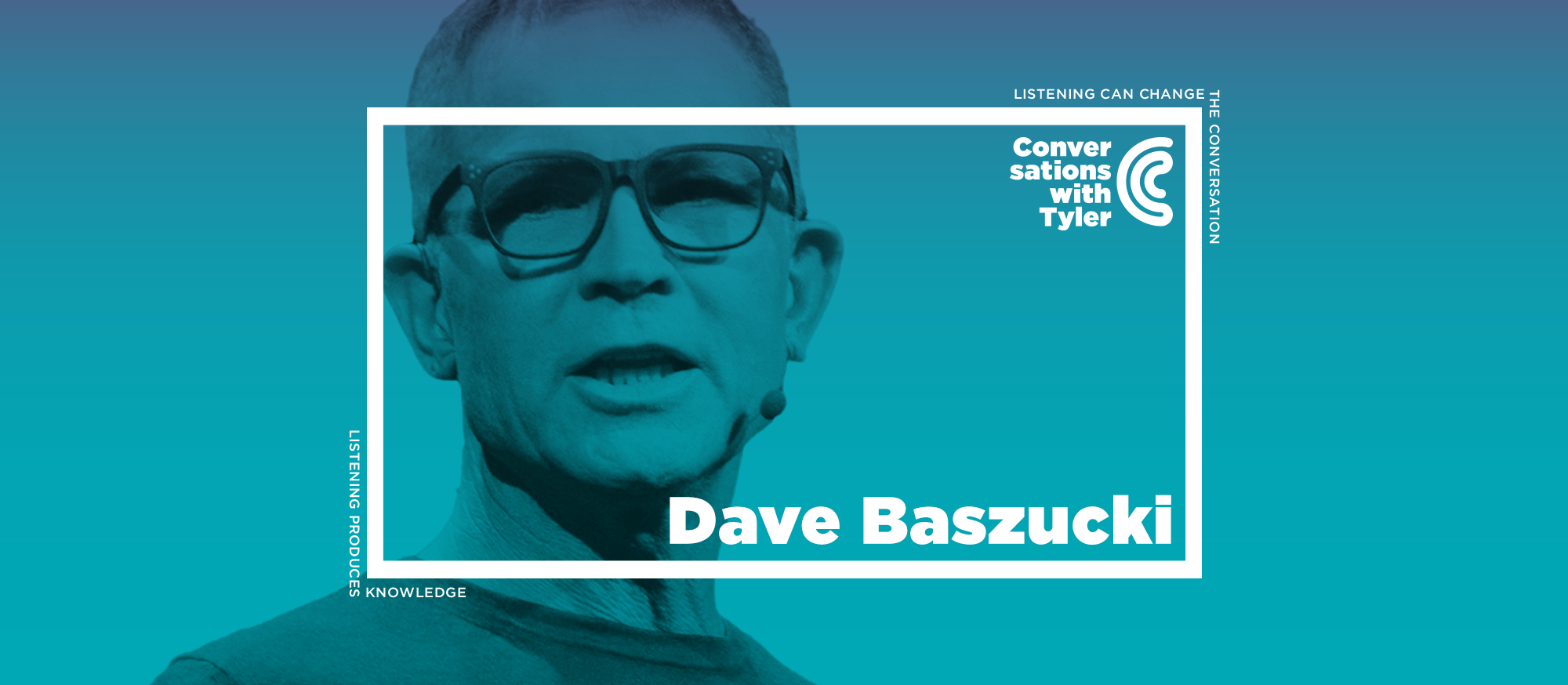



Dave Baszucki is co-founder and CEO of Roblox, the user-generated gaming platform where all the games are built by the community itself. With over 100 million daily active users and projected revenue bookings of $7 billion this year, it is one of the largest gaming economies in the world—and one that has made millionaires out of teenage developers in Argentina, South Korea, and everywhere in between.
Tyler and Dave explore why Roblox decided early against prioritizing advertising revenue, why Dave thinks the main competition of Roblox is its own execution speed rather than Fortnite, whether every mega platform inevitably becomes an everything app, how falling token costs will change the platform, why he insists all the games on Roblox are beautiful, whether Robux should have a floating exchange rate, why admitting you have kids under 13 on your platform turns out to be a competitive advantage, why he’s skeptical of blanket social media bans, what his son’s experience with bipolar disorder taught him about metabolic health, his two-year sabbatical between companies that involved a motorhome trip across North America and a stint hosting talk radio in Santa Cruz, why Mutiny on the Bounty remains one of his favorite books, what he’ll learn next, and much more.
Watch the full conversation
Recorded May 27th, 2026.
Thanks to Matt Mullenweg, of Automattic/WordPress, for sponsoring this transcript in dedication to everyone building Open Source.
TYLER COWEN: Hello, everyone, and welcome back to Conversations with Tyler. Today I am here chatting with David Baszucki, who is co-founder and CEO of Roblox, which is one of the world’s largest and fastest-growing games platforms. David, welcome.
DAVID BASZUCKI: Tyler, thanks for having me on. It’s great to be here.
COWEN: Roblox, what is it you all do to help create teenage millionaires?
BASZUCKI: The focus isn’t creating teenage millionaires, and at the same time, there are some teenage millionaires. Roblox was founded really with the vision of creating a platform where people could play and connect, where all of the content, all of the games, all of the experiences, whether it’s hide and go seek or a fashion game or growing a garden, is 100 percent created by the user community. You could call it self-service, you could call it UGC.
What’s really interesting about UGC content when creators and the community are making content is they can come up with all kinds of interesting and novel ways for people to play together. We started with two people a while ago, but year by year, Roblox has emerged to have millions of people every day playing together. As you correctly noted, some of those creators now who build the content on Roblox have become millionaires. They’ve evolved from hobbyists to small studios to larger studios. We have now a lot of people all around the world really making a living building the content for the millions of players on the platform.
COWEN: They get a share of your revenue for a game they build.
BASZUCKI: That’s exactly right.
COWEN: Your revenue comes from people paying to put their games on your platform, right?
BASZUCKI: The revenue has evolved in stages, and it’s a fun economic story, really, the progression of how the Roblox economy has evolved. The first fun thing to think about is the vast majority of the players on our platform are not spending any money. They’re coming, they’re playing for free, they’re having great experiences with their friend. Roblox runs not just on UGC content or content created by all of these millions of creators, but literally a virtual economy with a currency called Robux, a wide range of games and experiences, where, for those users who choose to, they can spend Robux in the experience.
When they spend Robux in the experience, that creator can then cash those Robux out for real money. It’s a bit of a virtuous economy cycle. The creators are extremely creative in how they build their economies. They want all of their creations to be fun for everyone who’s playing for free, which is the vast majority of everyone. At the same time, they do want to make a living and fund jobs and fund their studios, so they come up with amazingly creative ways to do it.
Very early on, in the game called Work at a Pizza Place, you could buy a motor scooter. If you wanted to get around the world more quickly, you could use some Robux, buy a motor scooter, and get around more quickly. Now we just see a vast array of incredibly innovative ways for creators to sell things within their experience.
COWEN: Is the future of your revenue basically going to be ads?
BASZUCKI: No.
COWEN: You have ads as a source of revenue, right?
BASZUCKI: It’s a relatively small source of our revenue right now. It’s so small that, on our earnings call, we don’t call it out. The vast majority of our revenue, which is growing very rapidly, is players purchasing Robux. They can buy them with a gift card. They can buy them on their iPhone. They can buy them in a store. They can go to a website to buy these Robux. Then, using them in experiences created by our creators, if they so choose. Once again, this is a subset of our users who have decided to go buy that. By and large, the majority of Roblox is running on a virtual economy.
COWEN: Given the incredible number of eyeballs you have, why can’t you make really a lot of money selling ads?
BASZUCKI: I feel we have to be thoughtful about what the future of advertising is in a platform like Roblox. We have chosen, unlike maybe other platforms, for example, short-form video or other video platforms, to not put advertising in front of every user. We actually did an experiment very early in our founding, where we experimented with something called pre-roll advertising, where everyone who played a Roblox game got a little short video. We actually decided to pull it out. We decided to pull it out because we really wanted to focus on the fun and the user experience. By and large, our virtual economy has grown so well that we haven’t been compelled to really ever consider it.
The two areas where we’re looking at advertising, the first is a lot of our creators who make a new creation would like to boost and get more people to visit that place. There’s a very common mechanic in the gaming space where people go and buy traffic. I want more visitors to test my game. We do allow creators to purchase what we would call a sponsored tile to get some new visitors and experiment on their game.
Actually, there’s a fun story because that’s arguably how Roblox got started. Second, there’s a subset of creators who, in addition to virtual currency, we are letting experiment when they place it for certain types of ads. By and large, once again, we have such a strong virtual economy that that’s really been the primary revenue stream for the company.
COWEN: Say the 15-year-old millionaires that are created with the help of Roblox, how often do you meet them?
BASZUCKI: A lot.
COWEN: What are they like?
BASZUCKI: Some of the most brilliant, creative people you’d ever see, really. It’s a pleasure and a great responsibility to meet a lot of them, not just at our developer conference. We have a developer conference once a year. Over 1,000 of them come, and we hang out with all of them. We’re constantly having groups of them come and visit. What’s been really fascinating to me, some of them are 15, some of them are 19, some are 23, some are 30, some are 40, but the collective creativity of many of our creators rivals what you might experience when you’re interviewing some public company CEOs. The creative types of things they think up, how they think about the games they’re building, is really inspirational.
COWEN: Where do they tend to come from geographically? What’s the overrepresented area? Canada?
BASZUCKI: The funny thing about Roblox is there’s no overrepresented area.
COWEN: It’s not evenly distributed, right?
BASZUCKI: We have creators in Argentina, in Brazil, in South Korea, in Japan, in the US, in Europe. What we typically find is those creators come from being prior Roblox players. In a way, if we had to say, is there over- or underrepresentation, I would venture to say it’s somewhat proportional to where we find Roblox players. Right now, as Roblox goes over 100 million daily active users, we’re in pretty much most of the countries, and that is spawning creators in many of those countries.
If anything, in those countries where the cost of living might be lower, so not the United States, a creator is earning in the global economy on Roblox, whether they’re in the US or some other country, it can actually be easier to find your lifestyle as a full-time creator in some other countries.
COWEN: Reed Hastings of Netflix, he once said famously something like, “The main competitor to Netflix is sleep.” What’s the main competitor to Roblox?
BASZUCKI: I would say that what we sometimes think about is the main competitor to Roblox is our own ability to execute and build on our vision. The reason I say that is the global gaming market for content, for people building games and playing games, is about a $200 billion market. Right now, coming off last year and going into next year, we’re in the $7 billion of projected revenue bookings this year. If you run $7 billion divided by $200 billion, that’s in the 3.5 percent to going on 4 percent of the global gaming market.
We believe Roblox is somewhat unique in that we still have creators making games, we still have people playing them, but we believe the Roblox platform and the way we integrate everything from the tooling to the economy, to the safety and civility system, to the ability for creators to build a gamer experience one time, have it run on any device, have it autotranslate into any language is a real advantage to many up-and-coming creators.
We’re really building this platform, and we’ve said publicly we’d like to get to 10 percent of that global gaming content market and beyond in the US. In a way, we’re competing with our own ability to build our platform at increasing levels of quality, to ship things more quickly we know our creators want. That’s how we think about it.
COWEN: Say someone knows your platform and at a given moment decides not to play a Roblox game, what are they probably doing instead? Sleeping? Their homework?
BASZUCKI: They’re probably doing a podcast with Tyler. I’m not playing right now. We all know what the rest of the world is other than Roblox. There is a big world out there. What we are focused on is moving to 10 percent and beyond of the global gaming market on our platform. That’s plenty of room to focus on. We have a very small portion of a very big market. We’re announcing really the future of how creators can build faster with AI. We’ve recently shared a vision for multiplayer photorealism that we believe will integrate AI in our current platform. We have a lot to focus on right now in the gaming market.
COWEN: If you beat out Fortnite, what does that scenario look like?
BASZUCKI: Fortnite’s a wonderful product. I’m not going to comment on whether we beat them or not. The stats are fully available for the public to go and browse our concurrent users and how many people are on the platform. They’re a wonderful creative team as well. We’re very different platforms. I think, for us, it’s not about beating out someone. It’s about our bigger vision of how games are created, how we can build this expanding digital economy, and how more types of people can play the games that are on Roblox.
COWEN: Do you think any very successful platform evolves into a kind of everything app where people just use it for social networking, for trading recipes, sometimes even dating, commerce? Is that just inevitable?
BASZUCKI: This is a great conversation topic. We talk about it all the time. For a while, WeChat was viewed as the everything app: digital finance, messaging, chatting, deep integration with mini-games, a wider range of that. I think we’ve seen some tension over time, the evolution of some platforms splitting. Facebook and Messenger split. Instagram’s all integrated. We’ve heard other platforms talk about being the everything app. We’ve heard X talk about digital finance and chat.
I think the jury’s still out. There’s a balance, I believe, from a UX design standpoint, on the cognitive load of how to design an everything app versus the familiarity people have of splitting their cognitive space between this is a chat app, this is a gaming app, this is a short-form video app, and thinking about it that way. I feel the jury’s still out on that. I think people are experimenting at that from both sides of the aisle.
COWEN: Will the public and also policymakers ever be happy enough with something that de facto becomes an everything app? When I was a kid, of course, there was no online life. People would go to parks. A lot would happen in parks. Mostly good things, but occasionally some bad things. People back then did not really think to blame the park, per se. They would blame the wrongdoers. Now it seems we have this world where there are companies. They’re easily identifiable.
Arguably, on net, they provide a lot more positive than negative, but they’re always a target because they’re an everything app, and in every everything app, some bad things are going to happen. How does an everything app survive that?
BASZUCKI: I think you’re touching on a whole range of things. I think one thing you’re touching on is the expectation in many ways that technology and digital platforms go to their own standard in a way. In self-driving vehicles, even when a self-driving vehicle is 10 or 20 times statistically fewer crashes per mile, it’s still very much under the scrutiny of the public radar.
Even if commercial airline transport is X times safer than driving in a car per mile, it can be under public scrutiny. I’m optimistic that, for us, the public scrutiny we get is really integrated in our vision for the platform, which is we’ve said we want to set the world global standard for healthy, safe, age-appropriate digital engagement. We think that’s really good for business, actually. We’re unique amongst many apps in having people under 13 on the platform and saying we have under 13.
Most apps out there are labeled as 13+, but I think most people know there are a lot of nine, 10, 11, 12-year-olds on most apps that are 13+. For us, it’s been a huge benefit. It’s allowed us to lean, literally since we started, into all of the innovations that started with world-class filtering, started with never sharing images, have evolved to AI-based age check, have evolved to segmenting communication.
Now that we have all of this working together, even evolved to how we select content for different ages, I would say there’s a different digital standard. At the same time, it’s something we don’t shirk away from. We welcome the introspection because that’s our commitment and really our responsibility for the platform.
COWEN: Right now, you can only message across fairly narrow age groups. A 12-year-old can message a 13-year-old, but not, say, message a 19-year-old. Do I understand that properly?
BASZUCKI: That’s correct. If you were to call mega platforms any platform with over 100 million daily active users, for example, I believe Roblox is quite unique in either gaming platforms, social networking platforms, social media platforms, in using digital age check to estimate the age of just about everyone, and use that, as you correctly note, for banding communication with people who aren’t known. I will highlight that as in addition to world-class text filtering, and that is in addition to we don’t allow people to share images, for example, when they’re chatting.
COWEN: Those age bands, it’s like a three-year window, or what’s the restriction?
BASZUCKI: They are overlapping. As you correctly noted, plus or minus a few years, people can chat. Generally, adults are not communicating with young people on our platform unless they happen to be trusted friends in real life and, for certain ages, parentally approved.
COWEN: Say, do they have ways of sharing email addresses or text numbers that are maybe encoded, or your software doesn’t pick up, and it becomes a route through which they contact each other anyway?
BASZUCKI: You’re very wise in thinking like a savvy 15-year-old. One of the things we’ve been working on for many, many years is the savvy 15-year-old who wants to try to break off our platform to maybe another platform where they can share images or share their address, moving to encoding, moving to trying to share a handle on another platform. These are all things we work very hard at detecting and filtering as part of our industry-leading text filters, in addition to the age banding, and in addition to no image sharing. We really focus on trying to keep people on Roblox, so they can’t go to other platforms and do some of this stuff.
COWEN: How do you think about the following tradeoff? If you can only message someone in a very close age group, that, of course, is likely to make the system safer. At the same time, there’s an implicit admission that it’s dangerous to be messaging people much older or much younger. How do you decide where to put the band? Do you worry about the implicit admission that there’s something fraught with the messaging at all?
BASZUCKI: This notion you’re talking about of implicit admission, we face head-on that we have 12 and under on our platform, and we want to work with legislators, with our innovation, to be the best in the world at that. I’ll dive into that a bit more. We think all of the innovations we’re continuously rolling out are defining what we believe will be the global standard. We think it’s a lot better to do what we’re doing than just assume we don’t have nine-year-olds on our platform.
That is what most apps are doing today without some form of age estimation. I’m very optimistic. What we’re building as far as supporting connection, supporting play, supporting creativity, we’re going in a very good direction here with what we’re defining for our safety and civility standard. I don’t think there’s any admission in always innovating.
COWEN: How does your AI system translate across so many languages so quickly? It’s as if you got to Claude 4.7 before Claude did, from what I’ve seen.
BASZUCKI: It’s interesting that we’ve seen the evolution of AI systems over the last four to five to six years. Even five or six years ago, before AI wasn’t big and hot in the public sphere, there were early machine learning technologies like BERT and other types of ML filters that we were very early on, adopting both for our text filtering system, for language translation, for monitoring in different languages. Many of these systems that are filtering language or translating language don’t need the giant trillion-row LLM to be very effective and to work very, very quickly.
We innovated very early on in the notion that if I were to make an experience on Roblox and push publish, we would auto-translate that into many languages. We have creators in Japan who are building games in Japanese who are being played in Argentina. We have creators in the US who are building games who are being played in South Korea. It creates really this more future-forward vision where, of course, AI can translate languages. It’s really been part of what we’ve been working on, I would say, not just recently, but for several years.
COWEN: Let’s say the token costs for what you’re doing would fall by 10 times or even 100 times, which is not crazy over time because they’ve already fallen so much. What will you be able to do that you cannot economically do now?
BASZUCKI: We’re right in the middle. For, I think, all of our listeners right now who are curious what our token costs, the exciting place where people are talking about token costs right now is in software development. A listener could think of a token cost as how much money I’m spending every day on Codex or Claude Code or Cursor, or you name it, to help me write my software. There’s a lot of debate right now on the ratio between the cost of people and the cost of tokens.
Some companies are probably spending, for every $100 on their people, $1 on tokens. Other companies may be spending $50 in tokens for every $100 of people. The most far-reaching people who are looking out there say, “Oh, they might spend more.” I agree with you. Token costs are going to keep coming down and down and down, which means for software, more AI power to help build software. In the gaming space, we have shared that games are more complicated than software. Games have code. They have 3D objects. They have avatars. They have what are called NPCs, which are fake players with brains. They have scenery. They have missions and quests.
What we’ve embarked on is to do for gaming what’s happening in the coding space right now. Now, because games are very complicated and they have 3D objects and code and all of these things, when AI spins up and starts generating all of these things, you could imagine it using a lot of tokens, maybe. The more tokens fall in price, and the more efficient AI gets, one can imagine all Roblox creators being able to iterate more quickly to build higher-quality content and to possibly start even testing their experiences in ways they’ve never tested before.
With infinite tokens, I could see a future where creators build an iteration of their experience and do a million hours of testing with simulated players in five minutes, get those results, iterate on their game, do another million hours and iterate on their game, and then take it live and learn more quickly. I think overall, lower token costs equals more iteration, higher quality, more creativity for the Roblox creators.
COWEN: What percentage of your games now do you feel are beautiful?
BASZUCKI: All of them.
COWEN: Some look just quite ordinary. They might be fun, but I wouldn’t say they’re beautiful, right?
BASZUCKI: Well, I was trying to go a couple levels out of the box on you there. The reason I feel they’re beautiful is when you said that, I immediately went to look and feel, but then I tried to imagine the 12-year-old or the 18-year-old or the 30-year-old struggling to build something wonderful and the human connection to those games. By that definition, I think they’re all beautiful. They are all the efforts of creation of real people trying to pour their hearts out to make something that other people love to play.
On an artistic basis, I think you could ask me what percent of paintings in the MoMA do I think are beautiful. I’d probably say 20 percent. If I had to look at 1,000 Roblox games, I wouldn’t name which is more beautiful to me because I think that’s less important than really the heartfelt work of all the creators.
COWEN: I’ve been struck when I look at gaming at how much people don’t seem to care much about the visual beauty of their games. I would have expected something different, say, 15 years ago, and they just want a game that engages them somehow. Normal standards of visual beauty seem to have fallen away. Is that incorrect? Would you correct that impression in some manner?
BASZUCKI: I think you’re absolutely correct. What I feel you may actually be describing, if we looked into other disciplines, the evolution of story from the campfire to written to audio to a movie, and the increasing fidelity; all of those stories, in a way, are beautiful, but at the time, for the vast majority of the creators, it may be that writing is just easier than producing a 4K Hollywood movie. I feel that’s a little bit like the metaphor you’re talking about right now in gaming.
For the vast majority of people, their story or their idea for their game is actually pretty beautiful. Whether it’s a fashion game like Dress to Impress or it’s a grow garden game, the games are arguably beautiful, even if they don’t look photorealistic. What I think we’ll see is, over time, as AI helps accelerate the ability to make games look really polished in any style the creator wants—could be photorealistic, could be anime, could be a Warner Brothers 2D cartoon look—you and I might say that looks more beautiful, but the core gameplay is still somewhat the original gameplay. I think we are going to see games arguably look more beautiful, even though I think they’re all beautiful.
COWEN: Now, if I look at successful economies today, they very often have floating exchange rates with each other—US dollar versus Japanese yen. But Robux, they have a fixed exchange rate with the dollar. Why not let that rate float?
BASZUCKI: It’s really interesting. We’re a US company, but at the same time, everyone around the world is playing on Roblox. For now, generally one Robuck equals about a penny. It’s been somewhat consistent since we started. That said, I’m actually open to the notion, looking forward to the future. Obviously, this is just brainstorming. Roblox creators, don’t get all excited. We’re not going to do this. It is interesting to think, as Roblox becomes more and more global, should the Robuck more be pegged to a basket of global currencies to, in a way, pay homage to the various currencies in the world? I’m not against that.
I think we generally like to anchor in the physical world, so we’re tied to something, but it’s also shown us a fair amount of fiscal conservatism. We treat the Robuck very seriously. If a developer’s holding Robux in their account for five years, they probably like the idea that it’s not going way off on a tangent from the dollar, that they can trust, they can cash it out today or in a year. If the Robuck was radically inflationary, we might create weird mechanics where the second you earn your Robuck, you better cash it out. I think it’s created a bit of stability in the economy for the creators to know we’re somewhat roughly tied to the penny, even though we’re not really a true currency.
COWEN: Is there any way I can buy or trade a Robuck off platform?
BASZUCKI: Generally, we discourage that. I’ll tell you why. We have such an enormous responsibility to the younger players on our platform, to the less sophisticated players on our platform. We have a responsibility both for monitoring the content on our platform, how the economy works, to the extent we can, have them have a fun and economically safe experience. I would be concerned with off-platform trading if that might make some users vulnerable.
COWEN: Now, I’m known for having had some debates with Jon Haidt about his views on social media. What do you think of his take? Surely you’ve encountered it.
BASZUCKI: I’ve heard the name. Can you tell me more about who that is?
COWEN: Well, he wrote a bestselling book. It’s still on The New York Times bestseller list, arguing that social media are truly toxic for the younger generation, ruining their lives, their mental health. In my opinion, much overstated. I do think there are some real costs involved with social media. I think he neglects the benefits. As you know, many countries either have done or will do a ban on social media for youth, typically below the age of 16, but that number can vary. Jon Haidt has led that movement intellectually. What do you think of what he’s done, of his arguments?
BASZUCKI: I have a bunch of thoughts on this. I do feel we can go back somewhere around 0 AD in ancient Greece or somewhere, whatever, there is someone famous—I got to see if I can find the quote—where someone was concerned that the youth were reading too much. I remember that data point. Then I can remember when I was growing up with 512 analog TV, my parents were very concerned that my life was going to be ruined by TV. We had parentally enforced TV screen time control.
I do think there’s nothing new about us evaluating what technologies are safe for young people, both as a society as well as parents. On social media, here’s where I think the interesting balance is. When I was younger, in that vulnerable 13 through 16 age, I used to learn a lot by going to the library and reading the newspaper rack and going through the card catalog, and trying to get in tune with world events. We had ABC, NBC, CBS News. All of that. I do feel that same age group right now is not going to the newspaper rack in the library, and probably doesn’t want to have anything to do with ABC, NBC, CBS world news.
They are probably on a short-form social media platform. They are probably getting a lot of cat videos and a lot of sports videos and other things. They are probably getting world events as well. I think the balance is where do 13 through 16-year-olds learn about world events? I think we have to be thoughtful in how can they be very informed about world events and the news in today’s world. That’s really complicated. I guess I don’t support just a blatant all-out ban for 13 through 16. I think we have to be thoughtful where they can get their news.
COWEN: Now, as you probably know, Indonesia and Australia have already done bans for under 16. Do those bans cover Roblox or not?
BASZUCKI: First off, one thought about Roblox and the way we operate is with an enormous respect for the laws and cultures of individual countries. We have a platform that is very dynamic, is very configurable, both on our policies, on different age ratings, and we really do our best to respect and work with policymakers on what they’ve chosen to do in their country.
Fortunately, in Australia, what we’ve seen, and I think legislators in the US and around the world are starting to see, is it’s not just one big clump. It’s not just social networking, social media, gaming, and AI chatbots. These are each very different types of products that can’t just be thrown into a single bill or a single law. Social media is typically shorter-form video consumed by oneself, has discovery algorithms.
Social networking, I think of it more as sharing FOMO-inducing pictures with my friends. Gaming is typically, especially on Roblox, much more something you do with your friends. More like when I was on the telephone when I was a kid, and we didn’t have online gaming platforms. Then we have a whole new angle coming, which is AI chatbots, which also have to be very thoughtfully designed because they can be very powerful. We may have AI chatbots contributing to education someday, and at the same time, we’ve heard some stories in the newspaper.
I think more and more countries are starting to tease these apart. In the case of Australia, we’ve enjoyed working with them in configuring Roblox in an appropriate way for their country.
COWEN: Say to the extent their ban becomes binding, and so far it seems it is not so binding, are you worried that social media activity switches onto, say, Roblox, which is not, I believe, covered by the ban, and that it puts this weight on your service, which is a kind of everything app, that it really wasn’t designed to bear, and that eventually you become a target too for this ban?
BASZUCKI: I feel, given the thoughtfulness of our communication with the leaders around the world and hearing what individual countries feel is going to be appropriate for the young people in those countries, I’m optimistic. Given the amount of control we have in working with them, I feel we can keep concentrating on getting to 10 percent of the global gaming space and even more in the US. That’s a clear path right now that I feel is less encumbered than some of the horizontal things you mentioned.
COWEN: A lot of these bans, they also do not cover, say, Discord. Over time, can the law even distinguish social media from other internet sites?
BASZUCKI: Oh, wow. You’re very complicated, right? How does one surgically define the wide spectrum of the overlap between chat, communication, short-form video, image sharing, gaming, and AI chatbots? We do work very hard to support legislators around the world in the crafting of what we would hopefully believe is good legislation, when a lot of times we’ve seen legislation come along with things we’re already doing. For example, I don’t know, California age-appropriate design code. We are already essentially doing those kinds of things. I would say for me and for our company, the position is more how can we be a resource for legislators around the world?
COWEN: Five years from now, what will age verification look like?
BASZUCKI: I feel we’re going to see continued—I love using the word convolution. It mathematically means taking all of the signals, for me, at various levels of accuracy and just getting better and better in a privacy-compliant, legally-compliant way of taking full responsibility to the best of our ability to know the age of everyone on our platform. There are a lot of sources of signals. There may be a requirement someday in the US to have every app share the user’s age.
There may be other forms of signals in another country. I think we’re just going to see an increasing accuracy as more and more of these signals become available. It creates a huge responsibility for platforms like us. We use all of this facial age estimation signaling ephemerally. We do not keep it around. We don’t want to keep it around. I think there is a responsibility for vendors to manage these signals, but I’m optimistic.
COWEN: I don’t mean necessarily today, but why not use something like eye scans? Because the better you get at age verification, there’s then a higher incentive to just auction off usernames and passwords, say on 4chan, and someone buys it and they get on, and it seems as if they’re verified. If you have an eye scan every time someone logs on—
BASZUCKI: You’re once again in a very positive, creative way thinking like a 15-year-old brilliant kid on Roblox, so thank you.
COWEN: This is true flattery, to be compared to a 15-year-old.
BASZUCKI: We have such a creative user base that many of the things you mention, we already see them trying to do it. I want to have my older sibling sign up. I want to have this happen. The other thing you mentioned, which is continuous, is very important. We already have, in addition to facial estimation, a lot of other signals that give us hints of the age of that user, and can very often tell that phone’s been traded around or something’s amiss. Where you’re going with the eye scan or more of a continuous verification is where we’re already headed as well, and some of that is already working on our system.
COWEN: Now, as you know, a lot of your philanthropic work, along with your wife, your family, it has to do with mental health issues. Do you think there’s today a mental health crisis amongst American teenagers, or it’s more or less at a normal level?
BASZUCKI: I’ll put it in maybe the reference frame of what we work on. What we work on is mental health related to metabolic health, and the concept that, in addition to all of the other ways we work to combat a wide range of things, bipolar, schizophrenia, eating disorders, and one could go on, in addition to drugs and medicines and therapies, the actual balance of the food one eats, the protein, carb, fat ratio, has a surprisingly large impact on many, many people.
Our own family history was my son got hit with really bad bipolar, went to the hospital several times. The story, I think, that millions of parents get hit with—many, many medications, many, many doctors. Being told by many doctors, “Yes, you’re just going to have to be on five medications continuously for the rest of your life.” What happened in our family, after years of research, is we ran into someone who was able to treat their bipolar with what is called a keto diet.
A ketogenic diet is a high-fat, low-carb diet. For my son, that is the one thing that brought him some relief and some remission. There’s a lot of really interesting evolutionary and historic rationale for this. Keto means burning fat rather than glucose. Potentially up until 10,000 years ago in the agricultural revolution, that’s how a lot of us were operating. One could say with the agricultural revolution, more carbs in our diet, and then arguably over the last 100 years, more sugars and corn syrup in our diet. The diet itself that we’re eating is very different and could be contributing to mental health problems for many people.
I would comment that I am concerned about the diet that many people eat. We fund a lot of research to really double-blind, full official survey so we can start publishing this.
COWEN: Do you worry about a scenario where, say, three-quarters of the players on Roblox are AI bots or agents, and the humans get disillusioned with the system because they want to play against other humans? Is that a fear you have, or you think it’s fine if there’s AI bots being a significant portion of the players, or you think you have a way to stop it?
BASZUCKI: I don’t think it’s a fear, but I think it’s something, as a responsible CEO of a platform like this, I have to be thinking about all the time. I feel, in a way, our vision of the future is almost like Isaac Asimov with the rule of robots. We’ll probably add to our principles something like every nonhuman player on Roblox, you’ll be able to tell that’s nonhuman versus human, unless you’ve decided on your own that you want to go to Westworld and not know the difference. I think that’s probably a responsibility.
I think more and more, it’s going to take a lot of thought and energy to tease those apart over time. I’m a little bit optimistic in the raw motivation that there’ll be some players at the right age who just say, “Hey, I don’t care if I’m playing with AI or humans.” I think many of us, if not most of us, are going to want to know I’m playing with a human. I have an optimism about the human desire, whether it’s a piece of artwork, a movie, some music, something to know that that has been human-created or that is a human.
COWEN: What if there’s no Turing test to distinguish the humans from the AIs? I’m not sure we have one now in other settings.
BASZUCKI: We should chat about this. I feel coming up with the Turing test for the year 2090 is a really noble thing to be thinking about.
COWEN: We need a Turing test quite soon, right? Agents will be everywhere, probably in less than a year, but certainly within two years.
BASZUCKI: We may need a Turing test sooner than later, even if we can’t imagine it right now. I am somewhat optimistic that the more desire there is for a Turing test, the more potentially very large market there is for really good Turing tests. I’m a bit optimistic about AI fake images and photos because I do think the market’s going to evolve to go all the way back to who’s validating that image or photo. It’s almost like Underwriters Laboratories. People don’t know about this, but in the 1920s, before there was a lot of government protection for buying your new toaster or your new mixer, a private company formed to put a sticker on toasters that they had checked your toaster.
When I’m on social media now, I love all the weird cats fighting with duck videos or dogs fighting with goat videos. I’m starting to get a little worried that some of those videos I’m seeing are AI-generated rather than real, and I only want to see the real ones. I’m a customer of AI validation. I only want to see the real cat-duck videos.
COWEN: Do you think the Mark Zuckerberg vision of the metaverse is dead, or will AI bring it back in some form? The idea that normal people would spend two, three hours a day in something like the metaverse, having fun, building things, trading with AIs, whatever.
BASZUCKI: I don’t think that’s dead at all. Generally, if we go back through the sci-fi literature, those things mostly come to pass. I do think sometimes they come to pass at their own pace. There’s that early Dune movie where they were playing with a digital tablet. It looks a lot like an iPad right now. I think following that movie, we saw Apple cycle through. We cycled through the PalmPilot. We cycled through the Apple Newton tablet.
It was only a fair amount of time later we popped on the iPhone and the iPad. I feel we’re seeing more and more people play in immersive environments. We are starting to see, as you can imagine, all of the trappings around concerts and other type of utility use, birthday parties. We’re not fully in the full-blown video level of use that we’re doing right now that arguably accelerated during COVID. I do think, ultimately, immersive 3D simulation will be a superset of video. We will have photorealistic immersive 3D communication. We’ll choose to use that just because it’ll be easier than video. I don’t think it’s dead at all.
COWEN: Why is Mutiny on the Bounty one of your favorite books?
BASZUCKI: Who told you that? Just kidding.
COWEN: I don’t remember. Probably GPT told me. I don’t know. Am I wrong?
BASZUCKI: You are exactly right. I’d say when I was growing up, I had a globe. Then, when I got older, I put an 8×12 world map on my wall. I just used to read all those ancient explorers and look where they were going and imagine those places and Magellan and Captain Cook and Darwin and Joshua Slocum and all that stuff. Mutiny on the Bounty had both that exploration angle as well as a little bit of the fantasy utopia angle as well.
They sail to Tahiti to get the breadfruit. There’s a huge human battle between Fletcher and Captain. Beyond Mutiny on the Bounty, it’s real, it’s historical, it’s nonfiction. One of the crews went on to Pitcairn Island and literally, with 20 people, tried to set up and live there. They were not found for 20 years later. Captain Bligh was set adrift in a longboat, literally a 30-foot rowboat with 20 people. They rowed all the way from Tahiti through Fiji, all the way to the island of Timor, and survived arguably the greatest solo navigation in history. I highly recommend it. There’s three versions of the movie. They’re all good.
COWEN: Which is the best one?
BASZUCKI: I think the very first one, with whoever that guy was that played the godfather in Apocalypse Now, I forget his name, the actor. The first Mutiny on the Bounty, Fletcher Christian was played by a young Marlon Brando, which was captivating.
COWEN: You had an early company that did window washing. What did you learn from that company?
BASZUCKI: I was in college freshman year. I wanted to try to make some money over the summer. It was almost like that when someone says plastics, except someone in my freshman dorm said window washing. I said, “No, what’s up with that?” He said, “Here’s what you do. Two-person company, you could wash all the windows in a house in one day for $75.” I’m like, “No way.” Me and my brother that summer went and bought a bunch of window cleaning supplies and squeegees and ladders. We practiced on our own house. We figured out what’s the best formula.
Then all summer long, we would walk around the neighborhood, knock on the door—company was called Crystal Tech—quote the house. Then, during the day, wash one or two homes. We were just nonstop business and arguably high quality. We had to sell as well do it. We got really good at ladders, really good at difficult situations. I’d say by the end of the summer, we were literally pro-window washers.
COWEN: Your first company, you sold for what? $20 million? Then for a while, you weren’t doing anything? What happened during that interim period?
BASZUCKI: Yes. The first company was Knowledge Revolution. Arguably, early signals of things that I was compelled and drawn to around simulation. It started as an educational software company for learning physics. It expanded to be a physics simulation company for both education as well as mechanical engineering. We got some of our early signals for Roblox there. Literally, before we were selling the company, we knew this had to be online. We knew it had to have avatars. We knew people needed to be able to build and share stuff.
That company was acquired. I worked for a couple years in a mechanical engineering software company. Then, yes, I had a two-year sabbatical. I went on a really long motorhome trip. I got to hang out with my kids a bunch. I flirted with being a talk radio show host on the radio for a little bit.
COWEN: That was Santa Cruz, right?
BASZUCKI: KSCO Santa Cruz, 680.
COWEN: What was your show about?
BASZUCKI: It was called Freedom Talk. It was, I’d say, a nonpartisan show about really the future of freedom of speech around what types of laws support personal freedom. It was a really hard show to get people to call into. Santa Cruz is a really small market, so it’s hard to get people to call into, but yes, we had a lot of great conversations on that.
COWEN: When you drove around in a motorhome, how did you choose destinations?
BASZUCKI: It started with overplanning. If you can believe it, before then, there wasn’t online mapping, so I had a CD-ROM map called Streets and Trips, plotted the whole route. Initially, tried to pick every campground for three months, and then I would say, by three weeks in, it went a lot more spontaneous. It went more day by day, but it was up the West Coast, up through Canada, up through Edmonton, east across Canada, visiting a bunch of relatives, down through Minnesota, west through the Black Hills, over to Colorado, down through Nevada, and back home in three months.
COWEN: Who were your mentors today?
BASZUCKI: Wow. I’m inspired by people whose inventions within the time they were operating somewhat span the test of time. I would say very inspired by Walt Disney, very inspired by Leonardo da Vinci, very inspired by people who, ever in their period, invented some cool stuff.
COWEN: How young is your youngest mentor?
BASZUCKI: I would say my youngest mentor, if I had to pick them, would be two or three of the Roblox creators who are under 18 who are inspirational to me.
COWEN: Last question. What do you wish to learn about next?
BASZUCKI: Oh, wow. I have gone back to a review of ancient world history. I’ve historically been a just heavy, heavy nonfiction science, mechanical computing stuff. I think as a counterpoint to everything I do in my life, it’s ancient Greece, Xerxes, all that stuff. That’s where I’m focusing now.
COWEN: David Baszucki, thank you very much.
BASZUCKI: Thank you, Tyler.