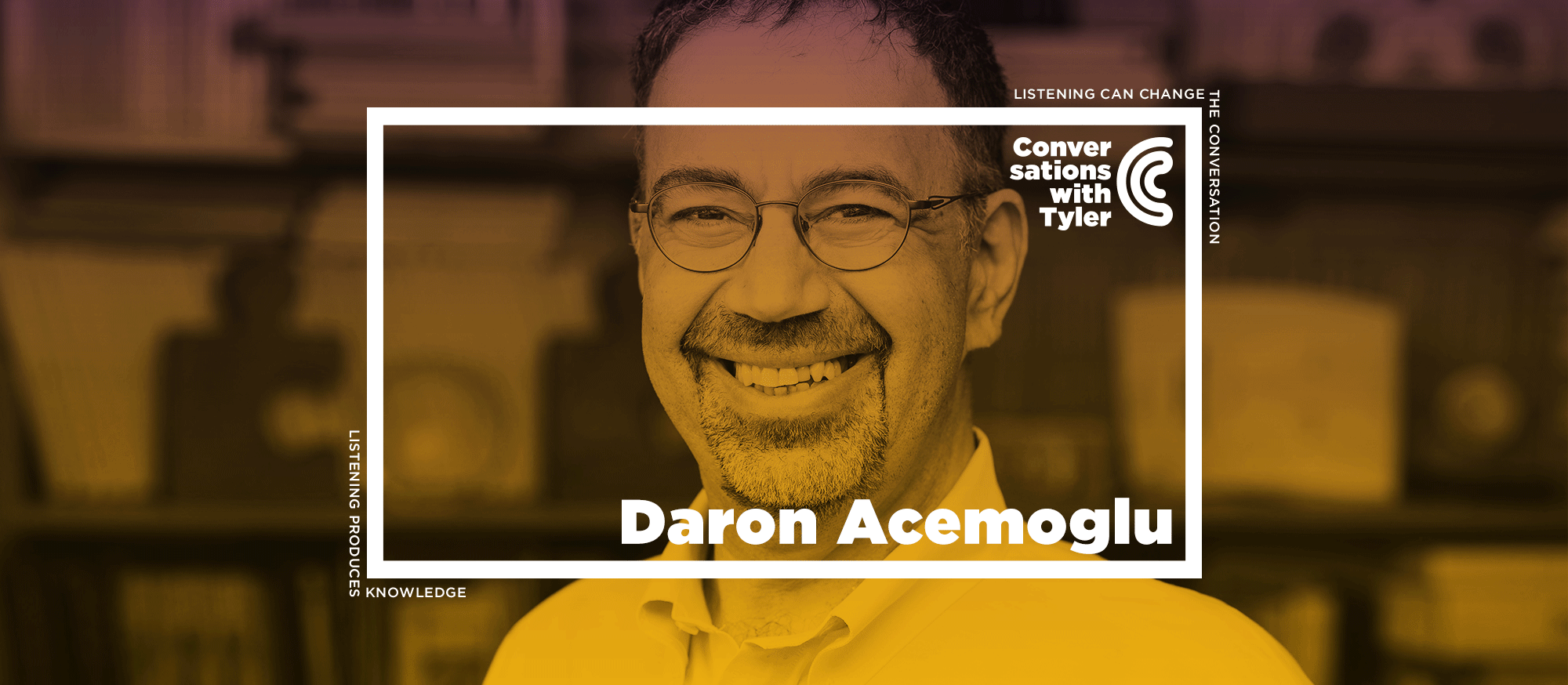



Daron Acemoglu returns for his second appearance with a new book, What Happened to Liberal Democracy?, which Tyler reads as an attempt to redefine and revitalize liberalism for our times. Where Daron’s first visit was about how states and societies contend for the narrow corridor in which liberty survives, this one asks what liberals themselves got wrong, and the answer implicates the educated elite—that is to say, you.
Tyler and Daron discuss what’s wrong with social contract theories and Rousseau’s general will, whether Acemoglu is more objectivist than Rorty, why he blames left liberalism’s own establishment power for its collapse, what standard is left once you refuse to have a book of higher values, nondomination versus noninterference, who counts as working class, why automation alone will not lead to widespread prosperity, how he can call himself a free speech absolutist while wanting to regulate social media, why he worries we’ve given up on educating Americans, whether teachers’ unions need to be reconstituted, what the life expectancy for an educated twenty year old is today, whether open-source models undercut the centralization worry, what pro-worker AI actually means, why the fertility crisis leaves him strangely close to a real business cycle position, whether AI will raise his own already prodigious paper output, why Armenia has disappointed economically, what he wants to learn next, and more.
Watch the full conversation
Recorded July 15th, 2026
TYLER COWEN: Hello, everyone, and welcome back to Conversations with Tyler. Today I’m honored to be sitting here with Daron Acemoglu. He is, of course, Nobel laureate in economics, arguably the best-published and, by some measures, the best-cited economist in the world. Most importantly, he has a new book out, What Happened to Liberal Democracy? This is a major work. I think of it as an attempt to redefine and revitalize liberalism for our current times. Daron, welcome.
DARON ACEMOGLU: Thank you, Tyler. It’s my pleasure, and thanks for that wonderful introduction, which gets to the heart of the matter. That’s exactly what my ambition is with the book. Whether it will succeed, that’s much more questionable.
COWEN: I’d like to start with an oblique question. What is your main objection to social contract theories and contractarianism?
ACEMOGLU: That’s jumping into the book, but that’s part of how I try to think of an alternative to the current conceptualization of liberalism, which I believe relies too much on social contract theories. In my mind, social contract theories try to circumvent a key question, which is that we need to build consensus around shared moral values and shared priorities. In their place, contractarian ideas put in some absolute truths that we are supposed to agree on philosophical grounds. That’s a too extreme a view or too extreme way of putting it, but I think it fits the Rousseau end of it.
Then the other ones are adjacent to it, not exactly as strict as the Rousseau end. The Rousseau’s general will, for example, overrides any kind of consensus that a community, for example, could have because the general will is defined to have precedence over any kinds of agreements or shared moral values or shared priorities. I think by doing that liberalism avoids asking some of the hard questions. For example, how to deal with intolerance or how to deal with different views than its own, especially those that challenge it.
COWEN: Richard Rorty had a consensus-based defense of liberal democracy. Is your view the same as his, or are there some metrics along which it’s different? Are you more objectivist in some way?
ACEMOGLU: I wouldn’t say it’s more objectivist. I think my commitment in my mind has always been that it’s impossible for us at any point in time not just to know what’s really the absolute truth, but also to have a clear map of what is the right stance. In the same way that I think many people would agree science makes gradual and sometimes uncertain progress toward some better understanding, I think morally, philosophically, we also have to have gradual uncertain evolution toward what we agree on. Objectivism, in some sense, is too strict.
COWEN: Say we’re not evolving toward greater agreement.
ACEMOGLU: No, sometimes we go back.
COWEN: Today, it seems we’re not evolving toward greater agreement, right?
ACEMOGLU: We’re not. Absolutely not. I think you can blame that on reactions to globalization, reactions to technology, better authoritarian challenges. This is the most uncomfortable part because I see myself firmly within the left liberal tradition. I think it’s partly because of the failure of left liberalism. In some sense, if you think of why did Rome fail or collapse, we can tell a story about the barbarians were really too strong. No, really, Rome collapsed because internally it had problems that opened up weaknesses against outside invaders as well as some inside problems.
It’s the same with left liberalism. I think it became quite influential throughout much of the Western world and some of the emerging economies as well over the last 70, 80 years. It did not use that establishment power just in the right way, creating its own weaknesses that made it much more vulnerable to outside attacks. That’s why I think we are now going back because we are at an interregnum period in which ideas are battling again. In some sense, it’s just like the early 19th century where you had all these very different ideas and they were trying to get a toehold in the imagination of people. I think we are going through a period like that, except that there are really many more confusing ideas out there.
COWEN: Say when we’re not evolving toward greater consensus, what’s the external standard you introduce to judge which are the correct ideas and which not? Like Rorty, you need one, though.
ACEMOGLU: I don’t have one.
COWEN: Then why believe in what you believe?
ACEMOGLU: Okay. I think what I believe is, first of all, not as an external standard—I don’t know whether external standard or internal standard is the right word—but that we have to defend some degree of individual freedom because everything starts from that, both in terms of our meaningful lives, but also any kind of improvement in the human condition requires individual initiative, and that individual initiative is impossible without some amount of freedom, a meaningful freedom, not just saying, “Okay, you have the freedom to pray, but you cannot express that idea with others or you cannot turn it into action.” Some meaningful freedom.
That is the only starting point that we need to have. Around that, we need to build things with some sort of consensus within society. That’s what I think liberalism has to recognize, that you have to enshrine those rights, but then give enough elbow room to people to form their own community-level agreements.
COWEN: You present some different values in the book. One is nondomination. Another is noninterference. There’s others. When they clash, what’s the metric you introduce to decide how to resolve that clash?
ACEMOGLU: I wish I had a perfect answer for that. I don’t.
COWEN: You have an imperfect answer.
ACEMOGLU: I have an imperfect answer. I think noninterference by itself isn’t enough because, at least as read or as interpreted by some philosophers and economists, it is just about being left alone from higher authority or typically state-level authority, although it could be some other authorities as well. We do also need opportunities and some way of actualizing our intentions and our freedom. That’s what the idea of nondomination, which goes back to Roman Republican times, recognizes.
It is not, in my mind, an extremely interventionist philosophy. It doesn’t say the state knows it best or that the state should always have an opportunity to override individual or group-level decisions. It does emphasize that providing people some amount of protection against those who have much greater physical or other power relative to them is something that cannot be done at the individual level. It has to have a community-level component.
COWEN: That’s a good answer, but is it an answer to the question? If we’re Sidgwick, we might say, when values clash, we look to utility, or maybe it’d be cost-benefit analysis to decide which gets priority. You’re not willing to say that, so why not? What’s wrong with that answer?
ACEMOGLU: Let me start with what’s wrong with a general-will type answer—I’m simplifying it—but I would say in a general-will type of approach is that we have a book in our hand which says when values clash and when there’s something, here is a higher value and we’re going to follow that. Ultimately, even though he’s a true liberal, John Rawls also goes into that direction. Now, you might think utilitarianism avoids that because it says, “No, we don’t have a book. All we do is we turn everything to utils and then we compare those utils.”
Who decides how to compare, how to turn things into utils? When there are externalities that are important? There again needs to be a book. I don’t like that book because who decides what that book is and how can we be certain that book exists? That’s why once we have the building blocks of individual liberty, then I think we have to go back to society and seek consensus on what our temporary book should be.
COWEN: There’s a lot of talk in your book about what you call working-class liberalism, but say today in America, what exactly is working class? Household income, it’s almost six figures. Percentage working in manufacturing, it’s what, 8 percent to 9 percent. Private sector unions are very small. Is this even a meaningful notion today, the working class?
ACEMOGLU: It may or may not be. That’s why I say that social democracy, as it evolved in Scandinavia and then spread to Europe and to some extent in a modified version to the United States, isn’t the right actualization of liberal ideas today because it very strongly relies on unions and a particular kind of industrial working class. Today we don’t have an industrial working class. If by working class I meant industrial working class, obviously that would be almost a vacuous notion. But we have the vast majority of people who live by earning their living in the labor market. That’s the working class.
If you’re getting your income from the labor market mostly, not from capital, not from your parents, then in my definition you’re part of the working class. The working class is distinguished by having a very diverse set of skills. Not just one skill. It’s going to have the manual part. It’s going to have the trades. It’s going to have office jobs. It’s going to have entrepreneurship of some sort, but that’s what the unifying theme is. That’s of course not a very simple unifying theme. There’s going to be a lot of heterogeneity within the working class. That’s why I emphasize in the working-class liberalism different communities that are going to have their own practices and values.
COWEN: Say when MIT decides who in the economics department should get tenure, that’s a working-class decision?
ACEMOGLU: Yes. It’s like the edge of the working class because the tenured professors are a bit weird.
COWEN: Tell me what’s wrong with the following view. There’s an educated elite in most countries. They decide who gets a Nobel Prize, who at MIT gets tenure, how to referee economics papers at top five journals. I think for the most part they know best. Other parts of the working class need to feel included enough not to bring the system down. But actual outcomes and policies, we do as much as possible want to be decided by the educated elite. Is that a correct view? Because that’s close to my view. Is it your view?
ACEMOGLU: No, it’s not my view.
COWEN: Tell me your view.
ACEMOGLU: Okay. How many hours do we have? You very succinctly summarized what—I try to convey this in the book, but perhaps not clearly enough—but what I think brought liberalism’s crisis. In two words, liberalism crisis is related to the rise of a post-industrial economy in which what you just called the educated elite has become both much more powerful and more numerous, and a philosophical shift that gave more and more priority and power to the educated elite. Whether you approach that from the left liberal point of view or from more of a right liberal point of view, that’s problematic in my mind.
We cannot have true freedom and true flourishing of a population when there is a clear hierarchy, whether it is by education, it is by race, it is by income. Just empowering the elite in that way is not going to cut it.
COWEN: But we want to cover up the role of the elite to some extent, right? The Straussian view.
ACEMOGLU: Okay, well, if you cover it up really well. No. I think the nuance here is that I am also very committed to expertise, obviously, given where I am. One challenge, which I mentioned in passing, and perhaps I should have done more in the book on this, is how do you utilize and respect expertise without creating the wrong kind of technocracy that is insular and too self-confident and, frankly, looking down upon the rest? Unfortunately, that’s what we’ve created in the United States and Europe, and that’s what working-class liberalism has to avoid.
COWEN: Now, here’s a sentence in your book that I very much disagreed with. I almost thought you left out a word. Let me read it to you, and I’ll tell you why I disagree. You wrote, “Automation is central to my account because it severs the link between mass production and shared prosperity.” Now, I view automation as creating the link between mass production and shared prosperity. There’s a lot of evidence that automation doesn’t lower the labor share. I know well your papers with Restrepo. That’s about the composition of labor income, right? Not about the total labor share. There’s a new paper out by Barany, Patel, and Siegel looking at France up through 2019. Automation doesn’t harm the labor share at all, so why be so negative on automation? I just think it’s great.
ACEMOGLU: There are two parts to this. The first is how to put automation in our pantheon of different types of technological changes. By the way, by just having this conversation, we have gone way beyond what most economists do, which is to give up the pretense that there is just one kind of technology, that technology has a uniform effect. We’re explicitly talking about automation because there are other kinds of technological changes as well. I think that’s very important. I think blackboxing of technology is one of the least productive things that we’ve done as economists. By the way, I’m guilty of this for the first 15 years of my career too.
Second is what is the conceptual and then empirical effects of automation? Let me start with the second. I don’t know this new paper that you mentioned.
COWEN: There’s plenty of papers showing automation brings prosperity, right? You could say the whole history since the Industrial Revolution.
ACEMOGLU: No, those are macro things, and let’s come back to that. The evidence in terms of what automation does, at least at the firm or the sectoral level, is very clear. It does reduce the labor share. I have several papers on this. There are another 20, 30 papers. This is one area where evidence and theory are very well aligned. When you look at how it does it, it just really coheres with the theory. What automation is, is that it takes tasks or activities that were previously performed by labor and it transforms them to capital, algorithm, machinery, or whatever, robots. That has a first-order impact on the labor share because fewer things are done by labor.
Now, that doesn’t mean labor is going to get unemployed. There could be enough demand from nonautomated tasks for labor, but that would never come back to increase the wage enough to restore the labor share to where it is. That’s exactly what the theory is. Then when you look at the data, and in some papers we’ve been able to do that at the sectoral level, but in some papers really look at it very micro about what tasks are disappearing, what kinds of workers’ wages are changing, what kind of employment is changing, it coheres very well with the theory.
Now, at the macro level, it’s more complicated because there are composition effects between like Walmart effects and things like that, so we can talk about those, but I think the evidence, at least the ones that I know, is very clear that automation will reduce the labor share. That doesn’t mean reduce the wage.
COWEN: Sure. Wages are very high in the United States.
ACEMOGLU: Wages are high.
COWEN: What are we worried about? Even the labor share, if you adjust for equity compensation, it’s gone from 62 to 60. That might be modestly unfortunate, but it’s hardly a tragedy from 62 to 60.
ACEMOGLU: Hold onto that thought because it’s a great question, Tyler, but I want to come back to the first part of your earlier question because that’s very important. What’s my view of automation? How should we view it? Let me first tell you my view and then we can talk about whether it’s justified or not. I am not, 100 percent not, against automation. Automation has been ongoing since at least the beginning of the Industrial Revolution. It enables us not to do some of the harder, more manual, more routine, more back-breaking tasks. That’s fantastic. If the only type of technological change out of that many diverse types of technologies, if the only thing that we do is automation, then that’s not going to be a firm basis for shared prosperity.
When you talk about the US economy has high wages—for example, wage growth was very high in the ’40s, ’50s, ’60s, ’70s—that’s not, in my mind, just because of automation. Automation was a contributing factor, but more because of other kinds of technologies that created new opportunities, new tasks where workers that were displaced from the more mundane things could go, so that combination.
What I am really worried about in the age of AI, and robots’ entry into the manufacturing sector illustrates this very well, if you prioritize automation and don’t do enough of the new task creation, new opportunity creation for labor, that’s when the labor share decline is going to become more severe, and the wage growth is going to be not there, or in fact, it could be negative. The thing about automation is that you’re right, automation could increase the real wage, but it could even reduce it.
COWEN: Well, it could. How many cases are there, say since post-World War II—Western Europe, Japan, South Korea, United States—where automation has on the whole decreased real wages?
ACEMOGLU: On the whole, but again, define on the whole. If on the whole is at the macro level when you look at the time series, that’s not just automation because automation is coupled with lots of other things. For example, my work on this with Pascual wasn’t that great because we did not have fantastic measures of new task creation. David Autor with his co-authors has written a more recent book that’s with much better data. What he shows and what we also found is a lot of the wage growth in the post-war period in the United States is related to these new tasks. About 40 percent to 50 percent of what the US labor market supports right now in terms of human work is related to these new tasks.
Really it’s not correct to say, “We’ve had a lot of automation since World War II and look at wages,” but if we zero in in periods of rapid automation, and that’s what we do in the paper on robots with Pascual Restrepo, you do see wage decline. The wages of people who used to be in especially blue-color heavy manual tasks that were the ones that robots of the 1990s and 2000s went after, like welding and painting and things like that, the wages of those workers both—
COWEN: Sure. Some tasks.
ACEMOGLU: —in the aggregate and also in local labor markets went down quite a bit.
COWEN: That’s a funny definition of automation because the new tasks being created, so often they’re coming from machines, right—
ACEMOGLU: They are, absolutely.
COWEN: —and from computers.
ACEMOGLU: Oh, 100 percent, but that’s why I’m, again, if perhaps we’ll go to this later, when I talk of AI, I don’t say, “AI is going to be automation.” No, AI is going to be hopefully both automation and new tasks and then creating the right balance. Again, once we open that black box of technology, which I uploaded enthusiastically five minutes ago, then we are also saying, well, there are different rates at which these different components of technologies are advancing. During some periods, and when we went so much into robots, that was one, automation was really going very rapidly and new task creation wasn’t going as rapidly.
By the way, that’s not just in the nature of technology. When Japanese and South Korean, and to some extent German car manufacturers, for example, were introducing robots, they also redesigned jobs to create many new tasks that American companies didn’t do. There’s a lot of choice in that endeavor. That’s why I think AI is so exciting and so dangerous.
COWEN: You have a new paper with David Autor, Beirn, and Scott where when the number of young people is relatively low, there’s induced innovation, and that raises per capita income, right? Does that not make you much more optimistic? Is it at variance with your papers with Restrepo? It’s a much more positive vision, right?
ACEMOGLU: Yes, it is a more positive vision, absolutely, 100 percent. By the way, the precursor to that paper is also another paper I wrote with Pascual Restrepo. Both papers use the task-based framework, but that just shows exactly like I was trying to say in the task-based framework and in my thinking automation isn’t bad. Sometimes automation is a response to scarcities of certain types of factors, in which case it’s really very important for enabling economic growth.
By the way, I think the possibility that there will be shortages of labor in certain, especially manual tasks, is indeed, as you say, a possibility for optimism, but depends on how you deal with it also. In both papers, you also see the element of choice. You have to do the technology, and not every society does that technology in the same way. We could get that wrong. We can get too excited with certain currents in AI and miss some of those boats, or we can use AI just the right way to deal with our shortages while also creating opportunities for remaining workers.
I don’t think there is any law of nature or economics that all of these things are going to work perfectly, or there is just one path for them to work in one way and not in other ways.
COWEN: At the beginning of your book, there’s an excellent quotation from Frederick Douglass. I read, “Slavery cannot tolerate free speech. Five years of its exercise would banish the auction block and break every chain in the South.”
ACEMOGLU: I love that quote.
COWEN: For you, what are the limits of free speech, and how do you decide where they go?
ACEMOGLU: I wish I could say that, for me, there should be no limits to free speech. Ultimately, that’s what I believe if you allow me to define free speech. If I just said that sentence, you would give me an immediate counter example, having read my book. You would say, “But you’re in favor of regulating social media. Isn’t that restrictions on free speech?” I actually don’t believe so. I think I would like to be a free speech absolutist while also regulating social media. I can say more on this, but it looked like you had a question.
COWEN: Children are a complicated case for any liberal theory, I would say, right?
ACEMOGLU: Absolutely.
COWEN: Putting aside children, are you an absolutist on free speech?
ACEMOGLU: No. Again, I am an absolutist on free speech as I define it, but no, I’m not going to say that social media should not be regulated.
COWEN: For adults, what’s the limiting case where you think we should limit free speech?
ACEMOGLU: In my opinion, again, we shouldn’t limit free speech, but we should still regulate social media. The way that I think about this is the following. We should let individuals say whatever they want. Once social media can build very complex algorithms that human nature could not have anticipated, and we are evolutionarily not very well prepared, and they can almost weaponize certain types of statements, I think that’s no longer free speech. The free speech is when Tyler says something. I never want to take your right away, but I want to regulate what other people take your statement and how they use it.
That’s why I think I am an absolutist when it comes to free speech because I never want to restrict Tyler’s right to say anything. You can come back to me and say, “No, you’re not an absolutist because you want to put some framework about how others, companies, by the way, the most powerful companies humanity has ever seen, how those companies can take Tyler’s speech and use it in their algorithms or in the way that they feed into your vulnerabilities.”
COWEN: Say book markets and the printing press, they weaponized Marx and Lenin for many decades. That’s an algorithm in the very broad sense that led to terrible consequences, much worse than whatever you might think current social media have done, and yet we believe in free speech for the printing press.
ACEMOGLU: I do. I do believe in it.
COWEN: Why don’t you look at the printing press and say, “Oh my goodness, this was horrible. We need to restrict what books are put out by publishers”?
ACEMOGLU: First of all, the history is that when the printing press first came, it was used in the religion wars. It did have some periods during which we adjusted to it. If I was alive during that period, I don’t know what my reaction to that would have been. Think of American society or European society or even India or Latin America in the 1980s. I think even though some people could be swayed by some extremist books of one sort or another from the right or from the left, humanity, human community was very well adjusted to the broadcast of certain free speech–driven ideas via books.
Algorithms are a completely different matter. If social media, and this is one of the proposals I make related to social media, always stayed in the nonalgorithmic feed that on Facebook, Twitter—TikTok couldn’t exist in that case—you only see posts by your chosen outlets and your friends and neighbors in chronological order, I think we would adjust to that very quickly. That’s like the Myspace kind of model. Once algorithms can see, “Tyler has a weakness for this specific thing, I can fan the flames,” I think that’s a completely new world.
Now, perhaps in 10 years’ time, our education system, not by the way so optimistic about our education system, that’s a different conversation, but it’s possible that our education systems, our social norms will evolve such that we are well adapted to those algorithms. Perhaps at that point, I could have a different view. Right now, I find the ability of these very powerful companies to exploit the free speech of other people potentially very damaging to mental health, to people’s daily social activities, and to political discourse.
COWEN: Since you’re a left liberal, I want to pull you in the direction of being more pro-immigration. The H-1B visa program, which no one thinks is well designed, but it’s, what, 85,000 workers a year, it’s not really creating brain drain for India or China. It gives people an incentive to develop skills.
ACEMOGLU: I came by the H-1B.
COWEN: Good. It’s wonderful. In one of your pieces, one of your recent columns in the public press, you seemed pretty down on high-skilled immigration. Oh, Americans won’t become educated enough. You were back and forth, but why not just say high-skilled immigration is great. There’s more innovation. It helps the whole world. It’s good for our budget. There’s marginal problems, but it’s hard to think of a policy that more economists on a bipartisan basis would endorse. Why be so waffling on it?
ACEMOGLU: Great question. I was trying to have my cake and eat it too in that piece. It’s always dangerous to do that. It’s also not an academic piece. That was an op-ed.
COWEN: Sure. It’s still what we think, right?
ACEMOGLU: Yes. Here is my view, and perhaps the op-ed should have been written this way. I love H-1B. I think skilled immigration is great, as it is right now, despite its problems, as you point out. Here is the problem that I’m very troubled by. That educated elite that we’re talking about—let me not use a different word, although I feel uncomfortable with that word, but let’s use that educated elite—has given up on the education of Americans because they think that they can fill any skill gap with importing those skills, whether they are nurses, whether they’re doctors, whether they’re programmers. That’s the problem.
I would love to have skilled immigration, but I would love also to renew the, I call this the social compact, to distinguish it from the social contract, the social compact of America such that the influential people, be they politicians, journalists, or tech barons, really have a commitment to the education of Americans.
COWEN: COVID era aside, test scores are pretty flat for decades. Higher education right now, because of President Trump, has a crisis, but in general, longer-term, it’s been getting better and better. Quality of economics research been getting better and better. Why think we’ve given up on education in this country? I don’t see that.
ACEMOGLU: Well, about half of people in the United States in middle school read and write a couple of grades below.
COWEN: That’s longstanding. Immigration is much more recent, right? It’s not because of immigration that that’s coming down.
ACEMOGLU: No, but we’re not doing anything about that despite the fact that everybody recognizes that we are moving into the skills age where we are going to need more and more human capital. We’re not doing anything. We’re just giving up on these people. I think that is what really bothers me, that somehow we have, as the most powerful, arguably the richest, country in the world, have resigned ourselves to give up on the education of about a third to a half of the youth.
COWEN: When you say given up, you look at New York City, which is a complex place with some real problems, but per capita spending per student is through the roof.
ACEMOGLU: Oh, yes, I know.
COWEN: It’s arguably way too high.
ACEMOGLU: We’re spending money. We’re throwing money at it, but we’re not really dealing with the root causes. Some of that money goes to a dysfunctional education system that’s become ideological.
COWEN: We should break the teachers’ unions.
ACEMOGLU: Well, I am, in general, as you know from the book, in favor of unions because labor needs to be represented, but yes, teacher unions, right now, I think they need to be reconstituted because they no longer serve children’s interest.
COWEN: Less than a year ago, you wrote a much-debated piece on artificial intelligence and argued that over the next—
ACEMOGLU: Which one? I’ve written many.
COWEN: The big long one.
ACEMOGLU: They’ve all had many detractors.
COWEN: You’ve argued it will have only a very small productivity boost over the next 10 years, right?
ACEMOGLU: Right.
COWEN: It’s now less than a year later—
ACEMOGLU: Oh, no. That paper was written in 2024, it was published, so yes, three years after that, yes.
COWEN: Okay. Anthropic is a trillion-dollar company. The rate of increase of its revenue is through the ceiling. Models seem to be getting better at an accelerating pace. Do you wish to revise your estimates?
ACEMOGLU: Yes. If I were writing that today, I would revise my estimates, but the general point remains. There are three general points there. One is a meta point, which is that there is a particular way we should think about the contribution of artificial intelligence to productivity. It’s going to come through doing new things, and it’s going to come through cost savings in the things that we already do. That’s the meta point.
The second was trying to put some flesh on those bones and say, given the numbers that others have come up with for what tasks, what occupations are going to be impacted by AI? Can we try to do that?
Then the third was just a rhetorical point, which is the industry just comes up with some crazy estimates, so can we try to ground them a little bit? Those are the three things. The first and the third, I would write them exactly the same way today. The second, which is the numbers, of course, would be different. Relative to what I thought in 2023, 2024, when that paper was written and completed, yes, the models have advanced faster. On the other hand, relative to what I was expecting there, the applications on the basis of the models, which are crucial for the spread of the models, widespread adoption of the models, have been developing pretty sluggishly.
The future is very unknown, very uncertain, much more than usual, and I try to emphasize that in the paper, and agentic AI is creating much more uncertainty in that. It is possible that agentic AI will also facilitate those applications, and in the course of two years or three years, we’re going to have many applications that small and medium-sized enterprises can take off the shelf and use. That would be a game-changer. My expectation is that it’s still going to be somewhat slow. Yes, I think I would revise that up a little bit, but not radically.
COWEN: If we look at, say, 1995 to 1998, we have an IT boom. It looks quite unsexy by current standards, but productivity growth goes up by at least half a percentage point. I would be shocked if what we have now didn’t do at least as much for us. I completely reject the crazy utopian or dystopian estimates, but would you be willing to say that half a percentage point of productivity growth is certainly something easily imaginable and maybe to be expected? Or is that still too high for you?
ACEMOGLU: I think that would be an amazing thing. Our society would be so much better. I wish it were.
COWEN: Your prediction.
ACEMOGLU: Well, to put my prediction into perspective, you’ve mentioned 1995, 1998, but we had been making those investments that led to that for the previous 20 years. It depends on what period you take. If you take 1980, or some people actually started in the mid-’70s, to, say, 2008, before the financial crisis, during that period, our productivity isn’t super rapid. There are periods in which it’s rapid. That’s exactly what I expect. In the next, when I wrote in 2024, so that would be next 10 years, so 2024 to 2034, I would expect exactly the same thing, that there will be one or two years of very rapid growth.
Okay, my estimates were definitely AI is increasing GDP and TFP, which is great. We don’t have many levers to increase GDP and TFP. That’s fantastic, but it’s not going to be the kind of game-changer that McKinsey or OpenAI or Anthropic are thinking about.
COWEN: If someone is 20 years old today, they’re well educated, and they don’t buy a motorcycle, what do you think is their life expectancy? I think it’s 100. What’s your view? In part because of AI and computational biology, which in a sense is a broader vision of AI. I think people will die of old age or motorcycle accidents.
ACEMOGLU: Great question, great question. Look, I have not given that much thought in the way that you posed it.
COWEN: You may reach 100, right? You already told me you’re younger than I am. I have an outside chance. Save accordingly.
ACEMOGLU: Okay, I’m agreeing with you. I’m going to reach 100. Look, I think what we have seen in Russia and in the United States, both before COVID and during COVID, is that public health is a major contributor to mortality and morbidity. Computational biology is very exciting. I find it super exciting. New drugs, AI or not, they’re pretty amazing. By the way, many of the new drugs we’re making right now all predate AI. There are some companies that are doing very interesting AI-based drug discovery, but none of them are using large language models. That’s a different question.
COWEN: It’s computational nonetheless, right?
ACEMOGLU: It’s computational. That’s right. I’m very optimistic about AI if AI goes in the right way. That’s why I’m always emphasizing AGI through large language models is the target for me, because that’s just sucking all of our energy and all of our resources. That’s a different discussion. I think so long as public health issues aren’t tackled, the way that that impacts the average American or bottom 30 percent Americans is still going to be an issue.
COWEN: Oh, I agree, yes. The educated person can live to 100.
ACEMOGLU: Oh, you said the educated person.
COWEN: Yes. He takes care of himself or herself. There’s GLP-1 drugs, which are not AI, but significant.
ACEMOGLU: GLP-1 is very interesting.
COWEN: More to come.
ACEMOGLU: More to come. I think it’s a real game-changer. mRNA and GLP-1 are the two examples that are pre-AI amazing technologies. Even with GLP-1, my understanding is that unless you do the public health side of it, it’s not going to have the same impact. People lose muscle. People might suffer other adverse effects in terms of strength if they just do GLP-1. What do they have to do? They have to do exercise. They have to change their habits. They have to change their diets. Well, that’s all public health.
COWEN: There are so many large American corporations that are using open-source AI, very often from China. Some will claim it’s only nine months behind the best proprietary models. That’s debatable, but it’s not that far behind. With open-source out there, why worry so much about AI centralizing power? It seems to me an extraordinarily competitive market, and it almost cannot stop being so.
ACEMOGLU: Fantastic question. Look, I go back and forth on this. On the one hand, if I do scenario planning for the future, one very important scenario is that indeed the AI stack is not going to empower the foundation models, but is either going to create much bigger profit and monetization opportunities for those that go before the foundation models, like the chips like Nvidia, or the applications. The reason for that is exactly what you say. It’s actually becoming easier and easier to distill these models. There’s going to more competition, et cetera.
That, I think, is definitely a nonzero and probably 30 percent or so probability in my mind, just making it up. It’s impossible to have objective probabilities here. The large language model approach is centralizing. Both the philosophy and the practice of it is that you take all of the data that you can, and one model rules it all. Now, that model can be copied, so perhaps you cannot monetize it that well, but there is a centralizing element to it.
COWEN: Maybe to the knowledge, but not the power, right? The gains will go to the users, just as they have for electricity, antibiotics, fire.
ACEMOGLU: The gains could go to some users. That’s right. That’s part of that 30 percent. Again, that’s 30 percent.
COWEN: Why isn’t that 95 percent, say? Open source is there. It’s quite cheap, especially with the yanking of Fable 5. Everyone’s so obsessed now with diversifying their reliance. The knowledge is centralized in the sense everyone wants to draw on all the knowledge, but that’s hardly a bad thing. It’s like having more data in your model. It’s mostly a good thing.
ACEMOGLU: Again, I think that’s definitely a possible path, but all of the winner-take-all dynamics, both between companies and between China and US, is going in the opposite direction. If you’re right, then China and US should collaborate on everything because there is no winner-take-all dynamics. You should take up that to the Trump administration. There shouldn’t be much of a competition between OpenAI and Anthropic because neither of them are going to dominate the market.
If you look at the valuations or the investments of these companies, I think there is a significant winner-take-all. That’s why I’m undecided. But it’s a very good question that you’re posing here. If I take a step back, and this relates to both Hayek and to some of the themes that I try to develop in What Happened to Liberal Democracy?, I believe that liberalism and the kinds of society that we want to build that supports freedom does need decentralization.
Excessive centralization of many sorts is inimical to that agenda. I worry that the current AI approach has a centralizing element. Perhaps that’s excessive worry that market dynamics and other aspects of AI is going to take care of it, but I still worry about that. I think true decentralization would be much better served with more domain-specific models of AI and other approaches that really use high-quality data for specific things, which I think is the more promising thing. By the way, there’s more of that in China than in the US. That’s an interesting observation.
COWEN: You’ve called repeatedly for what you call pro-worker AI. Just specifically, what does that mean in terms of regulation? Because current AI, by definition, the knowledge or the abilities are fairly general, but they’re implemented in a decentralized fashion. Mercatus has accounts. We use AI. Companies use AI on their own. Is the regulator supposed to look at what Stripe, Mercatus, all these different institutions are doing with their AIs, and ask if it helps the workers and approve it or not? What does that regulation look like for you?
ACEMOGLU: Fantastic question. Thanks for asking that, Tyler. I’m again going to give a two-part answer to that. The most important part of what I’ve been, like a broken record, talking about pro-worker AI for 10 years—although the term I’ve been using only for about five, that’s what I want to clarify. I do not think that we know today or we desire today a regulator deciding what is pro-worker AI and what’s not, and then saying only pro-worker AI should be enabled. I’ve never argued that, and I do not believe that.
What I believe is that pro-worker AI would be much better for society, and if we find a way of cultivating it, we would be better off. Cultivating it has to start by changing the narrative, changing the aspirations of tech entrepreneurs and tech companies, and public policy has a role but has a supporting role in that. No, I do not believe that we need to have a regulator that says, oh, only pro-worker AI is allowed. Absolutely not.
What is pro-worker AI? Let me just clarify that for a minute. By pro-worker AI, I mean AI that enables workers to do new or more sophisticated things by giving them information, by expanding their problem-solving and their expertise. That’s intimately related to the earlier discussion that we had about automation and other things. Automation, again, narrowly construed, isn’t pro-worker AI. If we use new machinery and new information systems to train people better to do things that they couldn’t do, nurses now can do much more, journalists can do much more, electricians can do much more, that is where pro-worker AI comes in.
COWEN: Now, a somewhat different question. Your recent paper with Autor, Beirne, and Scott, does that mean you’re less worried about the fertility crisis than many of my friends?
ACEMOGLU: Yes, I am less worried about it.
COWEN: Does that mean you’re not really such a Keynesian? Because the fertility crisis, aggregate demand, aggregate supply, they’re shrinking forever. A Keynesian or a supply-sider could get quite worried. Paul Romer, the market size is shrinking, he should get quite worried. In a funny way, you end up at a real business cycle point of view where as long as the induced innovation is positive, the macro will go fine. You’re like Long and Plosser, King and Plosser in your macro. Is that wrong?
ACEMOGLU: I never thought of King and Plosser about induced innovation.
COWEN: It’s about the residual, and if the residual is—
ACEMOGLU: Habakkuk was the first one who was about this. He argued that this is the reason why the American economy outpaced the British one in the 19th century. I always thought that was intriguing. The models that I’ve been working on for the last 25 years on this topic always said that’s a possibility. By the way, it’s not a certainty, but it’s only after seeing the evidence that I’m more in that camp. No, I never saw myself as a traditional Keynesian. I think there are some great ideas in Keynes. Obviously, aggregate supply, however you define it, doesn’t always determine things, but I never saw myself as a traditional Keynesian, and I never understood the new Keynesian models very well.
I’m sure, because we see this, there are episodes in which aggregate demand shortages create problems, but the fertility declines or birth rate declines are slow acting. It’s not like it happens overnight. Perhaps that’s part of the reason why that aggregate demand shortage is not working out that much. By the way, I’m also finding these results surprising. We’ve checked them so many times, and that’s why we’ve done them so many different ways, but it seems to be there in the data.
COWEN: What if someone says, well, there’s a lot of young labor missing after World War II, but right before us is this period of great population plenty, and to some extent, it’s expected. No one thinks there’ll be a 1.3 total fertility rate, whereas today, you have all these countries, some of them quite poor—Brazil, I think, is at 1.36 or so—and that just seems to be ongoing, and it may fall even further. Isn’t there a Lucas critique objection to your lack of fear of the fertility crisis?
ACEMOGLU: Absolutely, 100 percent. Yes, that’s a very good point. The last paragraph of that paper says that. We’ve never seen anything as large as what’s going on in China. By the way, South Korea went through exactly the same thing, but South Korea is much smaller than China, is a fraction of the world population. South Korea was already developed by the time it was doing that. China is a little bit less developed than South Korea when they started. India, 10 years ago, Narendra Modi was out there saying India cannot deal with this population, and now he’s talking about a fertility crisis.
Actually, the reasons, the causes of that fertility crisis are fascinating. That’s so poorly understood. That’s a different matter. Yes, indeed, Brazil is going through it. Turkey is going through it. Mexico is going through it. India is going through it. When the whole world goes through it, except sub-Saharan Africa, perhaps the general equilibrium, general world equilibrium effects are going to be different. That’s a possibility, absolutely.
On the other hand, again, also, as we point out in the last paragraph, we’re also making people who live longer, as you said earlier on, and live healthier. That’s also going to change things. That’s going to enable people to accumulate more and more relevant human capital throughout their lives. That’s another completely new thing.
COWEN: Now, you’re well known for writing a lot of papers, but just also a lot of very well-cited papers. Is AI going to increase your rate of output?
ACEMOGLU: So far, I think a lot of people are using AI. In economics, at least, it’s being used in a more labor-saving way. I don’t see anybody, and definitely not me, using AI in a way that, oh, my God, I’m now generating ideas I couldn’t generate. I think, both for me and other people, it’s only the very best papers that contribute significantly to collective knowledge. The question is, is AI going to change those papers? If I were, again, I’m talking for myself, to write three more of my below-average papers, nobody would care, and nobody should care about that.
COWEN: You don’t always know which are the hits, right? Paul McCartney, Hey Jude would be his best song. Maybe yes, maybe no. You do more. There’s some hit rate. Beethoven wrote a lot that was not as wonderful as the Fifth Symphony, and so on. The quantity and quality often go together, especially with top achievers.
ACEMOGLU: They do.
COWEN: Ken Arrow wrote an incredible amount. Milton Friedman did. Maybe you’ll just do more and have more top work, and when you need a meta-analysis on a topic, the AI will give it to you in an hour.
ACEMOGLU: For a meta-analysis and things like that, AI is going to be very useful.
COWEN: Cleaning up data. It’ll happen much more quickly.
ACEMOGLU: Cleaning up data. Again, that’s labor-saving. That’s what I meant by labor-saving. The one thing that I’m using AI and other people are using it better than me, that’s very exciting, but so far, it hasn’t led to the big breakthroughs, it’s turning historical, verbal, qualitative data into measures that we can use for quantitative research. I think that’s very, very important. That’s very, very exciting. What you say is also true, that there is a lot of uncertainty. For my own track record, I know when a paper is okay, not that great. I don’t know the other one. I often think, oh, this paper is going to be great, and it doesn’t turn out to be. The bottom ones you sort of know.
COWEN: Now, some number of MIT economics graduate students have received job offers from Anthropic, OpenAI, have taken them, are considering taking them. How do you feel about that? Is that the future of MIT economics, is to feed the beast, the AIs? At high salaries, of course, right?
ACEMOGLU: At high salaries, of course. Look, let me answer a different question first. Because I’ve seen somebody else write about this recently. I think The Economist magazine. AI companies are also hiring a lot of philosophers. What do you think about that?
COWEN: I think they’re hiring the wrong philosophers, frankly. I’m happy that they’re doing it.
ACEMOGLU: I think AI companies have a lot of money and are waking up to the fact that their decisions are so consequential that they need to think about the broader effects. I actually applaud them for hiring philosophers.
COWEN: I agree.
ACEMOGLU: Now, for economists, it’s a bit more complicated. That’s why I wanted to answer the philosophers first. Because for economists, they’re doing it for two reasons. One is they’re thinking about it broadly, but second is to whitewash. They want to have better reports that say our impact is going to be positive, we’re going to contribute to productivity, we’re going to contribute to well-being. That’s not the best use of our economics talent. The question is, if you’re going to go to Anthropic, if you’re going to go to OpenAI, make sure you have backbone, you have nerves of steel, and you have standards, a moral compass.
COWEN: Are you optimistic about the future of Armenia, given how close it is to Russia? Or is that just never going to work that well? As you know, two-thirds of its history, it’s ruled by the Persians. More recently, Russia has been the major influence. It’s part of the Soviet Union. Now it’s autonomous, but with an uncertain future. What do you think?
ACEMOGLU: You know, but your audience may not, I’m Armenian. I follow Armenia. At the time of independence, by many standards, Armenia looked like the best placed because it was the place where the Soviet Union chose as education and technical expertise, engineering hub.
COWEN: The people are so smart.
ACEMOGLU: The people are well educated.
COWEN: Armen Alchian, right?
ACEMOGLU: Yes, exactly. Kasparov. It has disappointed. Armenia has really disappointed. It has underperformed economically. It had a good start in terms of building democracy, and then it’s squandered that. It still has that human capital focus, but the situation is very difficult. It’s squeezed between Russia, Turkey, and Azerbaijan. Turkey is now finally perhaps going to start allowing trade and other things with Armenia, but it’s not always.
It’s a landlocked country. It cannot export anything because, again, transport is not a possibility. It has to find a way of using its talent. I think the AI age actually creates opportunities for Armenia. There is a lot of interesting activity going on there, but the geopolitics is really, very risky. So far, it has somehow managed never to anger Russia, which I don’t know how they manage that. On the other hand, that comes at the expense of sometimes being too pro-Russian. It’s a complicated situation.
COWEN: I’ll be visiting Armenia for the first time in September. Now, of course, I’ll read guidebooks, ask my AIs, but what else should I know to make my visit a better one that I won’t pick up from traditional sources?
ACEMOGLU: Oh, boy. That’s a hard question. I mean, just have fun. I don’t know.
COWEN: How’s Armenian food different from Turkish food?
ACEMOGLU: Armenian food in Turkey is very, very similar to Turkish food because the two have merged. In fact, the Armenian language that I learned when I was born in Turkey—but my first language was Armenian—is actually somewhat different than the Armenian that people speak in Armenia because it’s merged with Turkish. Armenian food in Armenia is different than Turkish food. Armenian food in Turkey is very similar to Turkish food. You’ll get a diversity.
COWEN: If I want Armenian food in America, should I go to Fountain and Vermont in Los Angeles or somewhere else?
ACEMOGLU: Los Angeles is the second-largest Armenian city in the world. I’ve not spent that much time in Los Angeles, so I’m not able to guide you there.
COWEN: Final question—but before, just your book again, What Happened to Liberal Democracy? by Daron Acemoglu, new out this year—what is it you want to learn about next?
ACEMOGLU: I have several big questions that I’m exploring right now. One is what we just talked about, how can we make AI, not as a regulation, but just ground up, how can you make AI more pro-worker? I think that’s just my big passion. Second, all of these questions, and actually your first question, intersect with the following issue: Where do you need talent in society? Where do you need talent, education, expertise? Is it enough to have it at the very top with the elite, the best scientists, and then it will trickle down, or do you need it everywhere in society? What makes the most radical innovations work? I think we actually don’t know the answer to that question. I suspect that it’s not as top-down as sometimes the standard histories tell, so that’s the second thing.
Then the third, it’s both bridging this gap between political economy, which is half of my work and more than half of my passion, and all of these things. What’s the role of ideas? The materialist conception, which is both dominant in Marxism and all of the leftist social science and economics, leaves very little room for ideas. When you look at the real world, sometimes ideas from individuals, but also from groups, create very different dynamics. That’s the third thing that I’m passionate about.
COWEN: Daron Acemoglu, thank you very much.
ACEMOGLU: Thank you, Tyler. This was a pleasure, always.
Image credit: Bryce Vickmark