



Andrew Graham-Dixon’s new book, Vermeer: A Life Lost and Found, rests on the conviction that you cannot understand what’s in a painting without knowing what its maker was thinking about. In Vermeer’s case, that context includes a forgotten liberal sect — the Remonstrants and Collegiants, Christians without a church who believed peace would come through reading and toleration rather than a returning Messiah. Recover that world and a woman alone in a sunlit room is a radical image in a Europe where half of Germany had just died in war. If he’s right, the label beside every Vermeer in every museum will one day have to change.
Tyler and Andrew discuss whether it was inevitable we’d rediscover Vermeer, how that vanishingly rare sect left its fingerprints all over his life, why the Met has misread its own Allegory of the Catholic Faith, whether Vermeer painted for money or pointedly refused to, where the Gardner’s stolen Concert might be, why Dutch music never blossomed as much as Dutch painting did, how the Church of England rivaled the Cultural Revolution in wiping out British art, whether you can still spot an English painting on sight, the love that saturates late Rembrandt and the mystery of his soaring print prices, the nail on the wall that proves two Vermeer paintings are a pair, why the French are to blame for George Stubbs’ lack of status, whether we can still love Malevich, why Andrews calls recent Richter “almost like printing money,” why female artists and antique textiles remain absurdly cheap, why nobody builds beautiful neighborhoods any longer, and much more.
Watch the full conversation
Recorded April 7th, 2026.
TYLER COWEN: Hello, everyone, and welcome back to Conversations with Tyler. I’m very happy to be here today in person with Andrew Graham-Dixon. He is one of the world’s leading art historians, art critics, and he is prominent in the world of documentary. Andrew, welcome.
ANDREW GRAHAM-DIXON: It’s a great pleasure to be here, Tyler.
COWEN: Andrew has a new and fascinating book out among his many books. It’s called Vermeer: A Life Lost and Found. Let’s start with Vermeer. Why was Vermeer’s art forgotten for so long, until the middle of the 19th century? How could that happen? To us, it looks very accessible and beautiful, and obviously better than most of his contemporaries.
GRAHAM-DIXON: Well, this was part of the general mystery of Vermeer that I have tried to explain in the book. I don’t think it had previously been very well explained, but what has emerged quite clearly is that he painted basically all of these great paintings, the finest examples of his work, for one single family. They kept them very close. They left them to their daughter. She died young, left them to her husband. He died only in 1696, 20 years after Vermeer’s death, and only then did these paintings enter the world at large. Up until that time, they’d only been owned by one family.
I can’t think of another case of a great artist—I imagine if all Rembrandt’s pictures had been painted just for one man and his wife, we would never have heard of him probably.
COWEN: Where do they start being seen? What’s the first public unveiling of Vermeer as a great artist?
GRAHAM-DIXON: It would be in the mid-19th century when they were finally—the miracle is that these paintings were sold at auction. No one’s heard of Vermeer. As soon as they then get resold in the later 17th century, they’re being resold as if they were by other artists because Vermeer is not a name. He’s not like Gucci. Vermeer, if it gets sold, it gets sold as a Rembrandt or as a Gerard Douw, as even a Pieter de Hooch. His work is being sold under false currency, if you like.
What’s amazing is that it all survives, and it survives long enough for this wonderful guy called Théophile Thoré, who’s a French revolutionary exiled from France, goes to Belgium, a Frenchman’s idea of purgatory. But in Belgium, he discovers Vermeer and puts together the fact that all these paintings, which are masquerading as those by other artists, are actually by Vermeer. He says, “There is this painter called Vermeer. We never heard of him. Isn’t he incredible?” Within 50 years, 60 years, Marcel Proust writes his great novel, À la recherche du temps perdu, at the center of which he places a man, a character, a Swann, who is obsessed by Vermeer.
Proust makes it very clear that he regards the View of Delft as the most beautiful painting in the world. Vermeer is one of the greatest. From that moment onwards, Vermeer begins his ascent to become one of the most loved painters in the history of civilization, but it’s very late.

View of Delft (c. 1660–1661) — heaven on earth?
COWEN: Does this whole history make you more persuaded by objectivist or subjectivist theories of aesthetics? That is it inevitable who becomes a great painter?
GRAHAM-DIXON: Mystical aesthetics is where I would go with this because it seems to me that it’s a proper miracle that a painting that has nothing—nothing on its side, no one fighting for it, no one rooting for it, no name, it’s got nothing except itself—survives 400 years. Not only that, all of the other paintings, more or less all of the others, survive. I think that’s a true miracle. It’s what Vermeer put into those paintings, and that’s really the heart of my book, what’s in the paintings that made them survive. That faith, that belief, that idealism, that dream, that beauty that’s in the paintings, that’s why they survived.
That’s why no one threw them away. They didn’t not throw them away because they were valuable; they weren’t valuable. They didn’t not throw them away because they were by a famous person. They didn’t know who they were by, but they kept them because they knew they had something in them.
COWEN: In what sense was Vermeer a liberal?
GRAHAM-DIXON: Well, the main discovery of my book is that Vermeer was among the very first pioneers of what we now call the liberal tradition.
COWEN: What we now call the Netherlands, then the Dutch Republic.
GRAHAM-DIXON: In the Dutch Republic, and the Dutch contribution to the Enlightenment, which is the origins of the liberal tradition, has been very much forgotten. That’s absolutely at the heart of my book, is an attempt to remember these people, to bring them back into the place in history that they deserve. I’m not only talking about Vermeer. I’m talking about his friends, his patrons, because that’s the discovery of the book, is that he and his friends were a remarkable group of people, and they have been completely forgotten, and what they believed has been largely forgotten too. We need to remember it now, probably more than ever.
COWEN: This was also a religious movement.
GRAHAM-DIXON: Yes.
COWEN: Doctrinally, how would they have been different from, say, Protestants in England? The Collegiants, the Remonstrants?
GRAHAM-DIXON: Yes. Vermeer’s patrons, it emerges, and Vermeer himself, were part of a Protestant sect in Holland called the Remonstrants. They had a more extreme manifestation called the Collegiants, and they were unique among all Christian denominations of that time in being utterly opposed to division, hostility, enmity. The only thing they wanted was to bring all Christians, indeed all people—they included Jewish people and Muslim people—they wanted to bring everyone together within a faith that only really cleaved to the essentials of what Jesus Christ said, particularly in the Sermon on the Mount.
They said, “If you actually follow Jesus properly, you can never make war. You can never persecute someone who differs from your opinion. You can never pick on somebody because they believe something different.” They were very, very tolerationist. They formed the first pacifist movement in European history. They lived in a time of appalling warfare, the Thirty Years’ War, probably the worst war in the history of the modern West. Fifteen million out of 20 million German people died in the course of 30 years, and the 5 million who were left, all the women had been violated, and all the men only have one arm or one leg. It was truly atrocious.
They’re responding to real traumatic historical events. They’re responding to what is going on around the corner from where they live. They come up with this very, very beautiful approach to life, full of optimism, full of idealism. For about 20 years, the Dutch Republic actually lives by these codes of belief to a great extent. It’s the only tolerant country in Europe.

The Art of Painting (c. 1666–1668) — the map made Tyler think Catholic; the context says otherwise.
COWEN: If I look at The Art of Painting, a painting by Vermeer in Vienna, one of my favorites, I used to think of that as a Catholic painting, in part because of the map in the back of the scene. Are you revising that view?
GRAHAM-DIXON: Yes. Vermeer marries a Catholic, which has led to a common mistake that he must have converted to Catholicism. It’s very clear from the documentary evidence that I present in my book that all of his friends are from this Remonstrant, Collegiant axis. Of course, that’s exactly what a Remonstrant would do, is marry a Catholic.
COWEN: A lot of my friends are Jewish, and I’m not Jewish. That’s not dispositive. It may mean something.
GRAHAM-DIXON: No. We’ve got so much evidence to show that Vermeer was a member of the Remonstrant and Collegiant movement, and he painted all these pictures for those people. If the Remonstrants and the Collegiants had a bone of contention with anyone, it was probably with the extreme militant Jesuits, who did more or less want to extinguish them. This is the problem with toleration. How do you tolerate someone who actually wants to snuff you out? They did their best. Vermeer is a tolerant Remonstrant who’s actually married to a Catholic and living in a Catholic corner in Delft. His pictures are most certainly not Catholic paintings.
COWEN: If I go to the Met in New York, there’s a painting which we call Allegory of the Catholic Faith. Of course, you know it well. At least I was taught the painting is showing the celebration of Catholic mass in private homes in a surreptitious manner. Is that wrong?
GRAHAM-DIXON: Yes, that is wrong.
COWEN: What’s the correct way to think about that painting?
GRAHAM-DIXON: In my book, it’s all about toleration, so I cannot possibly lay down to you what I think you should believe. The key, as always, is the context. I’ve discovered the context of the picture, which has not really been written about. If you look at the Met’s text that it puts forward to promote a particular idea about that picture, they don’t mention at all the owner of the painting, who was a very interesting man indeed, called Hermann von Schwoll, who was the head of the Hamburg post office and a very, very rich man, free-thinking, dissident. He supported a young man who lived in his house, didn’t have any money, and he was one of the first popular journalists, a liberal journalist.
He wrote in favor of the Collegiant movement. He wrote proto-feminist tracks. That was another aspect of these people. He was most definitely not a militant Catholic. He liked allegories. The Allegory of the Catholic Faith, in my opinion, is an allegory of how hard it is to get to God if you are a Catholic. The woman in the picture is surrounded by emblems of the complex doctrines of the Catholic faith, which Remonstrants and Collegiants said, “That’s what’s holding you back. You’re far too doctrinally complicated, you Catholics. You’d kill us over whether we believe or not that the wafer is actually the real flesh of Jesus.” Or, “Let’s just forget all these doctrines and we’ll get together and we’ll just unite and read the New Testament together and we’ll get straight to God. We’ll get straight to heaven without all of this clutter.”
That painting is full of clutter. Everywhere you look, there are trip hazards. She’s almost about to fall over this globe, which symbolizes, in theory, the Catholic Church’s dominion over all of this world, which was a doctrine which Vermeer and his friends found not to their taste.
COWEN: What do you make, though, of the 15 children being baptized Catholic? Yes, there were 15, as you know, which is remarkable. Only one wife, right?
GRAHAM-DIXON: He loved his wife very much, but it wouldn’t be right—Protestants had lots of children. You can’t say that, oh, he’s had lots of children, and therefore he’s a Catholic. That doesn’t really compute. People have kids.
COWEN: No, but the kids were Catholic, right?
GRAHAM-DIXON: Yes, sorry, absolutely. No, his children are raised as Catholics because Vermeer has no money.
COWEN: What about the simple hypothesis, Vermeer wasn’t very Protestant? A lot of men just aren’t that religious. They’ll go along with what their wives want. She was Catholic, we know that. He did these pictures for money. His patrons were Protestant. He just wasn’t very religious. That’s how I would read Vermeer’s career.
GRAHAM-DIXON: Would you still read like that? I think the paintings are profoundly religious. I think he was profoundly religious. What he didn’t do was paint for money. Someone with his talents, if he’d wanted to paint for money, he could have been rich. He didn’t need to paint for money because his mother-in-law, Maria Thins, was one of the richest women in Delft. He struck a devil’s bargain, if you like, I think, whereby she will support the family. She will support her daughter, who’s rebelled against her, to marry Vermeer in the first place. She didn’t approve of the marriage, but she reluctantly agrees. She will pay all the bills, but it’s to be her rules.
They will be brought up, like her, as Catholics. Vermeer doesn’t like it, but it’s okay. He’ll put up with it. Where his heart is in the Remonstrant corner of the city, his heart and soul is there. That’s what he believes in. He does all of this so as not to have to paint for money.
COWEN: The Vermeer painting, The Concert, that was stolen from the Gardner Museum, do you have any intuition where it might be or if it still has survived?
GRAHAM-DIXON: Oh, man, I wish I did.
COWEN: You must have a best guess. Who can I ask who will know better than you?
GRAHAM-DIXON: I’m not that kind of art detective. I try to excavate the meanings of the paintings, not their whereabouts. I’m really sorry to disappoint you.
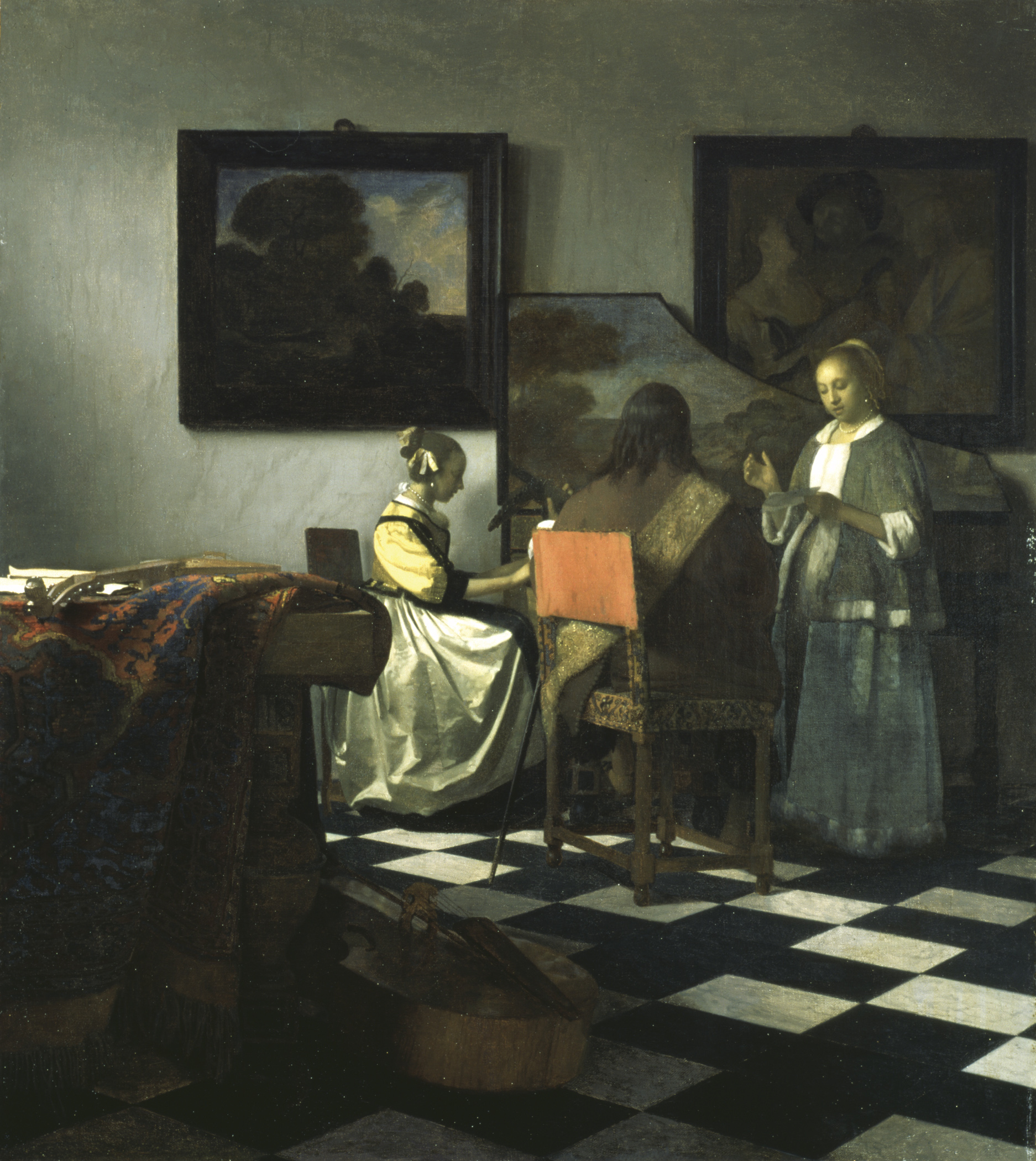
The Concert (c. 1664) — ending a meeting in harmony.
COWEN: You may contest the premise here, but why did not Dutch music blossom in the same manner that Dutch painting did?
GRAHAM-DIXON: That painting that you just mentioned, The Concert, is a very good example of Dutch music blossoming. To simplify things a little bit, Dutch music essentially doesn’t blossom because Dutch Calvinism, orthodox Calvinism that is, the official faith of the Republic, considers music to be dangerous to the soul. To listen to music or to perform music, it’s like admiring a beautiful statue of the Virgin Mary. They think it’s wrong. The statue has to be smashed. The music has to be got rid of because that’s in the way of your faith.
That’s why you have these wonderful pictures of the white churches of the Reformed Dutch. They’re churches without images, but they’re also churches without music. But the Collegiants don’t have such objections themselves. They think music helps bring you to God. A Collegiant meeting is a very beautiful thing. I should perhaps explain for people who are not familiar with any of this that the Collegiants are Christians without a church. Most of them are women, 80 percent. This, by the way, is why all of Vermeer’s paintings are of women, because he’s painting for this predominantly female Collegiant group who meet in the house of his patrons, which is next to the Remonstrant church.
That painting, The Concert, as it’s called, which is a misnomer, it’s not a concert; it’s a painting of a Collegiant meeting taking place. It’s a pair with a painting, which I can’t tell you where it is because it’s owned by the King of England, Charles. It was his mother’s favorite painting. I saw it once in her bedroom. She used to keep it very close. Those two paintings show us what the music-making at the end of a Collegiant meeting might have looked like. You see this group of people playing music. There’s a wonderful CD, I can’t remember the name of it, I could get the reference for it, where you can actually hear this music.
They set the Psalms to very complex, musical, beautiful, multivocal harmonies. You have to imagine that there’s a meeting. The meeting might go on for five hours. These women are all there together, and they’re talking, talking, talking, talking. First of all, one of them reads out a passage from the New Testament. Then they all talk about what it means. Then they discuss what they’re going to do the next day, how they’re going to help because they do a lot of charity work, these people. They plan their proposals. They probably have an argument about whether the Messiah is actually going to come in the year 1666.
Maybe he will, maybe he won’t. They might have a quarrel about that. At the end, when all the single voices have finished speaking, the voices all come together in this song, in this music, which is itself a demonstration of what harmony between people looks like.
COWEN: Was there more, you could call it iconophobia, in England at the same time? Churches stripped bare, visual arts penalized?
GRAHAM-DIXON: Yes. In Britain, the Church of England was as astonishingly destructive as the Chinese Cultural Revolution. They destroyed the entirety of British art.
COWEN: Say, Durham or Lincoln, those places were not wrecked. They’re in remarkably good shape today.
GRAHAM-DIXON: The church is left. It’s like theaters, but all of the actors have been killed. The stage set is left, but everything is gone, all the art, all the sculpture, all the stained glass. There’s a wonderful quote by one of my favorite historians, Lawrence Gowing. He said, “If you were to try to reconstruct the glories of British medieval art, it would be as if you would try to put together a diplodocus from half a tailbone and one tooth.”
COWEN: I’m a big fan of your book, A History of British Art. In that, you insightfully remark that a lot of English art earlier on was harder, more angular, and less obsessed with perspective. Have those traits carried down into English or British art of the 19th and 20th centuries, or even today?
GRAHAM-DIXON: I’m a bit suspicious about identifying national traits. I’m not sure.
COWEN: If you see a painting that’s English, my guess is you can recognize it as such. Oh, that’s English. It’s not French. I’d be shocked if you couldn’t do that.
GRAHAM-DIXON: I think in the 20th century and the 21st century, that might be harder. I think I might struggle because the power of Esperanto and also the herd mentality of the modern artist should not be underestimated. People are very good at imitating other people. You can look at Russian art in the 19th century. An awful lot of it looks very French because they were so obsessed with trying to imitate the French, because that was the pinnacle of civilization. I think it’s a bit of a tricky one.
To go back briefly to Vermeer, his patrons and their meetings, and these pictures that are painted for their meetings, I just think it’s such an astonishing thing, the lesson that’s being shown to other people in a time when, as you just alluded to, in Britain, if you’re a Catholic, forget marrying a Catholic. If you discover a Catholic, they will be tortured to death in public. They will have their entrails ripped out in public. They will be fed their own eyeballs. It’s truly awful. Yet in Holland, a tolerant Remonstrant such as Vermeer can actually marry a Catholic.
He’s painting for a Remonstrant and her husband, who, to their meetings for these Christians without a church, you don’t have to believe in God. You can be Jewish. You can be a Muslim. The only thing you have to believe is that Christ’s teachings in the Sermon on the Mount contain the salvation for mankind. When you think of those people actually meeting, it’s the difference between, say, for example, if you’ve got the Troubles in Northern Ireland and you’ve got people from Sinn Féin meeting, the nationalists, the politicians meeting.
That’s completely different than if you’ve got Catholic mothers of sons who’ve been shot in the conflict deciding to meet in their houses with Protestant mothers, women who’ve been shot, meet together, hug, talk, and embrace. That’s completely different. That’s what these people were doing. It’s as if, I don’t know, what would the example be today? It’s as if, say, for example, some Jewish mothers got together with some mothers from Gaza and had a picnic in the rubble together. What message would that send? That’s the message they’re sending.
It’s an aspect of Dutch history that is just, as far as I’m concerned, it’s never mentioned. It’s been forgotten. You can go to any number of wonderful galleries like the Washington National Gallery, where you’ve got amazing, beautiful, wonderful Dutch art, but this context, this troubled context behind it, the war, the death, it’s just been edited out. It’s been forgotten. It’s not part of people’s consciousness. I’m trying to put it back.
COWEN: How does Rembrandt fit into this doctrine of toleration?
GRAHAM-DIXON: That’s a great question. I was on a show of late Rembrandt in the National Gallery in London with a good friend of mine, Danny Katz, who’s a Renaissance sculpture expert. Very plain spoken, but always has something interesting to say. We were just looking in this dark room, all these wonderful paintings, The Jewish Bride, it’s wonderful, beautiful painting, so tender. He said, “Everywhere you look, everywhere you look, there’s just love. You’re surrounded by love, aren’t you?” That’s what Rembrandt is. It’s love.
COWEN: There’s quite a bit of Judaism in his paintings, as you mentioned.
GRAHAM-DIXON: There are Jewish people in his paintings. He painted, I’ll get his name wrong, Menasseh ben Israel, the head of the Jewish community in Amsterdam. Very interestingly, it’s not really been talked about because people always say Vermeer and Rembrandt are the opposite. The origin for my book about Vermeer is really the discovery that I made. Wherever you look in detail in Vermeer’s life, you find members of this religious movement, the Remonstrants or the Collegiants. They’re not very common. Only one in 500 people in Holland is a Collegiant. If I find eight in Vermeer’s life, including the leader of the movement, we know that he’s part of it. It’s just no way that he’s not.
Interestingly, Rembrandt knows these people, too. Rembrandt’s older, a fair bit older, but he paints the head of the Remonstrant Church, Uytenbogaert. Sorry for the butchery in my Dutch accent. Uytenbogaert. That portrait is in the Rijksmuseum. As far as we know, Rembrandt’s a slippery fish, but I think his approach is very open. He’s very nondoctrinaire. He’s certainly not a hardline Calvinist. He’s friends with the Mennonites. The Mennonites are very liberal. I think it’s not a coincidence that the liberal West adopted Rembrandt as its favorite artist.
Looking back now with this historical knowledge that I feel I’ve gained about this period, this forgotten secret of this amazing movement that existed, that they seem to have been a part of.
COWEN: Do you have any intuition why Rembrandt prints, in even the last two or three years, have gone up so much in price? People used to say Old Masters were greatly underpriced. They’re such a bargain. Not long ago, a Canaletto auctions for $30 million, which struck me as a bit crazy. Rembrandt prints, which are more or less the same thing over time, they’ve gone up by two times or three times over a few years. What’s going on here? Old Masters coming back because people are sick of the rest, or is it just anomalous?
GRAHAM-DIXON: It might be a little bit anomalous. I’ve been following it because I was friends with a guy at Sotheby’s who did a lot of research into a recently discovered Rembrandt. It felt like there’s a ceiling for a Rembrandt painting. This is a lovely painting of the Nativity, a monochrome painting. It sold for £10 million or $10 million, which is the same price as the last two Rembrandt self-portraits have sold for. When you think an Andy Warhol, which is essentially a screen print, is selling for maybe $100 million, it does seem really weird and underpriced.
Yet, as you say, the prints have been selling for figures that, compared to the paintings, are really high. I don’t know. It is my belief that Rembrandt is a painter just full of love for the world. The values that are enshrined in his paintings are important values. Maybe that we live in such tough times, maybe people just feel the value of those things all the more.
COWEN: There are attributions for both Vermeer and Rembrandt, as you well know. How uncertain are they? What does the uncertainty hinge upon?
GRAHAM-DIXON: I’m not interested in paintings that weren’t in the house much. I know what they were, so I don’t need to get involved with attribution. I’m only really interested in the paintings that were in the house. You have one here in Washington.
COWEN: Sure.
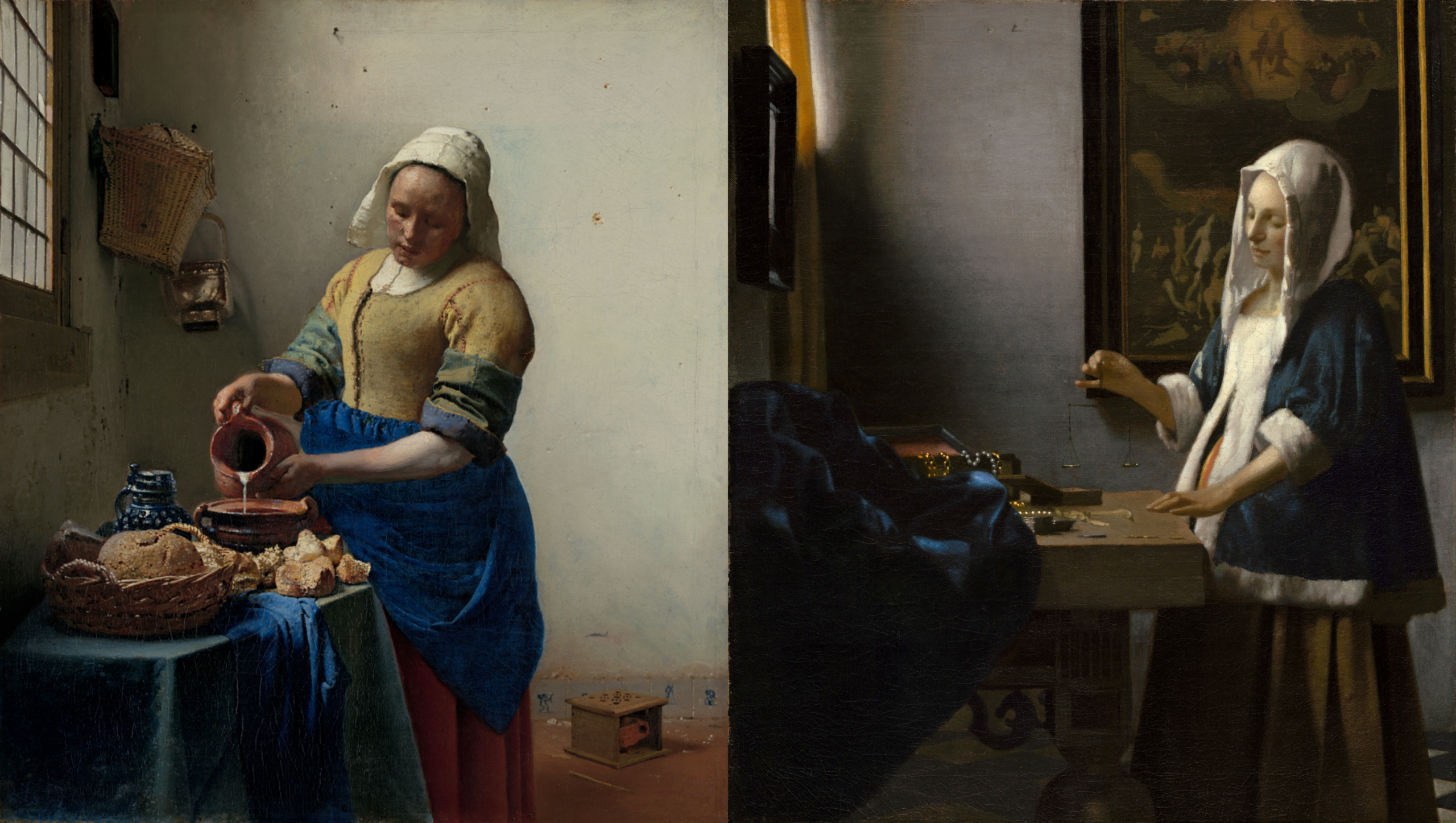
The Milkmaid and Woman Holding a Balance — a pair, per Graham-Dixon: the contemplative life and the active life. Note the nail above each woman.
GRAHAM-DIXON: Woman Holding a Balance.
COWEN: It’s now accepted. Formerly, it was uncertain. I’m never sure whether I should trust the new judgment.
GRAHAM-DIXON: Well, there’s no question. As I show in my book, one of the things that emerges from the book, once you actually know why the paintings were made, once you know the beliefs of the people for whom they were painted, suddenly, one of the things that emerges really clearly about the paintings is that a lot of them were painted in twos. The Woman Holding a Balance is clearly, without any doubt, the pair to the famous painting in the Rijksmuseum called The Milkmaid. All of the painting’s titles are nothing to do with Vermeer. They’re all modern inventions.
She’s not a milkmaid, and she’s not just a woman with a balance. What the two pictures represent is the two aspects. They simplify Christianity to its bare essentials: Do well, think well. At the end of the day, you consider, have I behaved as Jesus would have wanted me to behave today? Have I done everything that I should have? I ask my conscience this question. That’s what the Woman Holding a Balance is doing. She’s not weighing gold. She’s weighing her conscience. Behind her, there’s a painting of the last judgment where the souls are being weighed by Archangel Michael.
She has weighed her own soul. There’s nothing in the balance. The scales are empty. They’re perfectly poised. Her conscience is clean. The other lady, exactly the same scale to the room she occupies, the same light source coming from the left, she is crumbling bread into a bowl of milk. She’s making what the Dutch call bread pudding, which was the food that you gave when you administered charity to the old and to the very young, people who were too infirm or old to be able to chew solid food. You gave them this pap, this bread pudding. That’s what she’s doing.
She’s robed in blue, almost as if she were a modern Madonna. If you’re seeing them in traditional Christian terms, they are Martha and Mary. They are the contemplative life and the active life. If there’s any doubt in your mind about them being a pair, which they’ve never been identified as a pair as far as I’m aware up until now. They were certainly not hung as a pair in the great Rijksmuseum exhibition that happened a few years ago. If you look at the two pictures, if you get them up onto a computer screen together, you’ll see that there’s a nail in the wall.
Just above and to the left of each woman in exactly the same place. It’s Vermeer tapping us on the shoulder from 400 years ago and saying, “Yes, if there’s any doubt that these paintings are a pair, look at the nail.”
COWEN: What did you learn from the great Rijksmuseum exhibit of more or less all the Vermeers? When you saw them all together, it must have been the first time for you. What new idea did you have?
GRAHAM-DIXON: Well, I was testing the big new idea, which is the book. It was great timing for me because I had completed the first draft of my manuscript, or most of it, certainly when it came to the paintings. I’d written more or less everything that I wanted to write about the paintings. There was this fantastic opportunity to see them all. The Rijksmuseum’s director, Taco Dibbits, who I’d known for a long time, was kind enough to give me, in effect, a free pass because it was a very tough ticket. I think I went to the exhibition maybe 30 or 40 times.
I went many, many times just to really embed in the paintings. You had to go toward the end of the day, particularly when the crowds slackened off a bit, or right at the beginning if you got in before anyone else. You’d get a little bit of time, especially with the paintings at the far end of the show. It was great. I’m very grateful to them.
COWEN: Putting aside the details of your own thesis, what is it you think you see more of on the 17th visit as compared, say, to the second visit? Most are all of the pictures you had seen before, anyway, in other places, just not together.
GRAHAM-DIXON: Yes. I think the subtlety of the light, things like that, and certain details. Those nails in the wall may have come fairly late, actually. I think I may have seen those late, although the paintings were actually hung 120 yards apart, because when they put on that exhibition, they obviously weren’t aware of the context that I’d discovered. No one could really be in a position to understand those sorts of meanings, perhaps. It’s only with the discovery of the context that it’s possible to see what he was actually trying to do. It was a very interesting exhibition from the point of view of looking at the pictures purely as paintings because there was no strong narrative drive to it.
COWEN: What do you think of the quality of the restorations?
GRAHAM-DIXON: Vermeer’s paintings were in fantastically good condition. I was lucky enough 28 years ago to film at the Mauritshuis with the BBC crew just at the point where the View of Delft had been restored, and the Girl with a Pearl Earring had been restored. I could see very clearly, and he talked me through it. It was a man called Jørgen Wadum who’d done the restoration. The minimal retouching necessary in a Vermeer, almost nothing wrong with the painting. There’s no controversial filling in of void space, which you normally have, certainly with a Renaissance painting.
To what extent do you bring that area of loss back? How much do you harmonize it so that it doesn’t disturb the modern eye looking at the painting? You can’t really leave a gaping hole. In the case of Vermeer, there aren’t these gaping holes. One thing I remember that was fantastic, which is one in the eye for the people who are always going on about the camera obscura, which I think is one of the more boring things people talk about when they talk about Vermeer. Did he use a camera obscura and all that? If you look closely, as Jørg showed me, at the highlight in the pearl, in the Girl with a Pearl Earring, there’s a splash. He’s dropped the paint. He’s dropped the paint.
Likewise, if you look at The Lacemaker, the painting in the Louvre, which I controversially describe as a painting about maternal love, and I say that the sewing cushion with all its red threads is a visual metaphor placed there by Vermeer for the woman’s placenta, nourishing the baby. She’s making a piece of lace for her baby, and she’s pregnant, and the sewing cushion. All of those red threads, they’ve actually been thrown. It’s like a little Vermeer Jackson Pollock prefiguration. He’s thrown the paint.
COWEN: What makes George Stubbs such an underrated painter?
GRAHAM-DIXON: I think he’s been underrated forever because of his subject matter. I blame the French. The French in the 17th century invented a system for ranking works of art by their subject matter. Up at the top, you and I, we could put on some armor and confront each other with swords, and Poussin would paint us. That would be a history painting done from the life. That would be at the pinnacle. Then would be a painting of an event, maybe a meeting between great men. Then, below that, there would be a portrait.
You’d keep going down, and eventually you’d get to paintings of still lifes, like flowers and fruit, or paintings of animals. These were the lowest works of art because they featured the basest things. I think that Stubbs, to a certain extent, was the victim of that.
COWEN: Are we now able to see them properly?
GRAHAM-DIXON: Yes. It’s been no problem since Stubbs and Constable, more than anyone else, slightly controversial to say, but I think they paved the way for modernism because they showed, not necessarily deliberately, but they showed that anything could be painted, anything at all, like a piece of mud or a piece of a river could be painted in such a way as to touch on the very highest thoughts and ideas and beliefs and feelings that subject matter is completely, in a sense, irrelevant. Cézanne picked up on that when he said, “I want to stun Paris with an apple. I’ll paint an apple, and I’ll paint it with such astonishing concentration that you’ll see it as an epistemological challenge to all of your philosophy.”
I think that French art gets that from British art because British art has to be like that because that’s all the aristocrats are going to commission. They look down on people like Stubbs, in a sense. If I’m an aristocrat in the 18th century and I want a really important picture, I’ll go to Italy and I’ll buy one, thank you very much, and I’ll buy my history painting from Titian. You, sir, Stubbs, you just paint my horse. It’s my racehorse, and I’m very fond of him. Paint him well and don’t scare him.
COWEN: You think the French also have underrated Géricault, who painted and drew many horses?
GRAHAM-DIXON: Géricault, of course, went to England. Géricault spent some of his formative years in the early 19th century in London. He brought some of that spirit of English revolution to French art. Interestingly, Géricault’s great friend and the man who looked up to Géricault more than anyone else, Delacroix, who did he idolize out of all the British artists? Constable. He loved Constable, Delacroix. Somebody should write a book about it. This special relationship that’s partly to do with intense jealousy and hatred, but also to do with unexpected mutual admiration.
COWEN: How would you contrast what you absorb from a Géricault horse compared to a Stubbs horse?
GRAHAM-DIXON: Stubbs, I think, he’s not painting himself. Géricault’s painting himself. Géricault horses are self-portraits. Stubbs is trying to understand how the world works, and Stubbs understands the miracle. He really sees it as a miracle. It’s very interesting. In Stubbs’s later engravings, he seems to work his way toward the beginnings of the Darwinian theory of evolution because he’s done a lot of dissection, and he’s beginning to see that there are similarities in the way that a chicken’s hips are formed to the way that human hips are formed.
He’s beginning to wonder whether there might not be some contiguity of relationship between the different animal species. It’s very near the end of his life, so of course, he never pushes forward to it. I believe it’s not entirely eccentric to see the currents of thought that led Stubbs to those ideas as being contributory to the great river of Darwinian theory that’s going to come about 50 years later. I think he’s confronting that mystery of existence and of species and who we are, and maybe we can understand who we are through looking at a horse.
I also sometimes get from his horses, I get a tremendous sense of species fellow feeling. There’s that great painting that’s in Mount Stewart. I can’t remember the name of the racehorse, Hambletonian. The racehorse had been flogged to within an inch of its life to win this great prize for the owner. Stubbs has painted the horse at the moment after the race when the groom is comforting the horse and the horse is flecked with blood, and its eyes are wild. Stubbs paints the picture almost as if he’s painting a concentration camp victim or something. He’s saying, “How could you do this to this wonderful creature, this wonderful being?” I love Stubbs. You can tell.
COWEN: Many are held in the state of Virginia, as you probably know, in the Mellon Collection in Richmond. I’ve seen them many times.
GRAHAM-DIXON: Yes, that’s Basil Taylor. The great Stubbs expert was huge friends with Paul Mellon. It’s all about who you know and when you know them. Paul Mellon has got more money than anyone else. He loves art more than anyone else, and he becomes friends with Basil Taylor, which is, I suppose, a shame for England, but a wonderful thing for Yale. My favorite picture, I think, in the whole Mellon, is that picture of the zebra. Do you know that picture?
COWEN: I think I do.
GRAHAM-DIXON: I love that picture.
COWEN: Another favorite book of yours of mine, the Howard Hodgkin study. Now, it seemed to me in the 1990s, there was some chance Hodgkin would have a big breakthrough. The New York Times wrote him up. He might become this major contemporary painter, but it never quite happened. His prices are still pretty reasonable. The works are lovely. Who was right, the people who thought he was incredibly important, or that he’s a minor modernist?
GRAHAM-DIXON: I wouldn’t call time on anybody’s reputation. Hey, Vermeer’s a pretty good case. Vermeer had no reputation at all for 400 years. I think Howard’s doing okay.
COWEN: I would argue for him. What’s your view now, because it’s decades since you wrote the book?
GRAHAM-DIXON: Yes. No, that’s fair enough. I see the patterns by which the world values things. I don’t pay a great deal of attention to them unless I’m asked a question like that. I think, “Oh, gosh. Of course, this is what people think about,” and I don’t think about it. I just think about what they are. I think they’re such wonderful pictures. Eventually, they will be just as expensive as the pictures of Matisse or Vuillard or Bonnard or those other artists.
Howard, I think, belongs within that tradition very much. He’s an unusual painter because he decides to extend and deepen a tradition that he has nothing to do with personally, nationally, or historically. He just becomes so fascinated by it. I’d probably add Degas to that, too.
COWEN: Indian miniatures, right, which he collected.
GRAHAM-DIXON: He always said they weren’t an influence on his work.
COWEN: I never believed that.
GRAHAM-DIXON: I never did either, to be honest. You’re darn right.
COWEN: He had incredible taste in Indian miniatures.
GRAHAM-DIXON: He did, he did. What a wonderful collection he had of Indian miniatures. I used to love going to see Indian things with him. We used to go because he used to live right behind the British Museum. When I was a young art critic, I became friends with him, and I used to go often to have lunch with him. We would always go in to look at the Indian things.
COWEN: What was he like?
GRAHAM-DIXON: He would be very emotional. Very emotional. I would say, “Oh, I loved that painting that you made of the Henry Moore at the Bottom of the Garden.” Then he would suddenly remember, because every painting that he did was like a moment in his life. It had its origins in a particular moment. There were emotions brought back in tranquility, if you like. He would suddenly remember what was happening on that day and how much he loved that person, but they’re dead now. It was just someone to turn the taps on. He would weep great big tears, proper big tears, like Toad of Toad Hall tears, except they weren’t fake tears; they were real tears. Very emotional. You had to rather watch your step. You never knew if you’d have to take a timeout for 20 minutes.
COWEN: Do you feel there’s a category of artist where it’s now impossible to still love them? If I think, say, of Malevich, who is a great artist and very important historically, but when I see them, I’m left cold. Maybe I’ve seen them too many times, or maybe there are too many fakes, or maybe that kind of image has been too commercialized, but it now does nothing for me, and I’m not sure that will change, but without taking any credit away from him. Is that a meaningful concept to you?
GRAHAM-DIXON: Yes. I don’t feel like that, but I don’t look at Malevich all the time. I’ve become more and more interested in context. When I look at Malevich, I just see the Black Square, and I just see that moment. So many millions of people have died. This is a revolution. This is a moment when the people will rise up, and all these beautiful ideas are in the air, and all these people dreaming their dreams, and that’s going to be crushed. If I see those pictures and I’m thinking those thoughts, I can still find that I look at those pictures and I might feel like a choking-up feeling because of that.
I feel that deeply with Vermeer. It’s so tragic. If I look at the View of Delft, the Collegiants and the Remonstrants, Vermeer’s people, they believed that as people read more books, as people became more educated, they would all read Socrates, they would all read good philosophy, they would read the Bible. They would become friends. Everyone would become friends with everyone else. All religious discord would disappear. War would become a thing of the past. Tyrants would hand over their power to the people.
They genuinely believed that, and they didn’t just believe it. It was a belief in the New Jerusalem, which was very widespread among the Jewish communities of that period, as well as the Catholics, the Protestants. Lots of people believed in this, but only the Collegiants believed that it would happen, not by some Messiah coming down with lightning and thunder. They actually believed that the spirit of Christ, by which they meant the spirit of love and the spirit of peace, would inhabit people automatically. The more they could read and understand and talk to one another in these Collegiant meetings, that peace on earth would happen, and that it wouldn’t be some kind of amazing miracle thing.
That heaven on earth looks like your hometown on a really sunny, clear day. The women are at the shops. The children are playing. The boats are ready to take you to wherever you want to go. That is heaven on earth, and that’s what that painting is of. Every time I see that painting, in a different way from the Malevich, it’s in touching distance. We could have that. We could have that more or less everywhere if we just stop being so stupid.
COWEN: Past Vermeer and Rembrandt, is Fabritius the next greatest Dutch artist from that era, or who comes close to those two?
GRAHAM-DIXON: Well, “Fabritius,” as I’ve been taught to pronounce him.
COWEN: Forgive my American pronunciation for all these names, but it’s what people understand here.
GRAHAM-DIXON: I always pronounce him like that. The only reason is because I did my book as an audiobook recording, so I had a lot of tuition in pronouncing names right. I think Fabritius is a fantastic painter. He’s definitely, in my opinion, the source for Vermeer’s wonderful technique. This tonal painting that no one else does. Fabritius does it. He’s in Rembrandt’s studio. They know Leonardo da Vinci’s theories because they’ve just been published in France. The book’s in Rembrandt’s studio. We know that they know these ideas, and he’s doing it. He’s putting it into practice. Without Fabritius, Vermeer couldn’t paint the way he does. I think the tragedy of Fabritius, and again—
COWEN: He dies young.
GRAHAM-DIXON: —he dies young, but people don’t really understand. How does Fabritius die? You probably know how he dies. He dies because Delft is the largest weapons store in Europe. Somebody goes in with a candle, and it blows up, and a third of the whole city is destroyed. Fabritius is blown to pieces. Again, why would that happen? It’s because they’re still at war. This is a culture completely at war. There’s war everywhere. I’m going later, so maybe I’m wrong, but I’m going to go to the National Gallery of Art in Washington, to the Dutch section, and I’m going to see, is there any mention made anywhere, in any room, of the fact that half the population of Germany died during this period?
COWEN: I don’t think so.
GRAHAM-DIXON: That 80 years of war between Holland and Spain had led to the massacre of huge numbers of civilian populations. If you don’t understand these things, how on earth—when you see a radiant painting by Vermeer of peace, it’s not just a painting of a woman in a room. A painting of a woman writing, itself it’s like, “Gosh, she’s not being assaulted. She’s not being grabbed out of her home. She’s not having her possessions taken away,” because all over Europe, that was what was happening. These ordinary scenes are actually charged with meaning that we can’t recover unless we know the context.
That’s why I write books, really, is to try and understand. If you don’t understand what they were thinking about, how on earth can you understand what’s in these pictures?
COWEN: Would the Dutch painters have seen van Eyck’s and other Low Country paintings? The best ones.

Diana and Her Nymphs (c. 1653–1654) — early Vermeer, borrowing the foot-washing of Flemish altarpieces. Mauritshuis, The Hague.
GRAHAM-DIXON: I don’t know what paintings Vermeer would have seen, but I’m sure that he had seen paintings by van Eyck. It’s quite hard to piece together what they would have seen. There were dealers in Amsterdam dealing in really wonderful paintings of that school. Flemish art is around because, after all, the Low Countries is the Low Countries. Yes, it’s been divided into North and South. I think he would be familiar with that tradition. For example, there’s an early painting in the Mauritshuis of Diana and her companions.
I think there’s this very strong Christian undertow to this classical painting where you’ve got a basin and a cloth, and one of Diana’s nymphs is washing her feet, much as Mary Magdalene washes the feet of Christ in Flemish altarpieces. It looks so much like the paraphernalia that you’d see in a Flemish altarpiece that Vermeer must have seen one of those altarpieces to borrow that from it.
COWEN: When you think about contemporary art, which has become quite controversial in the United States, how healthy is the current state of affairs in general?
GRAHAM-DIXON: I cannot even begin to pretend to do my exam answer because—
COWEN: No, you’ve been a judge for the Turner Prize.
GRAHAM-DIXON: I have.
COWEN: You see plenty in London. You get around the world.
GRAHAM-DIXON: I do, but to be perfectly honest, I’ve spent seven years only looking at archives and thinking about Dutch art, really. I’m currently thinking about a Renaissance artist, but I have hardly seen any modern art at all. What I have difficulty with in contemporary art is the very elevated reputations certain artists have. Because the modern art world seems to be so institutionally rigid. If Museum X has lots of paintings by Richter, Museum Y also does, Museum A, B, C, D, E, they’ve all got lots of paintings by Richter. In my opinion, Richter’s work of the last 20 years is almost worthless. I think it’s just not interesting. I think it’s coasting. I might even go so far as to say it’s almost like printing money.
You make these pictures. They’re very mechanically made. They sell for $20 million each. How, within the existing institutions of the art world, is that downgrade going to happen? I can say that, but it’s not going to make any difference. The museums aren’t going to change. Like my book on Vermeer. If people take my book on Vermeer seriously, it means that every caption by every painting on every website of every museum will have to be completely different. Now, I personally think that in 20 years’ time they will be, but I know it’s not going to happen this week or next. How’s it going to happen with these other artists?
COWEN: Take someone like de Kooning, who’s a truly great artist, but as you’ve pointed out yourself, the variance of the works is very high. There’s a lot of bad or only so-so de Koonings. Are those still due for a spill in terms of esteem, price, display, or do you just think the way it’s at, well, he’s de Kooning, we’ll grant him that, and the good ones are good enough?
GRAHAM-DIXON: I think it’s an interesting question. Again, I remember I reviewed in New York many years ago—I don’t know when it would be, shortly before de Kooning died—there was an exhibition of his late work, and people were quite skeptical about it. I thought, looking at it, there was so much of what had been in the earlier work.
COWEN: I think it’s often quite good, some of them.
GRAHAM-DIXON: Yes. I felt that he was talking to himself. When I feel that an artist is talking to themselves, when it’s real, this is what I love about Vermeer, that it’s so real. He’s only painting what he cares about. That’s it. He wants to paint the conscience. He’s not thinking about who likes it, who’s going to like it, how much it’s going to be worth. Likewise, de Kooning, at the end of his life, he—not likewise, but in a very different way, but he’s within a different tradition and so on. He’s genuinely thinking about what he’s doing.
I’ve seen artists, an artist that shall not be named. I remember being at the Royal Academy and standing behind this artist in the queue for the cloakroom. There was a very pretty attendant taking coats, and he just said, “Do you not know who I am?” She said no. He said, “I am a very important artist.” I thought, “Oh, man. It’s over.” As soon as that happens, you know it’s over. You have to be thinking about the art that you’re making, and you have to be caring about it. I think we can always tell when that’s the case, or I hope we can. I think we can.
COWEN: When you’re acting in a role as an art buyer, obviously, you ask yourself, “Do I like the work? Can I afford the work?” What’s a deeper question that you would apply that other art buyers should apply for making better decisions?
GRAHAM-DIXON: I don’t think I’ve ever bought art. I was on the Government Art Committee, which buys art for embassies, for the government’s art collection. That’s a very specific kind of buying because you’re buying art by British artists that will favorably represent British art abroad in embassies and so on. I don’t know. If I were trying to advise, you mean advise like a collector or someone?
COWEN: Or yourself. You could afford a Rembrandt print. Not the very best ones perhaps.
GRAHAM-DIXON: A fifth state, yes. No, you’re quite right. I think I bought a John Nash for about £20 the other day in a junk shop.
COWEN: A lot of Bloomsbury works are quite affordable. I think they’re underpriced.
GRAHAM-DIXON: Yes. I’ve got a friend who is a very rich fund manager, and he only collects work by female artists only. That’s all he buys.
COWEN: Yes, they’re also underpriced still.
GRAHAM-DIXON: He’s rediscovered a number of women artists of the prewar period in Britain. He tells me that they’re so unknown that once he’s discovered one, he can then find their work in other sales, but it’s often not listed as being by them because no one else really knows about this person. He’s saying he’s put together 25 works by Phoebe, whoever she is, who was an RA in the 1920s, and he said, “I’m buying these things for £5 each.” He said it’s a great myth that the museums of the world are correcting the patriarchal imbalances of the past by buying female—
COWEN: I agree.
GRAHAM-DIXON: He said it’s not actually happening. There’s lots of fantastic work by women artists, and museums aren’t buying any of it. They could buy it for £5 if they actually just got their fingers out.
COWEN: Textiles are grossly underpriced, I think, relative to aesthetic quality.
GRAHAM-DIXON: I agree. Actually, funnily enough, that’s a very good point. One of the very few things I have bought in the last 10 years was a Mennonite textile made somewhere in the southern states of America out of little bits of the black suits of the mourning costumes of the men. A beautiful thing, and it was, I think, $1,000. Goodness knows how long it took to make. It’s a beautiful thing. It’s like an abstract work of art. Absolutely. No, I agree. That’s the thing with art, once you find a corner that you like—that’s why I have to not get too involved. Because if I did—
COWEN: You’d do nothing else.
GRAHAM-DIXON: —I’d end up buying 100 Mennonite quilts.
COWEN: Obviously, you live in Britain. If you think about the physical environment of Britain, there are so many wonderful towns. Bath is famous. Somewhere like Bradford can be stunning, not every part of it. If I think about more recent neighborhoods, I understand King Charles may be trying, but it’s hard for me to think of a single place in America also that I consider highly attractive in the same way that British-built neighborhoods might have been knockouts, say before World War II, whatever the cutoff date may be.
Why has that happened? Why do we not build beautiful neighborhoods anymore? Maybe you challenge the premise, but where is it really? You could say maybe Copenhagen, maybe parts of Helsinki, but the Western world seems to be failing at that.
GRAHAM-DIXON: Yes. Generally speaking, we appear to be living through a crisis of confidence in our own ability to make the world a better place. We talk about it a lot. We agonize over things like the environment and issues like that, but there’s very little of that. I made a TV series years ago about the art of Scandinavia. There was that amazing project in Scandinavia where they decided they were just going to build 5 million houses, and they did it. They were beautiful houses. They were made for ordinary people to live in. Even actually in America in the 1950s, there were not dissimilar projects to that, utopian schemes of that kind, which produced very beautiful neighborhoods.
COWEN: It’s now a long time ago, isn’t it?
GRAHAM-DIXON: It’s a long time ago. And I keep coming back to this book about Vermeer, but that’s what I find so touching about those people. There’s a painting called The Little Street by Vermeer, which is on the cover of the book. It shows us the house in which Vermeer’s paintings all hung. I have discovered it’s actually the house of his patrons. If you could press way face to the window, you’d see Vermeer’s paintings inside that house. That painting is about what it is that makes a beautiful neighborhood, and it’s belief and it’s cooperation, it’s toleration, it’s love, it’s all the things.
Vermeer’s Remonstrant preacher friend of the family wrote a book, and in his book he talks about religion and faith, and he says it’s like a house. Everyone has to put a brick in. It’s not a house one person makes and everyone else worships in. Everyone has to put a brick in. That painting, if you look at the join between the two houses, the house which used to hold all Vermeer’s paintings and the house next door, each owner of each house has mended a bit of it. You’ve got this sense that in this neighborhood, everyone has contributed a bit to each other’s houses.
James Fenton wrote a great poem about Jerusalem, which is essentially a poem written a number of years ago about the Israeli-Palestine conflict. It’s got these two terrible crushing last lines: “I have destroyed your home, you have destroyed my home.” Vermeer’s painting is the opposite of that: “I have made your home, you have made my home. I have repaired your home.” You can imagine that painting opening out into the whole of a beautiful town, and in Delft you can still visit that town.
The more I’ve thought about this book I’ve been writing, the more I’ve felt I’ve been writing almost meditations on the lessons that those people, Vermeer and his friends, had to teach us, because you can’t make anything beautiful, you can’t make a good community unless you have beliefs. To me, people have just lost their beliefs, and they don’t believe strongly enough in the importance of cooperation, and it’s sad. It’s not that it can’t be got back. I don’t believe it can’t be got back. What you touch on, it’s a raw nerve.
COWEN: Two final questions. First, let’s say you meet a young British person who wants to be some version of the next Andrew Graham-Dixon. What non-obvious advice do you have for them? Work hard, look at art, sure, but what do they really need to hear from you?
GRAHAM-DIXON: My first advice is never, ever, ever try to be a version of someone else.
COWEN: They want to be in the world of art and do TV documentaries and YouTube and write books. That’s what I mean.
GRAHAM-DIXON: Yes, I know. I think build networks of friends and don’t rely on corporations. Do it yourself, that would be my advice. I was lucky because I was a young would-be art critic and all the jobs were taken. There were six national newspapers and they all had art critics. They were all over 60 and they’d been in their jobs for 20 years. I was lucky because a new newspaper was founded called The Independent, and they hired me to be the art critic. That’s not going to happen for most people.
The BBC employed me to make art documentaries. The BBC doesn’t do that anymore. They’re not interested in culture anymore, which is weird, but they’re not. Nowadays, you’d have to do it for yourself—self-fund, self-finance, and above all, have fun.
COWEN: Just to plug your book again, Andrew Graham-Dixon, Vermeer: A Life Lost and Found. I like this very much, as I do all of Andrew’s other books. Last question, what will you do next?
GRAHAM-DIXON: I’ve found a really interesting painting by one of the greats, and I’m writing a book about it.
COWEN: That’s a secret, that painting?
GRAHAM-DIXON: It is a secret.
COWEN: Great.
GRAHAM-DIXON: It is a secret.
COWEN: I look forward to the book. Andrew, thank you very much.
GRAHAM-DIXON: Cheers, Tyler.
Image Credit: Aliona Adrianova