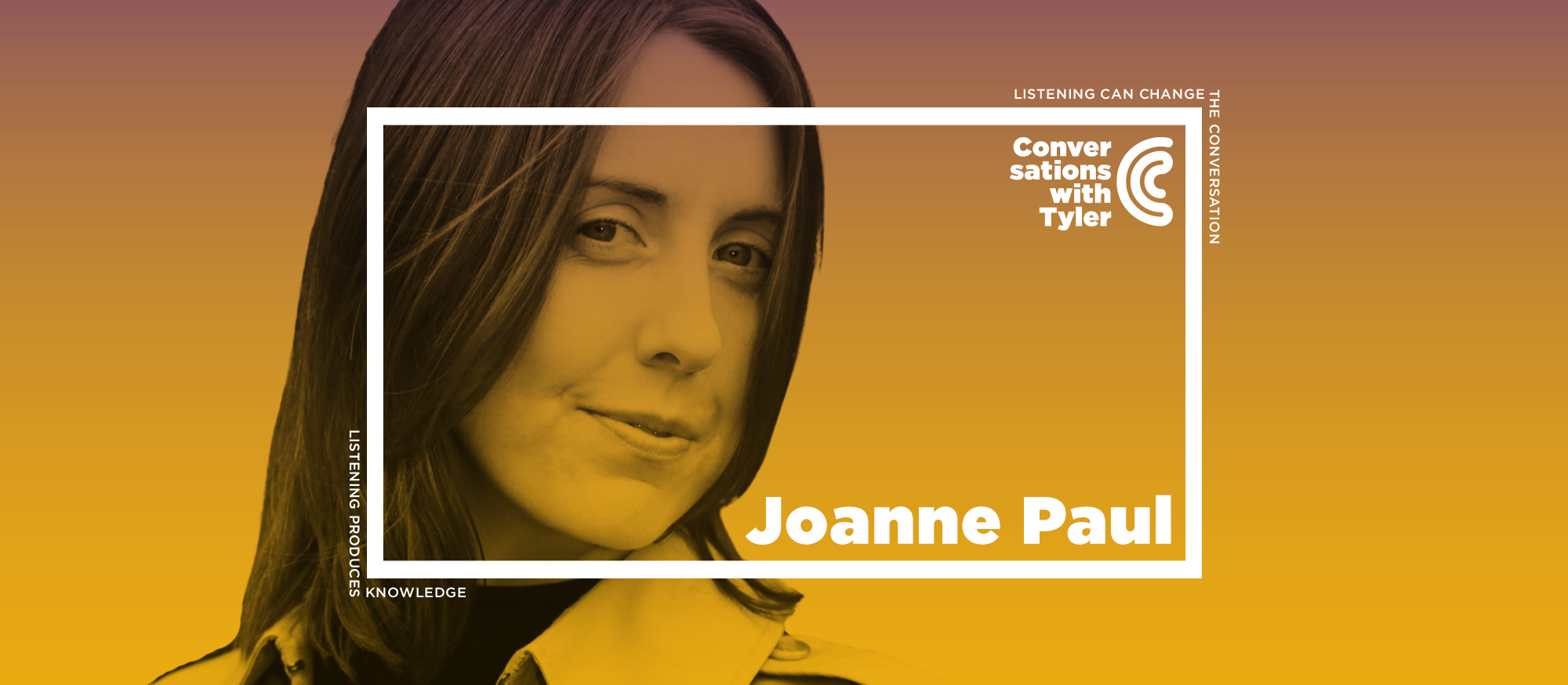



Joanne Paul is a historian at the University of Sussex, author, and a go-to Tudor expert on YouTube. She tells Tyler she’s drawn to the 16th century because it sits between the medieval and the modern, and because its paths not taken are a way of asking whether our own world had to turn out this way. Her biography Thomas More: A Life takes its subject in that spirit, refusing to reduce More to either martyr or monster.
Tyler and Joanne discuss how More influenced Erasmus, what to make of Utopia, why fear drove More’s persecution of heretics, how Holbein’s portraits of More and Cromwell differ, what movie depictions get wrong about More, how his execution was viewed at the time, how the Tudor period paved the way for Shakespeare and the scientific revolution, the surprising social mobility of the period, how the City of London governed itself and where that clashed with the Crown, Joanne’s upbringing in Canada and what drew her to English history, what she thinks sits beneath a lot of Britain’s current stagnation, the subject of her next book, and much more.
Watch the full conversation
Recorded February 19th, 2026.
TYLER COWEN: Hello, everyone, and welcome back to Conversations with Tyler. Today I’m chatting with Joanne Paul. She’s a historian, popular writer, and broadcaster, prominent on YouTube, and she’s affiliated with the University of Sussex. She’s an expert in the Renaissance and early modern periods, and I very much enjoyed her latest book called Thomas More: A Life, which is on sale now. Joanne, welcome.
JOANNE PAUL: Oh, thank you.
COWEN: I have many questions. Now, as you know, Erasmus wrote quite a bit about Thomas More, including a dedicatory letter in In Praise of Folly. If More was so dogmatic, what about him did Erasmus admire so much?
PAUL: More and Erasmus have a really interesting friendship. It doesn’t start well. Erasmus is actually very put off by Thomas More at first. They meet in 1499, actually at the same time that they meet the young Prince Henry, who would become Henry VIII. They don’t hit it off immediately, but soon after, they’re exchanging letters, and it’s clear that Erasmus has a deep admiration for Thomas More. It’s not always so clear that Thomas More feels the same about Erasmus. Actually, you can sometimes get a sense of a bit of annoyance from More about Erasmus. Erasmus is a full-time occupation as a friend; he’s a bit of work.
COWEN: What’s he annoyed about?
PAUL: He writes a lot of letters and demands a lot of letters in return. He’s a bit of a hypochondriac. He’s always chasing promotion, but then doesn’t always follow up. He’s very high maintenance, I think, is what Thomas More feels about him. They do fall out for a number of years, not to do with anything regarding religion or the Reformation, but actually to do with the fact that Thomas More becomes Lord Chancellor. That he essentially gives up his career as a scholar, his reputation as a scholar, to devote himself almost entirely to the service of Henry VIII.
No letters are exchanged, that we have anyway, between More and Erasmus for those years that he’s Lord Chancellor. It has nothing to do really with dogmatism. Both are defenders of the Catholic Church. Neither is interested in aligning with Luther, particularly. It has more to do with the choices that More makes in his public career.
COWEN: How did More influence In Praise of Folly, Erasmus’s greatest work?
PAUL: Erasmus dedicates Praise of Folly to More, as you say. He may have written some of it, parts of it, while staying at Thomas More’s home. The title itself, Praise of Folly, can actually in Latin mean praise of More. More stands in some ways as that figure of wise folly that Erasmus is trying to articulate in Praise of Folly. I think the pair too were just very interested in satire, in using satire as almost a stick to prod the prideful and powerful with, as a way of bringing them down a bit more and really trying to point out to them how silly their pride was. Both Erasmus and More liked poking fun, liked making fun of those who they considered to be stuffed up with pride.
COWEN: Do you read Thomas More’s Utopia as satire? Or Book 2, do you think he meant it? “This is the actual utopia.”
PAUL: I think Utopia is intentionally enigmatic. I think it’s a riddle. It’s a lot of different things. Certainly, satire is one of those things. He is trying to poke fun. If we take, for example, the passage about gold and precious jewels in the island of Utopia, they use gold as chamber pots. They use gold as chains to imprison their prisoners and their slaves. Those who therefore arrive on the island of Utopia covered in jewels and gems are laughed at. Gems are given to children to play with. Those who deck themselves out in all this wealth are laughing stocks. More is definitely doing something satirical with that, suggesting that in European courts, those who adorn themselves in such ways ought to be mocked.
Why do they think that this metal gives them some sort of power or authority or status above anyone else? The idea that gold chains, in particular, signify servitude, I think is something he’s specifically suggesting in the text. That those who wear, for instance, chains of office, as he does in his famous Holbein portrait, that they are in some way enslaved by their service to the king.
Satire is certainly a big part of Utopia. There are other elements of it as well, as we know. I think he’s trying to say something very pointed about the nature of the island of Utopia, as both obviously completely fantastic, unreal, impossible, while at the same time, there’s something about Utopia that I think he’s suggesting is more real than the world that he lives in. You think about his world, 16th-century Europe, you think of the world we live in today, it’s based a lot on artificial elements. Money, totally made up. Property, totally made up. Social hierarchy, totally made up.
These are falsities. There’s nothing real or true about these things. These are the things that the Utopians have rejected in favor of things that are real, that are true, that actually have value. The investment in gold, the value of gold is false, is untrue. Whereas the Utopians value things that actually matter—virtue, food, water, clothing that is useful. I think he’s trying to make a point about that difference between falsity and reality, that Utopia is in some sense more real than the real world itself.
COWEN: The high degree of surveillance in this Utopia, is that intended as a good thing or a cautionary note, or we’re supposed to be ambivalent about it?
PAUL: Utopia is really interesting because, of course, it’s the first book to use that word, utopia. It’s not necessarily the first utopia. We can point to some others, but it’s the first in that genre to use that name. We’re so used now to dystopias undermining the very concept of utopia. We live in a post-enlightenment liberal world where individual rights, individuality is so important to us that we can’t look at a utopia like More’s without seeing the darker elements of it. I don’t think most of those dark elements that we see today were intended by More. I think that there are some that we can point to. I think the Utopian’s attitude to war, their attitude to slavery, we could definitely question. In terms of surveillance and in terms of individuality, those were not things that More was that concerned with.
I think that comes out of a much more post-enlightenment and indeed post-20th century perspective that we really hone in on those. If anything, More was really troubled by the concept of individuality. He saw pride in that, the sin of pride. Utopia in many ways is about forgetting, letting go of what is private, what is ours, what can be demarcated as ours, and instead emphasizing the public and what can be shared. That’s why there is no private property in Utopia.
COWEN: Why is the story told through the third-party narration of Raphael? There’s even multiple layers of narrative between More and Raphael, right?
PAUL: Yes. Here we dig into the riddle and the enigma that is Utopia because Book 2 of Utopia, which describes the island, is, as you say, narrated by Raphael Hythloday, whose name can mean all sorts of things. It could mean peddler of nonsense. It could mean someone who’s actually pointing out nonsense and letting us know where we need to be aware of nonsense happening. That way, we take him a little bit more seriously. Raphael, of course, an archangel, so maybe we should be taking what he’s saying at face value. That’s Book 2, and that’s that long description of the island.
Then around that, there’s Book 1 and another framing at the end, which puts the book within a discussion between Raphael and the character of Thomas More. This is set up to really get us, I think, to question who the authority in the text really is. Raphael only comes to the description of Utopia because of a debate that he’s having with this character of Thomas More about whether one, as an educated, experienced person, ought to give their advice, their service to a king, to a prince.
There’s all sorts of other satires and criticisms and things that happen in that conversation. They really turn to the description of the island of Utopia as an example of a place where one could give counsel because there is no pride, because there is no greed, because there is no social hierarchy, and so on. It’s framed within this larger discussion. Thomas More comes back at the end, after the description of Utopia, to say, well, this could never, ever happen. The institutions upon which Utopia is based, I might wish, but would never expect to see in the world around me.
It really leaves the reader with a question about what they ought to be taking from Utopia. I think that’s part of why the text is still being discussed 500 years later, is because it is a puzzle. I think there are elements of it we can solve. I’ve done my best to. Really, it’s left very much to the reader to decide what the lessons of Utopia really are.
COWEN: As you point out in the book, and you’re well aware, he oversaw the persecution of heretics. He oversaw torture. He was misogynistic when he wrote about women. Was he just a bad guy? Is that the correct picture of More, or am I supposed to admire him? He took a stand on principle, and he died, but what was the principle, really? To defend Catholicism, which then was also an instrument of torture?
PAUL: As a historian, I take one of my principles as to not try to put people into a box of good or evil.
COWEN: I’m not a historian. Should I just dislike him?
PAUL: No, I think you should be interested in these contradictions. I think you should be interested in the complexity that is the human experience. I think we should ask questions about why someone who is clearly very educated, clearly very intelligent, clearly very worldly in many ways, has also these beliefs that we rightly and should condemn. With Thomas More, I think he comes to these beliefs out of a place of fear. I think that’s something that we should take note of. He was afraid of what he would consider the Lutheran heresy. He was afraid of how it would lead to the breakdown of his society, and he was convinced by those people who held that to be the case.
I think that there are important lessons in that for us today, the way that we can become convinced that a group will lead to the breakdown of our society, that fear can lead to that hatred and indeed that violence. I think that’s an important lesson. If we just reject, oh, he was bad, then I don’t think we understand the way in which someone like Thomas More can become convinced that way. In terms of his role in opposing heresy, yes, he advocated for the persecution of heretics. He thought it was right and just that they were burned at the stake. I think that at times his role in that has been overstated, and I think we just need to understand what it was in historical reality.
He imprisoned heretics. He interrogated them. We don’t know if he tortured them. That was something he was accused of at the time. He said he didn’t. I don’t know that we’ll ever find evidence either way on that. There were three cases that he oversaw as Lord Chancellor of those who were burned at the stake. I only say that because I see on social media and the like and people presenting me with the suggestion that hundreds were put to the flames by Thomas More personally. I just think we have to understand what it is that we are actually talking about.
COWEN: Have you ever been to the Frick Museum and seen the Holbein portrait of More?
PAUL: Yes.
COWEN: What makes it so compelling?
PAUL: I think it’s partly so compelling because Holbein was a friend of Thomas More’s. He knew him. He knew him intimately. He was living at Chelsea when he did that portrait. You can see the level of detail that he gives Thomas More. You can see the individual little hairs on his chin. You can see the twinkle in his eye. This is someone who knew More very, very well and respected him. I think it is useful to contrast, as the Frick does, More’s portrait by Holbein with the one he does of Cromwell, which lacks, I think, that intimacy and that connection with the man himself. There’s something pallid about his presentation of Cromwell as opposed to More.
I think the other thing that makes it so compelling is that we have not only that portrait of More by Holbein, but we have the family portrait as well. We don’t have Holbein’s original of that. We have his original sketch and then a later copy, but we are able to see More in the context of his larger family, especially the women of his family are given a very strong role in that family portrait. It’s a very unique portrait for the time. We don’t get many presentations of Tudor figures in that sort of setting.
COWEN: A Man for All Seasons. It’s a famous movie. It’s a portrait of More. What’s the main bias in that film?
PAUL: Robert Bolt in Man for All Seasons, the play, and then the film, needed a figure who would stand for certain principles that were important to Bolt and his time. They included freedom of conscience, in particular, a willingness to stand against an oppressive state. Bolt, personally, was very interested in those things. The refusal to swear to the act of succession and the act of supremacy, he found those principles in More. More himself would not have advocated for those. As I said, he’s someone who actually is very worried about this idea of individual authority and individual conscience.
That is his complaint, his criticism, his worry about Lutheranism. The More that is presented in Man for All Seasons is very detached from the historical More. We can see it in that famous line, “It’s not because I believe it, it’s because I believe it.” That’s something entirely contrary to anything More himself stood for.
COWEN: Let’s say you’re recasting that movie today. Who is it you pick to play Sir Thomas More?
PAUL: I get asked this all the time and I don’t have a good answer. I really don’t know. It’s hard to recast Paul Scofield. I don’t have an answer for that.
PAUL: I’d just go watch the film again, frankly.
COWEN: How about Benedict Cumberbatch?
PAUL: Yes, I could see him. He has been suggested before. People have suggested to me James McAvoy. I think they have played figures like More in many ways before. Sure, I’d probably watch that.
COWEN: In general, when history is portrayed in movies, what’s the biggest general bias that you feel? The people are too heroic or characters are too simple or what goes wrong?
PAUL: I think there is a temptation always to paint figures as heroes or villains, as has been done with Thomas More. He’s a hero in Man for All Seasons. He’s basically a villain in Wolf Hall. We lose some of that complexity of a contradictory, complex human individual. Of course, there’s a desire to sex things up and to make things more both sexy and violent than they necessarily were. I think this desire to smooth over complexity, again, we look at someone like Thomas More as opposed to Cromwell, it seems always the case that one has to be good and the other has to be conniving and cunning and a little bit mean.
Man for All Seasons, it’s More as the hero, Cromwell as the villain. That’s swapped in Wolf Hall. Whereas actually, they had known each other for decades before the conflicts of the 1530s. They had more in common than I think those productions show us. I think there’s more of a mix of what we would admire and what we would condemn in each of them.
COWEN: How did it matter that the Tudors were Welsh?
PAUL: Well, in a couple of different ways, it matters that the Tudors were Welsh. Partly, it’s to do with the precarity of the Tudor dynasty. They didn’t have a very strong claim to the throne, and their roots were used against them. Certainly, before he’s Henry VII, when he’s making waves in Europe and threatening invasion and stuff, Richard III calls him Henry Tydder, as, I think, a way of undermining him as a leader to whom people might flock, making fun of this very Welsh name that he has.
It’s certainly the case, and some very good work has been done on this, that they didn’t use the name Tudor in the Tudor period. That’s us doing that. That was something of which they were ashamed and didn’t make reference to. Henry was known as Henry of Richmond before he became Henry VII, and there wasn’t the sense of a Tudor dynasty, this name, until much, much, much later. That’s something we impose on them.
COWEN: As the Reformation is approaching, in England with the common people, is Catholicism declining in popularity, or it’s just the same? Is there any great outcry for getting rid of the church?
PAUL: That’s a really interesting question because you framed it as if it’s something that is popular or not popular, that’s something they can accept or reject. It’s not framed in that sense. You are a Catholic.
COWEN: They could hate the church courts or not hate the church courts, right? Even if they have no power.
PAUL: Absolutely. They did often criticize Thomas More as someone who criticized elements of the church. There were certainly heretics known as Lollards. They didn’t think of themselves as heretics, of course, but they were treated as heretics. Sorry?
COWEN: In a funny way, they’re Catholics still.
PAUL: They’re still Catholics, absolutely. Any attempt to change, reform, criticize the church is very much from within. Thomas More was a huge critic of the church, huge critic of the church, as was Erasmus, to the point where when Luther starts publishing his criticisms of the church, people think they’re actually coming from Erasmus. They think Erasmus and Luther are the same person because Erasmus had articulated such harsh criticisms of the church.
There was no question in the minds of most of these reformers that change had to happen inside the church. There was no other option than that. That’s part of what More was so concerned about in the Reformation, was this idea of a fragmenting. He was interested in the unity of the church, the community of the church. The idea that that the church might fragment was terrifying to him and indeed for many in the period. It wasn’t something that you decided to pick up or not. You were a Catholic.
COWEN: Say, when he’s executed, are people upset or they’re just like, “Whatever. Next”?
PAUL: There’s a lot of upset when Thomas More is executed, and Henry VIII knows that that’s going to be the case. They’re very aware when they’re trying to pressure Thomas More into accepting the supremacy of Henry VIII as head of the church that people are watching within England and beyond. In many ways, it’s a bit of a PR disaster that they’re not able to get him to submit. There are attempts from some, such as the Archbishop of Canterbury, Thomas Cranmer, to say, “Well, what if we just get him to agree to part of it? Then other people might get in line and people will see that and see that he’s acquiescing.”
Then the concern is that they’ll see that they’re compromising. There’s this awareness of people watching. Certainly when he’s executed, even the scheduling of that, they want to make sure it doesn’t happen on a feast marking the birth of Thomas Becket because of those parallels between Thomas More and a king named Henry and Thomas Becket and a king named Henry. They’re very conscious of the fact that it is a controversial thing to do. Most people are upset by the idea that Henry VIII, that Cromwell, that this regime would hound Thomas More to his death.
COWEN: Shakespeare obviously is coming much later in the 16th century and spanning early into the 17th. How is it that Shakespeare became so smart and insightful? What precursors are there in the era you specialize in? Do you see it coming at all?
PAUL: I’m certainly not going to say that Shakespeare was too smart to have existed.
COWEN: We know he existed.
PAUL: I’m not going to sit here and say it was the Earl of Essex or something like that, or the Earl of Oxford. It’s the Earl of Oxford, isn’t it?
COWEN: It’s still the same puzzle. Someone became that smart, right?
PAUL: Exactly. Yes. Throughout the 16th century, there’s a real growth, an explosion, really, in education, certainly in literacy at the most basic level. That’s partly coming out of, well, two movements: the humanist movement, of which Thomas More was a part, that argued for wider accessibility of education. Thomas More even advocated for the education of girls, women. But also the Reformation, which in many ways came out of that movement, arguing that people needed to be literate in order to read scripture. We see a growth in grammar schools, particularly free grammar schools.
Thomas More, when he was a child, went to the only free grammar school in London. That’s not the case decades later, there are others. Really, these schools were nominally designed to help children, largely boys, exclusively boys in the schools themselves, to learn Latin grammar. That’s why they’re grammar schools. They did so by reading Latin texts. Boys would be introduced to writers such as Cicero, Ovid, and so on, and introduced to these stories and these structures for telling stories.
They were introduced to rhetoric. We can see Shakespeare using these tools in telling his stories, in writing his soliloquies, in writing his poetry. It’s very neoclassical in what he’s doing. It’s because of this growth in education through the 16th century.
COWEN: What precursors of the scientific revolution do you see, other than education? That’s coming in the 17th century. Is there more emphasis on calculation or measurement or accounting? What are the roots in the Tudor period?
PAUL: A lot of that comes from the Renaissance, as indeed humanism does. There’s this reintroduction of a lot of classical texts, an advocacy for reading these classical texts, particularly Greek texts and learning Greek. A lot of it is coming from an engagement with Greek mathematics and science. The other thing, and this is something I really emphasize when I’m teaching the scientific revolution with my students, is that we have to remember that the scientific revolution isn’t this grand triumph of science over religion or mysticism or what have you, that these two things very much go hand in hand through the 16th and into the 17th century.
The scientific method, for instance, comes from alchemy, which we might think of as an occult science. The methodology for scientific experimentation comes out of this desire to find the philosopher’s stone. Someone like John Dee is this polymath, as well as this occultist, Francis Bacon, has his interests in these sort of mystical elements as well. The growth and interest in what we might think of as mystical texts, a lot of them having to do with Judaism, as well as these Greek texts, comes together to form, I think, something that looks like the foundations of the scientific revolution.
COWEN: There’s so many wonderful things going on, or at least starting in England at the time, but the visual arts seem quite backward. Holbein is wonderful, but he’s from the continent. Why aren’t the visual arts more advanced?
PAUL: I’m not an expert in this. There’s a fantastic book that’s just come out on Tudor art. I’d recommend people go and have a look at that. Yes, Holbein’s naturalism, realism is unmatched at the time. I think they do look to Italy, to the continents, to Germany, to the Netherlands for Renaissance art, for the developments that are happening at the time. We don’t see the same support for homegrown art in England at the time. There are artists who are trying it. I think there’s just this idea that it’s no good unless it’s from the continents.
COWEN: That book just convinced me how poorly England was doing. I did buy that book.
PAUL: There you go.
COWEN: Handcrafted items might be good, but something like painting just seems low quality, and I don’t understand why.
PAUL: I’m not sure why either. She is the expert on these things. If the book doesn’t have an answer, I’m not sure I do.
COWEN: If you accept the premise, why did antisemitism rise so much in the 16th century in England? In general, it seems that happened during the Renaissance, right? Maybe something about larger state structures, more discourse, greater need for victims, higher volatility. Do you have an intuition?
PAUL: I have some sense of this. This is not something I’ve spent much time on. I know in terms of a more European-wide trend, a lot of it has to do with the Inquisition, with the Reformation, with a desire to isolate and eliminate any heterodoxy, anything that isn’t in conformity with the Catholic Church. Especially, of course, we can look at the Iberian Peninsula and the desire to reconquer the entirety of the Iberian Peninsula for Catholicism to reject anything that looks like a questioning of the Church. It’s not something I’ve spent extensive time on.
COWEN: How much Islam is there in England then? Is it a few visitors? Is it anyone? Can you show up? Does someone whack you in the face? How does that work? The distances are not that great, right?
PAUL: Yes. I don’t think you’re going to find that many people in England at the time who are openly professing to be Muslim. Of course, there is a number of people who have Moorish ancestry, and we know that. Again, there’s been some very good work on that in recent years. There is an academic interest, again, in Hebrew, in Hebrew scholarship, as well as in Islamic texts.
We see, of course, that a lot of ancient knowledge of which they’re very interested in the period is transported, in some sense, through Islamic scholarship in the early Middle Ages. It’s not until you get into the late 16th century that you’re having, for instance, visitors from Persia or ambassadors who are going over in that sense. We’re not seeing that in the early 16th century.
COWEN: Say I’m in Morocco and I take a boat to England and I step off the boat, am I noticed? Is the treatment hostile? Does anyone care? Am I a huge novelty?
PAUL: It probably depends on who you are. Certainly, it would be something novel. It depends on who you are.
Racism in the 16th century was different to our modern scientific racism. That’s not to say that there wasn’t racism. Thomas More is often held accountable for the racist sentiments that he expresses in some of his works and letters, for instance. It functions slightly differently to our racism today. There was a sense in which one’s social status could, in some sense, transcend one’s race.
Famously in Italy, of course, there’s a duke who was Black. There were other examples in England. One of the trumpeters in Henry VII’s court was Black. That didn’t automatically mean that you were part of some sort of subclass or that you were excluded on the basis of the color of your skin, but it would have been noted and people would have considered it potentially to have expressed something about one’s character, for instance. It was associated often with a sort of moral darkness that was reflected in your skin.
COWEN: There’s a lot of upward mobility back then, isn’t there? Cranmer, Cromwell, they’re not from wealthy families. Other than being a woman, what was it that ruled you out of advancing?
PAUL: Yes, there is a lot of social mobility in the Tudor periods. That comes thanks to Henry VII, who had this strategy, essentially, of employing capable administrators, smart, smart men from lower backgrounds in these roles in government largely as a way of keeping the nobility down and also having this class of bureaucrat that was essentially disposable, that he didn’t have to worry about people getting upset if he tore them down. Of course, Henry VIII does the same thing. Very few of the people that we might mention survive very long in the Tudor courts. There are people he can lift up and eliminate as he needs.
You still needed, though, to have an education. Without that education, you couldn’t be useful in the way that More, Cromwell, Cramner were, Wolsey was. That was essential. You needed Latin, some understanding of the law. Yes, not being a woman certainly helps. Women did have positions of great power and authority, and some indeed were scholars and artists and everything else, but that was rare, the exception, rather than the rule.
Women were not considered able to reason, to have prudence, to control themselves emotionally, and were excluded from formal governance. I say formal there because it’s worth noting that what we see in the 16th century is an increasing formalization of positions. Moving from late medieval into what we can properly call early modern, we see the exclusion of women as things become more formalized, more institutionalized. They’re there more strongly, more powerfully as a presence before things become very institutionalized.
COWEN: You’ve written a lot about the monarchy, but just the City of London, how is that governed? Is it the monarch also in charge, or there’s a council, there’s a mayor? What happens there?
PAUL: That is a point of contention throughout the 16th century. The City of London has a mayor then as it does now. There’s a court aldermen.
COWEN: Not elected, right?
PAUL: Yes. Oh, that’s a good question. I think he’s elected by the council at that stage, but don’t quote me on that. I’d have to check. It is largely democratic or nominally democratic. Of course, there are all sorts of requirements in terms of who can vote. You have to be a citizen, which usually means you’re a freeman of London. You’re part of the guild system in London. That’s very important. You have to be nominated and approved of by a trading guild in London and so on. There’s all sorts of restrictions on the franchise, but it is designed to be a fairly Democratic system.
In theory, the city does govern itself within the larger realm that is England, but there are all sorts of conflicts that happen between the city and the Crown in the 16th century. Thomas More, in fact, ends up in the middle of a few of them. He’s undersheriff of London for a time, and then he becomes a representative of the Crown. In fact, even draws attention the way in which he won’t be trusted in the city anymore if he takes any sort of annuity or payment or reward from the Crown, that there is this sense of conflict between the two of them.
COWEN: Now, am I correct in thinking you’re from Western Canada?
PAUL: I’m from Ontario.
COWEN: Ontario, okay.
PAUL: I did my master’s in British Columbia.
COWEN: How do you think your Canadian background gives you a different understanding of Tudor history than most historians who tend to be British?
PAUL: I would love to think that it does. I don’t know for sure that it does. I think my religious background maybe might be interesting in that I was raised Roman Catholic, but now profess to be an Anglican. On the question of Thomas More, I have some awareness of both sides of the Reformation. I think Canada has a deep appreciation of the monarchy from afar. I don’t know if this is something you want to talk about, but today is a very interesting day for the British monarchy as just a few hours ago, Andrew Mountbatten-Windsor was arrested.
I think being in England as opposed to being in Canada, you’re aware of the darker side of monarchy in a way that we just see the flash and the ornamentation of it all. It’s such a joy and a real privilege to be able to walk into an archive here in the UK and just be handed boxes and boxes of material related to the period that I study that we just don’t have access to in Canada. Hopefully, I’d like to think that my appreciation for the gift that is that history means that maybe I’m a bit more passionate or dedicated to those archives than I might otherwise be.
COWEN: What is it about Canadian history that interests you most, even if you don’t work on it or write on it?
PAUL: Part of me would like to. I loved Canadian history when I was doing it at high school and then at university and even a little bit during my master’s. I’m, by training, an intellectual historian, so I’m interested in the history of ideas.
I’m interested in the way in which Canada has produced a really interesting intellectual history, one that really draws, I think, on republican thought, obviously on federal thought, on the idea of creating a federation, but one that has also really contributed to discourses around multiculturalism. Some of the leading theorists on multiculturalism have come from Canada. I’m interested in that story of what really makes Canadian political thought and the way that that has impacted other schools of thought around the world.
COWEN: What, for you, is the biggest puzzle in Canadian intellectual history, the thing you’d like to understand but you don’t and it gnaws at you and people argue about it?
PAUL: That’s a great question. I really do want to go back at some point. I don’t know if I’ll ever have the opportunity to do this and look at some of the earliest expressions, written expressions, of Canadian political thought. We’re going back to confederation and a little bit before and understand the different influences on that and what they were trying to do with that.
I’d really like to think a bit, too, about how they’re influenced and they are influenced by Native confederations and Native thoughts and how that flows into what is Canadian political thought. In recent decades, that’s been even more apparent. My MA supervisor was James Tully, who really draws on a lot of those strains of thought in constructing his political theory. Those are things that I’m interested in. I really appreciate the question because I’ve not gotten to think about these things in recent years. I’d love to come back to them one day.
COWEN: Biographically, what is it that led you to English history? It does mean you’re going to have to move to England to actually do it? You did move to England.
PAUL: I did. Partly it’s because I don’t have very many other languages.
COWEN: That will work in Canada, too.
PAUL: That’s part of it. I think I was interested in the time period, specifically. I had the benefit of an education at a Canadian university, which differs slightly from a university in the UK in that you have a broader range of courses that you can take. You can really just take surveys and figure out what really appeals to you. As I went through my degree, which is a four-year degree, I realized, essentially, that everything I was picking was vaguely 16th century, whether it was in history or in politics. It took reflection to work out why.
I think a large part of that is to do with the way that the 16th century sits in this liminal and very transitional space between what we can recognize as medieval, and therefore, in some senses, is foreign and almost fantastical, and those things that we can identify as very modern and that we do indeed recognize that are familiar to us. Over the course of the 16th century, you see both. You see a movement from one to the other.
Also, you see things, and this really intrigues me, you see things that could have been. You see not the path that we took necessarily, but the paths that we could have. I find that as something that really appeals to me to think about, not only as a counterfactual history, but indeed, often those contain lessons for us.
Paths not taken are options we might have now or ways that we can sit at a distance and think about the world that we did create and question that, and maybe even start to dismantle it a bit. My PhD supervisor, Quentin Skinner, often talks about history and the contingency in history as providing a sense of agency. We are not necessarily bound by the world as we find it. History inspires us to question it, to think about rebuilding it. That’s something that I find in the 16th century.
COWEN: What was it like working with Quentin Skinner? I love his books.
PAUL: Brilliant. He is the most supportive mentor, the most brilliant man, of course. One of the best things about working with him is the space that he gives to you. I was a very young scholar. I had barely stepped foot in an English archive before. I really didn’t know what I was about. I’d only studied in Canada.
I’d never been to Cambridge or Oxford or anything else. Yet, he really empowered me to have the space to try things out, to say things, to question things. That, as a young scholar, as a woman in a male-dominated field as well, makes all the difference in the world. He’s really committed himself for the last several decades, too, ensuring that he’s empowering those voices and giving space to them. He’s brilliant.
COWEN: Not counting London, Cambridge, or Oxford, but where is your favorite place in England?
PAUL: My favorite place in England. I adore Warwick. I’ve spent a lot of time in Warwick. There’s Warwick Castle, nearby is Kenilworth, Lord Leycester Hospital. There’s a lot of fantastic history in Warwick. The minute we sign off, I’m going to think, “Oh, I should have said that place.”
COWEN: There’s so much choice, right?
PAUL: Yes, there’s so, so much choice. I love Edinburgh. You said the UK, didn’t you? Not just England.
COWEN: You can pick it. I love Liverpool, actually.
PAUL: Oh, is it? I haven’t been to Liverpool in, oh, I’m going to date myself, probably about 20 years. I think I need to revisit it. I love Manchester, Bristol, beautiful. I could go on forever, but I’ll say Warwick and surrounds for the moment.
COWEN: What’s the hardest thing about living there for you? You’re still Canadian in a bunch of ways. Is it the hot and cold water from the separate faucets or something more fundamental than that?
PAUL: Yes. When we had our bathroom redone, we made sure that that was not the case. I can’t stand that. The hardest thing, it took a while for me to learn how to drive here, if I’m being honest. It’s not just the roundabouts and the other side of the road. That’s not that hard. It’s just a different style of driving.
The roads are so narrow that you always feel like you’re in someone’s way. I miss the space, the openness of Canada. Everything here does feel a bit confined and constrained. I have to say, despite the fact that it doesn’t get as cold as in Canada, for several months of the year, I feel I’m just always cold because the houses just aren’t as insulated as we manage in Canada.
COWEN: How is the Anglican Church doing these days? You mentioned you’re an Anglican. Do you despair? Do you think it’s fine?
PAUL: I am encouraged by the appointment of the latest Archbishop of Canterbury. I’m hoping that’s a very positive appointment. I’m hoping that it can pull itself out of the controversy and the difficulties and, in some ways, the tragedies of previous decades, and can think about moving forward in a positive way. Several members of my husband’s family are members of the clergy in the Church of England, and so I’m very aware of the challenges that it’s faced, but I’m hopeful.
I’m certainly someone who thinks that part of the answer needs to be fully embracing women in the clergy. That churches are closing down who won’t even consider a female vicar. They’re closing down because they’re not finding clergy to look after them. They’re not allowing for not even 50 percent, probably more than that, of who’s coming in to the clergy right now to come in and look after their parish. I think that has to be part of the answer.
COWEN: What percent of the English population do you think believes, say, in the Trinity and the resurrection?
PAUL: That’s a great question. I don’t know.
COWEN: Is it 5 percent or 1 percent, 30 percent?
PAUL: I have no idea.
COWEN: I guess 5 percent, but I don’t live there.
PAUL: I don’t know. I’m sure there’s surveys on this. I have no idea. I think, too, it would be interesting to frame that question precisely because I think that there are a lot of people in England and probably elsewhere as well who participate in Anglican communion, who go to church from time to time and certainly at Christmas and Easter and celebrate Christian-widely holidays but wouldn’t necessarily believe in that sense or might even say that they believe but haven’t interrogated that belief in a very long time, for instance. I don’t know. I’d be very interested in the numbers.
COWEN: If you don’t know, that suggests it’s quite low. I’m in the US—
PAUL: I think probably.
COWEN: —in Virginia. People will talk about devils and hell and angels. You hear the chatter all the time. You could question how much they believe or how far, but those are common topics.
PAUL: The Anglican Church and the English in general are quite a bit more restrained about talking about those sorts of things. Yes, I agree. I think the fact that it doesn’t come up much. The other thing to say is that I’m an academic and it became very unfashionable many years ago for academics to be religious in any way. I’ve been in situations in academic contexts where I’ve been mocked for believing in the flying spaghetti monster, as some will put it. It’s not something that I encounter that much and not something that I talk about that much because there is still such a criticism of those who have a faith beyond reason.
COWEN: Why do you think the UK seems so stuck now, both politically and economically? There’s a lot of talent in the country, right? An incredible history, great location, English language, world’s best time zone.
PAUL: I think there’s a lot of things that have gone on in the UK in recent years that have led to a sense of stagnation, a sense of frustration, certainly a huge economic downturn. I’ll say explicitly that I think that Brexit posed a huge problem for the UK, both in terms of its identity and its economic position in the globe. We saw a huge standard-of-living crisis following Brexit, which we’re still not fully recovered from.
I think there’s a lot of very short-termist thinking when it comes to investments. I’ll take the example of higher education. Of course, that’s an example which I find myself in. It’s one of the UK’s greatest commodities and products, is its education. When you think of great universities of the world, of course, Oxbridge comes up, Oxford and Cambridge, as well as you can think about the LSE, Imperial, so on and so forth.
Yet, there has been a real disinclination to invest in higher education. There’s been real significant cuts to funding. There’s been attacks on the concept of expertise. There’s been particular attacks on the humanities, on history, indeed on languages. There’s a sense in which they’re shooting themselves in the foot when it comes to one of the UK’s great commodities and one of the things that upholds its reputation around the world.
Unfortunately, there’s also been a lot of racism and xenophobia in this country, which of course sits beneath Brexit as well and has continued to pass that point, which has, I think, held us back from bigger conversations. We’ve gotten stuck on these topics, which are designed to divide and therefore, conquer.
COWEN: Very last question. Your last book, Thomas More: A Life, was what led to this podcast. Please tell us if you can, what will you do next? What do you want to do next?
PAUL: I’ve got two more books under contract. I think I’m allowed to talk about one of them. In fact, it hasn’t been announced yet. I think there’s a press release forthcoming. I checked with my editor today and I am allowed to talk about it. It will be called Tyrant, and it will be a portrait of tyranny in the reign of Henry VIII.
Not only an understanding, a greater understanding of his tyranny, of the character, the personality of a tyrant through Henry VIII, but I’m also very interested in the responses to tyranny, the work done by those who seek to prevent, to mitigate, to oppose tyranny, what their strategies were, successes, the failures, and really just to think about the concept, the nature, the expression of tyranny in the 16th century.
COWEN: Joanne Paul, thank you very much.
PAUL: Thank you.
This episode was made possible through the support of the John Templeton Foundation.