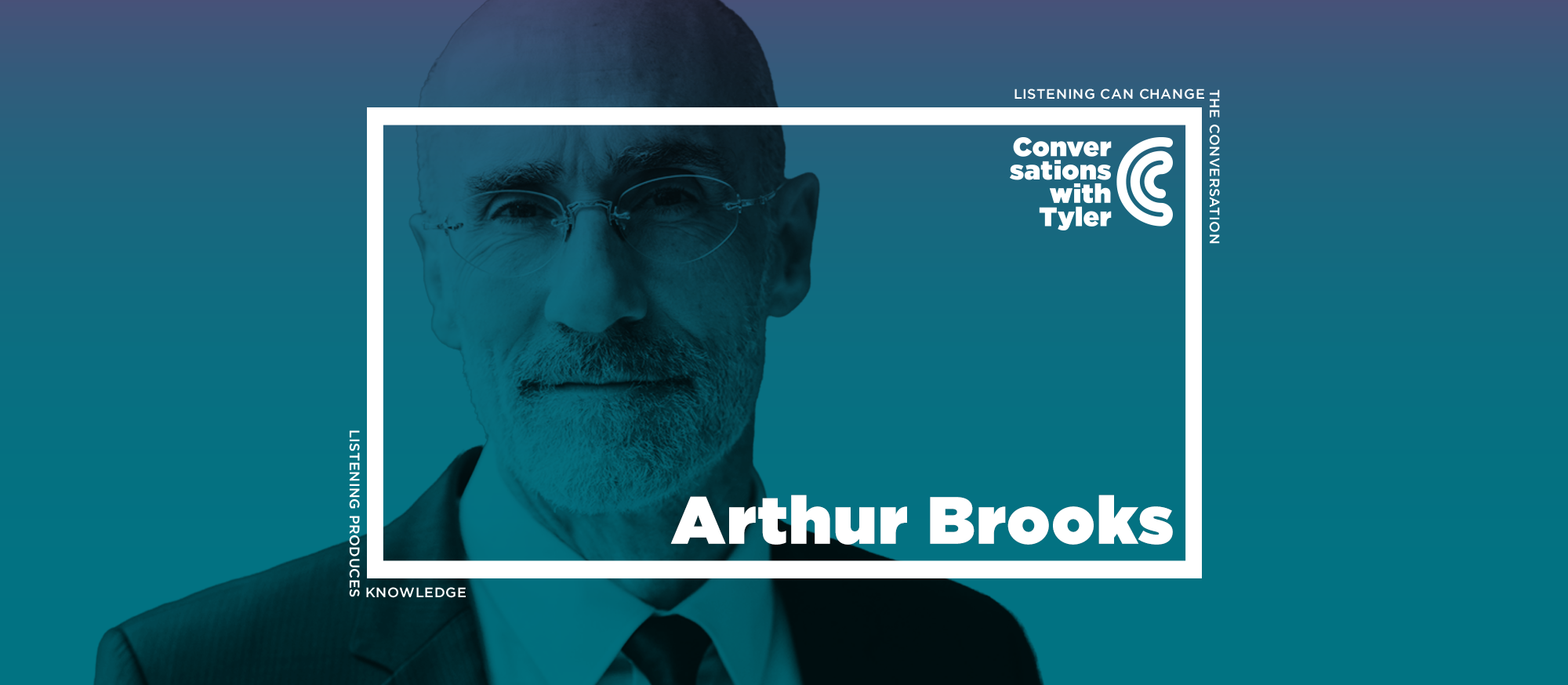



Arthur Brooks reckons he’s on the fourth leg of a spiral-shaped career: French horn player, economist, president of the American Enterprise Institute, and now Harvard professor and evangelist for the science of happiness. His new book, The Meaning of Your Life: Finding Purpose in an Age of Emptiness, argues that happiness isn’t a feeling but a combination of enjoyment, satisfaction, and meaning — the macronutrients of happiness, he calls them — and that most of us are gorging on the wrong ones. Tyler, naturally, wants to know: what’s the marginal value of a book on happiness, and what does spiral number five look like?
Along the way, Tyler and Arthur cover how scarcity makes savoring possible and why knowing you’ll die young sharpens the mind, what twin studies tell us about the genetics of well-being and why that’s not actually depressing, the four habits of the genuinely happy, the placebo theory of happiness books, curiosity as an evolved positive emotion, the optimal degree of self-deception, why Arthur chose Catholicism rather than Orthodoxy, what the research says about accepting death, how he became an economist via correspondence school, AI’s effect on think tanks, the future of classical music, whether Trumpism or Reaganism is the equilibrium state of American conservatism, whether his views on immigration have changed, what he and Oprah actually agree on, which president from his lifetime he most admires, Barcelona versus Madrid, what 60-year-olds are especially good at, why he’s reading Josef Pieper, how he’ll face death, and much more.
Watch the full conversation
Recorded March 19th, 2026.
Thank you to listener Timothy Kubarych, writer of financial and economic poetry, for sponsoring this transcript.
TYLER COWEN: Hello, everyone, and welcome back to Conversations with Tyler. Today I’m delighted to be chatting with Arthur C. Brooks. I’ve known him for a long time. Arthur’s life trajectory is a little difficult to describe. He recently said to me he changes careers every 10 years. He was a professional French horn player in the world of classical music, a well-cited economist, often in the area of cultural economics.
He has been president of the American Enterprise Institute, has done things with Oprah, has done yet more, now is a professor at Harvard’s Kennedy School of Government. He has a recent track on the notions of happiness and the meaning of life. He has an important new book out called The Meaning of Your Life: Finding Purpose in an Age of Emptiness. Arthur, welcome.
ARTHUR BROOKS: Thank you. It’s nice to talk to you on your show.
COWEN: Now, you’ve mentioned in one of your books, and I quote, “We Brookses die fairly young.” How does that influence your quest for happiness?
BROOKS: One of the biggest mistakes that I think that we make in the new science of longevity is the notion that if we could actually take the death date out of our lives, that we would live happier, better lives. I think that’s wrong because you and I as economists understand the importance of scarcity. How scarcity actually gives you the ability to savor things. Scarcity is actually central to savoring, as a matter of fact. One of the things that’s pretty interesting in the literature that I’ve seen—as a behavioral economist, I read mostly psychology, of course—is that you tend to look at the lifespan of the same gender parent and then make discounting decisions in your own life on the basis of that.
My dad, as an academic, just like me, he retired at 62, got sick pretty quickly after that, stopped working because he couldn’t, and then died at 66. I feel like the clock is ticking. The result is that my work, I’m savoring it in a different way. I’m making sure that I’m doing things. I’m answering questions that I think are important. The result is I like it better now than I ever did.
COWEN: Maybe it’s better when savoring isn’t an illusion, that you’re actually going to live to 94 and not die when your Dad did. Is there something to the notion that the real meaning of life is to have a fairly mentally thin existence, not too much introspection, a la Marc Andreessen? People who have high meanings of life, they’re facing death, or they’re in Ukraine, they’re confronting the Russian monster, and so on. Isn’t meaning for life, in a way, quite overrated?
BROOKS: It’s possibly the case, but it really depends on why we would think it’s overrated in the first place. Most of the reason that people would object to a deeply philosophical life is because that requires a lot of suffering. That kind of introspection actually leads to plenty of pain, but therein lies the contradiction of happiness itself. Happiness requires a lot of unhappiness. Now, the definition of happiness is really the right place to start. Happiness isn’t a feeling at all.
Happiness has feelings associated with it, like the smell of the turkey is associated with your Thanksgiving dinner. The smell of the turkey isn’t the same thing as the turkey dinner. The turkey dinner is protein, carbohydrates, and fat, which are the macronutrients. Similarly, I think the most compelling definition of happiness is the combination of enjoyment, satisfaction, and meaning.
Meaning that we’re talking about here is just one macronutrient. The thing that a lot of people like to focus on when meaning becomes painful is enjoyment. I get that. They feel like they’re a lot happier under the circumstances, but that’s an evanescent macronutrient. The one that’s longest term actually requires that we live fully alive. That means that we let suffering find us.
COWEN: If happiness is not so special, and if the meaning of life is not so special, what is the value you use, a la Sidgwick, to trade off these other values against each other? What’s your unit of account, so to speak?
BROOKS: Yes, I know. That’s a real problem because it turns out that you have a unit of account between protein, carbohydrates, and fat. Per gram, they’re five, five, and nine calories respectively. There is a way that we can baseline against them. The trouble is that there’s been no really good way except self-evaluation of well-being to understand how enjoyment, satisfaction, and meaning, how they actually compare with one another. They’re highly complex ideas. They’re not complicated ideas. They’re not accounting ideas. The result of it is that there’s a lot that you have to go on with respect to intuition and your own experience.
COWEN: What do you think of the pretty common view, it often comes from twin studies, that well over 50 percent of happiness is simply genetic? Assuming you’re not living in a war zone or dying of terminal cancer. You grow up a certain way, you were born a certain way, and there you go, you play your cards.
BROOKS: Yes. I think that those studies are very robust. Lykken and Tellegen in the Minnesota identical twins surveys have shown pretty well, based on personality research, when identical twins were raised in separate homes—which is about as good a structure as about as close to a randomized treatment control experiment that you can get to without a diabolical Harvard experiment to separate babies from their parents—what they find is that between 40 percent and 80 percent of all personality characteristics are genetic, which is to say, Tyler, that your mother really did make you unhappy, I suppose.
That might seem like it obviates or vitiates this whole idea that happiness is something worth pursuing. Actually, it doesn’t because the same studies show that about 50 percent of your tendency toward alcohol abuse is also genetic. Tyler, if you said, “Hey, Arthur, I got a big problem. Both my parents were drunks, and all four of my grandparents were bootleggers, and I guess I’m doomed to alcoholism,” I’d say, “Tyler, I have a new whiz-bang technology for turning the genetic proclivity from 50 percent to 0 percent. It’s called not drinking.” In other words, when you understand your genetic tendency, you can tailor your habits. That’s a beautiful thing. Now, one side note, 50 percent, approximately, between 42 percent or 58 percent, depending on the studies that you’re looking at, is genetic.
Another 25 percent is circumstantial, which is the war zone effect, et cetera, or falling in love, whatever it happens to be. That’s evanescent as well. That’s temporary because our moods and our circumstances, they necessarily change. The last 25 percent are habits, which allow us to tailor our circumstances, in other words, to get better luck and to manage our genetics. That’s why habits, even though they’re only 25 percent directly, more or less, that’s why they matter the most.
COWEN: Not drinking seems much easier to engineer than being happy. You can just become a Mormon, and you’ll have a lot of peers who don’t drink. I don’t see many people who become much happier past a certain age.
COWEN: What’s the marginal value of books on happiness? Is it measured by the price?
BROOKS: Well, it depends on who wrote the books, Tyler.
COWEN: Say your books. What does your new book sell for, on the meaning of life?
BROOKS: It’s a good question. Who knows? That’s actually a good question. Somewhere between $16 and $30, depending on where you’re buying it, I suppose. The real question, and this is something I’m really interested in, is the extent to which habits can actually change your well-being. There’s a reason, by the way. There have been a million books on happiness, and happiness still tends to be elusive. I take your point. It’s very well taken, and I try to approach it without a lot of hubris.
Here’s the problem as I’ve seen it. You and I, we’re not just economists. What we really are—we try to be experts in how to learn stuff. That’s one of the great things about your work. You’re interested, and you’re curious, and you’re interested in how people are interested, in point of fact. Here’s actually how you learn something and make it permanently part of your repertoire. Number one, you understand it. Number two, you practice it. Then number three, you share it. It’s an interesting thing. My father used to say this.
My father was a PhD biostatistician, a lifelong mathematics and statistics professor. One time I saw him giving a graduate seminar in advanced calculus, a 90-minute lecture with no notes. It was like watching Jascha Heifetz playing the violin. It was like a virtuoso performance. I was of the age. I was already in my 20s. I admired my dad by that point. I said afterward, I said, “Dad, how did you do it? How do you know that so well? How is that part of your very being?” He was joyful while he was doing it, too, by the way, because he was in a state of flow.
He said, “Simple. I learned it. I’ve taught it 100 times. In other words, I’m practicing it in my research, and I’m sharing it constantly because I’m a teacher.” That’s the same way to be a great golfer. That’s the same way, actually, if you want happiness to not be an impermanent well-being woo-woo internet phenomenon. You need to understand, actually, what’s going on, that the psychology is biology. You need to change certain ways that you live, and then you need to share it with other people. I’ve found that that’s what actually makes the idea sticky.
COWEN: What do you think of the view that books on happiness or the meaning of life, they’re a kind of placebo? They don’t help directly, but you feel you’ve done something to become happier, and the placebo is somewhat effective.
BROOKS: I think that there’s probably something to that, although there’s some pretty interesting new research that shows that the placebo effect is actually not real. Have you seen some of that new research?
COWEN: Yes, but I don’t believe it. Nocebos also seem to work in many situations.
BROOKS: I know. I take your broader point. I take your broader point. I think that the reason for that is that when people read most of the self-improvement literature, not just happiness literature, what happens is that they get a flush of epiphany, a new way of thinking. That feels really good. That feels really inspirational. The problem is it doesn’t take root.
It’s like the seeds that are thrown on a path in the biblical parable. They don’t go through the algorithm that I just talked about, and so not all of these things can be compared. I would not have gotten into this line of research and this line of teaching if I thought that it was just going to add another book to a long line of self-improvement books that make people feel good but don’t ultimately change their lives.
COWEN: Say a person reads a new and different book on happiness once a year at the beginning of the year. Now, under the placebo view, that’s a fine thing to do. It’ll get you a bit happier each year. Under your view, it seems there’s something wrong. Isn’t the placebo view doing a bit better there? You should read a book on happiness every year, a different one. It’ll revitalize you a bit. Whether or not it’s new only matters a little.
BROOKS: Yes. It might remind you of some things that you knew to be the truth that you had fallen away from. One of the things that I like to do is I like to read a good book by one of the church fathers, for example. They’re more or less saying the same thing. It reminds me of something that I learned as a boy and that I’ve forgotten as an adult. It might actually remind me to come back to many of these practices and many of these views.
I think that there are real insights. There’s real value that can come from science-based knowledge about how to live a better life. I think that you and I are both dedicated to science in the public interest and also science in the private interest as well. I think there is some good to be gotten through many of these ideas. Not all. Once again, not all happiness literature is created equal.
COWEN: What’s the best observational predictor of which people give the best happiness advice, or meaning of life advice, for that matter?
BROOKS: Give me an example so I understand your question.
COWEN: Someone might say if someone’s a rabbi, they’ll give you very good happiness advice. It may or may not be true, but it’s a claim you could then pursue—if someone is old, if someone has a PhD, and so on. Who gives the best happiness advice in general?
BROOKS: Oh, yes. I understand what you’re saying. You pretty much hit it on the head. The habits of the happiest people—I teach at a business school. One of the things we like to do with case studies is end the case study by saying, “What do the most successful CEOs do every day? What do the most failing CEOs fail to do every day? What are the bad practices that they have?” What are the happiest people, which is to say the people who are most abundant in their self-evaluation or a third-person evaluation of enjoyment, satisfaction, and meaning, what do they do every day?
The answer is they pay attention fundamentally to four big things. Their faith or life philosophy. They think deeply about the why questions. Also, they stand in awe of something bigger than themselves, so they’re not stuck looking in the mirror. They have strong family relationships. They have close friendships. They have real friends, not just deal friends. They’re certainly not isolated and lonely and spending all day on the internet. Last but not least, they’re doing something productive where they feel like they’re earning their success through their merit and hard work, and they’re serving other people. That’s what it comes down to.
COWEN: Only the fourth of those applies to Elon Musk, and he’s our most successful CEO ever?
BROOKS: Yes. I think that you’re doing something where you’re serving others and earning your success every day, Tyler, and I believe I am as well. I believe that my postman is, and I believe that my plumber is. That’s really important. By the way, this is one of the reasons I’m such an enthusiast for the free enterprise system, because it allows us to find the places where our skills and our talents can actually find each other. It’s the ultimate ikigai way of organizing an economy.
COWEN: What’s the deepest theory you have as to why younger people so often reject happiness advice, even when it comes from happy people?
BROOKS: Yes. One of the reasons is because it’s inconvenient. It’s one of the same reasons that people will not take all kinds of good advice. It’s funny. Alcoholics, they’re the only group of people where you can say, “Hey, there’s door number one and door number two. Behind door number one, there’s prison, there’s death, there is institutionalization. Door number two is freedom and happiness and good relationships.”
An alcoholic will say, “I got to get back to you on that.” The reason is because they’re living in a particular way, and they’re path dependent, and they might be addicted, and they don’t have very much experience. It’s not just young people. It’s all kinds of people who they reject what is manifestly good advice all the time because good advice is often incredibly inconvenient.
COWEN: It’s a discount rate issue?
BROOKS: Could be a discount rate issue. It could be a rationality issue. It could be an addiction issue, which might be rational, it might not, depending on your views on Gary Becker, et cetera. The truth of the matter is there’s all kinds of friction in the model that we have in the way that we take or don’t take advice.
COWEN: There’s plenty of young people who are not addicts in major ways, and it seems they still don’t listen very carefully. They would just be happier. I don’t think it takes four years of sacrifice to be happier, given some of the other things you say, and they still don’t do it. What’s your deepest account of why they don’t do it?
BROOKS: Yes. Part of it is that I think that people are quite resistant to take advice from the people who are most likely to give it to them. That’s the credibility of the source and the relationship to the source. People ask me all the time, Tyler, “How do I get my teenage kids to take your advice on device use?” Which is classically one of the best ways that you can help teenagers to live happier, better lives, to be less lonely, to be less depressed, to be less anxious.
They’re not going to throw their phones into the ocean, but at least to have serious protocols around their device use where they have more time in person and outside, and all the stuff that Jon Haidt talks about, but we’ve all talked about where the data, I think, are manifestly clear. They say they’re not going to listen to me on this. This is one of the ways that I recommend to parents that they have to do two things so that teenagers are more likely to take their advice.
Number one is you got to model the behavior, not talk about it. You and I are both dads. You and I have both raised kids. What do you do? What should you tell them? The answer is it doesn’t matter. What matters is what they see you doing. The number one predictor of your kids using their phones around the dinner table is you using your phone around the dinner table. The second is that appealing to an outside authority is sometimes really useful.
One of the reasons I write my books is because I want people to recommend them to people that they love and to say, “I just read this book by some nerd at Harvard named Arthur. What a nerdy name. I thought it was maybe interesting, but I’m not sure. Would you read it and tell me what you think?” and have it become a matter of family discussion. That becomes a better way to do it as well, as opposed to wagging your finger at your kid and saying, “Do this thing.” I think that’s generally pretty ineffective.
COWEN: Where does curiosity fit into your framework? Say it’s late at night, a basketball game just finished, and I decide to go to ESPN to check the score. I’m pretty sure it doesn’t make me happier. There’s even something zero-sum about it. Your team might lose. It’s unlikely it adds to the meaning of my life, but I can say I just want to know. Is that something you should want to talk me out of?
BROOKS: No, no.
COWEN: Is just wanting to do things a sufficient reason to turn away from these goals of happiness and meaning of life? If it is, can’t we multiply that example many times and get people pretty far away from happiness and meaning of life? Maybe that’s why the young people don’t listen so much.
BROOKS: I think that the reason that curiosity is important, because curiosity is ultimately a basic—I should say interest is a basic positive emotion that leads to happiness. It also leads to longer, better lives. There’s two streams of research that support this. The first is the work on the science of emotion, including the neuroscience of emotion. Now, this is not the area that I was trained in. I was trained as a traditional behavioral economist, social scientist.
When I came back to academia seven years ago, I really substantially had to retrain in neuroscience because this is the direction that the fields are going. The interesting work on curiosity and interest is it’s one of the seven basic emotions, and it’s a positive emotion at that. Human beings in the late Pleistocene, 250,000 years ago, when the modern brain was more or less what it is today, the members of the species Homo sapiens living in bands of 30 to 50 kin-based hierarchical individuals, the ones that had the most kids were the ones who learned the most.
The result of it is that there was a lot of positivity, there was a lot of cognitive and emotional reward that came from learning new things. How does that reach us today? You want to know the score. You want to learn a new thing. You want to learn a new skill. You love that. That’s part of an important life. Now, the second part of the research that reinforces this is the research from the Harvard Study of Adult Development that my colleagues have been conducting for 85 years up at Harvard that has been following the same cohort of people since the late 1930s.
The original cohort had JFK in it and Ben Bradlee, and the Boston Strangler, and a bunch of people that didn’t make it through to the end of the study. The people who are still alive, one of the things that they all have in common is that they’re lifelong learners and they love to learn. This is a strategy. Curiosity is not an idle thing. It might kill the cat under the wrong circumstances. We even in the Catholic faith, we have a word for idle curiosity or for the curiosity that hurts your soul, it’s called concupiscence. Have you ever heard that word, Tyler?
COWEN: Sure.
BROOKS: Concupiscence is not what I’m talking about, but the desire to learn something. That’s a natural human thing. That’s an evolved thing and it’s a good thing too.
COWEN: What’s the optimal degree of self-deception?
BROOKS: That’s a good question. How much should you actually be honest with yourself? Of course, there’s the Kantian view where Immanuel Kant said 0 percent self-deception is the right amount. That’s almost certainly wrong. One of the things that I’m really interested in is this new field of applied philosophy. Have you heard about this, where you study a philosopher, and you try to live according to their precepts strictly for one or two or three weeks at a time?
COWEN: It’s not possible, usually.
BROOKS: It’s pretty hard. I tried to live like a Kantian and tell exactly zero lies, and it’s a miracle that my marriage survived. That’s all I can say. I’m not a Kantian, it turns out. The truth is that the ultimate Kantian idea of pure honesty is to not lie to yourself. The truth is that there’s a lot of self-protection that goes into it. Of course, a little of that can go a long way. The whole idea of convincing yourself of something that’s fundamentally untrue is harmful.
The best way to live, I think, to find the right balance of this came about from the teachings of William James, who really is the first social psychologist, the father of modern psychology. He wrote The Principles of Psychology, and he separated the psyche into the I-self and to the me-self. The me-self looks in the mirror, the I-self looks outward, and we have to do both. The essence of consciousness is this ability to be two people and know that we are two people.
This is why Homo sapiens, with their abundant prefrontal cortex—30 percent of your brain by weight—are so dominant as a species is that we can be two people in this particular way. He says you have to get the balance right if you want to live a good life. Most of that is not even bothering to deceive yourself because you spend more time looking outward and understanding the world as opposed to thinking about yourself in the first place.
COWEN: In the Soviet Union, it was sometimes the case if people had terminal diseases, they wouldn’t tell them until they had to. What do you think of that?
BROOKS: I don’t think much of that as a matter of fact. Part of the reason for that is that the question is not whether or not you’re going to be in the optimal state of positive affect. The reason for that is because a life well lived truly of meaning is one that actually faces one of the most meaningful aspects of life itself. It’s a difficult thing to talk and write about, as a matter of fact, which is suffering.
Now, you know the work of Richard Davidson at UW-Madison. He does work on where happiness and unhappiness are processed in the brain. What he’s found is that unhappiness is largely a right-hemispheric phenomenon. He does this by looking at the musculature of the face when people are having happy and sad emotions. This is not a coincidence because the work of the Iain McGilchrist, whose work I know you know really well on hemispheric lateralization, says that meaning is a right hemispheric experience as well.
It’s no coincidence, therefore, that suffering in life leads to an understanding of life’s meaning and that deepens life’s sense of richness. Now, a little suffering can go a long way, but that’s one of the reasons that when you work with the Tibetan Buddhists—which is a big area of my work over the past 12 years, has been with the Dalai Lama’s community among the Tibetan Buddhists in Dharamsala—they talk about this idea that suffering is an important part of life, and that the key to understanding suffering is by understanding the formula that it equals pain multiplied by the resistance to the pain. The result is that lying to yourself to lower the pain is usually not the optimal approach to the best life, but rather understanding how nonresistance to the pain can lead to plenty high pain, but suffering that’s manageable.
COWEN: Why not cram all that contemplation of death into your last three months rather than your last 18 months? Do intertemporal substitution, right? Accelerate it. Ben Sasse probably is facing a pretty short timeline, but he’s done a remarkable job, even publicly, of coming to terms with what’s happening. Isn’t that better than two years of the same?
BROOKS: That’s an empirical question, actually, at the end of the day. That’s the kind of thing that you and I could gather data on, and some people, in point of fact, have. We all remember Elisabeth Kübler-Ross’s stages of death and dying, the stages of grief. She had a comprehensive study in the 1960s and 1970s and wrote a fabulously bestselling book that has not stood up extremely well to the subsequent research, but it’s a great book nonetheless and is worth reading.
She was a Swiss physician, psychiatrist. She talked about the stages of grief that people go through. There’s a lot of misery that when people find out they’re going to die. They’re bargaining and they’re angry and they’re in denial. Then they get to the last stage, which is acceptance. Now, a lot of research since then has said, okay, how long is each stage and what do people actually experience in each stage? To cut to the chase, here’s what the research basically says. People get to acceptance pretty fast, and they’re happier during the acceptance phase than they were before they were told they were going to die.
Now, this is important, right? This is an important thing because what that says is—if you’re taking it at its face, and again, the research is the research, and it could be updated, and everything’s contested—what this suggests is that if you’re doing it right, the more time you have, the more meaningful your life is going to be, and the more you’ll actually savor it. The truth is, Tyler, I would prefer to have 18 months of advance notice as opposed to three, and here’s what I really want, somewhere between five and 20 years, which is what I actually have.
COWEN: Speaking of Buddhism, why is the footprint of Buddhism shrinking around the world? There’s fewer Buddhists every year.
BROOKS: It’s a good question, except that there’s fewer of most serious practitioners of almost every substantial faith.
COWEN: It’s quite a sharp decline, right? Especially Korea, Japan, China.
BROOKS: Yes. No. I think that probably we Catholics are giving the Buddhists a run for their money. According to Pew this year, for every 100 people who enter the Catholic Church, 840 left. That’s a pretty sharp decline. I think this has a lot to do with the general urbanization, technologization, and the secularization of especially younger cohorts today. If I were a Buddhist leader, if I were a religious leader, as opposed to just a religious person, I’d be thinking about the opportunity for religious revival, and I think, quite frankly, we’re due for one.
COWEN: Why, for you, Catholicism rather than Orthodox Christianity?
BROOKS: Yes. It’s a good question, except that there’s some practical reasons for that. I did convert. I started when I was 15 after having a mystical experience at the shrine of Guadalupe in Mexico. I went through the conversion. I was an evangelical Protestant at the time. I came from a very religious family. Probably religion is not a foregone conclusion, but near to. Then I don’t feel like I chose Catholicism; I feel like it chose me. Now, there’s a practical consideration as well, which is the Catholic Church is like Starbucks. It’s ubiquitous and has a uniform, high-quality product.
COWEN: There’s an Orthodox Christian church in every major American city. There’s multiple of them, right?
BROOKS: No, that’s true.
COWEN: Quite popular with younger men. If younger men need role models, you would be the perfect role model. Just intellectually, ideologically, is there some preference for Catholicism?
BROOKS: My brother is actually Orthodox, and my brother’s a very rigorous Orthodox as well. I admire it a lot. I admire the Orthodox a great deal. For me, the Catholic Church is something that is part of religion as heartbeat, as diet, as exercise, as ubiquitous as getting up and putting on my shirt. The great thing about being part of the universal Catholic Church is literally its ubiquitousness.
The fact I go to mass every single morning, and I travel 48 weeks a year, and the fact is there’s one every place is what it comes down to. Now, that said, I don’t think I’m better than everybody else, but I do want it to be part of the rhythm of my life in this particular way. I’ve come to love the Catholic Church as much as any institution in my life.
COWEN: I once suggested to Peter Thiel that he should be Catholic, and his response was something like, “The popes are too left-wing.” What do you think? Why are they so left-wing?
BROOKS: Yes. Well, the truth is that everybody’s too much something for me. Whatever it happens to be, the Catholic Church, here’s evidence of its unerring truth. It’s still around despite all the people in it, despite all the laity, and despite all the clergy, and despite all the hierarchy in the Catholic Church. Popes aren’t perfect, and I certainly don’t agree with them on all sorts of things. The truth is, I would never find that in any institution that I love or any institution that I follow. I’ve got to live in the world.
COWEN: In politics today, how have your views on immigration evolved over, say, the last 10 years? Many people on the right have become much more anti-immigration, especially for Western Europe. Have you changed at all?
BROOKS: I have not. I’m not trying to say that I’m right. I’m not trying to say that I’m never mistaken or that I don’t change my views on that, but I’m just unalterably pro-immigration. I always have been. I think it’s the vitality of American life is the fact that there are people who are Americans by choice as opposed to just by birth. I also believe strongly in the whole idea of the hypomanic edge from John Gardner’s research that suggests that there’s a genetic mutation that’s manifest in the ultimate entrepreneurial act, which is immigration itself.
Now, that said, that doesn’t mean that I think we should have open borders or radical policies where there is no control on immigration for anybody at any time, but I’m pro-immigration because I’m pro-America, quite frankly. Now, I’m a biased suspect. I have to plead guilty to the fact that David Brooks one time told me, he said, “You’re so pro-immigrant, you marry them,” because my wife’s an immigrant.
COWEN: Her, right? Not them.
BROOKS: Yes. I’m also a foreign adoptive father. The truth of the matter is that if you look at my family, it looks like you plucked 11 random individuals out of the population around the world and put them in one house.
COWEN: Say you look at Northern England, some parts of which are pretty intensely Islamic. Has it gone as well? Have you updated your views?
BROOKS: No. I think that there’s a difference in the ability of different populations to assimilate and different cultures in their willingness and ability to assimilate new people. I think we need proper public policies that help people to assimilate and insist that they do so. There’s been greater, lesser degrees of success around the world.
COWEN: I think it’s fair to say what we call the right wing in America, it’s become much, much more Trumpy. Does this shift you to the left or make you question what the right wing was to begin with, or do you just feel lost and confused, or do you say, that’s great, I’m more Trumpy, too? How have you dealt with that emotionally and intellectually?
BROOKS: Yes. I’ll answer, but you’re going to have to answer after me, will you?
COWEN: Sure.
BROOKS: Part of it is because sometimes when I don’t know what I think, I just read your blog. The truth is that it’s been a disconcerting time. As my Spanish wife one time pointed out, who is an American citizen and deeply loves this country, American society is largely driven by cultural fads and moral panics. The problem with that is that it obscures our attention to gradual cultural decline. That’s her view. I have to say that I find that view very compelling.
We have all kinds of cultural and political fads and all kinds of moral panics. Cultural fads are the things that we’re all doing, and we don’t quite know why, but other smart people are doing them, so we do. Panics, grievance panics, are based on the idea that we should all be angry and afraid about something, even though we weren’t 10 minutes ago. You and I live on college campuses, so we can’t actually avoid this. Politics actually exists according to fads and panics as well.
That means that if you think you know the Republican Party, you don’t, because it’s going to change. The same thing is true for the Democratic Party. However, when you’re out of an equilibrium, that you should assume that the equilibrium at some point will return. If you liked it the old way, you should keep it the old way. It’s like the old Obama promise. If you like your insurance or you like your doctor, you can keep your doctor. If you like your Republicanism, you should be able to keep your Republicanism.
Don’t worry about it if people actually don’t agree with you. This is America, for Pete’s sake. I don’t like the populism. I don’t think the populism is right. I’m an old-school free enterprise guy. That’s what really animates me in this particular way. I have very many traditional views that don’t seem to be in favor at this point. I also have a lot of confidence that this is the mainstream view, and it’s actually going to return. I have not just confidence, I have hope that actually I can do something to urge it along. Now you.
COWEN: I would say it’s mostly unfortunate. I consider myself a classical liberal. I think there’s been negative emotional contagion from a number of very bad events, some of which were partly random. Say that 9/11 actually happened, that COVID came along when it did, and if a bunch of bad things happened, the Great Financial Crisis, that’s less random. People turn to worse ideas, and we’re suffering under that, and then it spreads, and then negative ideas lead to further negative ideas, and people become less happy, and that leads to worse policy, and we’re stuck in this rut.
Now I never expected classical liberalism or classical liberal Republicanism to be that dominant anyway. I’m not that surprised. I see it as a return to some features of, say, late 19th-century America that I feel never went away. I’ve never liked them, but I think it’s maybe what we really are. There was this odd bubble. You can debate when the years run, but something like 1980 through 2016, that seemed quite normal, but that was an illusion. Now we’re back to the real state of things.
BROOKS: Interesting. Yes. You’re saying, I think, that Trumpism is an equilibrium and Reaganism was a disequilibrium, and I’m saying the opposite.
COWEN: Exactly. On much of the rest, we agree, and in terms of what we want, I think we agree.
BROOKS: I think that’s right. I guess we don’t have to figure out who’s right, we just have to wait.
COWEN: How will artificial intelligence influence politics and the political spectrum? Easy question, right?
BROOKS: It’s a good question. I agree. One of the questions I get mostly, as you can imagine, because of my work, is how is it going to affect happiness? I’ve been thinking about it an awful lot. We discussed a minute ago the hemispheric lateralization theory of Iain McGilchrist, that the right side of the brain is the mystery and meaning and why questions of life, and the left hemisphere of the brain largely adjudicates the what and how to and engineering and technological questions of life. The problem is that in modern society, we’ve been kicking everybody into the left hemisphere of the brain and walling off the right hemisphere because people spend all day on their screens, and the hustle and grind-engineered Silicon Valley culture that we live in has actually eliminated a lot of the mystery and meaning from life and the incentive to actually ask those questions.
That’s a lot of what my new book is about, is how to get back to the right side of your brain, as a matter of fact. Now, AI is a magnificent extension of the left hemisphere of your brain. It’s a how-to and what engine, but it’s not a why engine. Any real why question that matters, you can’t put into ChatGPT and get something meaningful to you to say, “Why am I alive? For what would I be willing to give my life?” You put that into ChatGPT, it’ll start by buttering you up and telling you what a smart question it is, and then it’ll tell you how five different people have answered that question, and you’re left completely unsatisfied as a result of that.
The answer to the basic happiness question, which is an adjunct, which is next to the political questions, I think, is that if you use it for left brain things to free up your time and then go over to the right brain side of your life with your love and your faith and your relationships and beauty and suffering, then your life’s going to get better. It’s a very real possibility, Tyler, that this is what’s going to happen in economics and politics today.
If we went back 150 years or a little bit more, people would say, “Oh, the Industrial Revolution is going to permanently ruin society because it’s urbanizing and people don’t know each other and the traditional folkways are going away.” It had some rough transitions, to be sure, by bringing in market economics and division of labor and specialization, et cetera. The end of the day was a middle class and the weekend. That’s not the fruit of labor unions. That’s the fruit of the Industrial Revolution and the amazing largesse that it created through capitalism.
COWEN: That took a long time, right? This may be 70 years at the interim. What’s our interim going to look like? Will it be more nostalgia and more small-C conservatism?
BROOKS: Yes. I think it will be. I think this will be speeded up. I think within 20 years that we will have something like the post-industrial equivalent of the fruit that was wrought by the Industrial Revolution, that that’s what we’ll see from what’s going on today.
COWEN: Do you think the classical liberal view on AI should be that we don’t much regulate it or that we regulate it like a national security object, the way we might regulate atomic bombs?
BROOKS: I don’t know. I’m wrestling with that, and I don’t know the answer. Can you give me your opinion, please? Otherwise, I’m going to have to just go to your blog and look at it and form my own opinion on the basis of that.
COWEN: I think for now, we don’t know how to regulate it, and it’s changing more quickly than Congress can act intelligently. Maybe Congress cannot, at the moment, act intelligently at all. I’ll say hold off, but leave open the option because we might need to in some important ways.
BROOKS: I think that’s a pragmatic view.
COWEN: Now, your 2007 book, Who Really Cares?, it had a data-backed thesis that was correct at the time, that political conservatives are more generous than political democrats or—liberals is not exactly the word. Left-wingers. Do you think that’s still true?
BROOKS: It is, although some of the distinction is disappearing. Now, the reason for that is that if you run a regression analysis and you have how much people give on the left-hand side, on the right-hand side, a whole bunch of covariates that include political ideology and religious behavior and income and other demographics, what you will find is that the big coefficient that really matters and highly significant is religion, is religious activity. Those things, when you’re looking at a crosstab, that they tended and still do to a large extent, not as much as they did before, to be correlated between politics and religion.
The reason the conservatives gave more in 2006, 2007, 2008, et cetera, was because they tended to be more religious. That was the reason. That’s what it came down to. They also were a little bit more community-oriented, but it’s largely because of religion. Now, to the extent that we have a whole wing of so-called conservatives that are getting more and more and more secular, you’re going to see less of that phenomenon. That’s what I actually think we’re probably seeing today.
Nonetheless, I would suspect—I haven’t rewritten that book, I haven’t rerun all those data because I’m doing something different at this point—I still think that we would see the correlation significant in the same direction.
COWEN: If we had to compare your political views to those of Oprah Winfrey, and you tried to boil down the difference to as small a number of dimensions as possible, what accounts for the difference? You and she get on great, you respect each other, admire each other, you’ve worked together. Why haven’t you converted her, or she converted you?
BROOKS: I think that we probably haven’t tried to convert each other because when we talk to each other, we’re talking about things that are more important to us, like our religious faith because of our desire to actually lift people up in these bonds of happiness and love. We haven’t really talked very much about politics. It’s not because we’ve been avoiding it. It’s the same thing when I talk to my older brother, whom I love. We differ completely on politics because we were raised in Seattle, and he stayed.
I went to AEI, and we had different lives for sure, but we never really talk about politics because there are so many more important things than politics. The reason that we haven’t converted each other is probably because we haven’t tried. What do we both care an awful lot about? We really do care about a just society and how to get it. We probably differ in the extent to which government can instantiate that, can actually achieve that. I think we’re pretty close to each other on market economics, as a matter of fact. She’s one of the greatest entrepreneurs of our time, as a matter of fact.
We both agree that the priority of our capitalist system should be to create equal opportunity. No, not just equal opportunity, the greatest opportunity possible for people at the margins of society. Now she probably has more faith than me in the ability of government to actually achieve that. I have more faith in trying to bring as much market impulse as possible, as much freedom to the poor as we possibly can, but we have the same moral goals, which is one of the reasons that we love each other.
COWEN: Put aside Zelenskyy because I know you honored him when you were running AEI. Who’s a political leader you admire today?
BROOKS: I’ll say something controversial.
COWEN: Sure.
BROOKS: You can ask me an even more targeted question. Tell me an American president in your lifetime that you authentically admire. Is there one, Tyler?
COWEN: I was born in 1962. I would say Reagan and the first Bush would be the leaders in that. I admire Obama in some ways, but don’t really like too many things he either did do or didn’t do. I at least see he was trying to be an admirable example of something. I give him credit for that. That would be my answer.
BROOKS: That’s a good answer. Agree with versus admire, that’s an important distinction that you just made. I appreciate that an awful lot. My favorite president in my lifetime is George W. Bush. How do I know that?
COWEN: He’s the one I would like the most, actually.
BROOKS: Yes, but he’s my favorite president. Why? Because all the mistakes he made, I probably would have made too. This is actually how you see somebody that you really admire. You don’t look at what they’ve done that’s successful. Look at the things that they did that were unsuccessful and say, “Honestly, would I have made the same mistake?” If the answer is yes, then that’s somebody who’s, in a way, admirable in their view.
Of course, you have to look at what they did subsequent to the errors as well to see whether or not they learned and whether they’re a person of integrity, which I think W. manifestly is. This is somebody in public life that I have a great deal of admiration and love for, is George W. Bush.
COWEN: I like how he’s done his so-called retirement, but he’s a bit too much of a tragic figure for me to put him into that spot.
BROOKS: Because of the Gulf War, I understand.
COWEN: Just in general. A number of things went wrong.
BROOKS: Right. No, that’s for sure. All I can say is, if I had been president, probably the same things would have gone wrong.
COWEN: Who’s the greatest French horn player ever besides you?
BROOKS: That’s Dennis Brain, of course. Dennis Brain, who was the wunderkind who picked up the French horn at age two. Two. By a very young man, was the principal hornist in the Royal Philharmonic Orchestra. Did the first major recordings of the Mozart concertos, of both Strauss concertos. Died tragically at the age of 36. Coming back from the Edinburgh Music Festival at night, driving his high-powered sports car, ran it into the base of a bridge and died in a fiery accident, leaving the world without the world’s greatest French horn player.
COWEN: Do you like the Ligeti horn trio?
BROOKS: Yes, I do.
COWEN: I love it. I think it’s great.
BROOKS: I like the Ligeti horn trio. I love the Ligeti horn trio. The best concert arrangement actually is that where the Ligeti horn trio is the first half and the Brahms horn trio is the second half.
COWEN: That’s right. Now, why did you start getting worse in your 20s as a horn player? Because you were still playing all the time. Usually, you get better, right? You’re not that old in your 20s.
BROOKS: Classical musicians, they tend to peak about age 36, according to the literature. That’s when most of them will look back on their career and say, “That’s when I was doing my best playing.” My best playing was when I was about 20, as a matter of fact, is what I found. In retrospect, I think there’s a plausible physical explanation. We now know with brass players that those who don’t take care of themselves, they don’t warm up properly, actually, they play too long, it’s a highly physically taxing thing to do. They get micro tears in the muscle in the upper lip, which now can be repaired.
That was not a medical technology that was on offer in those days. That’s one explanation. The second is, quite frankly, Tyler, I was probably burning out, and I was getting ready for my next spiral, which by the time I was in my late 20s was going to turn out to be an economist, the world’s most noble profession.
COWEN: First, tell us your spiral theory of careers, and then we’ll get to you becoming an economist.
BROOKS: Oh, if only it were my theory. It’s from Michael J. Driver, the great social psychologist from USC, writing in the 1990s. He found, based on his research, that there are four kinds of careers based on psychological types. Of course, there’s more. This is based on a statistical method that you and I don’t like very much, called factor analysis or principal components analysis, where the data speak.
Nonetheless, the four types are what’s called the expert career. That was my dad’s academic career, where he taught for 40 years at the same institution, got a 2 percent raise every year, got his tenure in the mail without applying for it, and never thought of actually leaving because what he wanted was lifestyle and stability. That’s also the post office. The second type of career is the transitory career, where you don’t live to work. You work to live. The only reason that you work at all is to support a lifestyle. You’re a barista in Bangor for a little while, and then you’re driving a moving van, and then you fall in love and go move to a surf shack in San Diego or whatever, and your parents are very worried about you.
The third type is what we believe at the Harvard Business School, characterizes everybody, which is the linear career where you only change every three to seven years, depending on if you can get something better in your silo. The linear career means you go up and up and up and up and up. What I am is called the spiral, which is a series of mini-careers of your own design that last between seven and 12 years. Sometimes it’s for profit. Sometimes it’s nonprofit. Sometimes it’s making more money. Sometimes it’s making less money. Your career is an adventure where you’re impelled to go learn a big new thing.
COWEN: How is it you switched from French horn playing to economics?
BROOKS: Pure serendipity, as a matter of fact. I went back to get my bachelor’s degree because we were living in Barcelona. We got married in Barcelona. My wife had dropped out of high school at 16 to sing with a rock band. At the age of 27, started studying for high school again and said, “I got to tell you, this is the most interesting stuff I’ve ever studied.” She was taking a class in calculus. I said, “Really?” She started teaching me calculus.
I signed up for some correspondence school classes for my bachelor’s degree. I had one semester of college at that point. I went to college at 18, got one semester of credit during the first year, and then was offered the opportunity to pursue my excellence elsewhere, which means I got fired by the school, and then went out on the road as a classical French horn player. When I went back to college by correspondence, I had to take a whole bunch of general education.
I assumed that I would study musicology or composition. When I took economics, I was completely transformed. It changed my life. It gave me almost like a crystal ball into how the world works. Now, of course, that’s hubris. I was in my 20s and Homo sapiens are most dangerous not when they have a gun, but when they have one semester of micro, as you know, because they’re trying to explain everything. We know those people because I’ve subsequently taught that again and again and again.
I’m telling you, it really changed my life. I became obsessed with how models could help me understand human behavior. Then from there, I just couldn’t stop. By the age of 31, I left the French horn. I got a correspondence school degree completely at a distance. I never even visited the campus once. Then I started my PhD at 31, and I never looked back.
COWEN: Later on, did you just get bored with economics?
BROOKS: No, I never got bored with economics, but I was actually teaching nonprofit economics. I studied a nonprofit studies program at the public policy school at Syracuse, at Maxwell School, teaching economics every semester. I was working with a lot of nonprofit executive directors. I wrote a textbook on fundraising and social entrepreneurship. I started feeling guilty. I thought, “I wonder if I can actually do this. This is pretty hard work.” I started getting really interested.
Along came an opportunity to run a nonprofit. The American Enterprise Institute in Washington offered me the presidency through a series of failed searches, by the way. It’s not that I looked like such a great candidate. It’s just that they needed a president bad. It’s very hard to find a chief executive of a think tank. After a long trial with candidates, they offered it to me. The last words uttered by the board were, “What the hell?”
They gave me a trial interim period, and then I went, and I tried that. What does it mean to actually put these ideas to work? What does it mean to raise money? By the way, I was a visiting scholar at AEI at the time as an economist, and I love AEI. I love the idea of the free enterprise system in service of humanity, in service of the poor, which is really the moral basis of what AEI is all about. I felt very, very good about that mission, and I did it for almost 11 years.
COWEN: How long from now do you think it will be before an AI model with good prompting will write a better policy study than, say, the 70th percentile quality study from a good think tank?
BROOKS: That’s a good question. I think AI at not-too-distant future, will do a better job at executing policy analysis, but will do a very poor job at asking the right policy questions. I think that that’s going to be the comparative advantage, is the creativity and the human impulse, the curiosity that humans actually bring to it. The reason is because all large language models are being trained to what people have already done, ideas that people have already had.
What we’re incredibly good at using the right hemisphere, the why hemisphere of our brain, is asking new why questions, which actually leads us to the creativity that we’ll ask the best policy questions going forward. That’s what we’re going to have to specialize in—you, me, and everybody else in the space.
COWEN: What happens to staff numbers?
BROOKS: To staff members on the Hill?
COWEN: No, staff numbers in a think tank.
BROOKS: Oh, staff numbers in a think tank. I think that there will probably be less need for people who are doing the basic data analysis than there used to be. Certainly less need for people to run down studies. I use consensus.ai, which is phenomenal. You probably use it too. The best AI search engine for academics with access to the entire body of peer-reviewed research in the world. It’s the best research gopher I’ve ever had in my entire career. There’s going to be simply less need for that. Will there be more need for more creative jobs? Time will tell.
COWEN: What’s the future of classical music?
BROOKS: Classical music is ultimately something that’s best enjoyed by most people when it’s performed by human individuals in the realm of actual creativity. Now, that’s an important thing to keep in mind because it’s still going to be an incredibly esoteric interest. You and I love classical music, but we’re part of the 2 percent of the population that’s interested in it at all, which is perfectly fine as far as I’m concerned. The truth of the matter is that having it recreated by an artificial intelligence, it won’t be the same for the 2 percent that actually like it in the first place.
There will be no live concerts, which we like as well. I’m actually weirdly bullish on the most anachronistic museum-based form of art that ever existed, which is a bunch of people using 17th-century instruments sitting on a stage just like they were in the time of Bach.
COWEN: In the United States, should the federal government subsidize it?
BROOKS: No, I don’t think it should. You were ahead of me on this one, man. I was playing in the orchestra when you were railing against federal subsidies to the arts back in the day. When I came onto the scene, I realized as an economist that I was a free market economist. I was a classical liberal with libertarian tendencies. That’s just how I was. That’s how I was wired. I had no idea when I was in music, but I studied a little economics, and of course, that’s when I discovered your work.
I didn’t know any of your work except for your cultural economics work for the Association for Cultural Economics International. The result was it was you, me, and a couple of other cats out there that were real free marketeers in this space. I was railing against the idea of federal subsidies to the arts largely because of what I read from you.
COWEN: Let’s say you had to live in the Spanish-speaking world. Catalonia, I’m including as part of this.
BROOKS: I don’t know. That’s a controversial statement, Tyler.
COWEN: It’s in Spain, right?
BROOKS: It’s in Spain, sort of.
COWEN: Would you still pick the city of Barcelona, or Madrid has taken the lead, or Mexico City? Is the dark horse there, or where do you go?
BROOKS: I love Barcelona. Barcelona is where my heart is and always will be. Now, part of it is I’m a biased witness. I fell in love and got married there. My soulmate is from Barcelona. The truth of the matter is this is tied up not just in Spanish, but the fact that I speak Catalan, and it’s an important part of my life as well, is how this turns out. I also think, frankly, that Barcelona is the most interesting city in the world, despite all the bad things that have actually happened there. The Marxist mayor that turned it into a crime-ridden hellhole in certain neighborhoods.
These things are predictable. It’s basically the San Francisco of Spain at this point, meaning it’s the most interesting, beautiful city that is suffering a lot and that I hope will come back. I’ll still take Barcelona. Short answer.
COWEN: It’s much more touristy, and it’s economically stagnated.
BROOKS: That’s correct.
COWEN: I might have once said Barcelona, but now it’s clearly Madrid for me.
BROOKS: Madrid is a more vital city for sure. It’s more entrepreneurial as well. In my day, I was living in Barcelona in the ’80s and ’90s, and Madrid was a gray city of government functionaries. Now that’s actually where the action is. Still, Barcelona, man. It’s got the modernist architecture. It’s on the sea. It’s got the mountains. It has the natural beauty behind it that you just can’t get anyplace else, and by the way, Roman ruins. What’s not to like?
COWEN: What’s something about Catalonia that you might understand, and maybe American outsiders do not?
BROOKS: The Catalan language is a very distinct thing that people don’t understand when they first move to Spain, even those who are expats. It has a distinct culture, distinct literature, distinct art, distinct poetry, and that gives it a particular flavor, an idiosyncrasy to it, an artsiness that doesn’t exist in other places. Incredibly winsome, incredibly interesting. By the way, the Catalan language itself is just extremely beautiful.
COWEN: Do you still read in Spanish and or Catalan?
BROOKS: Yes. I lecture in both, as a matter of fact. When I go to Barcelona, which is every year, a couple of times ordinarily, I will usually give talks and lectures at the university and in public in both Spanish and Catalan.
COWEN: How would you describe the extra something you get from both reading in those languages and lecturing in them and speaking them?
BROOKS: There’s research on this, of course. That’s the research [by] Raymond Cattell and subsequent researchers on crystallized intelligence. Crystallized intelligence is one of the reasons that people are better teachers when they get older, people have better vocabularies when they get older, they’re better Scrabble players when they get older. The reason is because of pattern recognition. You can help that along. You can get better crystallized intelligence, a bigger library, and a better ability to use it as you get older if you study a foreign language.
Now, I had looked at that literature. I try to live according to research. Why be a behavioral scientist if you can’t live according to the research? I saw that people became happier, and they had richer lives, and they actually were better able to learn foreign languages after 50. I said, “I wonder if that’s true?” I had never taught in Catalan. I just spoke in street Catalan up to that point because when I lived there and with my wife, et cetera, we speak 50-50, Spanish and English at home with some Catalan thrown in.
I decided that I was going to give a series of speeches in Barcelona in Catalan. I studied up, and I did that, and it dramatically improved my ability to speak Catalan. My Catalan is much better at 61 than it was at 41 or 31, as a matter of fact, and that’s made my life better.
COWEN: Now, you love doing the Camino in northern Spain. As a result, are you ever tempted to walk the earth as your thing for, say, the next 10 years?
BROOKS: That’s a good question. I’m not tempted to do that because I’m a married man and I love my wife.
COWEN: She would do it with you.
BROOKS: That’s what I was going to say. It’s all I could do to get her to do eight days of the Camino with me. To do the next several thousand days walking around the world, there’s just no way. All I can say is I would be a bachelor, and that’s not in my goal set.
COWEN: Your current age is best suited for peak performance at doing what?
BROOKS: In terms of teaching?
COWEN: No, anything. It’s not French horn, it’s not baseball, but it’s, fill in the blank.
BROOKS: It is teaching.
COWEN: Teaching.
BROOKS: It’s absolutely teaching. It absolutely is. That’s actually according to the research and not just my personal experience. It’s very clear that the best teachers are over 40, ideally over 60, and many even over 70, as a matter of fact. That’s when you actually have the best ability to synthesize information, to recognize patterns, and to express ideas with greatest acuity in the language that nonspecialists can understand.
COWEN: Where do you most want to travel to and why?
BROOKS: It’s a good question, and part of the reason I hesitated, because I’m on the road 48 weeks a year, as it is, I’m traveling every single week for my work. I don’t see travel as an adventure. I don’t see it as a task, but I’ve been on the road starting as a professional musician when I was 19 years old. I’ve been months a year on the road. I’m a road warrior. That George Clooney movie, Up in the Air, that’s how I’ve always felt about life, is going from place to place to place to place.
The result of it is that I don’t have ambitions to see a particular place. Most likely, I will see it over the course of my work. I’m probably more likely to give you some sort of corny metaphysical answer like heaven.
COWEN: There’s plenty of places your work is unlikely to bring you, right?
BROOKS: Right.
COWEN: They’re a specific kind of place. They might tend to be poorer or less politically free. Are you curious in general to sample more from that part of the world?
BROOKS: Yes, I would. I’ve not spent time in sub-Saharan Africa, and I feel like I should. I really would like to. I’d like to spend more time in Southeast Asia than I have because I’ve experienced a lot of my Ahana Buddhism in the northern tier, including in Tibet, but not in the southern tier of Asia. I would like to spend more time studying with Theravada Buddhists. There are a number of both cultural and religious things that I would like to understand better than I do.
COWEN: Last two questions. First, how do you feel you will approach and deal with your own death?
BROOKS: I hope with courage. I have a pretty high confidence that I will because I don’t have a fear of death. I don’t even have a great fear of suffering. What I hope is that my death will be an inspiration to other people to live well.
COWEN: Before the last question, just to put in another plug for your book. It is available on Amazon and many other places. It is called The Meaning of Your Life: Finding Purpose in an Age of Emptiness. Last question, what will you do next?
BROOKS: I’m thinking circus juggler or firefighter because I’m coming to my next spiral, my next 10-year mark. It’s a good question. I’m thinking right now, at age 61, what will it mean to do less? I’m working hard. I’m traveling a lot. What I’m thinking about right now for the next spiral, I’m reading the work of Josef Pieper, the great mid-20th-century German philosopher who wrote Leisure: The Basis of Culture.
He defined leisure not as acedia, not as sitting on a beach, but as actually productive activity for which one is not compensated with the worldly rewards, largely in terms of spiritual depth, in terms of relationship development, and with respect to deep learning of new skills and new ideas. That’s what I’m thinking about, is actually what a proper life that has more leisure in it, what it can possibly mean. Maybe that’s the next spiral, is actually simply not working so much.
COWEN: Arthur Brooks, thank you very much.
BROOKS: Thank you, Tyler. This is wonderful. Thank you for your work, which has really meant a lot to me.
COWEN: Same here.
Image Credit: Jenny Sherman
This episode was made possible through the support of the John Templeton Foundation.