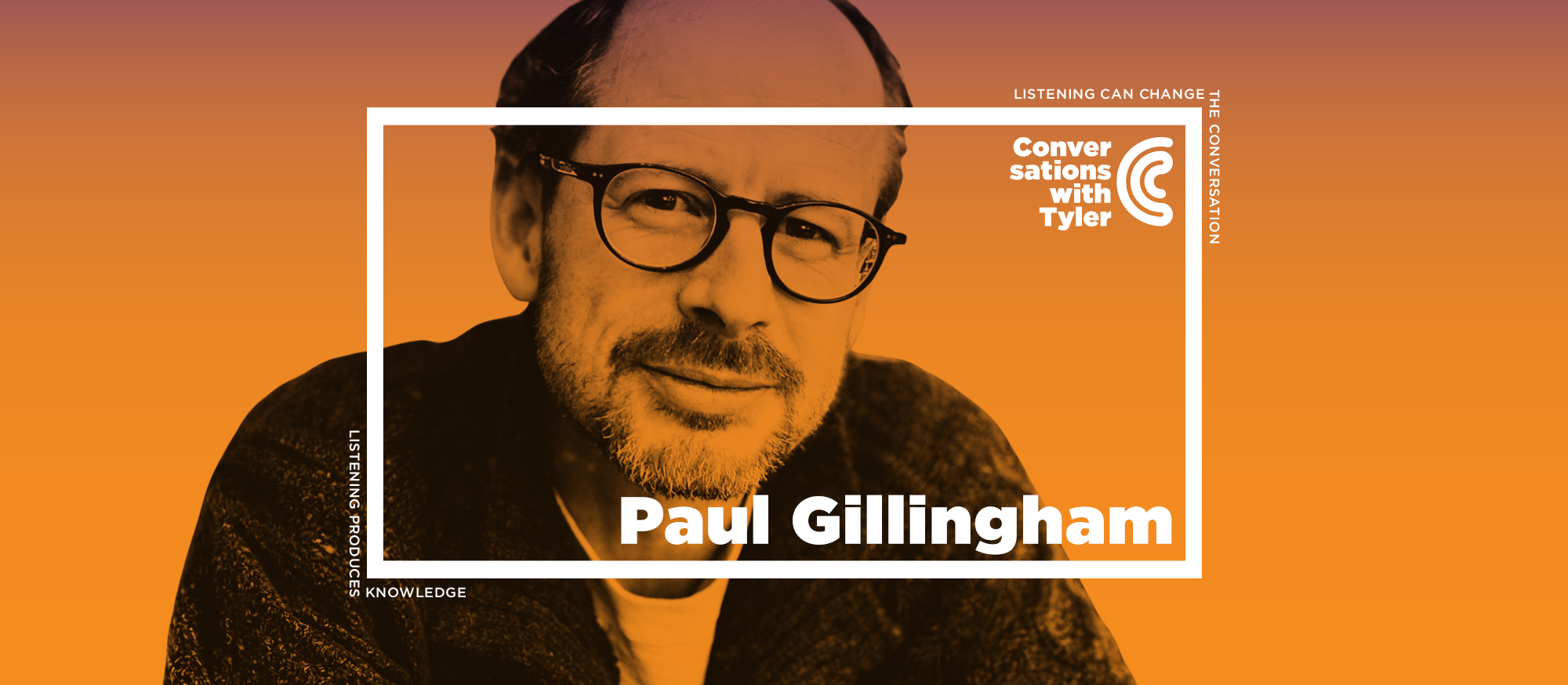



Tyler calls Paul Gillingham’s new book, Mexico: A 500-Year History, the single best introduction to the country’s past—and one of the best nonfiction books of 2026. Paul brings both an outsider’s eye and ground-level knowledge to Mexican history, having grown up in Cork — a place he’d argue gave him an instinctive feel for fierce local autonomy and land hunger —earning his doctorate on the Mexican Revolution under Alan Knight at Oxford, and doing his fieldwork in the pueblos of Guerrero.
He and Tyler range across five centuries of Mexican history, from why Mexico held together after independence when every other post-colonial superstate collapsed, to why Yucatán is now one of the safest places on earth, what two leaders from Oaxaca tell us about Mexican politics, how Mexico avoided the military coups that plagued the rest of Latin America, what Cárdenas’s land reform actually achieved versus what it promised, whether the ejido system held Mexico back, why Mexico worried too much about land and not enough about human capital, how Mexico’s fertility rate fell below America’s, why Guerrero has been violent for two centuries, why the new judicial reforms are a disaster, where to find the best food in Mexico and Manhattan, what a cache of illicit Mexican silver sitting on a ship in the English Channel has to do with his next book, and more.
Watch the full conversation
Recorded February 27th, 2026.
Thanks to Derk Cullinan for sponsoring this transcript.
TYLER COWEN: Hello, everyone, and welcome back to Conversations with Tyler. Today I’m chatting with Paul Gillingham. He has a new book out: Mexico: A 500-Year History. It is, in my view, the single best introduction to the history of Mexico and will be one of the best nonfiction books of this year, 2026. Paul, welcome.
PAUL GILLINGHAM: Thank you very much for those kind words, and it’s a privilege to be here. Thanks for the invitation.
COWEN: Now, after independence in 1821, why did not the rest of Mexico fragment the way Central America did a few years later, where it splits off from the Mexican empire? What determines the line? What sticks together with Mexico, and what does not?
GILLINGHAM: That’s a very good question because it’s one of the things that really makes Mexico stand out in that period, those histories, is that after independence, the rest of the Americas, you get a series of super-states. You get Gran Colombia, which is most of the Andes, and going across what’s now Venezuela. You get the United Provinces of the Rio Plate. These are huge, very difficult to conceive of super-states, and they fail within a decade. Elsewhere, you look at other post-colonial states, thinking particularly of India, within a couple of years, you’re fragmented and failed. Mexico doesn’t. Mexico actually stands up with the exceptions you put of Central America, which is formally part of it, in fact, but leaves within short order.
It’s one of these questions of what Álvaro Enrigue calls the miracle that Mexico exists. To explain it is a paradox. To make a try at it, I think that there is a common theme in Mexican history, which runs across most of those five centuries, which is a remarkable degree of hands-off government. It’s imposed. Mexico has a lot of mountains. It’s very difficult to rule from any central pole. Savvy governments, or governments with no choice, which are quite often the same thing, are very hands-off. Federalism is built into Mexico’s soul. I think that’s one of the reasons, from early on, Mexico actually out-punches the rest of the Americas in terms of sticking together as a territorial unit.
COWEN: As you know, in the early 19th century, there are rebellions in Yucatán, the Caste Wars, but Yucatán does not split off from Mexico. What keeps that together?
GILLINGHAM: Yucatán has always felt itself to be a different country, effectively, and that runs through to the present. You can see the cultural reasons, obviously, and the Maya and the other great, sophisticated urban culture of the 16th century and before. It makes sense that they should feel themselves very different from the rest of what becomes Mexico. In fact, it comes through in small but revealing ways. Back in the 20th century, people find themselves being asked whether they want a Yucatán beer or a foreign beer, and a foreign beer being anything in Mexico outside Yucatán.
Why doesn’t Yucatán leave? I think that it came extremely close. In fact, there’s a moment in the 1840s when Mexico and Texas form an alliance, and Texas is chartering warships out to Yucatán to try and prevent any naval incursions. Why on earth does Yucatán stay? I think it’s because of the absence of an alternative capital, because Yucatán is profoundly racially divided. It’s one of the few places in Mexico where you could say that really is a fairly stark racial divide. You have a plantocracy, in some ways, like the US South before the Civil War.
You’ve got a relatively small white plantocracy centered in Mérida. They have no interest whatsoever in leading an independent struggle. While the Maya achieve an underestimated level of sophistication as a state, it’s still not at the point where you would get, for more than a couple of years, a really joined-up independence movement spanning all races, all areas, and the entire peninsula.
COWEN: Now more recently, Mexico has a reputation for being very violent, but Yucatán is especially peaceful. There are years where it’s had a lower murder rate, I think, than Finland. Why is that part of the country, after this chaotic beginning, after independence, recently so peaceful, and so safe?
GILLINGHAM: Again, a good question. It, I think, explains broader patterns of drugs and violence in Mexican history. The first is that foreigners in Mexico have carte blanche, or what in colonial times we call a fuero. Foreigners are untouchable. Because much of Yucatán, the Yucatán economy centers on tourism, the Riviera Maya, Cozumel, et cetera, there’s an awful lot in these key populated coastal strips of foreigners. Killing them is bad business. Stability is better for business anywhere. In Yucatán, there’s more of an imperative for that. That’s one.
The other is that it has ceased being what it used to be, which is a major transit and transshipment route. When I proposed to my wife on a beach in Quintana Roo, we could go out at 8:00 a.m. next to Tulum, when Tulum was a small dusty town. We could go out, and twice a day, we would see small planes coming up from Central America. We knew perfectly well as they headed north up through Quintana Roo that this was a drugs run. As a transshipment route, it has been far surpassed. That other great reason for violence is absent.
COWEN: Why did the central government even create the state of Quintana Roo, now that you mention it?
GILLINGHAM: Oh, that’s an extremely good question. Quintana Roo is very much its own country. In fact, in the Caste Wars which you mentioned, there’s a very strong east-west divide on the peninsula. The east is where the Maya rebels really survive the most. I think that it’s an attempt to administratively corral the more unstable, difficult-to-rule parts of the country. Using Yucatán, your point made, as a country, it’s an attempt to corral them and say, “Okay, we can send armies in there, we can try and prevent the contagion.” The idea you can do that by drawing a line on the map is obviously profoundly optimistic. It’s more terrain and settlement, which keeps Quintana Roo different from the rest of the peninsula.
COWEN: But it worked, right?
GILLINGHAM: Can it be said to have worked when there are very few people there in the beginning? Quintana Roo is historically really low population. Most of the Yucatán was concentrated closer toward Mérida and that west coast. Quintana Roo really takes off because of mass tourism, and that’s because of state intervention. Relatively recently, Cancún was a village until the late ’60s, early ’70s.
COWEN: Before Porfirio Díaz, why is there so little attention to infrastructure in Mexico?
GILLINGHAM: Because the money’s not there.
COWEN: How does he get the money? What accounts for the change?
GILLINGHAM: What accounts for change is, first of all, the final achievement of independence. Formally, in the history books, 1821: The Spanish leave, Mexico’s independent, a new stage starts. That’s not actually true. Just in terms of the Spanish leaving, well, they don’t. They maintain a garrison on the key fortress in the main port, controlling the entrance to Mexico from the Atlantic, the port of Veracruz. The Spanish stay there until 1829, controlling it. They don’t really leave. Within two years of them finally leaving, you have a French invasion, a failed one, grand, but still an invasion, still that instability. Then you get obviously American invasions. Then you get a civil war.
I’m sure we’ll go into this in a minute—my point is that it’s not until 1867 when the Mexican independence forces take a European-imposed emperor and shoot him, which is not done. You don’t shoot emperors in global history. The Mexicans do. This is a clear declaration of independence. It’s an end to other empires’ pretensions. It’s the beginning of stabilization led by a brilliantly gifted, and this is a word I would almost never use, but a brilliantly gifted politician, Porfirio Díaz, who benefits from this being a time of a global boom when the rest of the world, the industrial world, craves Mexican resources. Díaz is very savvy to ride that into a new era where Mexico becomes the epitome of a successful, what used to be called, developing nation, and it’s with that you get the infrastructure.
COWEN: You have Díaz, you have Juarez, the other very important 19th-century leader, and they’re both from the state of Oaxaca. Is that coincidence, it’s only two data points, or does that tell us something?
GILLINGHAM: That is such a good question because it is something which really stands out. To add data points to that, at one stage under Díaz, something like two-thirds of the congressmen are actually effectively from Oaxaca. While congress is a rubber stamp, nevertheless, it tells you something. I think this is the culmination of a very long-term trend of Oaxacan political savvy and relative independence. Oaxaqueños are good at politics, and they are very politically engaged. If you want to make huge leaps, you say, well, that goes back to the conquest, the 16th century, where Spanish rule flows around them. Why? Because people who live in mountains tend to be quite good at war and quite prickly, and the Oaxaqueños epitomize this.
Outside the main valley, Oaxaca stays largely independent and very decentralized. It’s almost like New England democracy, it’s firstly independent, small cities, counties. Every time Oaxaca gets a chance, it seizes it to really push for autonomy and political power. You really see this—to wrap up this rather tangential explanation—the direct ancestor comes with independence, where suddenly towns are allowed to declare themselves counties with their own governments, their own elections, very competitive ones. Oaxaca does it to an extraordinary extent. Every village in Oaxaca says, “We are now a county.” It’s almost like Swiss cantons. It’s this extraordinary democratic urge, and that trains people to be good at politics.
COWEN: Do you think that helps account for why, to this day, Oaxaca State is so interesting to visit because there’s so much local autonomy?
GILLINGHAM: I love that. I would say, in part, because one of the traditional tourist attractions of Mexico is precisely indigenous culture, and because of this autonomy, Oaxaca has preserved a multitude of very strong indigenous cultures. I think, yes, I’d add to that, that it’s comparatively safe, a key consideration. That’s a recent thing. Tourism in Oaxaca goes back a long time. I think it’s also because you have this stunning colonial city. Oaxaca City is really beautiful, and we have in the US nothing at all, or Canada, we’ve got nothing like that.
Finally, and I actually believe this, Mexican cuisine is very, very diverse. People think Mexican cooking, tacos, well, yes. Oaxacan cooking is really a superb cuisine. One of the best. I would say Oaxacan and Yucateco cuisines are head and shoulders above the rest of Mexico. I don’t know how much that draws. Well, I do, actually. There’s quite a lot of culinary tourism, which tends to be rich tourism in Oaxaca these days. I think that’s another draw. It’s extraordinary, in fact, how many people have realized that over the last 15 or so years and formed these sort of expatriate, almost colonies in Oaxaca. It’s a fantastic place to live.
COWEN: A mere two weeks ago, I was eating barbacoa in Tlacolula. Have you ever been there?
GILLINGHAM: I have not, but I’m starting to resent this story already, and you haven’t told it, Tyler. Go on, do tell.
COWEN: Well, there’s a fantastic church in town. I would guess it’s, I don’t know, 20, 25 minutes outside of the main city, so it’s easy to get there. You just take a cab ride. We asked our cab driver, taxista, where’s the best barbecue in a nearby pueblo, and that’s where he took us. It was unbelievable.
GILLINGHAM: First of all, very good strategy. The best meal I had in Yucatán by country mile was about half an hour outside Mérida, and it was the same thing. Ask a local taxi driver, “Come on, if you want a really good meal, where would you go?” He said, “Ah, it’s a bit of a drive.” You say, “Okay, I can see perverse incentive, knowing my question.” When you end up in a small warehouse, really in the middle of nowhere, stuffed full of Mexican people with the most incredible deer, you think, “Okay, I actually think this was a fair reflection.” I envy you that meal.
COWEN: Twenty minutes out of a Mexican town is such a good recipe for finding the best food. Twenty minutes, 30 minutes, I’m not sure why, or just the outskirts.
GILLINGHAM: Yes, I think that’s actually quite true. There’s a book in this, Tyler. I’m not going to write it, but there’s a book in this. Sociologically explain the significance and quality of restaurants 20 minutes outside major towns in Mexico. If I could ask you while you’re there, what did you think of Monte Albán?
COWEN: It’s a little boring for me. I’ve been there twice. I didn’t go there a third time. The other ruins I much prefer. Yes, it’s fine.
GILLINGHAM: It’s funny. I say that to young people, and they go, “This is heresy.” Yes, frankly, given the plethora of archaeological sites in Mexico, I think Monte Albán is the most boring, large one by a country mile. It’s extraordinary. I’m so glad to hear that endorsed. I hope there aren’t too many Oaxaqueños listeners to this particular podcast, though.
COWEN: There’s that small tomb you can see—what’s it called? Is it Zaachila is the city or the pueblo? It’s again, 30 minutes outside of Oaxaca City, I think. We had some great food there. Just to see that one Zapotec tomb where you walk down the steps, and you have it all to yourself, to me, is better than Monte Albán was. That’s just one thing in a field.
GILLINGHAM: That’s the way Cobá used to be, Yucatán, and Xochicalco in Morelos. I’m glad about this; they’ve really expanded in the last 20 years, the dig, the tourism potential. They should have, because it’s stunning.
COWEN: Now, if we look to the early 20th century, it seems there’s some number of key leaders from the state of Coahuila. Is that coincidence?
GILLINGHAM: No.
COWEN: There’s Madero. There’s Carranza. Why does that happen?
GILLINGHAM: Coahuila is one of the states which benefits enormously from this global boom of the turn of the century, which translates into the US drawing investment and resources in an unprecedented way. I think that it’s taking half of British global investment at that time. Resources are desperately needed. The obvious thing in Coahuila is copper. Copper mines. On the border in Coahuila has a geography which stretches everything from arid mining territory through to really rich irrigated lands. It’s wealthy. It’s next to the US. You get a class of big landowners who are very diversified, very cosmopolitan. Madero was educated in part in Paris, in part in Berkeley. They look southwards and think, “This is a slightly sclerotic dictatorship. We can do better.”
COWEN: This is a big, very general question. After World War II, Mexico avoids military rule, and they avoid civil war, unlike many parts of the Americas. What’s your account of that?
GILLINGHAM: My account of that, first of all, that’s a major paradox which really lay behind the subject of my doctorate and my last book. How do you account for the fact that Mexico has a revolution, first of all, one of the great revolutions, which lays down radical prescriptions for equality, which are then produced by one of the most unequal economies in the Americas? You’ve got talking about revolution, you’ve got massive, enduring inequality, and yet you have this, as you point out, abnormal peace going back to 1929 with regular elections like clockwork every six years. Every six years, there’s a peaceful transfer of power. There is never any even imagination of a January, the 6th moment there.
To make another comparison, there’s, after 1929, no assassination. Whereas obviously here, JFK, RFK, MLK, there’s almost alphabet soup of assassination of progressive leaders. If you look at this and try and make it add up, it’s extremely difficult. I think it’s in part because the inequality misses some of the benefits for the rapidly growing urban populations, which range from superb dirt-cheap subsidized cinema to low housing rates to healthcare. Mexican healthcare, given its income band, it’s very, very good. Just looking at Gini coefficients for either income or wealth doesn’t tell the entire story of what Mexicans get out of the revolution.
The final thing is precisely those elections, because this is a one-party state and the elections are rigged. No question. All the way until the last decade, really, the national elections are rigged, but the local ones are not. Yes, they are, actually, but any group of people who feel strong enough, like say Oaxaqueños, about their local autonomy, about ruling themselves, can make enough of a fuss about it that through the mechanism of election, backed up by riot, they can actually get their people in. There is this unconventional but effective route to popular representation, which at time outpunches the British because in the British system, candidates just get imposed from the party. The party says, “Local candidate X will run for election in Surrey,” and that’s it. Democracy is finished. Mexico is not like that. I think that’s something that helps temper this radical inequality in qualitative terms, this apparent national, what the people call, soft dictatorship.
Then the final piece, and I’m sorry this answer goes on, but this is just a central paradox which political scientists and historians have struggled to understand for decades. I think we’re finally getting a handle on it. The final piece is the immense war weariness caused by a revolution that kills one in 10 Mexicans and the education that gives leaders all the way to the ’50s in the absolute pragmatic imperative: Whatever you do, keep the lid on, whatever needs doing. If it’s repression, then generally, conciliation works better. This extremely complex equation, I think, is what keeps the army out of politics, what keeps relative peace and relative buy-in to this unequal single-party state. There’s nothing like it. Mexico really is idiosyncratic in this, and it’s extraordinary, as you can see, complicated recipe.
COWEN: Right before World War II, the Cárdenas regime redistributes a lot of the cultivatable land. How does that fit into your story?
GILLINGHAM: That fits into my story in, it’s always good to say a work in trinity. I’m going to say in three ways, but then reserve the right to say a fourth. The first is that one of the key reasons for the Mexican Revolution is land. Mexico is a strongly rural country with strong traditions of this autonomy, small freeholding, or collective landowning in indigenous areas. The Porfiriato sees a revolution in this extraordinary concentration of land. This entails, obviously, dispossession of the peasantry. This is one of the key things that leads people like Emiliano Zapata to rebel. You have this pent-up demand for land from millions of families. That’s one.
Two, it largely, for many, fails because they get land, but they get land on the condition that say they continue factory farming. Everyone’s going to grow sugar. Everyone’s going to grow wheat. Not quite a Soviet kolkhoz, but the peasant doesn’t have autonomy, which they want quite often to plant whatever they want. This is, in many ways, a failure from their point of view, but there’s always the psychological payoff that they have got land.
Then, in more straightforward terms, this is one of the reasons that Mexico’s healthcare system, at a really nuts-and-bolts level, works. It’s because every communal farm, ejido they’re called, has a medical office. Even though, in the apparent terms of giving Mexico’s rural population a new level of wealth, autonomy, it doesn’t work particularly well. It brings a certain pride. It brings a certain independence. It brings good healthcare. There are all these less tangible benefits. There’s nothing like it in the Americas. It’s one of the key reasons, I think, that again, the countryside stays largely quiescent while it is stripped of resources in the 60 years after Cárdenas leaves office.
COWEN: Hasn’t the ejido system held Mexico back? Because without that system, many more people would sell their land to outsiders, move to the cities just to have much higher real wages, for instance, as you see in China.
GILLINGHAM: You do get massive urbanization. Its people being pushed out of the countryside by a deliberate transfer of resources. What do I mean by that? I mean that food prices are capped. The really key one, maize, its price is kept artificially low. This means that you can have an urban and especially industrializing workforce on the cheap. You can have really low wages. You can have quite low cost. In Mexico, reasonably high-quality industrialization, it all comes at the expense of the countryside. Does the ejido change that? No, not really.
Also, the ejido is used for precisely the sort of commercial farming which generates the profits, economies of scale that a command economy, or China, might actually achieve. In some instances, that’s not just run by the government, but it’s run by the government as a sort of almost shell company or front for the major foreign corporations. The key example is from the US, Anderson Clayton, one of the giants in food production, cotton, et cetera. They are, through the Mexican government, instructing ejidos exactly what to grow. In the end, functionally, what’s the difference? The pressure on the countryside and the attraction of the city means that you’re going to get this sort of Chinese-style and level of urbanization, irrespective of the agrarian reform.
COWEN: Has Mexico worried too much about land and not enough about human capital?
GILLINGHAM: No, I don’t think so.
COWEN: Say you look at Lebanese migrants. They don’t obsess over accumulating land. They have high human capital. They’ve done very, very well under the same regime.
GILLINGHAM: You could say the same about the Lebanese globally. You want the great diaspora merchants, you think Armenia, you think Lebanon. I think they bring that. Look at how much land there is in Lebanon. The Beqaa Valley is tiny. You can drive up and down it in about three hours if you’re feeling quite brave on any given day. I don’t think you’re absolutely right. Land is not a Lebanese aim.
Mexico, as a very strongly peasant society until 1960s, really wants what every peasant globally wants before you get rapid economic change, which is what they call subsistence autonomy. What does that mean? I want the guarantee that I can grow enough food to get my family through the next harvest cycle. You can see the logic to that. That’s actually a more conservative and stable economic structure than relying on commercial food purchase when your own income is low and unstable. What I’m trying to say is it makes very good sense.
COWEN: Does the cargo system, which is common in Mexican pueblos, does it make any sense? Is it sustainable?
GILLINGHAM: Yes, I think it is. Talking about human capital, I think that the cargo system actually, through its distribution of social capital, brings a lot of talented people to actually make the strange swap. The cargo system whereby you, an indigenous zone, assume political office with absolutely zero payoff and at quite considerable cost in terms of cash and time, it makes sense because it brings the brightest and best into office over and over again. This is when it works. This is a very broad generalization. The only real downside is a gerontocracy. When you look around our political system, it’s quite clear that gerontocracy isn’t limited to societies which work the cargo system.
COWEN: Say I’m a leader, comisario, I have to pay for part of the fireworks, part of the beer. Isn’t my incentive as a talented person to minimize local state capacity rather than really having everything develop?
GILLINGHAM: That’s a good question. I would say no, actually, and that generally cargo holders work as intermediaries with the state in the 20th century. By investing in fireworks, buying a share in a bull for a fiesta, and buying some pulque, whatever your local hooch is, and not just maintaining some stability, but doing it in part by bread and circuses, gives a level of control and local nuts and bolts of knowledge, which the central government then uses as part of this basic quest for stability. With stability going all the way back to Porfiriato comes development. I think that this is a vast generalization. The cargo system has great flaws, but the reason it endures is it also has great strengths.
COWEN: A lot of these villages, they seem quite dysfunctional. It seems not uncommon for, say, half of the grown men to be alcoholics. There’s a major problem with imbalance. The men leave, the women have to stay. They’re abandoned, or they can’t marry, or there’s no one to support the kid. Wouldn’t the central government do better, actually, just trying to minimize involvement in the villages?
GILLINGHAM: Sorry, I don’t understand the last part of that question. When you say minimizing involvement, do you mean just stepping back and letting villages get on with whatever their collective goals are? I didn’t quite understand.
COWEN: The village itself can make it hard to migrate because you cannot, in isolated fashion, sell your land to an outsider. Someone’s willing to bid for it, but the whole village, in essence, has a veto on whether you can sell your land. Wages are much higher outside the village. Alcoholism is lower outside the villages, typically. Should the villages be subsidized or, in essence, should moving to the cities be subsidized in terms of a net effective policy?
GILLINGHAM: I think that villages should be subsidized, and Mexican policymakers have realized that for a long time and done so. I think that land is no longer the question. Most people in villages—this depends very much where you go—but the reason half the men aren’t there is precisely because they have migrated to work, whether it be migrating to cities, whether it be migrating to the north. Remittances are a key source—they are the lifeline for many villages. That’s the way it’s been for nearly a century.
You get a certain amount of small-scale cultivation, as always, of maize, tomato, squash, chilies, et cetera, your full nutrient package. That’s a small portion of what people are actually doing in villages. That’s increasingly uneconomic on a market, local level. This is why you get this out-migration that you talk about. It’s not just male. It’s also women. Ever since they set up maquiladoras, there’s been a huge outflow. The more entrepreneurial to these factories on the border, tax-free zones to assemble US components.
Alcoholism, what remains, the real economic stress with this huge out-migration of young people, expresses itself, as it does in a lot of people, with drinking. What’s interesting, though, is not with drugs. Alcohol is this very strong constant. Speaking as a Brit, to speak about other people’s alcohol consumption is slightly hypocritical, and I’m not going to really go there. It is interesting that historically, Mexico is a hard-drinking society, and we’re going back to the colony now.
COWEN: Say I look at India, a country with a lot of problems. India typically grows between 4 percent to 8 percent a year, depending which numbers you believe. Mexico is lucky to grow at 2 percent a year. What accounts for the difference? Where is Mexico failing?
GILLINGHAM: Oh, I think Mexicans would see that as extraordinary success because Mexicans had the greatest demographic transition in history. The way you get population growth in any species is basically an S-shaped curve in the right environment. Mexico had this exceptionally steep curve. Its population in 1910 and 2000 increases 700 percent. That is steeper than anywhere in the world. That’s speed.
What does that mean? It means that you come to the ’70s, and just as population control starts to be a global concern, Mexico has this very joined-up state. It’s impoverished, but it’s pretty joined-up, and takes a look at what they see as being a problem, which is population growth, putting too much strain on state infrastructure, social services, and okay, so we need to control that ASAP. They put together this noncoercive campaign, unlike India. India identifies the same problem.
COWEN: I’m talking about per capita income growth, though. India gets a lot richer every year.
GILLINGHAM: I’m sorry. I thought you meant population growth.
COWEN: No.
GILLINGHAM: Okay, maybe we can go back to that because that also fascinates me. Per capita income growth, again, that’s an extremely good question. I think that Mexico has an overall impressive medium-term GDP growth. At the end of the ’60s, it’s the 27th-largest economy in the globe. Right now, it’s the 13th. The question becomes really income distribution. I think that if you look at it not in question of a few years or maybe a decade, but over a longer time, Mexican economic growth has been impressive. This isn’t all down to hard work or smart policy. It’s down to the great advantage of being next door to the world’s largest market.
What it does mean is that you have maybe not the extremely accelerated economic growth of right now in India, but post NAFTA, you actually do get quite a lot of quite fast takeoff, speed of growth. Maybe it’s just that Mexico has actually gone a stage beyond India. India is, if you want, playing catch-up. That’s me thinking on my feet. What do you think?
COWEN: I think human capital is by far the biggest problem. Then the slow rate at which small informal businesses are willing to enter the more heavily regulated sector is a real bottleneck.
GILLINGHAM: Mexico has a lot of human capital. One of the reasons that this population control works is because you get far more people going through those critical first three years of primary school. Ideally, everyone goes through high school. But that’s just not a global reality. The key metric is how many people you’re getting through three years of school, which teach you to read, write, and do rudimentary maths. Mexico’s record on that is far better than most middle-income comparatives. There’s a really good study which says especially women, far more get those first three years than precisely actually in India, Kenya, and Egypt. We’re looking now at this phase of takeoff I’m talking about, of the ’70s and ’80s. I think the human capital is really there.
COWEN: A lot of Latin America has above-average years of schooling for their income level, but pretty low test scores, pretty low performance at the top. Just for instance, that English, even getting by in conversation in Mexico, seems to be only about 7 percent. That, to me, is remarkably low, especially given how many of them migrate or wish to migrate. I think education has failed Mexico. Even though people, yes, they show up at the building, the teachers often aren’t good. Sometimes in the pueblos, they’re not even there.
GILLINGHAM: I think that Mexicans would absolutely agree with you. I would beg to, in part, differ. The first thing I’d say is that, since forever, a key skill in migrating has precisely been English acquisition. Again, this is global. You get this everywhere. There’s this realization. Migration selects the most entrepreneurial, the most dynamic, generally. This sector goes to the US, either preps beforehand or else learns very quickly here. It’s one of the reasons that they’re economically so successful. Back in Mexico, 7 percent speaking English. Do you think by global comparatives that’s low?
COWEN: For a neighbor, it’s very, very low. What percent of the Mexican population has lived in the US at some point? It’s got to be at least 10 percent, probably higher. That, to me, is stunningly low.
GILLINGHAM: I’d say that probably is part due to the urban-rural divide. Mexico’s population is now overwhelmingly urban. It tips in 1960 for the first time. There’s more city dwellers than country dwellers. There is a chasm between education in the countryside and education in the city. I would be interested in those numbers if you disaggregated them down to towns of, I would say, 4,000 plus and saw how that broke down. Because my bet would be that you would have far higher globally comparative or even beyond rates in the cities, which, as you say, would make sense.
You think, “Hold on a minute, you’ve got a country which invests by comparatives relatively well in education. You’re a neighbor to the US. Where’s the English?” Good question. As I said, I would disaggregate the data before I’m taking home the idea that there is a massive failure in that specific sector of the education system.
COWEN: To return to population, why is the Mexican total fertility rate now below that of the United States? Much poorer country, right? One thinks of Latin America as having high fertility, but it doesn’t anymore. What’s happened there?
GILLINGHAM: This, again, is the product really of two things which we’ve already been covering. One is this really joined-up noncoercive population control of the ’70s and ’80s, which was a global model. Mexico hosted the global conference on this, I think twice or three times. It got a prize from the UN. How could it do this compared to the rest of Latin America? Two things. First of all, by keeping Catholicism out of political life more than almost anywhere else. Whereas you have priests inveighing against the evils of contraception, again, across most other Latin American societies, the revolution and the 19th century before it meant that Mexico has a unique degree of separation of church and state.
The church just doesn’t say anything as the government goes about aggressively pushing the pill, condoms, et cetera. At this stage, the obvious question is, okay, well, hold on. The church doesn’t say anything. On a micro level, inside families, conservative people, until the ’70s, the total fertility rate was nearly seven per family. Traditionally, having children, especially male children, is a symbol of success. Economically, it used to be useful to have the spare hands. What changes at a micro level goes back to education. Women who are educated have far more autonomy to say yes to contraception.
You see this really clearly in rates of uptake of the pill, which in the ’60s goes through the roof as soon as it’s available. We’ve got surveys from hospitals. People are there. Do you take the pill? Yes or no? Yes, you do. Even in really conservative societies, there’s a village which has been very studied. It’s wonderful, called San Jose de Gracia in the highlands of Jalisco. There, we’ve got this really good qualitative micro study. Women just say yes, actually, we don’t want to have 6.7 children, thank you very much, and so we will use contraception. Sorry to the men, you’re just going to have to like that. Why is that? That globally correlates to primary education and women’s primary education.
How many women, for all the flaws, are getting through the doors for those first three years? By the end of the ’60s, it’s 73 percent. Again, go global to what was then a band of middle-income countries; there’s nothing like it.
COWEN: Now, most historians of Mexico, they’re not British, and you are. Where were you from in Britain, and how do you think that’s shaped how you read Mexican history?
GILLINGHAM: I know there’s a small group of British historians, and they’re rather good at what they do. My own story is actually not wholly British because I grew up in Ireland, in the southwest, in a county called Cork.
COWEN: That’s the accent you have, by the way, so I was confused when you said you were British.
GILLINGHAM: It’s a strange mix isn’t it?
COWEN: This fellow has an Irish accent.
GILLINGHAM: Yes, you’ve got a good ear. It’s sort of a hybrid. Growing up in Cork, I was supposed to give a talk last month at the university there, and I was thinking, “What can I say to link the two up?” Truth is, what I’ve been talking about, this fierce local independence, local pride, identity, this is so Cork. Cork sees itself.
COWEN: Absolutely. Land, also.
GILLINGHAM: Oh, no, totally. Land, as you say, and hardship—Cork is one of the centers of the Great Hunger, the Great Famine of the 19th century. There’s that. Then I was educated in Britain, and I was lucky enough to come across the smartest historian I’d ever met, a historian of the revolution called Alan Knight. I was deciding what I wanted to do with my intellectual life. I met this person and thought, “Okay, that’s what I’d like to do.” Thanks to the Oxford system, I could spend one semester, entire, just working with him, just on the Mexican Revolution, and that changed everything. Then there’s a flip answer, which is Mexico’s weather is a lot better than England’s.
COWEN: Now, when it comes to crime and violence, why is the state of Guerrero traditionally so tough, so violent, so difficult? Is it just mountains? Is it something else? Low state capacity? Ethnic groups that are there?
GILLINGHAM: Guerrero is a place which is very dear to me. I actually, for my doctorate, really tried to dive deep into two states, and Guerrero was one of them. I went to villages and did that level of work in various places. In part, yes, it’s geographic determinism. It’s mountains. Then you say, “Hold on. The Sierra Madre runs all the way up into the Rockies. Can you tell us a bit more?” I think it’s because of a long tradition of the drive for political independence, exacerbated in its intensity by a large Afro-Mexican population on the coast, who are distinctly conscious that they have been discriminated against, who are good at violence.
I think it’s because Guerrero is next door, it’s relatively close to Mexico City. It’s threatening to Mexico City in the way, say, Sonora or Yucatán isn’t so much. When some fairly oppressive conditions, you can imagine them, land monopolization, political thuggery, et cetera, combine in a state with people who really are very keen on independence and are relatively close to the city, the answer is this reinforcing cycle of repression, opposition, repression. That’s what you’ve seen in Guerrero going back really, on and off, across two centuries of Mexican independence, but specifically intensified from Porfiriato onwards.
What’s forgotten sometimes, really interesting, is that there’s three families which really run the Guerrero coast. One of them is actually American, hugely successful, major landowners. You think of Guerrero as being slightly remote, et cetera. It’s also got the major port of Acapulco. It’s extremely dynamic. It’s multiethnic. There’s a lot of competition, and there’s a long history of, again, this desire to be left alone.
COWEN: What’s your favorite part of Guerrero?
GILLINGHAM: If you drive north at what’s called the Costa Grande, so you go to Acapulco, you turn right, you go up what’s called the Costa Grande, and you get to tourist towns, Zihuatanejo, Ixtapa. After about four hours of driving, you get to a place called Saladita, which is basically a restaurant with a surf break. That and the village just about next door called Troncones. I spent a lot of very happy time there when I was a kid. That’s my favorite part.
COWEN: Did you spend any time in the Rio Balsas villages?
GILLINGHAM: No, I didn’t. There was a couple of reasons. One of the key ones was that region was perceived as being extremely dangerous while I was there. There were horror stories like the Egyptian consul took a wrong turn. Instead of going along the coast, went up into that area and was killed and dismembered, completely breaking the rule that foreigners are untouchable. No, I didn’t. I wouldn’t put it at the top of parts of Guerrero I would like to explore at length, either. Why? Have you been there?
COWEN: Yes, I’ve spent a lot of time there. They’re very beautiful. I used to go there to buy amates and pottery. The road in can be tricky, but they’re very safe once you get there.
GILLINGHAM: Which period are we talking about with that?
COWEN: I was mostly there in the ’90s and early 2000s, which was safer than today.
GILLINGHAM: You and me both.
COWEN: Then they were completely safe. No problems whatsoever.
GILLINGHAM: That was one of the roads, like the Costa Grande, where you were told, “Okay, between basically dawn and dusk, it’s not too bad as a sort of roll of the dice, but from dusk to dawn, that would be foolish to travel.”
COWEN: Lack of a guardrail would worry me as much as anything. For Nahuatl-speaking villages, it’s the best place to go in Mexico, I think, that I know of.
GILLINGHAM: There and, I would say, the northern Sierra of Puebla is also strong concentrations. Was that just for the off-the-beaten-track fascination, or was there a specific reason which took you there?
COWEN: I ended up writing a book about it, but mostly for art collecting. One comes to have friends in these places, as I’m sure you have too. You want to visit them, and they regard you as a family or compadre, whatever you’d call it.
GILLINGHAM: I’m glad I wasn’t more rude about it than I was already.
COWEN: It’s a tough place. Your living standard, once you arrive, is extremely low.
GILLINGHAM: The place I spent longest in is a village in the north called Ixcateopan, about an hour and a half drive, at least back then, out of Taxco, where a lot of people go. It’s a silver city. Ixcateopan was about 1,500 people then, really very poor, one cafe on the main square, and actual very little else. I ended up like a feeble foreigner going with a little camping stove and many cans of Campbell’s soup, tuna fish, and saltines. Those parts of the countryside, then, you had endemic threats to your stomach.
COWEN: Now, 30 years ago, I would not have thought, did not think that Michoacán would end up so violent, and yet it has. What’s the story in that state?
GILLINGHAM: First of all, me neither. The story in that state is a combination of production and transshipment. For transshipment, you’ve got the port of Lázaro Cárdenas, which is a huge port that is a total white elephant. It was built in the ’70s as a way of honoring the great revolutionary leader, Cárnas. It was not connected ever to anything, really. You’ve got this fantastic infrastructure for both coastal but also trans-Pacific trade. It’s a very good place to begin precursors, and fentanyl, more recently, precursors for meth. That’s part of the transshipment. It’s also that whole Pacific coast, obviously, is a major transshipment zone.
There’s also the production. Methamphetamine is large recently, but in the highlands also, heroin, poppy, and marijuana. You’ve got the avocado industry, huge prize for extortion, which is increasingly many drug-trading organizations’ principal or major part of their portfolio. Avocado farmers and lime farmers are great to extort. Then, finally, we come back to one of my favorite themes, mountains. It is quite easy to hide things like meth labs, and it’s quite easy to kill soldiers who come looking for you. Michoacán is made for guerrilla warfare.
It’s a combination of a place where you can produce a lot of excellent illicit goods, you can transship them, and you can kill state actors who come after you and make Michoacán this center of violence. The final piece is, over all these resources, it’s been a frontline over different cartels, shifting over the last 20 years as cartels come and go, but it’s never had that single organization dominance, which makes places safe.
COWEN: Now, in your model of how Mexico is evolving, as you know, Monterrey is quite a wealthy part of Mexico, and it’s growing. Twenty years from now, will that just be safe and normal, or is it still going to be in this in-between state where you have to worry what road you’re on, are you too close to the border, or will it just all be fine because of the wealth?
GILLINGHAM: Already, Monterrey is one of the places where I would feel really quite safe.
COWEN: In town, but out of town, right? You have to ask questions.
GILLINGHAM: Nuevo Leon, the state, it’s not frontline. These things, as you imply, shift rapidly. Until quite recently, Colima, Pacific coastal state, was really quite tranquil. It’s now the most violent state in Mexico. Until two years ago, Sinaloa, because it was controlled by a single drug trading organization, the Sinaloa cartel, was also counterintuitively really quite safe. It’s not anymore because there’s then transcend war. Look at that. Monterrey, I think it’s very bad business to have a war over drugs in somewhere which doesn’t grow them, somewhere which isn’t important to transshipment, and somewhere where there are such fantastic possibilities of extortion, middle and small-income businesses.
I would already be quite happy around Nuevo Leon. I would predict because of those structural factors, nothing to grow, little to tranship, and the wealth you point out, it will continue thus. In 20 years, I would hope with an even greater sense of security in the countryside around it.
COWEN: Now, the recent judicial reforms, which spilled over into the more recent administration, a lot of outsiders said, “That’s taking away the independence of the Mexican judiciary.” Do you agree, or how bad is it, or does it not matter much? What’s your sense?
GILLINGHAM: I think it matters greatly. I always found it strange, the idea of electing any judicial official. When I moved to the US, I thought, “Hold on, you do what?” The idea of electing judges is a really poor idea, I think, in Mexico because of the interest of local drug-trading organizations in having sympathetic judges. It’s a lot lower cost to get them elected than to threaten them. Judges are people who it’s generally a bad idea to kill. The state doesn’t like it. It happens really regularly, but still quite a high-risk strategy as opposed to just having them in your pocket.
While electoral turnout across Mexico is admirably high and remarkable, judicial elections have just been the glaring exception to that. I think turnout was 13 percent. I think that in itself is a condemnation of the whole project. While recognizing longstanding flaws in the Mexican judicial system, this is, I think, a disastrous reform.
COWEN: Why did they do it then?
GILLINGHAM: They did it, I think, because of a desire to get the current dominant party, Morena, really further dug into regional power by having sympathetic judiciary. I think that Morena’s local and regional activists were very keen on it. I think it was philosophical populism as well from the AMLO government. It’s one of the most unfortunate things I’ve seen come out of Mexican politics in the last decade.
COWEN: For our last segment, just some rapid-fire questions about Mexico. What’s your favorite Mexican movie? I’m going to say Silent Light, but your view may differ.
GILLINGHAM: Anything with María Félix in it.
COWEN: Name one.
GILLINGHAM: Doña Bárbara, superb. I’d also say, though, more recently, Y Tu Mamá También.
COWEN: That’s a great film.
GILLINGHAM: It’s difficult to stop laughing at.
COWEN: Three Burials of Melquiades Estrada, I like very much.
GILLINGHAM: I think that the black, dark humor there is profoundly Mexican. I think that’s one of the reasons why the British can really appreciate Mexico, is we’ve got a similarly dark sense of humor.
COWEN: Now, Howard Stern was famously rude about Mexican music. What in it do you like best?
GILLINGHAM: I like the fact that they do superb girly pop. That’s terrible, but they have really good, from the last 20 years, women singers who are extremely intelligent, tuneful, dynamic, varied. I’m thinking specifically of Julieta Venegas and Natalia Lafourcade—the latter, and this is in my book—wrote a song back in the year 2000, which is a hilarious reflection on her sister’s pregnancy, the state of the world, and called the First Lady of Mexico a racist worm. This is music that is thought-provoking and tuneful. I like that.
At its best, it’s a very clever music. For me, at its worst, with apologies to everybody who likes Los Tigres Del Norte, Norteño music, I cannot stand recorded. If you’ve ever heard it live, in a night spot, suddenly the polkas, the wheezing, the songs which are a Mexican version of gangster rap, you think, “Actually, yes, this is quite good.” I was in Ensenada a couple of years ago, and I’m in this bar with a masked guy with an M16 on the door and three Norteño bands inside, and it was fabulous. Even my least favorite has some legs to it. It can be very good fun and very evocative.
COWEN: What’s the great classic Mexican novel?
GILLINGHAM: It has to be La Muerte de Artemio Cruz, The Death of Artemio Cruz.
COWEN: Pedro Páramo, for me, or even Savage Detectives. I know Bolaño is from Chile, but to me, it’s a Mexican novel.
GILLINGHAM: Totally, and I’m glad you say that because Savage Detectives is very much a sort of insider’s novel of Mexico. The mockery of the UNAM, and specifically its faculty of law and philosophy, is just so spot on, and yet, in part because it is so close to what I study, which is the mystery of the origins of the one-party state and the PRI. In part, also, I think it’s one of the first Mexican novels I read, and things you read or things you listen to between the ages of 14 and 18, they mark you and stay with you, fairly or unfairly.
COWEN: Why Artemio Cruz as your pick?
GILLINGHAM: Artemio Cruz, because of the real human complexity of it. It’s the story of a young revolutionary who manages, through violence, luck, business smarts, extortion, to move from very poor beginnings to being a major Mexican mogul. The story skips between his life in decadent old age—and he’s made it, but in a classic sort of the hollowness of wealth down. He’s made it, but in human times, he’s totally emptied. Then the beginning, the story, if he got there, I find it so moving, so tragic, and so deeply evocative of the Mexico I read about, the Mexico I study.
I say, if I’d read it 10 years later, who knows? If I’d read it last year, I might actually be ranking it below the recent novels of Álvaro Enrigue, who two novels really stick out. One is like a modern Muerte de Artemio Cruz; it’s called Decency, Decencia, which anybody who likes Mexican humor, likes Mexico City, will just get. The other is You Dreamed of Empires in English, which is a retelling of the conquest as this glorified heist by a bunch of fortunate thugs, which I think most historians would agree with, and has some twists in it which are stunning. Alvaro, of course, has the advantage of he actually reads quite a lot of history. When he writes history, the details are there, and you find yourself nodding, “Oh, yes. I can believe that.”
COWEN: Ezra Klein is a big fan of the conquest book.
GILLINGHAM: I think it did very well, and I can see why. It was clever, it was complex, it was provocative, and it had a killer twist to it. What’s not to like?
COWEN: Let’s say an educated person comes to you. They live in the United States, and they have two weeks to spend, and they want to learn Mexico, but put aside Mexico City and put aside the ruins. They want to learn Mexico proper. Where do you send them? What’s the ideal Mexico trip?
GILLINGHAM: I’m thinking ideal in terms of educational.
COWEN: Yes, but it should be fun and interesting too, right?
GILLINGHAM: I would send them across the border in California, in Tijuana. I would then tell them to fly to, I think, probably Zacatecas, because the Baroque splendor of Mexico, it’s not captured anywhere with the same intensity. This was the center of the wealth-producing world. It had the biggest mine in the world under the colony. That translated into this absolutely—it’s beyond words. Architecture, it’s stunning. You get buildings. There’s a style called the Churrigueresque, where every inch is carved with extraordinary detail. I think Tijuana, Zacatecas.
From Zacatecas, I’d go to a town called Aguas Calientes. I would make sure to go there during the annual feria, which is notable for two things, apart from the fact that it’s a great week-long party. One is you get some of the best bull fights in Mexico. Two is this is one of the very few times when gambling is legal temporarily there. When you combine that, again, it’s a pretty colonial town. I’d make sure and go and see that symphony orchestra, which is superb, Argentine conductor. From Aguas Calientes, I think I’d take a plane and go to—I’m trying to do maths now—three days in each place. Nine days, two more cities. I would go to Xalapa in Veracruz precisely because it’s particularly untouristed for its quality as a city and the surroundings are beautiful temperate climate.
Then the final one is really cramming things in. I’d hope to have a private jet on this or else a driver. I would go to San Cristóbal de las Casas, the colonial capital of Chiapas.
COWEN: Great trip. Last two questions. First, what’s the best Mexican restaurant in or near Chicago?
GILLINGHAM: In or near Chicago, I’m not sure, for the simple reason my family’s actually based in New York. When I go out for dinner, it’s usually in New York.
COWEN: In or near New York, then?
GILLINGHAM: Oh, now that’s great because I just found a place.
COWEN: East Harlem or where?
GILLINGHAM: No, it’s downtown. It’s called Santo Taco, and it’s a taqueria which is exceptional. In case you find that to be inverse snobbery, I would say that underneath the taqueria, there’s a hidden, quite smart restaurant. It’s almost a sort of speakeasy restaurant. Both of them are superb, and I intend spending a lot of time in both of them. That’s my answer for New York. Get to Santo Taco and have two of that. You have to try two. One is their mushroom taco, which is a revelation, and the other is their carnitas. That’s it.
COWEN: Before the last question, just to plug your book again, Mexico: A 500-Year History. Everyone should buy and read it.
Finally, last question: What is it you will do next?
GILLINGHAM: I’m writing a book which is a prehistory of money laundering. It’s based on a document I found in the British Foreign Office, which is a query from a director of the great bullion dealers Johnson Matthey. It says, “I’ve just been in touch with a person on a steamship lying off in the Channel Islands who has £5 million worth of illicit Mexican government silver on board. I’d like to buy it pennies on the pound. What would your advice be?” The first bit of advice is check that the silver actually exists and don’t tell the Mexican government. I would like to know what happened next at that end because I think I know at the Mexican end where it came from and how it got onto the ship in New York Harbor.
I’m hoping to reconstruct using Mexican, American, there’s FBI involvement, and British archives as much as I can, the path of the silver in this decade, the first great decade of money laundering, which is the 1920s.
COWEN: Paul Gillingham, thank you very much.
GILLINGHAM: Tyler, it’s been a pleasure. Thank you for the invitation.